
Question 413 marksEasy
Three vertices of a parallelogram ABCD are A(−5, −1), B(3, −1) and C(1, −6). Use graphical method to find the co-ordinates of fourth vertex D.
Confirming your payment
Sign up now and get 250 free tokens.
Graphical Solution · Question 41 of 50
Three vertices of a parallelogram ABCD are A(−5, −1), B(3, −1) and C(1, −6). Use graphical method to find the co-ordinates of fourth vertex D.
Solution:
Concept: Opposite sides of a parallelogram are parallel and equal, and its diagonals bisect each other. The vertices are named in order round the figure, so in ABCD the side opposite AB is DC.
Step 1 — Plot the given vertices.
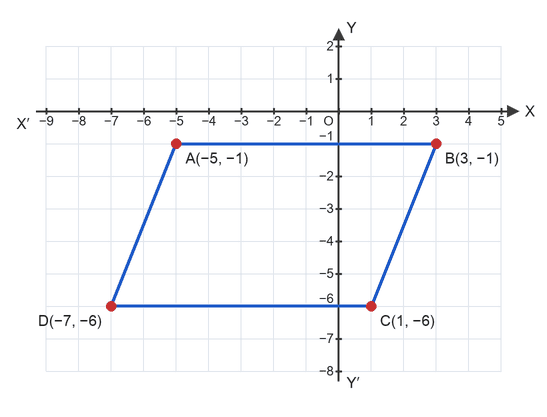
We plot A(−5, −1), B(3, −1) and C(1, −6). A and B have the same ordinate, so AB is horizontal.
Step 2 — Use the property of a parallelogram.
In parallelogram ABCD the side DC is parallel and equal to AB. So DC is horizontal, 8 units long, and D is 8 units to the LEFT of C (because B is to the right of A).
The ordinate of D is the same as that of C, −6. So D is (−7, −6).
Step 3 — Draw the parallelogram.
We join A, B, C and D in order.
Step 4 — Check with the diagonals.
The diagonals of a parallelogram bisect each other, so AC and BD must have the same mid-point:
The mid-points agree, so ABCD is a parallelogram.
Watch out: Go from C in the same direction as from B to A (to the left); going to the right would give (9, −6), which makes ABDC, not ABCD.
Therefore, the fourth vertex is D(−7, −6).