
Question 483 marksMedium
Solve graphically, the following equations.
; .
Take 2 cm = 1 unit on each axis.
Also, find the area of the triangle formed by the lines and the -axis.
Confirming your payment
Sign up now and get 250 free tokens.
Graphical Solution · Question 48 of 50
Solve graphically, the following equations.
; .
Take 2 cm = 1 unit on each axis.
Also, find the area of the triangle formed by the lines and the -axis.
Solution:
Concept: Two linear equations drawn on the same axes give two straight lines. The point where they cross lies on both lines, so its co-ordinates satisfy both equations at once: they are the solution of the pair. We then check that point in both equations.
Step 1 — Table of values for the first line.
For we make the subject.
We work out one value as an example.
That is the value at ; and are done the same way.
Step 2 — Table of values for the second line.
For we make the subject.
We work out one value as an example.
That is the value at ; and are done the same way.
Step 3 — Draw the two lines.
We plot the points of each table on the same axes and join each set with a ruler. The scale is 2 cm = 1 unit on each axis.
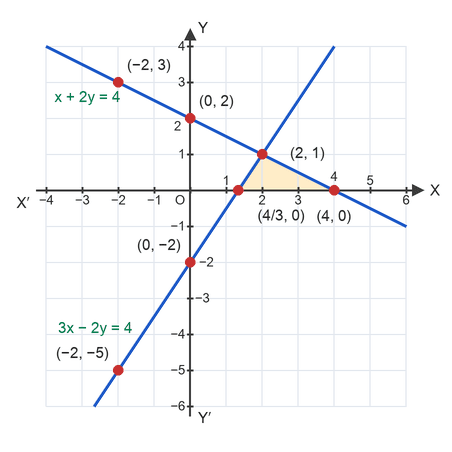
Step 4 — Read the point of intersection.
The two lines cross at (2, 1).
Step 5 — Check in both equations.
The point must satisfy both equations:
Step 6 — Find where each line meets the x-axis.
On the -axis .
So the triangle formed with the -axis has vertices (4, 0), and (2, 1).
Step 7 — Find the area.
The base lies on the -axis and the height is the ordinate of (2, 1), that is 1 unit.
That is sq. units.
Watch out: The -intercept is not a whole number; find it exactly by putting rather than guessing from the graph.
Therefore, the solution is , , and the area of the triangle is sq. units.