
Opening your dashboard
Class 9 Maths Chapter 17: Circle Solutions
44 textbook questions with step-by-step answers, free to read, for ICSE 2026-27.
Get talked through Ch 17, not just shown the answer
Reading a finished solution is not the same as being able to do it. The AI tutor takes one question at a time and works it with you, in your own words, until you can.
- Ask it out loud, in your own words
- It gives you the next step, not the answer
- Stuck on part (ii)? Start there
44 questions with solutions
1–3 marks · Mixed difficulty
- 11 mark
Question 1
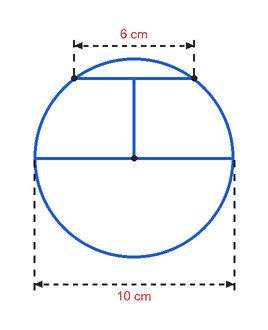
A chord of length 6 cm is drawn in a circle of diameter 10 cm, its distance from the centre of the circle is :
 Solve with AI
Answer
(A) 6 cm
(B) 8 cm
- Correct
(C) 4 cm
(D) 10 cm
Answer: (C) 4 cm
Concept: The perpendicular drawn from the centre of a circle to a chord bisects the chord. So the radius, half the chord and the distance of the chord from the centre form a right triangle, and Pythagoras' theorem links them: , where is the radius and is the distance from the centre.
Step 1 — Write down what is known.
The diameter is 10 cm, so the radius is 5 cm. The chord is 6 cm long, so half the chord is 3 cm.
Step 2 — Use the right triangle.
The perpendicular from the centre O meets the chord at its mid-point M. Triangle OMA is right-angled at M, with hypotenuse OA = 5 cm and AM = 3 cm.
Watch out: The perpendicular from the centre bisects the chord, so use HALF the chord in Pythagoras' theorem, then double the result if the whole chord is asked.
Why the other options are wrong:
- (A) 6 cm: 6 cm is the length of the chord itself, not its distance from the centre.
- (B) 8 cm: 8 cm is more than the radius (5 cm), but every chord is less than one radius from the centre.
- (D) 10 cm: 10 cm is the diameter of the circle.
Therefore, the chord is 4 cm from the centre, option (C).
- 21 mark
Question 2
The given figure shows two concentric circles and AD is a chord. The relation between AB and CD is :
 Solve with AI
Answer
- Correct
(A) AB = CD
(B) AB > CD
(C) AB < CD
(D) AB ≠ CD
Answer: (A) AB = CD
Concept: The perpendicular drawn from the centre of a circle to a chord bisects the chord. So the radius, half the chord and the distance of the chord from the centre form a right triangle, and Pythagoras' theorem links them: , where is the radius and is the distance from the centre.
Step 1 — Draw the perpendicular from O.
Draw OP perpendicular to the line AD, meeting it at P. The same line AD is a chord AD of the outer circle and contains the chord BC of the inner circle.
Step 2 — Use the bisecting property twice.
OP is perpendicular to chord AD of the outer circle, so P is the mid-point of AD and AP = PD. OP is also perpendicular to chord BC of the inner circle, so P is the mid-point of BC and BP = PC.
Step 3 — Subtract.
Taking the equal parts away from the equal parts gives:
The right-hand sides are equal, so AB = CD.
Watch out: P bisects BOTH chords only because the circles have the same centre O.
Why the other options are wrong:
- (B) AB > CD: It says AB is longer, but AB and CD are equal differences of equal lengths.
- (C) AB < CD: It says AB is shorter, but AB and CD are equal differences of equal lengths.
- (D) AB ≠ CD: It contradicts AB = CD, which we have just proved.
Therefore, AB = CD, option (A).
- 31 mark
Question 3
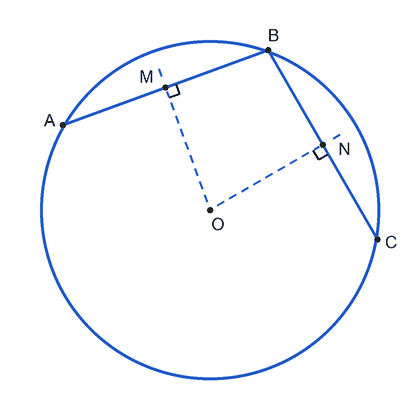
In the given figure, chord AB is larger than chord CD. The relation between OM and ON is :
 Solve with AI
Answer
(A) OM = ON
- Correct
(B) OM < ON
(C) OM > ON
(D) OM + ON = AB
Answer: (B) OM < ON
Concept: Equal chords of a circle (or of equal circles) are equidistant from the centre, and chords that are equidistant from the centre are equal. Of two unequal chords, the longer one is nearer to the centre.
Step 1 — Recall the rule for unequal chords.
Of two chords of the same circle, the longer chord is nearer to the centre.
Step 2 — Apply it.
AB is longer than CD, so AB is nearer to O. OM is the distance of AB and ON is the distance of CD, so OM < ON.
Watch out: The LONGER chord has the SMALLER distance from the centre.
Why the other options are wrong:
- (A) OM = ON: This holds only for equal chords, and here AB is longer than CD.
- (C) OM > ON: OM > ON would make AB the shorter chord.
- (D) OM + ON = AB: No theorem gives this. For example, in a circle of radius 5 cm, chords of 8 cm and 6 cm are 3 cm and 4 cm from the centre, and 3 + 4 = 7, not 8.
Therefore, OM < ON, option (B).
- 41 mark
Question 4
The line joining the mid-points of two chords of a circle passes through its centre, then the chords are :
Solve with AIAnswer
(A) not parallel
(B) equal to each other
- Correct
(C) parallel to each other
(D) not equal to each other
Answer: (C) parallel to each other
Concept: The straight line joining the centre of a circle to the mid-point of a chord (not a diameter) is perpendicular to the chord. Its converse also holds: the perpendicular from the centre bisects the chord.
Step 1 — Name the parts.
Let M and N be the mid-points of chords AB and CD, and let the line MN pass through the centre O.

Step 2 — Use the mid-point property.
OM joins the centre to the mid-point of AB, so line MN is perpendicular to AB. In the same way, ON joins the centre to the mid-point of CD, so line MN is perpendicular to CD.
Step 3 — Conclude.
Two lines that are both perpendicular to the same line are parallel to each other. So AB ∥ CD.
Watch out: This says nothing about the LENGTHS of the chords.
Why the other options are wrong:
- (A) not parallel: We have just shown that the chords are parallel.
- (B) equal to each other: They need not be equal: in a circle of radius 5 cm, parallel chords 3 cm and 4 cm from O on opposite sides are 8 cm and 6 cm long, and the line through their mid-points still passes through O.
- (D) not equal to each other: They need not be unequal: two parallel chords at the same distance on opposite sides of O are equal.
Therefore, the chords are parallel to each other, option (C).
- 51 mark
Question 5
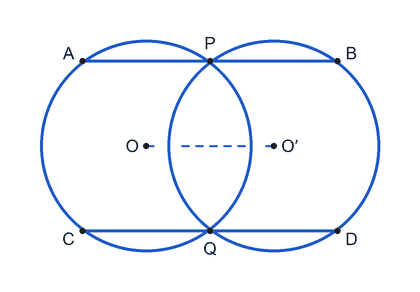
In the given figure, O and O′ are centres of two circles, AB//CD//OO′, then which of the following is not true :
 Solve with AI
Answer
(A) AB = 2 × OO′
(B) CD = 2 × OO′
(C) AB = CD
- Correct
(D) AB ≠ CD
Answer: (D) AB ≠ CD
Concept: The perpendicular drawn from the centre of a circle to a chord bisects the chord. So the radius, half the chord and the distance of the chord from the centre form a right triangle, and Pythagoras' theorem links them: , where is the radius and is the distance from the centre.
Step 1 — Look at chord AP of the circle with centre O.
Draw OM perpendicular to AB, meeting it at M. M is the mid-point of AP, so AP = 2MP.
Step 2 — Look at chord PB of the circle with centre O′.
Draw O′N perpendicular to AB, meeting it at N. N is the mid-point of PB, so PB = 2PN.
Step 3 — Add the two parts.
OM and O′N are both perpendicular to AB, and OO′ is parallel to AB, so OMNO′ is a rectangle and MN = OO′.
Step 4 — Do the same for CD.
Repeating Steps 1 to 3 with chords CQ and QD gives CD = 2 × OO′. Since AB and CD both equal 2 × OO′, AB = CD.
Watch out: The question asks for the statement that is NOT true.
Why the other options are wrong:
- (A) AB = 2 × OO′: This is true (Step 3), so it is not the false statement.
- (B) CD = 2 × OO′: This is true (Step 4), so it is not the false statement.
- (C) AB = CD: This is true (Step 4), so it is not the false statement.
Therefore, the statement that is not true is AB ≠ CD, option (D).
- 63 marks
Question 6
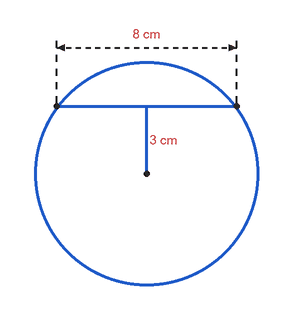
A chord of length 8 cm is drawn at a distance of 3 cm from the centre of a circle.
Calculate the radius of the circle.
Solve with AIWritten solution
Solution:
Concept: The perpendicular drawn from the centre of a circle to a chord bisects the chord. So the radius, half the chord and the distance of the chord from the centre form a right triangle, and Pythagoras' theorem links them: , where is the radius and is the distance from the centre.
Given: Chord = 8 cm, distance from the centre = 3 cm.
Step 1 — Find half the chord.
The perpendicular from the centre bisects the chord, so half the chord is 8 ÷ 2 = 4 cm.
Step 2 — Use Pythagoras' theorem.
The radius is the hypotenuse of the right triangle whose other sides are 4 cm and 3 cm.
Watch out: The perpendicular from the centre bisects the chord, so use HALF the chord in Pythagoras' theorem, then double the result if the whole chord is asked.
Therefore, the radius of the circle is 5 cm.
- 73 marks
Question 7
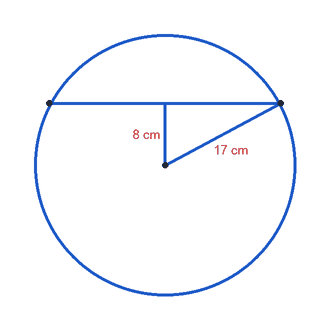
The radius of a circle is 17·0 cm and the length of perpendicular drawn from its centre to a chord is 8·0 cm.
Calculate the length of the chord.
Solve with AIWritten solution
Solution:
Concept: The perpendicular drawn from the centre of a circle to a chord bisects the chord. So the radius, half the chord and the distance of the chord from the centre form a right triangle, and Pythagoras' theorem links them: , where is the radius and is the distance from the centre.
Given: Radius = 17 cm, perpendicular distance = 8 cm.
Step 1 — Use the right triangle.
Let the perpendicular OM from the centre meet chord AB at M. In right triangle OMA, OA = 17 cm and OM = 8 cm.
Step 2 — Double half the chord.
The perpendicular bisects the chord, so the chord is twice AM.
Watch out: The perpendicular from the centre bisects the chord, so use HALF the chord in Pythagoras' theorem, then double the result if the whole chord is asked.
Therefore, the length of the chord is 30 cm.
- 83 marks
Question 8
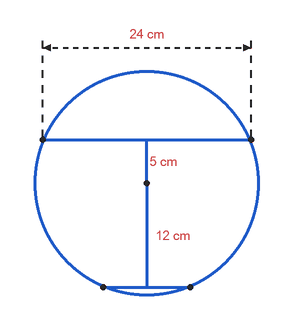
A chord of length 24 cm is at a distance of 5 cm from the centre of the circle. Find the length of the chord of the same circle which is at a distance of 12 cm from the centre.
 Solve with AI
Written solution
Solution:
Concept: The perpendicular drawn from the centre of a circle to a chord bisects the chord. So the radius, half the chord and the distance of the chord from the centre form a right triangle, and Pythagoras' theorem links them: , where is the radius and is the distance from the centre.
Given: Chord 24 cm at 5 cm from the centre; second chord at 12 cm from the centre.
Step 1 — Find the radius from the first chord.
Half of the 24 cm chord is 12 cm, and it is 5 cm from the centre. The radius is the hypotenuse.
Step 2 — Find half of the second chord.
The second chord is 12 cm from the centre, in the same circle of radius 13 cm.
Step 3 — Double it.
The whole chord is twice the half-chord.
Watch out: Find the radius first; the two chords share it.
Therefore, the chord at 12 cm from the centre is 10 cm long.
- 93 marks
Question 9
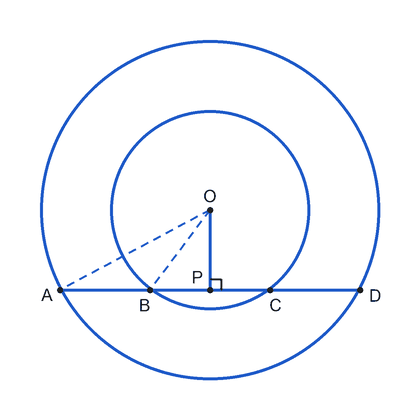
In the following figure, AD is a straight line. OP ⊥ AD and O is the centre of both the circles. If OA = 34 cm, OB = 20 cm and OP = 16 cm; find the length of AB.
 Solve with AI
Written solution
Solution:
Concept: In a right triangle, . OP ⊥ AD makes two right triangles, OPA and OPB, which share the side OP.
Given: OA = 34 cm, OB = 20 cm, OP = 16 cm, OP ⊥ AD.
Step 1 — Find AP.
OP ⊥ AD, so triangle OPA is right-angled at P, with hypotenuse OA = 34 cm.
Step 2 — Find BP.
Triangle OPB is also right-angled at P, with hypotenuse OB = 20 cm.
Step 3 — Subtract.
B lies between A and P, so AB is the part of AP that is left after BP.
Watch out: OA and OB are the hypotenuses here, so subtract the squares.
Therefore, AB = 18 cm.
- 103 marks
Question 10
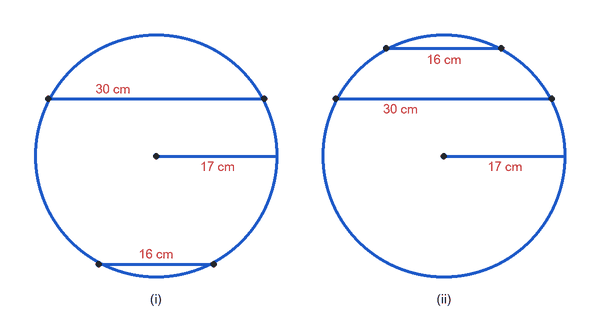
In a circle of radius 17 cm, two parallel chords of lengths 30 cm and 16 cm are drawn. Find the distance between the chords, if both the chords are :
(i) on the opposite sides of the centre,
(ii) on the same side of the centre.
 Solve with AI
Written solution
Solution:
Concept: The perpendicular drawn from the centre of a circle to a chord bisects the chord. So the radius, half the chord and the distance of the chord from the centre form a right triangle, and Pythagoras' theorem links them: , where is the radius and is the distance from the centre.
Given: Radius 17 cm; parallel chords 30 cm and 16 cm.
Step 1 — Distance of the 30 cm chord.
Half of it is 15 cm, and the radius is 17 cm.
Step 2 — Distance of the 16 cm chord.
Half of it is 8 cm.
Step 3 — Chords on opposite sides of the centre.
The centre lies between the chords, so the two distances add up.
Step 4 — Chords on the same side of the centre.
Now one chord lies between the centre and the other, so subtract the smaller distance from the larger.
Watch out: The LONGER chord is NEARER the centre (8 cm), the shorter one farther (15 cm).
Therefore, the distance between the chords is (i) 23 cm and (ii) 7 cm.
- 113 marks
Question 11
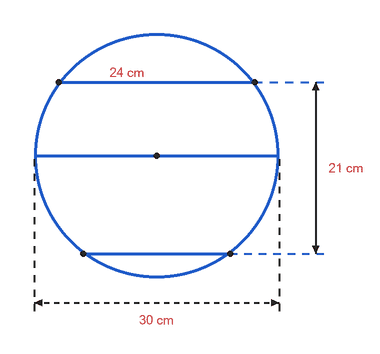
Two parallel chords are drawn in a circle of diameter 30·0 cm. The length of one chord is 24·0 cm and the distance between the two chords is 21·0 cm; find the length of the other chord.
 Solve with AI
Written solution
Solution:
Concept: The perpendicular drawn from the centre of a circle to a chord bisects the chord. So the radius, half the chord and the distance of the chord from the centre form a right triangle, and Pythagoras' theorem links them: , where is the radius and is the distance from the centre.
Given: Diameter 30 cm, one chord 24 cm, distance between the parallel chords 21 cm.
Step 1 — Distance of the 24 cm chord.
The radius is 30 ÷ 2 = 15 cm and half the chord is 12 cm.
Step 2 — Decide where the other chord is.
If the chords were on the same side of the centre, the other chord would be 9 + 21 = 30 cm from the centre. That is more than the radius (15 cm), which is impossible. So the chords are on opposite sides of the centre.
Step 3 — Find the other chord.
Use the right triangle again, with radius 15 cm and distance 12 cm.
The whole chord is twice the half-chord.
Watch out: Check which side of the centre each chord is on before adding or subtracting distances.
Therefore, the other chord is 18 cm long.
- 123 marks
Question 12
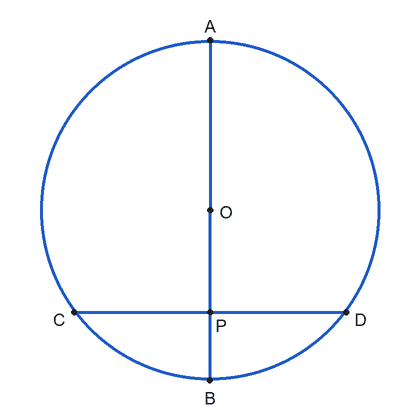
A chord CD of a circle, whose centre is O, is bisected at P by a diameter AB.
Given OA = OB = 15 cm and OP = 9 cm. Calculate the lengths of :
(i) CD
(ii) AD
(iii) CB.
 Solve with AI
Written solution
Solution:
Concept: The straight line joining the centre of a circle to the mid-point of a chord (not a diameter) is perpendicular to the chord. Its converse also holds: the perpendicular from the centre bisects the chord.
Given: Radius OA = 15 cm, OP = 9 cm, and the diameter AB bisects the chord CD at P.
Step 1 — See why AB ⊥ CD.
The diameter AB bisects the chord CD at P. The line from the centre to the mid-point of a chord is perpendicular to it, so AB ⊥ CD and every triangle at P is right-angled.
Step 2 — Find CD.
In right triangle OPD, OD = 15 cm (a radius) and OP = 9 cm.
P is the mid-point of CD, so CD is twice PD.
Step 3 — Find AD.
In the figure, P lies between O and B, so AP = AO + OP.
Now use right triangle APD.
Step 4 — Find CB.
PB = OB − OP, and triangle CPB is right-angled at P.
Watch out: AP = AO + OP (P is beyond O from A), but PB = OB − OP.
Therefore, (i) CD = 24 cm, (ii) AD = cm ≈ 26.83 cm and (iii) CB = cm ≈ 13.42 cm.
- 133 marks
Question 13
A straight line is drawn cutting two equal circles and passing through the mid-point M of the line joining their centres O and O′.

Prove that the chords AB and CD, which are intercepted by the two circles, are equal.
Solve with AIWritten solution
Solution:
Concept: Equal chords of a circle (or of equal circles) are equidistant from the centre, and chords that are equidistant from the centre are equal. Of two unequal chords, the longer one is nearer to the centre.
Given: Two equal circles with centres O and O′; M is the mid-point of OO′; a line through M cuts the circles at A, B and C, D.
Step 1 — Construct.
Draw OL ⊥ AB and O′N ⊥ CD, where L and N lie on the line. Let r be the radius of each circle.
Step 2 — Prove two triangles congruent.
Compare triangles OLM and O′NM.
- OM = O′M, because M is the mid-point of OO′;
- ∠OML = ∠O′MN, because they are vertically opposite angles;
- ∠OLM and ∠O′NM are both 90°, by construction.
So △OLM ≅ △O′NM by the A.A.S. rule, and therefore OL = O′N (corresponding parts of congruent triangles).
Step 3 — Compare the half-chords.
OL ⊥ AB, so L is the mid-point of AB; O′N ⊥ CD, so N is the mid-point of CD. By Pythagoras' theorem:
Since OL = O′N, the two half-chords AL and CN are equal. Each chord is twice its half-chord:
So AB = CD.
Watch out: The chords are in DIFFERENT circles, so the circles must be equal for equal distances to give equal chords.
Therefore, AB = CD. Hence proved.
- 143 marks
Question 14
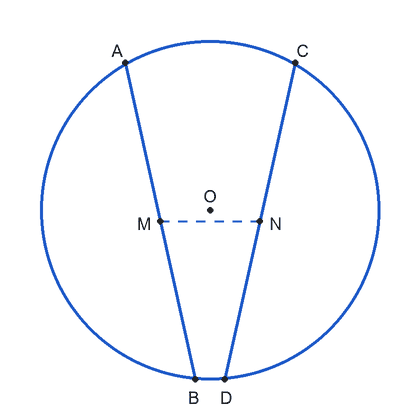
M and N are the mid-points of two equal chords AB and CD respectively of a circle with centre O. Prove that :
(i) ∠BMN = ∠DNM,
(ii) ∠AMN = ∠CNM.
 Solve with AI
Written solution
Solution:
Concept: The straight line joining the centre of a circle to the mid-point of a chord (not a diameter) is perpendicular to the chord. Its converse also holds: the perpendicular from the centre bisects the chord. Equal chords of a circle (or of equal circles) are equidistant from the centre, and chords that are equidistant from the centre are equal.
Given: M and N are the mid-points of the equal chords AB and CD of a circle with centre O.
Step 1 — Use the mid-points.
M and N are the mid-points of AB and CD, so OM ⊥ AB and ON ⊥ CD. Hence ∠OMA, ∠OMB, ∠ONC and ∠OND are all 90°.
Step 2 — Show OM = ON.
AB = CD, and equal chords are equidistant from the centre, so OM = ON.
Step 3 — Use the isosceles triangle OMN.
In △OMN, OM = ON, so the angles opposite them are equal: ∠OMN = ∠ONM.
Step 4 — Prove (i).
In the figure, O lies above MN, while B and D lie below it. So each angle is 90° minus the equal base angle:
The right-hand sides are equal, so ∠BMN = ∠DNM.
Step 5 — Prove (ii).
A and C lie above MN, on the same side as O, so each angle is 90° plus the equal base angle:
The right-hand sides are equal, so ∠AMN = ∠CNM.
Watch out: First join OM, ON and MN; the isosceles triangle OMN does all the work.
Therefore, (i) ∠BMN = ∠DNM and (ii) ∠AMN = ∠CNM. Hence proved.
- 153 marks
Question 15
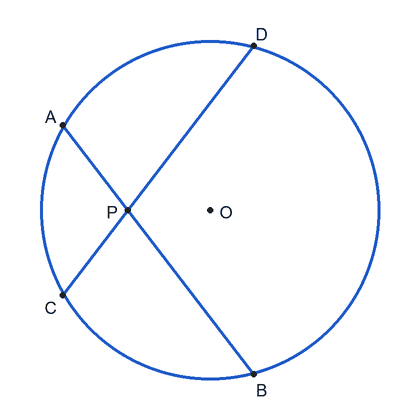
Two equal chords AB and CD of a circle with centre O, intersect each other at point P inside the circle. Prove that :
(i) AP = CP,
(ii) BP = DP
 Solve with AI
Written solution
Solution:
Concept: Equal chords of a circle (or of equal circles) are equidistant from the centre, and chords that are equidistant from the centre are equal. Of two unequal chords, the longer one is nearer to the centre. The perpendicular drawn from the centre of a circle to a chord bisects the chord.
Given: AB and CD are equal chords of a circle with centre O, cutting each other at P inside the circle.
Step 1 — Construct.
Draw OM ⊥ AB and ON ⊥ CD, and join OP.
Step 2 — Collect equal lengths.
Two facts give equal lengths.
- AB = CD, so OM = ON, because equal chords are equidistant from the centre.
- The perpendiculars bisect the chords, so AM and MB are each half of AB, and CN and ND are each half of CD.
- As AB = CD, the halves match: AM = CN and MB = ND.
Step 3 — Prove two right triangles congruent.
Compare right triangles OMP and ONP.
- OP = OP, because it is common;
- OM = ON, from Step 2;
- ∠OMP and ∠ONP are both 90°.
So △OMP ≅ △ONP by the R.H.S. rule, and therefore MP = NP.
Step 4 — Prove (i) and (ii).
In the figure, P lies between A and M, and between C and N. So:
These are equal, so AP = CP. Also:
These are equal, so BP = DP.
Watch out: Check in the figure whether P is between A and M or beyond M; it decides whether you add or subtract MP.
Therefore, (i) AP = CP and (ii) BP = DP. Hence proved.
- 163 marks
Question 16
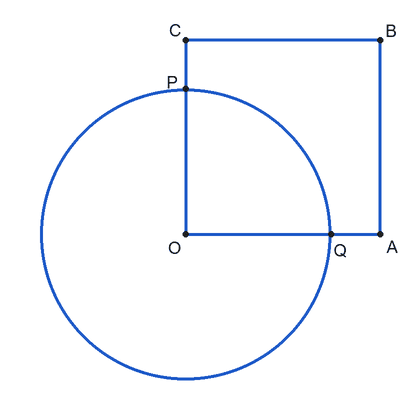
In the following figure, OABC is a square. A circle is drawn with O as centre which meets OC at P and OA at Q. Prove that :
(i) Δ OPA ≅ Δ OQC, (ii) Δ BPC ≅ Δ BQA.
 Solve with AI
Written solution
Solution:
Concept: All radii of a circle are equal, and all sides of a square are equal with every angle 90°. Two triangles are congruent by S.A.S. when two sides and the angle between them are equal.
Given: OABC is a square; the circle with centre O meets OC at P and OA at Q.
Step 1 — Prove (i): compare △OPA and △OQC.
Look at the sides and the angle between them.
- OP = OQ, because both are radii of the same circle;
- ∠POA and ∠QOC are both 90°, because each is the angle AOC of the square;
- OA = OC, because they are sides of the square.
So △OPA ≅ △OQC by the S.A.S. rule.
Step 2 — Find two more equal sides.
P lies on OC and Q lies on OA, so PC = OC − OP and QA = OA − OQ. Equal lengths minus equal lengths are equal, so PC = QA.
Step 3 — Prove (ii): compare △BPC and △BQA.
Again use two sides and the angle between them.
- PC = QA, from Step 2;
- ∠PCB and ∠QAB are both 90°, because they are angles of the square;
- BC = BA, because they are sides of the square.
So △BPC ≅ △BQA by the S.A.S. rule.
Watch out: For S.A.S. the equal angle must lie BETWEEN the two equal sides.
Therefore, (i) △OPA ≅ △OQC and (ii) △BPC ≅ △BQA. Hence proved.
- 173 marks
Question 17
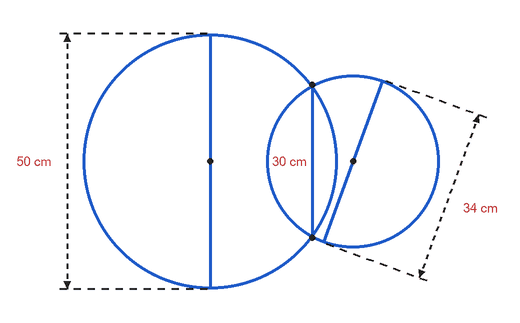
The length of common chord of two intersecting circles is 30 cm. If the diameters of these two circles be 50 cm and 34 cm, calculate the distance between their centres.
 Solve with AI
Written solution
Solution:
Concept: The line joining the centres of two intersecting circles is the perpendicular bisector of their common chord. Each centre, the mid-point of the chord and one end of the chord form a right triangle.
Given: Common chord 30 cm; diameters 50 cm and 34 cm.
Step 1 — Set up the figure.
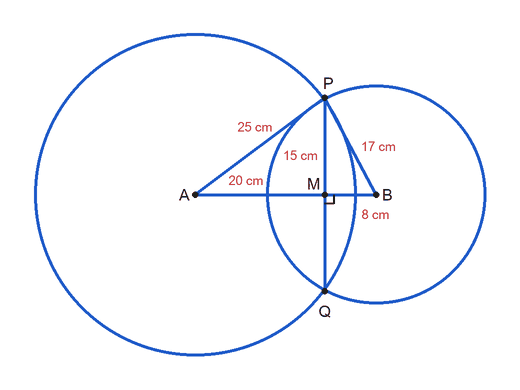
Let the common chord be PQ with mid-point M, and let the centres be A (radius 50 ÷ 2 = 25 cm) and B (radius 34 ÷ 2 = 17 cm). The line of centres is the perpendicular bisector of the common chord, so it passes through M at right angles, and PM = 15 cm.
Step 2 — Find AM.
Triangle AMP is right-angled at M, with hypotenuse AP = 25 cm.
Step 3 — Find BM.
Triangle BMP is right-angled at M, with hypotenuse BP = 17 cm.
Step 4 — Add the two distances.
Two intersecting circles are usually drawn with their centres on opposite sides of the common chord, as in the book. Then M lies between A and B.
Watch out: Use the RADII (25 cm and 17 cm), not the diameters.
Note: The stem does not say on which side of the chord the centres lie. If both centres were on the same side, the distance would be cm; the book's answer 28 cm takes them on opposite sides.
Therefore, the distance between the centres is 28 cm.
- 183 marks
Question 18
The line joining the mid-points of two chords of a circle passes through its centre. Prove that the chords are parallel.
Solve with AIWritten solution
Solution:
Concept: The straight line joining the centre of a circle to the mid-point of a chord (not a diameter) is perpendicular to the chord. Its converse also holds: the perpendicular from the centre bisects the chord.
Given: The line joining the mid-points M and N of chords AB and CD passes through the centre O.
Step 1 — Name the parts.
Let M and N be the mid-points of chords AB and CD, and let the line MN pass through the centre O.
Step 2 — Use the mid-point property for AB.
OM joins the centre to the mid-point of AB, so OM ⊥ AB. Hence line MN ⊥ AB.
Step 3 — Use it again for CD.
ON joins the centre to the mid-point of CD, so ON ⊥ CD. Hence line MN ⊥ CD.
Step 4 — Conclude.
AB and CD both make an angle of 90° with the same line MN. These are corresponding (or alternate) angles, and they are equal, so AB ∥ CD.
Watch out: The proof needs the line through the mid-points to pass through O; otherwise OM and ON are not along MN.
Therefore, the chords AB and CD are parallel. Hence proved.
- 193 marks
Question 19
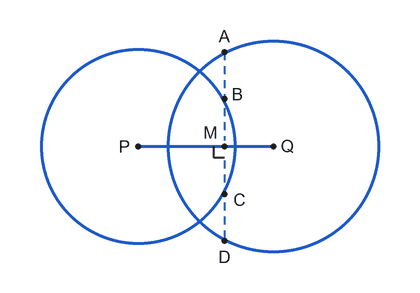
In the following figure, the line ABCD is perpendicular to PQ; where P and Q are the centres of the circles. Show that :
(i) AB = CD, (ii) AC = BD.
 Solve with AI
Written solution
Solution:
Concept: The perpendicular drawn from the centre of a circle to a chord bisects the chord.
Given: P and Q are the centres of the circles, and the line ABCD is perpendicular to PQ.
Step 1 — Mark the foot of the perpendicular.
Let the line ABCD meet PQ at M. Since ABCD ⊥ PQ, QM is perpendicular to the chord AD of the circle with centre Q, and PM is perpendicular to the chord BC of the circle with centre P.
Step 2 — Use the bisecting property.
The perpendicular from the centre bisects the chord. So AM = MD (chord AD) and BM = MC (chord BC).
Step 3 — Prove (i).
Subtract the equal parts from the equal parts:
The right-hand sides are equal, so AB = CD.
Step 4 — Prove (ii).
Now add BC to both sides of AB = CD:
Since AB = CD, the right-hand sides are equal, so AC = BD.
Watch out: A and D lie on the circle with centre Q, while B and C lie on the circle with centre P.
Therefore, (i) AB = CD and (ii) AC = BD. Hence proved.
- 201 mark
Question 20
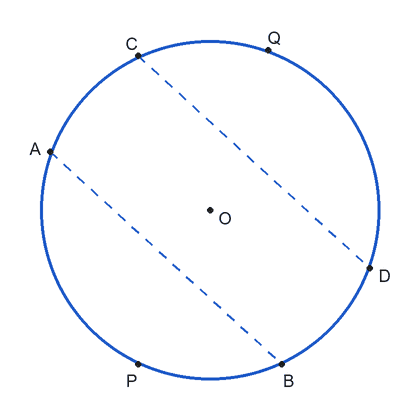
In the given figure, arc APB = arc CQD, then :
 Solve with AI
Answer
- Correct
(A) AB = CD
(B) AB > CD
(C) AB < CD
(D) AB ≠ CD
Answer: (A) AB = CD
Concept: In a circle (or in equal circles), equal chords cut off equal arcs and subtend equal angles at the centre. The angle an arc subtends at the centre is proportional to the length of the arc.
Step 1 — Recall the rule.
In the same circle, equal arcs are cut off by equal chords.
Step 2 — Apply it.
Arc APB = arc CQD, and AB and CD are the chords of these arcs, so AB = CD.
Why the other options are wrong:
- (B) AB > CD: Equal arcs always give equal chords, so AB cannot be longer.
- (C) AB < CD: Equal arcs always give equal chords, so AB cannot be shorter.
- (D) AB ≠ CD: It contradicts AB = CD.
Therefore, AB = CD, option (A).
- 211 mark
Question 21
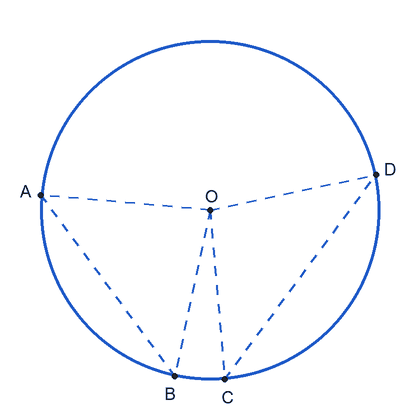
In the given figure, O is centre of the circle and ∠COD is greater than ∠AOB, then :
 Solve with AI
Answer
(A) AB > CD
- Correct
(B) AB < CD
(C) AB = CD
(D) AB + CD = AD
Answer: (B) AB < CD
Concept: In the same circle, a chord that subtends a larger angle at the centre is longer, because its ends are farther apart on the circle.
Step 1 — Recall the rule.
In the same circle, the larger the angle a chord subtends at the centre, the longer the chord.
Step 2 — Apply it.
∠COD > ∠AOB, so chord CD is longer than chord AB, that is, AB < CD.
Watch out: Compare the angles that the chords themselves subtend at O.
Why the other options are wrong:
- (A) AB > CD: It reverses the inequality.
- (C) AB = CD: Equal chords need equal angles at the centre, but ∠COD is larger.
- (D) AB + CD = AD: No rule gives this; in the figure AB + CD is clearly longer than AD.
Therefore, AB < CD, option (B).
- 221 mark
Question 22
In a circle, O is its centre and AB, CD are its two chords.
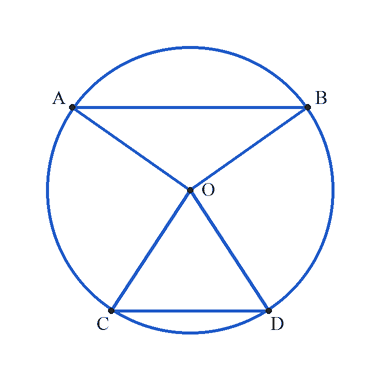
If AB : CD = 3 : 2, then ratio between ∠AOB and ∠COD is :
Solve with AIAnswer
(A) 1 : 1
- Correct
(B) 3 : 2
(C) 2 : 5
(D) 3 : 5
Answer: (B) 3 : 2
Concept: In a circle (or in equal circles), equal chords cut off equal arcs and subtend equal angles at the centre. The angle an arc subtends at the centre is proportional to the length of the arc.
Step 1 — Use the book's rule.
The book takes the angles at the centre to be in the same ratio as the chords, so ∠AOB : ∠COD = AB : CD.
Step 2 — Write the ratio.
AB : CD = 3 : 2, so ∠AOB : ∠COD = 3 : 2.
Watch out: The longer chord subtends the larger angle, so ∠AOB is the larger angle.
Note: Strictly, it is the ARCS (not the chords) that are proportional to the angles at the centre. For example, if ∠COD = 60°, then CD equals the radius, and a chord 1.5 times as long subtends about 97.2°, a ratio of about 1.62. The book intends the simple proportion, and 3 : 2 is the only option that fits.
Why the other options are wrong:
- (A) 1 : 1: 1 : 1 would need equal chords.
- (C) 2 : 5: 2 : 5 makes ∠AOB the smaller angle, but AB is the longer chord.
- (D) 3 : 5: 3 : 5 also makes ∠AOB the smaller angle, but AB is the longer chord.
Therefore, ∠AOB : ∠COD = 3 : 2, option (B).
- 231 mark
Question 23
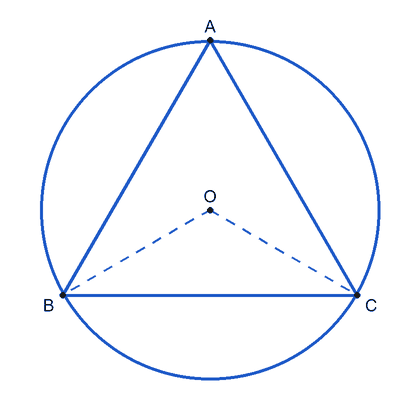
In the given figure, O is centre of the circle and ABC is an equilateral triangle, then ∠AOB is equal to :
 Solve with AI
Answer
(A) 105°
(B) 90°
(C) 60°
- Correct
(D) 120°
Answer: (D) 120°
Concept: In a circle (or in equal circles), equal chords cut off equal arcs and subtend equal angles at the centre. The angle an arc subtends at the centre is proportional to the length of the arc.
Step 1 — See the equal chords.
ABC is equilateral, so its sides AB, BC and CA are equal chords. Equal chords subtend equal angles at the centre, so ∠AOB, ∠BOC and ∠COA are equal.
Step 2 — Share 360°.
The three angles at O fill a complete turn.
Watch out: 60° is the angle of the triangle at a vertex, not the angle at the centre.
Why the other options are wrong:
- (A) 105°: Three angles of 105° make 315°, not 360°.
- (B) 90°: Three angles of 90° make 270°, not 360°.
- (C) 60°: 60° is an angle of the triangle, not the angle the side AB subtends at the centre.
Therefore, ∠AOB = 120°, option (D).
- 241 mark
Question 24
In the given figure, O is centre of the circle and chord AB : chord CD = 5 : 3. If angle DOC = 60°; then ∠AOB is :
 Solve with AI
Answer
(A) 120°
(B) 75°
- Correct
(C) 100°
(D) 80°
Answer: (C) 100°
Concept: In a circle (or in equal circles), equal chords cut off equal arcs and subtend equal angles at the centre. The angle an arc subtends at the centre is proportional to the length of the arc.
Step 1 — Use the book's rule.
The book takes the angles at the centre in the same ratio as the chords, so ∠AOB : ∠DOC = 5 : 3.
Step 2 — Find ∠AOB.
∠DOC = 60°, so ∠AOB is five-thirds of it.
Watch out: Multiply 60° by 5/3, not by 3/5, because AB is the longer chord.
Note: Strictly, the angle at the centre is proportional to the ARC, not the chord. With exact chords, CD equals the radius (∠DOC = 60°), and AB = × radius gives ∠AOB ≈ 112.9°, which is not an option. So the book intends the simple proportion, and 100° is its answer.
Why the other options are wrong:
- (A) 120°: This would give the ratio 120 : 60 = 2 : 1, not 5 : 3.
- (B) 75°: This would give the ratio 75 : 60 = 5 : 4, not 5 : 3.
- (D) 80°: This would give the ratio 80 : 60 = 4 : 3, not 5 : 3.
Therefore, ∠AOB = 100°, option (C).
- 253 marks
Question 25
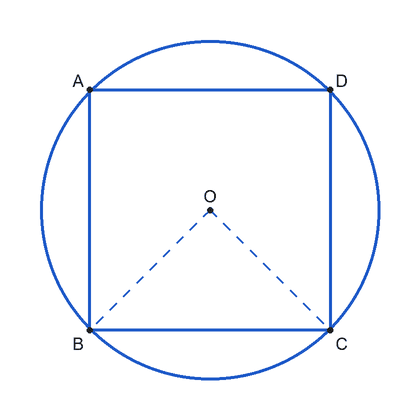
In the given figure, a square is inscribed in a circle with centre O. Find :
(i) ∠BOC
(ii) ∠OCB
(iii) ∠COD
(iv) ∠BOD
Is BD a diameter of the circle ?
 Solve with AI
Written solution
Solution:
Concept: The equal sides of a regular polygon inscribed in a circle are equal chords, so they subtend equal angles at the centre. These angles fill , so each side subtends at the centre. Two radii of a circle and the chord joining their ends form an isosceles triangle, so the two angles opposite the radii are equal: each base angle is .
Given: A square ABCD inscribed in a circle with centre O.
Step 1 — Find ∠BOC.
The four sides of the square are equal chords, so they subtend equal angles at O, and these four angles fill 360°.
Step 2 — Find ∠OCB.
OB = OC (radii), so △OBC is isosceles and ∠OBC = ∠OCB.
Step 3 — Find ∠COD.
CD is also a side of the square, so it subtends the same angle as BC.
Step 4 — Find ∠BOD.
∠BOD is made of ∠BOC and ∠COD together.
Step 5 — Decide about BD.
∠BOD = 180° is a straight angle, so B, O and D lie on one straight line. A chord through the centre is a diameter, so BD is a diameter.
Watch out: The base angles of △OBC are equal because OB and OC are RADII.
Therefore, (i) ∠BOC = 90°, (ii) ∠OCB = 45°, (iii) ∠COD = 90°, (iv) ∠BOD = 180°, and yes, BD is a diameter of the circle.
- 263 marks
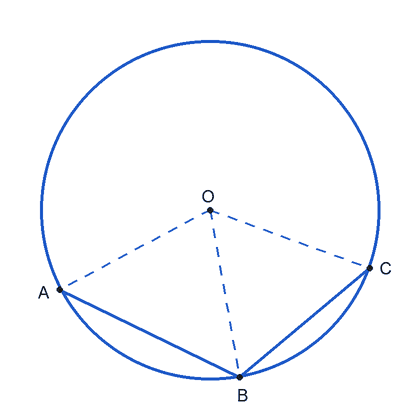
Question 26
In the given figure, AB is a side of a regular pentagon and BC is a side of a regular hexagon.
(i) ∠AOB
(ii) ∠BOC
(iii) ∠AOC
(iv) ∠OBA
(v) ∠OBC
(vi) ∠ABC
 Solve with AI
Written solution
Solution:
Concept: The equal sides of a regular polygon inscribed in a circle are equal chords, so they subtend equal angles at the centre. These angles fill , so each side subtends at the centre. Two radii of a circle and the chord joining their ends form an isosceles triangle, so the two angles opposite the radii are equal: each base angle is .
Given: AB is a side of a regular pentagon and BC is a side of a regular hexagon, both inscribed in the circle with centre O.
Step 1 — Find ∠AOB.
AB is a side of a regular pentagon (5 sides).
Step 2 — Find ∠BOC.
BC is a side of a regular hexagon (6 sides).
Step 3 — Find ∠AOC.
A and C are on opposite sides of OB, so the two angles add.
Step 4 — Find ∠OBA.
OA = OB (radii), so △OAB is isosceles.
Step 5 — Find ∠OBC.
OB = OC (radii), so △OBC is isosceles.
Step 6 — Find ∠ABC.
OB lies inside ∠ABC, so ∠ABC is the sum of the two base angles at B.
Watch out: ∠ABC is at the circumference, so build it from the two base angles at B.
Note: The printed stem leaves out the word “Find” before the list; each listed angle is to be found.
Therefore, (i) ∠AOB = 72°, (ii) ∠BOC = 60°, (iii) ∠AOC = 132°, (iv) ∠OBA = 54°, (v) ∠OBC = 60° and (vi) ∠ABC = 114°.
- 273 marks
Question 27
In the given figure, arc AB and arc BC are equal in length.
If ∠AOB = 48°, find:
(i) ∠BOC
(ii) ∠OBC
(iii) ∠AOC
(iv) ∠OAC
 Solve with AI
Written solution
Solution:
Concept: In a circle (or in equal circles), equal chords cut off equal arcs and subtend equal angles at the centre. The angle an arc subtends at the centre is proportional to the length of the arc. Two radii of a circle and the chord joining their ends form an isosceles triangle, so the two angles opposite the radii are equal: each base angle is .
Given: Arc AB = arc BC and ∠AOB = 48°.
Step 1 — Find ∠BOC.
Arc AB = arc BC, and equal arcs subtend equal angles at the centre.
Step 2 — Find ∠OBC.
OB = OC (radii), so △OBC is isosceles.
Step 3 — Find ∠AOC.
∠AOC is made of ∠AOB and ∠BOC.
Step 4 — Find ∠OAC.
OA = OC (radii), so △OAC is isosceles.
Watch out: For ∠OAC use △OAC, whose angle at the centre is ∠AOC = 96°.
Therefore, (i) ∠BOC = 48°, (ii) ∠OBC = 66°, (iii) ∠AOC = 96° and (iv) ∠OAC = 42°.
- 283 marks
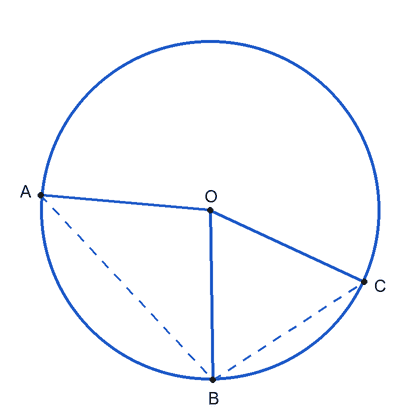
Question 28
In the given figure, the lengths of arcs AB and BC are in the ratio 3 : 2.
If ∠AOB = 96°, find:
(i) ∠BOC
(ii) ∠ABC
 Solve with AI
Written solution
Solution:
Concept: In a circle (or in equal circles), equal chords cut off equal arcs and subtend equal angles at the centre. The angle an arc subtends at the centre is proportional to the length of the arc. Two radii of a circle and the chord joining their ends form an isosceles triangle, so the two angles opposite the radii are equal: each base angle is .
Given: Arc AB : arc BC = 3 : 2 and ∠AOB = 96°.
Step 1 — Find ∠BOC.
Angles at the centre are proportional to the arcs, so ∠AOB : ∠BOC = 3 : 2.
Step 2 — Find ∠OBA.
OA = OB (radii), so △OAB is isosceles.
Step 3 — Find ∠OBC.
OB = OC (radii), so △OBC is isosceles.
Step 4 — Find ∠ABC.
OB lies inside ∠ABC, so add the two angles at B.
Watch out: ∠BOC is 2/3 of ∠AOB (the smaller arc gives the smaller angle), not 3/2 of it.
Therefore, (i) ∠BOC = 64° and (ii) ∠ABC = 100°.
- 293 marks
Question 29
In the given figure, AB = BC = DC and ∠AOB = 50°. Find :
(i) ∠AOC
(ii) ∠AOD
(iii) ∠BOD
(iv) ∠OAC
(v) ∠ODA
 Solve with AI
Written solution
Solution:
Concept: In a circle (or in equal circles), equal chords cut off equal arcs and subtend equal angles at the centre. The angle an arc subtends at the centre is proportional to the length of the arc. Two radii of a circle and the chord joining their ends form an isosceles triangle, so the two angles opposite the radii are equal: each base angle is .
Given: AB, BC and DC are equal chords, and ∠AOB = 50°.
Step 1 — Use the equal chords.
AB, BC and CD are equal chords, and equal chords subtend equal angles at the centre, so ∠AOB, ∠BOC and ∠COD are each 50°.
Step 2 — Find ∠AOC.
∠AOC is made of two of these angles.
Step 3 — Find ∠AOD.
∠AOD is made of all three.
Step 4 — Find ∠BOD.
∠BOD is made of ∠BOC and ∠COD.
Step 5 — Find ∠OAC.
OA = OC (radii), so △OAC is isosceles.
Step 6 — Find ∠ODA.
OA = OD (radii), so △OAD is isosceles.
Watch out: ∠AOD covers three equal angles (AB, BC and CD), not two.
Therefore, (i) ∠AOC = 100°, (ii) ∠AOD = 150°, (iii) ∠BOD = 100°, (iv) ∠OAC = 40° and (v) ∠ODA = 15°.
- 303 marks
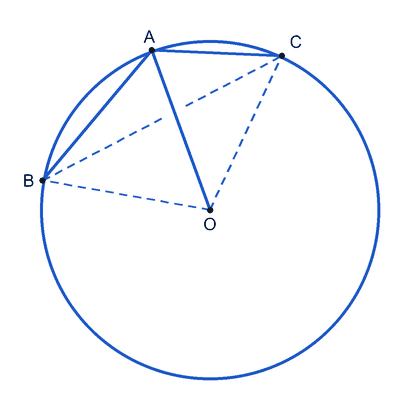
Question 30
In the given figure, AB is a side of a regular hexagon and AC is a side of a regular eight sided polygon. Find :
(i) ∠AOB
(ii) ∠AOC
(iii) ∠BOC
(iv) ∠OBC
 Solve with AI
Written solution
Solution:
Concept: The equal sides of a regular polygon inscribed in a circle are equal chords, so they subtend equal angles at the centre. These angles fill , so each side subtends at the centre. Two radii of a circle and the chord joining their ends form an isosceles triangle, so the two angles opposite the radii are equal: each base angle is .
Given: AB is a side of a regular hexagon and AC is a side of a regular eight-sided polygon, both inscribed in the circle with centre O.
Step 1 — Find ∠AOB.
AB is a side of a regular hexagon (6 sides).
Step 2 — Find ∠AOC.
AC is a side of a regular octagon (8 sides).
Step 3 — Find ∠BOC.
In the figure, B and C lie on opposite sides of OA, so the two angles add.
Step 4 — Find ∠OBC.
OB = OC (radii), so △OBC is isosceles.
This is 37°30′.
Watch out: B and C are on opposite sides of OA, so add ∠AOB and ∠AOC (do not subtract).
Therefore, (i) ∠AOB = 60°, (ii) ∠AOC = 45°, (iii) ∠BOC = 105° and (iv) ∠OBC = 37.5° (that is, 37°30′).
- 313 marks
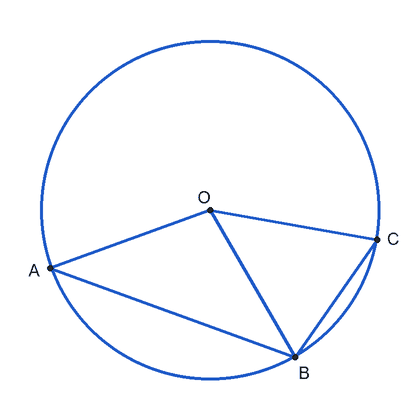
Question 31
In the given figure, O is the centre of the circle and the length of arc AB is twice the length of arc BC.
If ∠AOB = 100°, find:
(i) ∠BOC
(ii) ∠OAC
 Solve with AI
Written solution
Solution:
Concept: In a circle (or in equal circles), equal chords cut off equal arcs and subtend equal angles at the centre. The angle an arc subtends at the centre is proportional to the length of the arc. Two radii of a circle and the chord joining their ends form an isosceles triangle, so the two angles opposite the radii are equal: each base angle is .
Given: Arc AB = 2 × arc BC and ∠AOB = 100°.
Step 1 — Find ∠BOC.
Angles at the centre are proportional to the arcs. Arc AB is twice arc BC, so ∠AOB is twice ∠BOC.
Step 2 — Find ∠AOC.
∠AOC is made of ∠AOB and ∠BOC.
Step 3 — Find ∠OAC.
OA = OC (radii), so △OAC is isosceles.
Watch out: The longer arc AB gives the larger angle, so ∠BOC is HALF of 100°.
Therefore, (i) ∠BOC = 50° and (ii) ∠OAC = 15°.
- 323 marks
Question 32
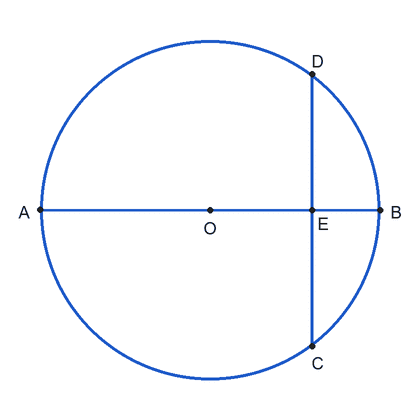
The figure, given below, shows a circle with centre O in which diameter AB bisects the chord CD at point E. If CE = ED = 8 cm and EB = 4 cm, find the radius of the circle.
 Solve with AI
Written solution
Solution:
Concept: The straight line joining the centre of a circle to the mid-point of a chord (not a diameter) is perpendicular to the chord. Its converse also holds: the perpendicular from the centre bisects the chord.
Given: CE and ED are 8 cm each, EB = 4 cm, and the diameter AB bisects CD at E.
Step 1 — Name the radius.
Let the radius be r cm, so OD = r. E lies between O and B, so OE is found by taking EB away from the radius OB.
Step 2 — See the right angle.
The diameter AB bisects the chord CD at E, so OE ⊥ CD and triangle OED is right-angled at E.
Step 3 — Use Pythagoras' theorem.
In right triangle OED, OD² = OE² + ED².
Watch out: OE is r − 4 (not 4): EB = 4 cm is measured from the circle, not from O.
Therefore, the radius of the circle is 10 cm.
- 333 marks
Question 33
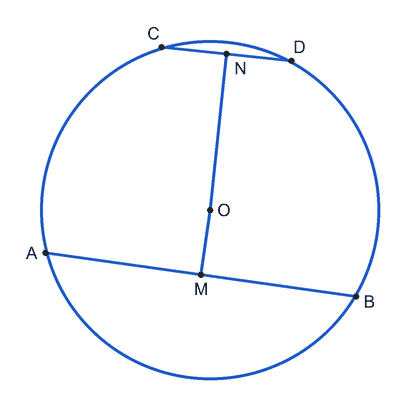
In the given figure, O is the centre of the circle. AB and CD are two chords of the circle. OM is perpendicular to AB and ON is perpendicular to CD. AB = 24 cm, OM = 5 cm, ON = 12 cm. Find the :
(i) radius of the circle.
(ii) length of chord CD.
 Solve with AI
Written solution
Solution:
Concept: The perpendicular drawn from the centre of a circle to a chord bisects the chord. So the radius, half the chord and the distance of the chord from the centre form a right triangle, and Pythagoras' theorem links them: , where is the radius and is the distance from the centre.
Given: AB = 24 cm, OM = 5 cm, ON = 12 cm, OM ⊥ AB and ON ⊥ CD.
Step 1 — Find the radius.
OM ⊥ AB bisects it, so AM is half of 24 cm, that is 12 cm. Triangle OMA is right-angled at M.
Step 2 — Find CN.
Triangle ONC is right-angled at N, with hypotenuse OC = 13 cm and ON = 12 cm.
Step 3 — Find CD.
ON ⊥ CD bisects it, so CD is twice CN.
Watch out: The perpendicular from the centre bisects the chord, so use HALF the chord in Pythagoras' theorem, then double the result if the whole chord is asked.
Therefore, (i) the radius is 13 cm and (ii) CD = 10 cm.
- 343 marks
Question 34
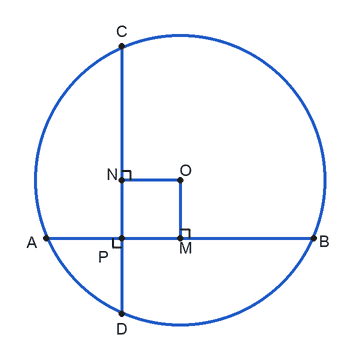
AB and CD are two equal chords of a circle with centre O which intersect each other at right angle at point P. If OM ⊥ AB and ON ⊥ CD; show that OMPN is a square.
 Solve with AI
Written solution
Solution:
Concept: Equal chords of a circle (or of equal circles) are equidistant from the centre, and chords that are equidistant from the centre are equal. Of two unequal chords, the longer one is nearer to the centre. A rectangle with two adjacent sides equal is a square.
Given: AB and CD are equal chords cutting at right angles at P; OM ⊥ AB and ON ⊥ CD.
Step 1 — Find three right angles.
OM ⊥ AB gives ∠OMP = 90°, ON ⊥ CD gives ∠ONP = 90°, and the chords cut at right angles, so ∠MPN = 90°.
Step 2 — Find the fourth angle.
The angles of quadrilateral OMPN add up to 360°.
All four angles are 90°, so OMPN is a rectangle.
Step 3 — Show two adjacent sides are equal.
AB = CD, and equal chords are equidistant from the centre, so OM = ON.
Step 4 — Conclude.
A rectangle with two adjacent sides equal is a square. So OMPN is a square.
Watch out: A quadrilateral with four right angles is only a rectangle; you also need two adjacent sides equal.
Therefore, OMPN is a square. Hence proved.
- 353 marks
Question 35
The radius of a circle is 13 cm and the length of one of its chords is 24 cm.

Find the distance of the chord from the centres.
Solve with AIWritten solution
Solution:
Concept: The perpendicular drawn from the centre of a circle to a chord bisects the chord. So the radius, half the chord and the distance of the chord from the centre form a right triangle, and Pythagoras' theorem links them: , where is the radius and is the distance from the centre.
Given: Radius 13 cm, chord 24 cm.
Step 1 — Find half the chord.
The perpendicular from the centre bisects the chord, so half the chord is 24 ÷ 2 = 12 cm.
Step 2 — Use Pythagoras' theorem.
The radius 13 cm is the hypotenuse of the right triangle.
Watch out: The perpendicular from the centre bisects the chord, so use HALF the chord in Pythagoras' theorem, then double the result if the whole chord is asked.
Note: The printed stem says “centres”; a circle has only one centre, so the distance from the centre is meant.
Therefore, the chord is 5 cm from the centre.
- 363 marks
Question 36
Prove that equal chords of congruent circles subtend equal angles at their centres.
Solve with AIWritten solution
Solution:
Concept: Congruent circles have equal radii. Two triangles are congruent by S.S.S. when all three sides of one equal the three sides of the other.
Step 1 — State the data.
Let the congruent circles have centres O and O′, and let chord AB of the first circle equal chord CD of the second. We must prove ∠AOB = ∠CO′D.
Step 2 — Compare the two triangles.
Join OA, OB, O′C and O′D, and compare △AOB and △CO′D.
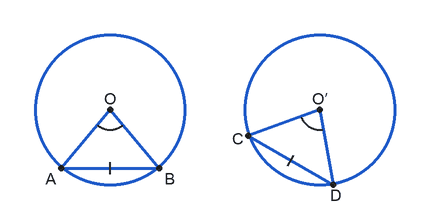
- OA = O′C, because the circles are congruent, so their radii are equal;
- OB = O′D, for the same reason;
- AB = CD, as given.
So △AOB ≅ △CO′D by the S.S.S. rule.
Step 3 — Conclude.
Corresponding parts of congruent triangles are equal, so ∠AOB = ∠CO′D.
Watch out: The radii are equal only because the circles are CONGRUENT; in unequal circles equal chords subtend unequal angles.
Therefore, equal chords of congruent circles subtend equal angles at their centres. Hence proved.
- 373 marks
Question 37
Draw two circles of different radii. How many points these circles can have in common? What is the maximum number of common points ?
Solve with AIWritten solution
Solution:
Concept: Through three points that are not in one straight line, exactly one circle can be drawn. So two different circles can share at most two points.
Step 1 — Draw the possible cases.
Draw two circles of different radii in every relative position, as below.

Step 2 — Count the common points.
Read each case from the figure.
- If the circles are far apart, or one lies inside the other without touching, they have 0 common points.
- If they touch, from outside or from inside, they have 1 common point.
- If they cut each other, they have 2 common points.
Step 3 — Find the maximum.
Two different circles can never meet in three points, because only one circle passes through three points that are not in a line. So the maximum is 2.
Watch out: The case “one circle inside the other” gives 0 common points, not infinitely many.
Note: Infinitely many common points happen only when the two circles coincide, which needs equal radii, so it cannot happen here.
Therefore, two circles of different radii can have 0, 1 or 2 points in common, and the maximum number of common points is 2.
- 383 marks
Question 38
Suppose you are given a circle. Describe a method by which you can find the centre of this circle.
Solve with AIWritten solution
Solution:
Concept: The perpendicular bisector of every chord of a circle passes through its centre, because every point on it is equidistant from the two ends of the chord.
Step 1 — Draw two chords.
Mark any three points A, B and C on the circle and draw the chords AB and BC.
Step 2 — Draw their perpendicular bisectors.
With ruler and compasses, draw the perpendicular bisector of AB and the perpendicular bisector of BC.
Step 3 — Mark the centre.
The point O where the two perpendicular bisectors meet is the centre of the circle.
Step 4 — See why it works.
Every point on the perpendicular bisector of AB is equidistant from A and B, so OA = OB. In the same way, O lies on the perpendicular bisector of BC, so OB = OC. So O is the same distance from three points of the circle, and the only such point is the centre.
Watch out: The two chords must not be parallel; chords with a common end such as AB and BC always work.
Therefore, the centre of the circle is the point where the perpendicular bisectors of any two non-parallel chords meet.
- 393 marks
Question 39
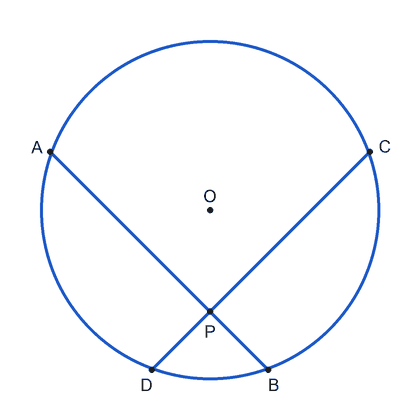
Given two equal chords AB and CD of a circle, with centre O, intersecting each other at point P. Prove that :
(i) AP = CP
(ii) BP = DP
 Solve with AI
Written solution
Solution:
Concept: Equal chords of a circle (or of equal circles) are equidistant from the centre, and chords that are equidistant from the centre are equal. Of two unequal chords, the longer one is nearer to the centre. The perpendicular drawn from the centre of a circle to a chord bisects the chord.
Given: AB and CD are equal chords of a circle with centre O, cutting each other at P.
Step 1 — Construct.
Draw OM ⊥ AB and ON ⊥ CD, and join OP.
Step 2 — Collect equal lengths.
Two facts give equal lengths.
- AB = CD, so OM = ON, because equal chords are equidistant from the centre.
- The perpendiculars bisect the chords, so AM and MB are each half of AB, and CN and ND are each half of CD.
- As AB = CD, the halves match: AM = CN and MB = ND.
Step 3 — Prove two right triangles congruent.
Compare right triangles OMP and ONP.
- OP = OP, because it is common;
- OM = ON, from Step 2;
- ∠OMP and ∠ONP are both 90°.
So △OMP ≅ △ONP by the R.H.S. rule, and therefore MP = NP.
Step 4 — Prove (i) and (ii).
In the figure, M lies between A and P, and N lies between C and P. So:
These are equal, so AP = CP. Also:
These are equal, so BP = DP.
Watch out: The chords are NOT given to be perpendicular; the proof uses only AB = CD.
Therefore, (i) AP = CP and (ii) BP = DP. Hence proved.
- 403 marks
Question 40
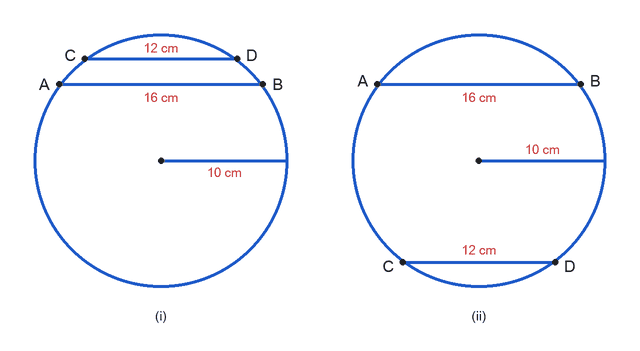
In a cricle of radius 10 cm, AB and CD are two parallel chords of lengths 16 cm and 12 cm respectively. Calculate the distance between the chords, if they are on :
(i) the same side of the centre.
(ii) the opposite sides of the centre.
 Solve with AI
Written solution
Solution:
Concept: The perpendicular drawn from the centre of a circle to a chord bisects the chord. So the radius, half the chord and the distance of the chord from the centre form a right triangle, and Pythagoras' theorem links them: , where is the radius and is the distance from the centre.
Given: Radius 10 cm; parallel chords AB = 16 cm and CD = 12 cm.
Step 1 — Distance of AB.
Half of AB is 8 cm and the radius is 10 cm.
Step 2 — Distance of CD.
Half of CD is 6 cm.
Step 3 — Same side of the centre.
One chord lies between O and the other, so subtract.
Step 4 — Opposite sides of the centre.
O lies between the chords, so add.
Watch out: The longer chord AB is nearer the centre (6 cm), the shorter chord CD farther (8 cm).
Note: The printed stem says “cricle”; it means circle.
Therefore, the distance between the chords is (i) 2 cm and (ii) 14 cm.
- 413 marks
Question 41
In the given figure, O is the centre of the circle with radius 20 cm and OD is perpendicular to AB.
If AB = 32 cm, find the length of CD.
 Solve with AI
Written solution
Solution:
Concept: The perpendicular drawn from the centre of a circle to a chord bisects the chord. So the radius, half the chord and the distance of the chord from the centre form a right triangle, and Pythagoras' theorem links them: , where is the radius and is the distance from the centre.
Given: Radius 20 cm, AB = 32 cm, OD ⊥ AB at C.
Step 1 — Find AC.
OD ⊥ AB at C, and the perpendicular from the centre bisects the chord, so AC is half of 32 cm, that is 16 cm.
Step 2 — Find OC.
Triangle OCA is right-angled at C, with hypotenuse OA = 20 cm.
Step 3 — Find CD.
OD is a radius, so OD = 20 cm, and C lies on OD.
Watch out: OD is a radius (20 cm), so CD = OD − OC.
Therefore, CD = 8 cm.
- 423 marks
Question 42
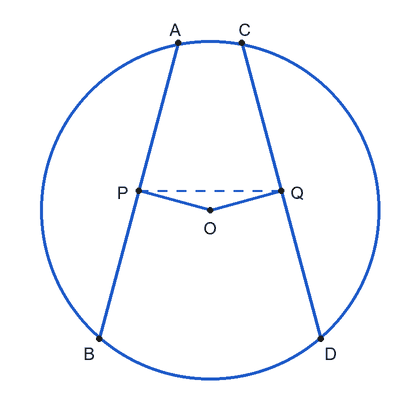
In the given figure, AB and CD are two equal chords of a circle, with centre O.
If P is the mid-point of chord AB, Q is the mid-point of chord CD and ∠POQ = 150°, find ∠APQ.
 Solve with AI
Written solution
Solution:
Concept: The straight line joining the centre of a circle to the mid-point of a chord (not a diameter) is perpendicular to the chord. Its converse also holds: the perpendicular from the centre bisects the chord. Equal chords of a circle (or of equal circles) are equidistant from the centre, and chords that are equidistant from the centre are equal.
Given: AB = CD, P and Q are their mid-points, and ∠POQ = 150°.
Step 1 — Show OP = OQ.
AB = CD, and equal chords are equidistant from the centre. OP and OQ are these distances (P and Q are mid-points, so OP ⊥ AB and OQ ⊥ CD), so OP = OQ.
Step 2 — Find ∠OPQ.
△OPQ is isosceles with OP = OQ, so its base angles are equal.
Step 3 — Find ∠APQ.
OP ⊥ AB, so ∠APO = 90°. PQ lies inside ∠APO, so take ∠OPQ away.
Watch out: ∠APQ = ∠APO − ∠OPQ, not ∠APO + ∠OPQ: PQ lies between PA and PO.
Therefore, ∠APQ = 75°.
- 433 marks
Question 43
In the given figure, AOC is the diameter of the circle, with centre O.
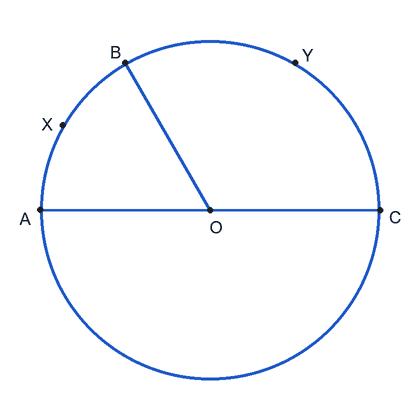
If arc AXB is half of arc BYC, find ∠BOC.
Solve with AIWritten solution
Solution:
Concept: In a circle (or in equal circles), equal chords cut off equal arcs and subtend equal angles at the centre. The angle an arc subtends at the centre is proportional to the length of the arc. A diameter makes a straight angle (180°) at the centre.
Given: AOC is a diameter and arc AXB = ½ arc BYC.
Step 1 — Link the angles to the arcs.
Angles at the centre are proportional to the arcs. Arc AXB is half of arc BYC, so ∠AOB = ½∠BOC.
Step 2 — Use the straight angle.
AOC is a diameter, so ∠AOB + ∠BOC = 180°, and we let ∠BOC = x.
Watch out: The LARGER arc BYC gives the larger angle; ∠BOC is twice ∠AOB.
Therefore, ∠BOC = 120°.
- 443 marks
Question 44
The circumference of a circle, with centre O, is divided into three arcs APB, BQC and CRA such that :
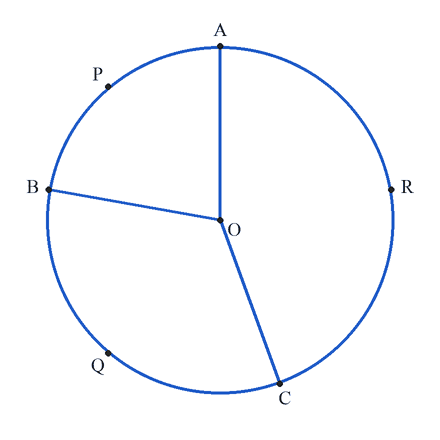
Find ∠BOC.
Solve with AIWritten solution
Solution:
Concept: In a circle (or in equal circles), equal chords cut off equal arcs and subtend equal angles at the centre. The angle an arc subtends at the centre is proportional to the length of the arc.
Step 1 — Turn the equal fractions into a ratio.
If each fraction equals k, then arc APB = 2k, arc BQC = 3k and arc CRA = 4k. So the arcs are in the ratio 2 : 3 : 4, which is 9 parts in all.
Step 2 — Share 360° in the same ratio.
Angles at the centre are proportional to the arcs, and the three angles fill 360°. ∠BOC stands on arc BQC, which is 3 of the 9 parts.
Watch out: The arcs are in the ratio 2 : 3 : 4 (the denominators), so arc BQC is 3 parts of 9.
Therefore, ∠BOC = 120°.
What Class 9 Maths Ch 17 covers
The sections of the chapter, in the order the book takes them. Every question above comes from one of these.
- 01Circle
- 02More About Circle
- 03Arc, Segment and Sector
- 04Properties of Chord
- 05Arc and Chord Properties
More ways to study this chapter
The same chapter asked three other ways. Practise it, revise it, and see what the board has set on Ch 17 before.
Class 9 Maths Ch 17 questions students ask
How many questions are there in Class 9 Maths Ch 17?
44 questions. Every one is solved step by step on this page.
Are these Class 9 Maths solutions free?
Yes. Every question and its full working is free to read, with no account needed.
Can I download the Class 9 Maths Ch 17 solutions as a PDF?
There is no PDF to download. Every solution is on this page instead, which means it is searchable, always the current syllabus, and readable on a phone. Use your browser's print option if you want it on paper.