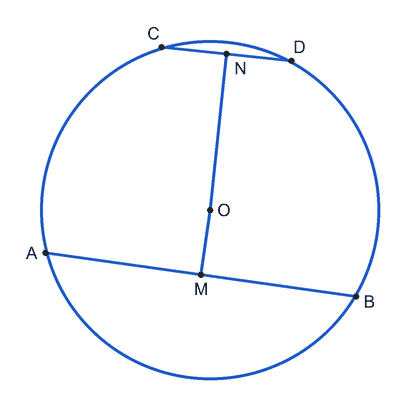
In the given figure, O is the centre of the circle.
Question 333 marksEasy
In the given figure, O is the centre of the circle. AB and CD are two chords of the circle. OM is perpendicular to AB and ON is perpendicular to CD. AB = 24 cm, OM = 5 cm, ON = 12 cm. Find the :
(i) radius of the circle.
(ii) length of chord CD.
Solution:
Concept: The perpendicular drawn from the centre of a circle to a chord bisects the chord. So the radius, half the chord and the distance of the chord from the centre form a right triangle, and Pythagoras' theorem links them: r2=(half-chord)2+d2, where r is the radius and d is the distance from the centre.
Given: AB = 24 cm, OM = 5 cm, ON = 12 cm, OM ⊥ AB and ON ⊥ CD.
Step 1 — Find the radius.
OM ⊥ AB bisects it, so AM is half of 24 cm, that is 12 cm. Triangle OMA is right-angled at M.
OA2=122+52=144+25=169OA=169=13cm
Step 2 — Find CN.
Triangle ONC is right-angled at N, with hypotenuse OC = 13 cm and ON = 12 cm.
CN2=132−122=169−144=25CN=25=5cm
Step 3 — Find CD.
ON ⊥ CD bisects it, so CD is twice CN.
CD=2×5=10cm
Watch out: The perpendicular from the centre bisects the chord, so use HALF the chord in Pythagoras' theorem, then double the result if the whole chord is asked.
Therefore, (i) the radius is 13 cm and (ii) CD = 10 cm.