
Question 263 marksMedium
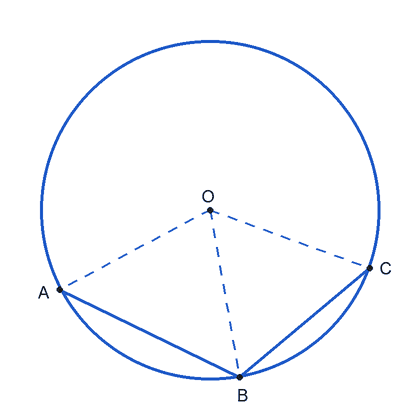
In the given figure, AB is a side of a regular pentagon and BC is a side of a regular hexagon.
(i) ∠AOB
(ii) ∠BOC
(iii) ∠AOC
(iv) ∠OBA
(v) ∠OBC
(vi) ∠ABC
Confirming your payment
Sign up now and get 250 free tokens.
Circle · Question 26 of 44
In the given figure, AB is a side of a regular pentagon and BC is a side of a regular hexagon.
(i) ∠AOB
(ii) ∠BOC
(iii) ∠AOC
(iv) ∠OBA
(v) ∠OBC
(vi) ∠ABC
Solution:
Concept: The equal sides of a regular polygon inscribed in a circle are equal chords, so they subtend equal angles at the centre. These angles fill , so each side subtends at the centre. Two radii of a circle and the chord joining their ends form an isosceles triangle, so the two angles opposite the radii are equal: each base angle is .
Given: AB is a side of a regular pentagon and BC is a side of a regular hexagon, both inscribed in the circle with centre O.
Step 1 — Find ∠AOB.
AB is a side of a regular pentagon (5 sides).
Step 2 — Find ∠BOC.
BC is a side of a regular hexagon (6 sides).
Step 3 — Find ∠AOC.
A and C are on opposite sides of OB, so the two angles add.
Step 4 — Find ∠OBA.
OA = OB (radii), so △OAB is isosceles.
Step 5 — Find ∠OBC.
OB = OC (radii), so △OBC is isosceles.
Step 6 — Find ∠ABC.
OB lies inside ∠ABC, so ∠ABC is the sum of the two base angles at B.
Watch out: ∠ABC is at the circumference, so build it from the two base angles at B.
Note: The printed stem leaves out the word “Find” before the list; each listed angle is to be found.
Therefore, (i) ∠AOB = 72°, (ii) ∠BOC = 60°, (iii) ∠AOC = 132°, (iv) ∠OBA = 54°, (v) ∠OBC = 60° and (vi) ∠ABC = 114°.