
Opening your dashboard
Class 9 Maths Chapter 17 Circle: Competency-Based Questions (CBQ)
40 questions on Chapter 17, each worked through on its own page with the AI tutor. Class 9 Maths, ICSE 2026-27.
40 questions
1–5 marks · Mixed difficulty
- 11 mark
Question 1
Competency: Understanding
The covers of manholes on a road are usually circular. A circular cover rests on a circular rim that is slightly smaller than the cover.
Why can such a cover never slip down through its own hole, however it is turned?
- 21 mark
Question 2
Competency: Understanding
A circular garden has a fountain at its centre. Two straight hedges are planted across the garden. Each hedge is 16 m long and has both its ends on the boundary. The hedges are not parallel.
The first hedge is 6 m from the fountain. How far from the fountain is the second hedge?
- 31 mark
Question 3
Competency: Analysis
The face of a wall clock is a circle. The twelve hour marks are equally spaced on its edge. A straight strip of tape joins the mark 12 to the mark 4.

A second strip of exactly the same length is needed. Between which two marks can it be fixed?
- 41 mark
Question 4
Competency: Analysis
A square tile of side 10 cm is placed on a circular plate. All four corners of the tile lie exactly on the edge of the plate.

How far is the centre of the plate from each side of the tile?
- 51 mark
Question 5
Competency: Evaluation
Assertion (A): A straight strip 12 cm long is fixed across a circular lid of radius 6.5 cm, with both its ends on the rim. The strip is 2.5 cm from the centre of the lid.
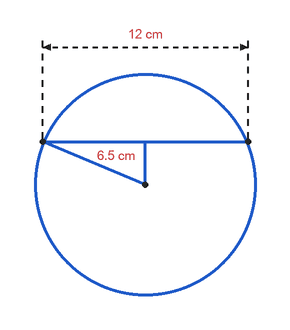
Reason (R): The perpendicular drawn from the centre of a circle to a chord bisects the chord.
- 61 mark
Question 6
Competency: Application
An artist marks points at equal distances all round the edge of a circular rangoli and joins each point to the next with a straight line. Each of these lines subtends an angle of at the centre.
How many points has the artist marked?
- 72 marks
Question 7
Competency: Application
The base of a round tin is a circle of radius 8.5 cm. Two straight sticks lie flat on the base. Each stick has both its ends touching the wall of the tin. One stick is 17 cm long and the other is 15 cm long.
Which stick must pass over the centre of the base? How far is the other stick from the centre?
- 82 marks
Question 8
Competency: Evaluation
Arnav writes in his notebook: "The line joining the centre of a circle to the mid-point of any chord is perpendicular to that chord."
Sara says, "Your statement fails for one kind of chord."
Which kind of chord does Sara mean? Explain why the statement fails for it, and write the statement correctly.
- 92 marks
Question 9
Competency: Understanding
The minute hand of a wall clock is 14 cm long. It moves from the 12 mark to the 3 mark. Let O be the centre of the clock, and let A and B be the positions of the tip of the hand at the start and at the end.
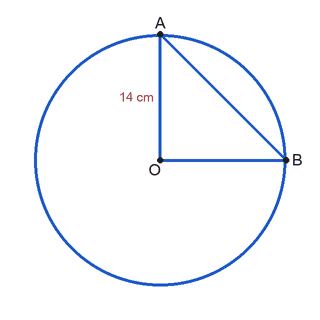
(a) Name the region swept by the minute hand, and state the angle at O.
(b) A straight line is drawn from A to B. Name the region between this line and the edge of the clock face. By how much is its area less than the area of the region in part (a)?
- 102 marks
Question 10
Competency: Application
Five chairs are placed at equal distances round the edge of a circular table of radius 90 cm. One more chair is brought, and all six chairs are again placed at equal distances round the edge.
(a) By how many degrees does the angle at the centre between two neighbouring chairs decrease?
(b) With six chairs, how far apart, in a straight line, are two neighbouring chairs? Give a reason.
- 113 marks
Question 11
Competency: Analysis
A mason has to rebuild a broken circular arch. Only the arc ACB of the old arch is left. He measures the straight distance AB as 80 cm. M is the mid-point of AB, and the height MC of the arc above M is 20 cm.

Find the radius of the circle of which the arch is a part.
- 123 marks
Question 12
Competency: Creativity
A circular stage has a radius of 10 m. The lighting team wants to fix three straight rails across the stage. Each rail must be exactly 16 m long, with both its ends on the edge of the stage. No two rails may be parallel.
Design a plan for the three rails. State how far each rail must be from the centre, and describe how the team should mark the rails on the stage.
- 133 marks
Question 13
Competency: Analysis & Evaluation
Three lamp posts A, B and C stand in a large park. A planner says, "Whatever the positions of three lamp posts, one circular path can always be laid so that it passes through all three."
(a) Is the planner's claim always true? Describe the case in which it fails, and say why.
(b) When such a path is possible, describe how to find its centre O, and explain why O is at the same distance from A, B and C.
- 145 marks
Question 14
Competency: Application & Analysis
Case study — Water in a pipe
A drain pipe lies flat on the ground. Its cross-section is a circle with centre O and radius 25 cm. The surface of the water in the pipe is a chord AB of this circle. The depth of the water is measured from the lowest point of the pipe up to the surface.
In the morning the surface AB is 48 cm wide and lies below the centre, as shown.

(a) Find the distance OM of the surface from the centre, and the depth of the water in the morning.
(b) Later in the day the surface of the water is 40 cm wide. Find the two possible depths of the water.
(c) At what depth is the surface of the water the widest? State this greatest width, and give a reason.
- 154 marks
Question 15
Competency: Analysis & Evaluation
Case study — Cutting a birthday cake
A circular cake with centre O is cut by three straight cuts AD, BE and CF. Each cut passes through O. The angles at the centre are , and .

The decorated border round the edge of the whole cake is 90 cm long.
(a) Find the angles at O of the other three pieces. Which pieces of the cake are exactly alike?
(b) Find the length of the border on the pieces AOB, BOC and COD.
(c) Rohit says, "The piece COD has twice as much border as the piece AOB. So its straight edge CD must also be twice as long as the straight edge AB." Is he right about the straight edges? Justify your answer.
- 161 mark
Question 16
Competency: Analysis
A sprinkler at the point O waters a lawn. Two circles with centre O are painted on the grass: an inner circle of radius 4 m and an outer circle of radius 9 m. Raju stands at a point P on the inner circle and Meena stands at a point Q on the outer circle. They may stand anywhere on their own circles.
What is the greatest possible distance between Raju and Meena?
- 171 mark
Question 17
Competency: Analysis
A circular pond has a straight fence AB across it, with both ends of the fence on the bank. The fence is 10 m long. Its mid-point M is 12 m from the centre O of the pond.
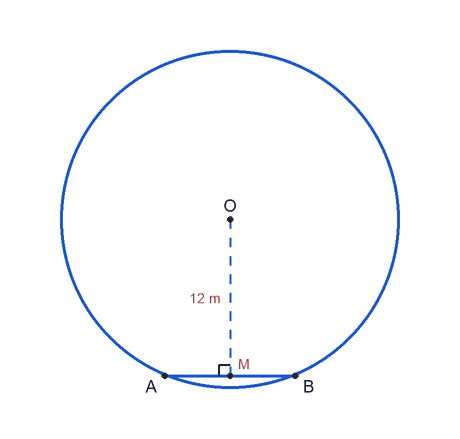
A duck starts at M and swims in a straight line through O to the bank on the far side of O. How far does the duck swim?
- 181 mark
Question 18
Competency: Analysis & Evaluation
A museum restorer is finding the centre of a broken round plate. She marks two chords on the edge of the plate. She draws the perpendicular bisector of each chord, and takes the point where they meet as the centre.
For which pair of chords does this method fail to give a single point?
- 191 mark
Question 19
Competency: Evaluation
A round table top has a radius of 85 cm. Two straight brass strips are fixed across it, each with both ends on the edge. Strip P is 13 cm from the centre of the table and strip Q is 77 cm from the centre.
Assertion (A): Strip P is more than twice as long as strip Q.
Reason (R): Chords of a circle which are equidistant from the centre are equal in length.
- 201 mark
Question 20
Competency: Analysis
A circular cake has centre O. The points A and B are on its edge, with .
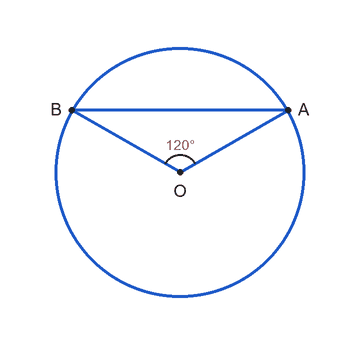
Rohan cuts along OA and OB and takes the smaller piece, X. Divya makes only one straight cut along AB and takes the smaller piece, Y, which is cut off. Which statement is correct?
- 211 mark
Question 21
Competency: Application & Analysis
A rope is tied tight across a circular pond, with both ends on the bank. The pond has radius 29 m. The rope has to pass through a post P which stands 20 m from the centre O of the pond.
What is the length of the shortest rope which can be fitted in this way?
- 221 mark
Question 22
Competency: Understanding
A thin wire is held tight across a circular drum, with its two ends always on the rim. The wire starts near one edge of the drum and is slid, always parallel to its first position, across the drum to the opposite edge.
Which statement describes how the length of the wire changes?
- 231 mark
Question 23
Competency: Application
Two lamp posts A and B stand 18 m apart in a park. A circular running track of radius 15 m has to be marked so that it passes through both posts.
How many different circular tracks can be marked?
- 241 mark
Question 24
Competency: Understanding
The figure shows the rim of a clock face. The twelve hour marks are equally spaced.

A bug walks clockwise along the rim from one mark to another. Which statement is correct?
- 251 mark
Question 25
Competency: Evaluation
Two straight planks AB and CD lie across a circular table, one on each side of the centre O, with their ends on the edge of the table. The planks are parallel and neither passes through O. M is the mid-point of AB and N is the mid-point of CD.
Assertion (A): The points M, O and N lie on one straight line.
Reason (R): The straight line joining the centre of a circle to the mid-point of a chord, which is not a diameter, is perpendicular to the chord.
- 262 marks
Question 26
Competency: Understanding
The figure shows the outline of a round tea coaster, a circle with centre O. PQ is a straight line through O, RS is a straight line which does not pass through O, and OT is 4.5 cm long. All the points P, Q, R, S and T are on the circle.
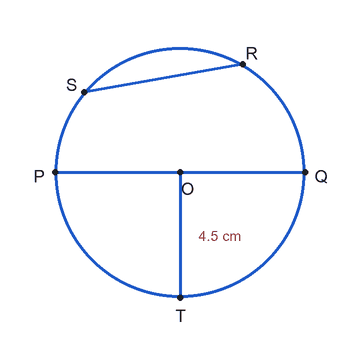
(a) Name one radius, one diameter and one chord which is not a diameter.
(b) Find the length of PQ. Hence say, with a reason, whether RS can be longer than PQ.
- 272 marks
Question 27
Competency: Evaluation
In a circle of radius 37 cm, two chords AB and CD are each 70 cm long. Isha says: "AB is 12 cm from the centre, and CD is 35 cm from the centre."
Check her claim. Show your working.
- 282 marks
Question 28
Competency: Application & Analysis
Asha, Ben and Chitra stand at the points A, B and C on the edge of a circular pond with centre O. , and Asha stands on the longer part of the edge between B and C. The straight paths AB and AC are equal. The edge of the pond is 72 m long all the way round.
(a) Find .
(b) Asha walks along the edge to Ben by the shorter way. How far does she walk?
- 292 marks
Question 29
Competency: Application
A cook cuts a triangular piece OAB from a round plate of radius 12.5 cm. The corner O is at the centre of the plate, and the corners A and B are on its rim. The side AB of the piece is 20 cm long.
Find the area of the piece.
- 302 marks
Question 30
Competency: Analysis & Evaluation
Zara says: "In a circle, the longer arc always has the longer chord."
On a circle with centre O, the chord PQ cuts off an arc PQ of at the centre, and the chord RS cuts off an arc RS of at the centre. Use these two chords to test Zara's claim.
- 312 marks
Question 31
Competency: Analysis
A drum has centre O. Two equal strings PA and PB are stretched from a point P on the rim of the drum to the points A and B on the rim.
Show that the line PO bisects .
- 323 marks
Question 32
Competency: Analysis & Evaluation
Kabir makes a kite frame inside a circular ring. He marks four points A, B, C and D, in this order, on the ring, and fixes straight sticks AB, BC, CD and DA with AB = AD and CB = CD. A cross-stick BD is also fixed.
Neha says: "A straight stick from A to C will pass through the centre of the ring."
Is she right? Prove your answer.
- 333 marks
Question 33
Competency: Application & Analysis
In a survey of 120 students of Class IX, the ways of coming to school were: 45 by bus, 30 by cycle, 25 on foot and 20 by car. The results are shown on a circle with centre O and radius 5 cm, divided into four sectors: Bus (AOB), Cycle (BOC), Walk (COD) and Car (DOA). The corners A, B, C and D of the sectors are on the circle.
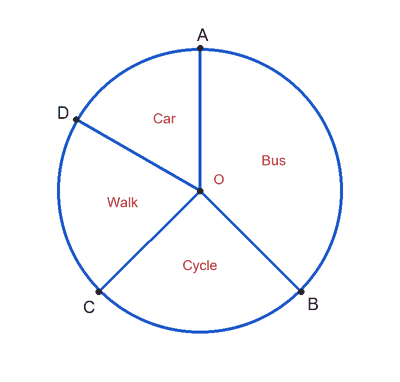
(a) Find the angle at O of each of the four sectors.
(b) Which of the chords AB, BC, CD and DA is the longest, and which is the shortest? Give a reason.
(c) Find the length of the chord BC.
- 343 marks
Question 34
Competency: Application & Evaluation
A round dining table has a radius of 65 cm. A flower vase with a round base of radius 25 cm will stand exactly at the centre of the table. The carpenter wants to fix a straight brass strip on the table top, with both ends of the strip on the edge, so that the strip does not pass under the vase: it must be at least 25 cm from the centre.
(a) What is the longest strip he can fix?
(b) He has two strips, of lengths 112 cm and 126 cm. Which of them can he use? Show your working.
- 353 marks
Question 35
Competency: Application & Creativity
A gardener has a circular flower bed of radius 5 m. She wants to fix six lamps on its edge, equally spaced. She has a rope exactly 5 m long, some pegs and nothing else to measure with: no protractor.
Describe how she can mark the six lamp positions. Explain why your method gives equal spacing.
- 363 marks
Question 36
Competency: Analysis
A circular rangoli has a radius of 30 cm. Four straight lines P, Q, R and S of coloured powder are drawn across it. The table shows the distance of each line from the centre of the rangoli.
Line Distance from centre (cm) Length inside the rangoli (cm) P 0 ? Q 18 ? R 24 ? S 30 ? (a) Find the lengths of P, Q and R inside the rangoli.
(b) What does the length of S show about the line S and the rangoli? Is S a chord?
(c) Riya wants one more line, exactly 50 cm long inside the rangoli. Using the table, between which two of the lines P, Q, R and S must its distance from the centre lie? Check by finding the distance.
- 375 marks
Question 37
Competency: Application & Analysis
Case study — A mobile tower and a highway
A mobile tower T gives a signal to every place within 26 km of it, so its coverage is a circle with centre T. A straight highway passes the tower so that its nearest point F is 10 km from T. The highway enters the coverage at P and leaves it at Q. (Hypothetical data.)

(a) Find the length PQ of the highway which is in coverage.
(b) A second straight highway has exactly 20 km of its length in coverage. How far is it from the tower at its nearest point?
(c) A bus travels along the first highway at 48 km per hour. For how many minutes is it in coverage? Find also the greatest number of minutes that any bus travelling at this speed along a straight highway can stay in coverage.
- 384 marks
Question 38
Competency: Analysis & Evaluation
Case study — Gates of a round park
A round park with centre O has four gates A, B, C and D on its boundary wall. The angles which the gates make at O are: , , and . (Hypothetical data.)

(a) Which two pairs of straight paths between neighbouring gates are equal in length? Give a reason.
(b) Show that the straight path BD passes through O.
(c) A fifth gate E is to be made on the wall so that and E is not the same as B. Find and say between which two gates E will lie.
- 394 marks
Question 39
Competency: Analysis
Case study — Rings of a target
A circular archery target has three rings drawn with the same centre O, of radii 13 cm, 15 cm and 20 cm. A straight laser line is drawn across the target so that its nearest point to O is 12 cm from O. The target is coloured in three bands: the inner disc (inside the 13 cm circle), the middle band (between the 13 cm and 15 cm circles) and the outer band (between the 15 cm and 20 cm circles). (Hypothetical data.)
Circle Radius (cm) Length of the line inside the circle (cm) Inner 13 ? Middle 15 ? Outer 20 ? (a) Complete the table.
(b) How much of the line lies in each of the three coloured bands? In which band is the most of the line?
(c) A second laser line has exactly 24 cm of its length inside the middle circle. How far is it from O? Does it enter the inner disc? Give a reason.
- 405 marks
Question 40
Competency: Application & Analysis
Case study — Two Wi-Fi routers
In a hall, a Wi-Fi router at X gives a signal at every place on or inside a circle of radius 13 m with centre X. An identical router at Y, 10 m from X, gives a signal at every place on or inside a circle of radius 13 m with centre Y. (Hypothetical data.)
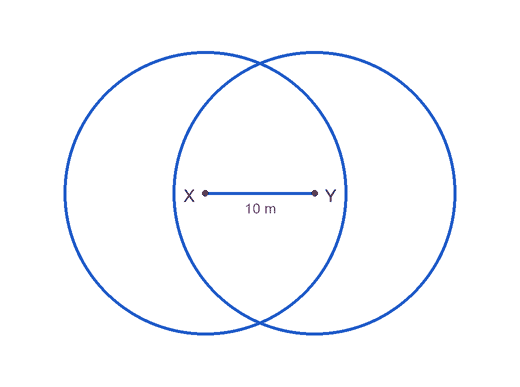
The table gives the distances of four desks from the two routers.
Desk Desk 1 Desk 2 Desk 3 Desk 4 Distance from X (m) 8 13 15 11 Distance from Y (m) 6 9 7 14 (a) For each desk, state whether it is inside, on or outside each router's circle. Which desks get a signal from both routers?
(b) Along the straight line through X and Y, how long is the stretch that gets a signal from both routers?
(c) The router Y is now moved farther away from X along the same line, so that this stretch becomes only 6 m long. How far apart are X and Y now, and how far was Y moved?