
Opening your dashboard
Class 9 Maths Chapter 1: Rational and Irrational Numbers Solutions
66 textbook questions with step-by-step answers, free to read, for ICSE 2026-27.
Get talked through Ch 1, not just shown the answer
Reading a finished solution is not the same as being able to do it. The AI tutor takes one question at a time and works it with you, in your own words, until you can.
- Ask it out loud, in your own words
- It gives you the next step, not the answer
- Stuck on part (ii)? Start there
66 questions with solutions
1–3 marks · Mixed difficulty
The first 20 solutions are on this page. This chapter is a long one, so the rest open on their own page to keep this one quick to load.
- 11 mark
Question 1
Let zero = , where and are integers. What additional condition will make a rational number :
Solve with AIAnswer
(A)
(B)
- Correct
(C)
(D) and
Answer: (C)
Concept: A rational number is a number that can be written as , where and are integers and . Every integer is rational, because .
Step 1 — Make the fraction equal to 0.
A fraction is 0 only when its numerator is 0, so .
Step 2 — Make it a rational number.
By the definition, the denominator of a rational number can never be 0. So we also need . For example, is a rational number.
Watch out: is fine for any , but is never allowed.
Why the other options are wrong:
- (A) : A zero denominator makes undefined, so it is not a number at all.
- (B) : If , then is not 0, so it cannot equal zero.
- (D) and : This also needs , which makes non-zero.
Therefore, the condition is , option (C).
- 21 mark
Question 2
Every non-terminating decimal number is a :
Solve with AIAnswer
(A) recurring decimal
- Correct
(B) real number
(C) non-recurring decimal
(D) circulating decimal
Answer: (B) real number
Concept: An irrational number cannot be written as . Its decimal never ends and never repeats, for example and . Rational and irrational numbers together make up the real numbers. If is a non-zero rational number and is irrational, then , , and are all irrational.
Step 1 — Look at the two kinds of non-terminating decimal.
A non-terminating decimal may repeat a block of digits, such as , which is rational. Or it may never repeat, such as , which is irrational.
Step 2 — Find what they have in common.
Rational numbers and irrational numbers are both real numbers. So every non-terminating decimal is a real number.
Watch out: Non-terminating does not mean recurring; some non-terminating decimals never repeat.
Why the other options are wrong:
- (A) recurring decimal: is non-terminating but it is not recurring.
- (C) non-recurring decimal: is non-terminating but it is recurring.
- (D) circulating decimal: Circulating means the same as recurring, and is non-terminating without recurring.
Therefore, every non-terminating decimal number is a real number, option (B).
- 31 mark
Question 3
7·478478..... is a :
Solve with AIAnswer
(A) terminating rational
- Correct
(B) recurring
(C) neither rational non-terminating
(D) not real
Answer: (B) recurring
Concept: A fraction in its lowest terms has a terminating decimal only when its denominator has no prime factor other than 2 and 5. Otherwise its decimal is non-terminating and recurring (a block of digits repeats for ever). Every rational number has one of these two kinds of decimal.
Step 1 — Look at the digits.
After the decimal point the block 478 repeats again and again, so .
Step 2 — Name the decimal.
A decimal in which a block of digits repeats for ever is a recurring decimal. It is also a rational number.
Watch out: The bar goes over the whole repeating block 478, not over one digit.
Why the other options are wrong:
- (A) terminating rational: The digits never stop, so it is not a terminating decimal.
- (C) neither rational non-terminating: It recurs, so it is rational; this option does not describe it.
- (D) not real: Every decimal number is a real number.
Therefore, is a recurring decimal, option (B).
- 41 mark
Question 4
is :
Solve with AIAnswer
(A) terminating
- Correct
(B) non-terminating
(C) periodic decimal
(D) not a rational number
Answer: (B) non-terminating
Concept: A fraction in its lowest terms has a terminating decimal only when its denominator has no prime factor other than 2 and 5. Otherwise its decimal is non-terminating and recurring (a block of digits repeats for ever). Every rational number has one of these two kinds of decimal.
Step 1 — Check the lowest terms.
71 is a prime number and it does not divide 75, so the fraction is already in its lowest terms.
Step 2 — Factorise the denominator.
We write 75 as a product of primes.
The prime factor 3 is not 2 or 5, so the decimal does not terminate.
Step 3 — Write the decimal.
Dividing 71 by 75 gives a decimal that never ends: , in which the 6 repeats.
Watch out: Check the denominator only after cancelling common factors.
Note: Two options are true as worded: a non-terminating recurring decimal is also periodic. The printed key, 'non-terminating', is kept.
Why the other options are wrong:
- (A) terminating: The factor 3 in the denominator stops the decimal from terminating.
- (C) periodic decimal: does repeat, so it is also a periodic decimal. Both (B) and (C) describe it; the book's key is 'non-terminating', the most direct description.
- (D) not a rational number: It is with integers and , so it is rational.
Therefore, is non-terminating, option (B).
- 51 mark
Question 5
Which of the following is terminating : , and ?
Solve with AIAnswer
(A)
(B)
(C)
- Correct
(D) None
Answer: (D) None
Concept: A fraction in its lowest terms has a terminating decimal only when its denominator has no prime factor other than 2 and 5. Otherwise its decimal is non-terminating and recurring (a block of digits repeats for ever). Every rational number has one of these two kinds of decimal.
Step 1 — Test 13/85.
The fraction is in its lowest terms, so we factorise the denominator.
The factor 17 is not 2 or 5, so it does not terminate.
Step 2 — Test 51/405.
Both 51 and 405 are divisible by 3, so we cancel first.
The factor 3 is still there, so it does not terminate.
Step 3 — Test 9/524.
The fraction is in its lowest terms, so we factorise the denominator.
The factor 131 is not 2 or 5, so it does not terminate.
Watch out: Cancel common factors first; then look for any prime other than 2 and 5.
Why the other options are wrong:
- (A) : Its denominator 85 has the prime factor 17.
- (B) : Its denominator 524 has the prime factor 131.
- (C) : Even after cancelling 3, the denominator 135 still has the prime factor 3.
Therefore, none of the three fractions is terminating, option (D).
- 63 marks
Question 6
Are the following statements true or false ? Give reasons for your answers.
(i) Every whole number is a natural number.
(ii) Every whole number is a rational number.
(iii) Every integer is a rational number.
(iv) Every rational number is a whole number.
Solve with AIWritten solution
Solution:
Concept: Natural numbers N = {1, 2, 3, …}; whole numbers W = {0, 1, 2, …}; integers Z = {…, −2, −1, 0, 1, 2, …}. A rational number is a number that can be written as , where and are integers and . Every integer is rational, because .
Step 1 — Part (i).
The whole numbers are 0, 1, 2, 3, … and the natural numbers are 1, 2, 3, … . The number 0 is a whole number but not a natural number, so the statement is false.
Step 2 — Part (ii).
Any whole number can be written as , for example . So the statement is true.
Step 3 — Part (iii).
Any integer can be written as , for example . So the statement is true.
Step 4 — Part (iv).
The number is rational but it is not a whole number. So the statement is false.
Watch out: One counter-example is enough to make an 'every' statement false.
Therefore, (i) False; (ii) True; (iii) True; (iv) False.
- 73 marks
Question 7
Arrange , , and in the ascending order of their magnitudes.
Also, find the difference between the largest and the smallest of these rational numbers. Express this difference as a decimal fraction correct to one decimal place.
Solve with AIWritten solution
Solution:
Concept: To compare fractions, write them with a common denominator and compare the numerators.
Step 1 — Use a common denominator.
The L.C.M. of 9, 12, 3 and 18 is 36, so we write every number with denominator 36.
Step 2 — Arrange in ascending order.
With the same denominator, the smaller numerator gives the smaller number. The numerators in order are −24, −20, 21, 22.
Step 3 — Find the difference.
The largest is and the smallest is . We subtract the smallest from the largest.
Dividing 23 by 18 gives . The second decimal digit is 7, which is 5 or more, so we round up to 1.3.
Watch out: Subtracting a negative number means adding it.
Therefore, the ascending order is , and the difference is , correct to one decimal place.
- 83 marks
Question 8
Arrange , , and in the descending order of their magnitudes.
Also, find the sum of the lowest and the largest of these rational numbers. Express the result obtained as a decimal fraction correct to two decimal places.
Solve with AIWritten solution
Solution:
Concept: To compare fractions, write them with a common denominator and compare the numerators.
Step 1 — Use a common denominator.
The L.C.M. of 8, 16, 4 and 32 is 32, so we write every number with denominator 32.
Step 2 — Arrange in descending order.
The numerators are 20, 17, −6 and −8 (with already over 32). From the largest to the smallest:
Step 3 — Find the sum of the lowest and the largest.
The lowest is and the largest is .
The third decimal digit is 5, so 0.375 rounds up to 0.38 correct to two decimal places.
Watch out: Among negative numbers, the one with the bigger size is the smaller number: .
Therefore, the descending order is , and the sum is , correct to two decimal places.
- 93 marks
Question 9
Without doing any actual division, find which of the following rational numbers have terminating decimal representation :
(i)
(ii)
(iii)
(iv)
(v)
Solve with AIWritten solution
Solution:
Concept: A fraction in its lowest terms has a terminating decimal only when its denominator has no prime factor other than 2 and 5. Otherwise its decimal is non-terminating and recurring (a block of digits repeats for ever). Every rational number has one of these two kinds of decimal.
Step 1 — Check that each fraction is in lowest terms.
In each fraction the numerator and the denominator have no common factor, so we only need to factorise the denominators.
Step 2 — Part (i).
16 is a power of 2 only.
So is terminating.
Step 3 — Part (ii).
125 is a power of 5 only.
So is terminating.
Step 4 — Part (iii).
14 has the prime factor 7.
So is not terminating.
Step 5 — Part (iv).
45 has the prime factor 3.
So is not terminating.
Step 6 — Part (v).
50 has only the prime factors 2 and 5.
So is terminating.
Watch out: A factor 2 or 5 alone never stops a decimal terminating; any other prime does.
Therefore, (i) , (ii) and (v) have terminating decimal representations.
- 101 mark
Question 10
The negative of an irrational number is :
Solve with AIAnswer
(A) a rational number
- Correct
(B) an irrational number
(C) a rational number and an irrational number
(D) a whole number
Answer: (B) an irrational number
Concept: An irrational number cannot be written as . Its decimal never ends and never repeats, for example and . Rational and irrational numbers together make up the real numbers. If is a non-zero rational number and is irrational, then , , and are all irrational.
Step 1 — Suppose the negative were rational.
Let be irrational. If were rational, then would also be rational, because the negative of a rational number is rational.
Step 2 — Reach the conclusion.
That is impossible, since is irrational. So is irrational. For example, is irrational.
Watch out: Changing the sign does not change whether the decimal repeats.
Why the other options are wrong:
- (A) a rational number: If were rational, would be rational too.
- (C) a rational number and an irrational number: A number cannot be both rational and irrational.
- (D) a whole number: Every whole number is rational, so the negative of an irrational number cannot be a whole number.
Therefore, the negative of an irrational number is an irrational number, option (B).
- 111 mark
Question 11
is always :
Solve with AIAnswer
(A) rational
- Correct
(B) irrational
(C) whole number
(D) natural number
Answer: (B) irrational
Concept: An irrational number cannot be written as . Its decimal never ends and never repeats, for example and . Rational and irrational numbers together make up the real numbers. If is a non-zero rational number and is irrational, then , , and are all irrational.
Step 1 — Multiply out.
We multiply each term in the bracket by and simplify the surd.
Step 2 — Decide its type.
The term is irrational and does not cancel. A rational number minus an irrational number is irrational.
Watch out: is 8, but the term is still left.
Why the other options are wrong:
- (A) rational: The term does not cancel, so the result is not rational.
- (C) whole number: Whole numbers are rational, and is not even an integer.
- (D) natural number: Natural numbers are rational, and is not even an integer.
Therefore, the number is irrational, option (B).
- 121 mark
Question 12
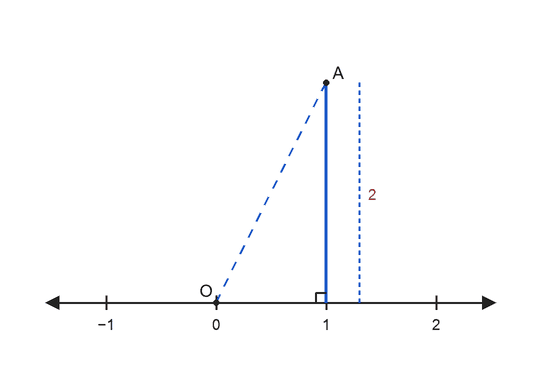
For the given figure length of OA is :
 Solve with AI
Answer
- Correct
(A)
(B)
(C) or
(D) neither nor
Answer: (A)
Concept: An irrational length such as can be drawn exactly with Pythagoras' theorem: in a right triangle, . A pair of compasses then carries that length onto the number line.
Step 1 — Read the figure.
The perpendicular stands at the point 1, so the base from O (the point 0) to 1 is 1 unit, and the perpendicular is 2 units high. OA is the hypotenuse.
Step 2 — Use Pythagoras' theorem.
In the right triangle, the square on OA is the sum of the squares on the other two sides.
So OA is units.
Watch out: Add the squares of the two shorter sides; do not add the lengths.
Why the other options are wrong:
- (B) : would need a height of , since ; here the height is 2.
- (C) or : The length is fixed by the figure, so only one value is possible.
- (D) neither nor : The length is exactly .
Therefore, the length of OA is , option (A).
- 131 mark
Question 13
is :
Solve with AIAnswer
(A) rational
- Correct
(B) irrational
(C) neither rational nor irrational
(D)
Answer: (B) irrational
Concept: For positive numbers and : and . Only like surds (the same number under the root) can be added or subtracted, for example .
Step 1 — Multiply the parts.
We multiply the numbers outside the roots and the numbers inside the roots separately.
Step 2 — Decide its type.
6 is not a perfect square, so is irrational, and so is .
Watch out: is ; the numbers under the roots are multiplied, not added.
Why the other options are wrong:
- (A) rational: 24 is not a perfect square, so the product is not rational.
- (C) neither rational nor irrational: Every real number is either rational or irrational.
- (D) : The product is , not . Adding 3 and 8 under the root (and halving) is not a rule.
Therefore, the product is irrational, option (B).
- 141 mark
Question 14
Two irrational numbers between 8 and 11 are :
Solve with AIAnswer
- Correct
(A) and
(B) and 10·5
(C) 8·2 and
(D) 3 and
Answer: (A) and
Concept: An irrational number cannot be written as . Its decimal never ends and never repeats, for example and . Rational and irrational numbers together make up the real numbers. If is a non-zero rational number and is irrational, then , , and are all irrational.
Step 1 — Write 8 and 11 as square roots.
Since and , every with lies between 8 and 11.
Step 2 — Check option (A).
65 and 120 lie between 64 and 121, and neither is a perfect square. So and are irrational and lie between 8 and 11.
Watch out: Check both conditions for both numbers: irrational, and between 8 and 11.
Why the other options are wrong:
- (B) and 10·5: 10·5 is a terminating decimal, so it is rational.
- (C) 8·2 and : 8·2 is rational, and is more than 11.
- (D) 3 and : 3 is rational and is not between 8 and 11.
Therefore, and are two irrational numbers between 8 and 11, option (A).
- 153 marks
Question 15
State, whether the following numbers are rational or not :
(i)
(ii)
(iii)
(iv)
Solve with AIWritten solution
Solution:
Concept: To square a sum or a difference, use and , together with . A number is irrational if a surd term is left after simplifying, and rational if every surd cancels.
Step 1 — Part (i).
We expand the square of the sum.
The surd term is left, so the number is not rational.
Step 2 — Part (ii).
We expand the square of the difference.
The surd term is left, so the number is not rational.
Step 3 — Part (iii).
We use .
The surd cancels, so the number is rational.
Step 4 — Part (iv).
We expand the square of the difference.
The surd term is left, so the number is not rational.
Watch out: Do not forget the middle term when squaring.
Therefore, (i) not rational; (ii) not rational; (iii) rational; (iv) not rational.
- 163 marks
Question 16
Find the square of :
(i)
(ii)
(iii)
(iv)
Solve with AIWritten solution
Solution:
Concept: To square a sum or a difference, use and , together with . A number is irrational if a surd term is left after simplifying, and rational if every surd cancels.
Step 1 — Part (i).
We square the top and the bottom separately.
As a mixed number, is .
Step 2 — Part (ii).
We use the square of a sum.
Step 3 — Part (iii).
We use the square of a difference.
Step 4 — Part (iv).
We use the square of a sum; the middle term is .
Watch out: is , not 10.
Therefore, (i) ; (ii) ; (iii) ; (iv) .
- 173 marks
Question 17
State, in each case, whether true or false :
(i)
(ii)
(iii)
(iv) is an irrational number.
(v) is a rational number.
(vi) All rational numbers are real numbers.
(vii) All real numbers are rational numbers.
(viii) Some real numbers are rational numbers.
Solve with AIWritten solution
Solution:
Concept: For positive numbers and : and . Only like surds (the same number under the root) can be added or subtracted, for example . A rational number is a number that can be written as , where and are integers and . Every integer is rational, because .
Step 1 — Part (i).
Here, and are unlike surds, so they cannot be added under one root. Their values are about 1.414 and 1.732, which add to about 3.146, while . False.
Step 2 — Part (ii).
Since , the left side is . True.
Step 3 — Part (iii).
These are like surds, so we subtract the numbers in front: is . True.
Step 4 — Part (iv).
Here, is of the form with integers , and , so it is rational. False.
Step 5 — Part (v).
Here, is of the form with . True.
Step 6 — Part (vi).
The real numbers are made up of all the rational and all the irrational numbers. True.
Step 7 — Part (vii).
Here, is a real number but it is not rational. False.
Step 8 — Part (viii).
For example, 2 and are real numbers that are rational. True.
Watch out: is never for positive and .
Therefore, (i) False; (ii) True; (iii) True; (iv) False; (v) True; (vi) True; (vii) False; (viii) True.
- 183 marks
Question 18
Given universal set =
From the given set, find :
(i) set of rational numbers
(ii) set of irrational numbers
(iii) set of integers
(iv) set of non-negative integers
Solve with AIWritten solution
Solution:
Concept: A rational number is a number that can be written as , where and are integers and . Every integer is rational, because . An irrational number cannot be written as . Its decimal never ends and never repeats, for example and . Rational and irrational numbers together make up the real numbers.
Step 1 — Simplify the roots in the set.
Here, is , an integer, so it is rational. is , which is irrational. is irrational. 3.01 and 8.47 are terminating decimals, so they are rational.
Step 2 — Part (i): rational numbers.
These are all the numbers that can be written as .
Step 3 — Part (ii): irrational numbers.
These are the numbers left over.
Step 4 — Part (iii): integers.
These are the whole numbers and their negatives; is the integer .
Step 5 — Part (iv): non-negative integers.
These are the integers that are 0 or positive.
Watch out: A root sign does not make a number irrational: is exactly 2.
Therefore, (i) rational: ; (ii) irrational: ; (iii) integers: ; (iv) non-negative integers: 0, 1.
- 193 marks
Question 19
Represent each of the following on different number lines :
, , , and .
Solve with AIWritten solution
Solution:
Concept: An irrational length such as can be drawn exactly with Pythagoras' theorem: in a right triangle, . A pair of compasses then carries that length onto the number line.
Step 1 — Part (a): mark 2√3.
Notice that and . So is the base of a right triangle whose hypotenuse is 4 and height is 2. At O (the point 0) draw OQ = 2 units perpendicular to the number line. With Q as centre and radius 4 units, draw an arc to cut the number line at P.
So OP is , and P represents .

Step 2 — Part (b): mark 2√2.
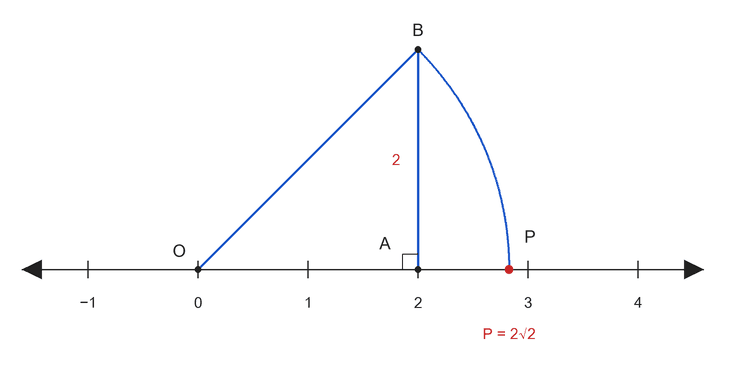
At A (the point 2) draw AB = 2 units perpendicular to the number line, and join OB.
So OB is . With O as centre and radius OB, draw an arc to cut the number line at P. Then P represents .
Step 3 — Part (c): mark 3 + √2.
Let A be the point 3 and B the point 4. At B draw BC = 1 unit perpendicular to the number line, and join AC.
So AC is . With A as centre and radius AC, draw an arc to cut the number line to the right of A at P. Then P is to the right of 3, so it represents .

Step 4 — Part (d): mark 3 − √2.
We draw the same triangle as in part (c), so AC is again . With A as centre and radius AC, draw an arc to cut the number line to the left of A at P. Then P is to the left of 3, so it represents .

Step 5 — Part (e): mark 2√5.
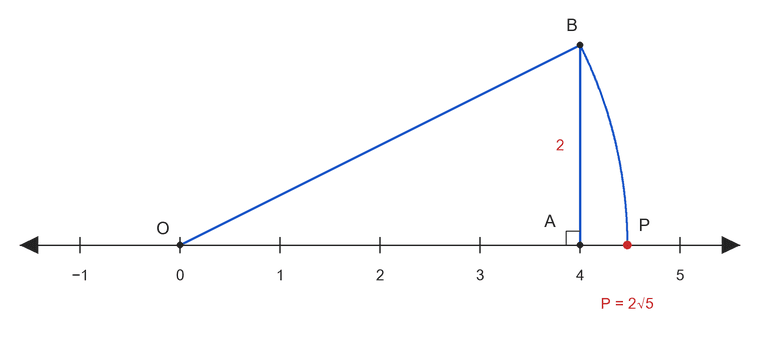
At A (the point 4) draw AB = 2 units perpendicular to the number line, and join OB.
So OB is . With O as centre and radius OB, draw an arc to cut the number line at P. Then P represents .
Watch out: In parts (b) to (e) the compass point goes on O or A, where the length starts on the line; in part (a) it goes on Q, because the known length is the hypotenuse QP.
Therefore, in each figure, the point P represents the required number.
- 203 marks
Question 20
Prove that each of the following numbers is irrational :
(i)
(ii)
(iii)
Solve with AIWritten solution
Solution:
Concept: In a proof by contradiction, we assume the number is rational, and show that this would make a number we know to be irrational ( or ) rational. Sums, differences, products and quotients (with a non-zero divisor) of rational numbers are always rational.
Step 1 — Part (i): suppose √3 + √2 is rational.
Let , where is rational and (the sum is positive). We take to the other side and square both sides.
Step 2 — Part (i): reach a contradiction.
The right side is made from the rational number by adding, multiplying and dividing, so it is rational. Then would be rational, which is false. So is irrational.
Step 3 — Part (ii): suppose 3 − √2 is rational.
Let , where is rational. We make the subject.
Since is rational, would be rational, which is false. So is irrational.
Step 4 — Part (iii): suppose √5 − 2 is rational.
Let , where is rational. We make the subject.
Since is rational, would be rational, which is false. So is irrational.
Watch out: In part (i), is needed before dividing by .
Therefore, , and are all irrational.
- 213 marks
Question 21
Write a pair of irrational numbers whose sum is irrational.
- 223 marks
Question 22
Write a pair of irrational numbers whose sum is rational.
- 233 marks
Question 23
Write a pair of irrational numbers whose difference is irrational.
- 243 marks
Question 24
Write a pair of irrational numbers whose difference is rational.
- 253 marks
Question 25
Write a pair of irrational numbers whose product is irrational.
- 263 marks
Question 26
Write a pair of irrational numbers whose product is rational.
- 273 marks
Question 27
Write in ascending order :
(i) and
(ii) and
(iii) , and
- 283 marks
Question 28
Write in descending order :
(i) and
(ii) and
- 293 marks
Question 29
Insert five irrational numbers between and .
- 303 marks
Question 30
Write two rational numbers between and .
- 313 marks
Question 31
Write three rational numbers between and .
- 321 mark
Question 32
If , is equal to :
- 331 mark
Question 33
If , then is :
- 341 mark
Question 34
is equal to :
- 351 mark
Question 35
is :
- 361 mark
Question 36
is equal to :
- 371 mark
Question 37
is equal to :
- 381 mark
Question 38
If , then is :
- 391 mark
Question 39
is equal to :
- 403 marks
Question 40
State, with reason, which of the following are surds and which are not :
(i)
(ii)
(iii)
(iv)
(v)
(vi)
(vii)
(viii)
- 413 marks
Question 41
Write the lowest rationalizing factor of :
(i)
(ii)
(iii)
(iv)
(v)
(vi)
(vii)
- 423 marks
Question 42
Rationalize the denominators of :
(i)
(ii)
(iii)
(iv)
(v)
- 433 marks
Question 43
Find the values of '' and '' in each of the following :
(i)
(ii)
(iii)
- 443 marks
Question 44
Simplify :
(i)
(ii)
- 453 marks
Question 45
If and ; find :
(i)
(ii)
(iii)
(iv) .
- 463 marks
Question 46
If and , find :
(i)
(ii)
(iii)
- 473 marks
Question 47
If , find :
(i)
(ii)
(iii)
- 483 marks
Question 48
If , find the value of .
- 493 marks
Question 49
If , find :
- 503 marks
Question 50
Show that :
- 513 marks
Question 51
Rationalize the denominator of :
- 523 marks
Question 52
If and , find the value of each of the following, correct to one decimal place :
(i)
(ii)
(iii)
- 533 marks
Question 53
Evaluate : .
- 543 marks
Question 54
If and ; find the value of .
- 553 marks
Question 55
Simplify :
- 563 marks
Question 56
Simplify :
- 573 marks
Question 57
Evaluate, correct to one place of decimal, the expression , if and .
- 583 marks
Question 58
If , find the value of :
(i)
(ii)
(iii)
(iv)
- 593 marks
Question 59
State true or false :
(i) Negative of an irrational number is irrational.
(ii) The product of a non-zero rational number and an irrational number is a rational number.
- 603 marks
Question 60
Draw a line segment of length cm.
- 613 marks
Question 61
Draw a line segment of length cm.
- 623 marks
Question 62
Show that : .
- 633 marks
Question 63
Show that :
(i) , if
(ii) , if
(iii)
- 643 marks
Question 64
Show that is irrational, if :
(i)
(ii)
(iii)
- 653 marks
Question 65
Show that is rational, if :
(i)
(ii)
(iii)
- 663 marks
Question 66
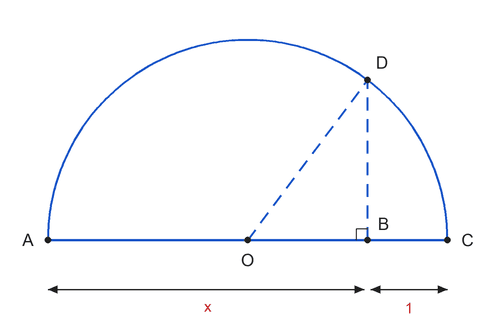
Using the following figure, show that BD = .
What Class 9 Maths Ch 1 covers
The sections of the chapter, in the order the book takes them. Every question above comes from one of these.
- 01Rational and irrational numbers
- 02Rational Numbers
- 03Properties of Rational Numbers
- 04Decimal Representation of Rational Numbers
- 05Irrational Numbers
- 06Representation on the Number Line
More ways to study this chapter
The same chapter asked three other ways. Practise it, revise it, and see what the board has set on Ch 1 before.
Class 9 Maths Ch 1 questions students ask
How many questions are there in Class 9 Maths Ch 1?
66 questions. Every one is solved step by step on this page.
Are these Class 9 Maths solutions free?
Yes. Every question and its full working is free to read, with no account needed.
Can I download the Class 9 Maths Ch 1 solutions as a PDF?
There is no PDF to download. Every solution is on this page instead, which means it is searchable, always the current syllabus, and readable on a phone. Use your browser's print option if you want it on paper.