
Opening your dashboard
Class 9 Maths Chapter 1 Rational and Irrational Numbers: Competency-Based Questions (CBQ)
40 questions on Chapter 1, each worked through on its own page with the AI tutor. Class 9 Maths, ICSE 2026-27.
40 questions
1–5 marks · Mixed difficulty
- 11 mark
Question 1
Riya draws a square of side 1 unit on graph paper and measures its diagonal with a ruler. She reads 1.41 units. Her friend Aman says the diagonal is exactly units and that cannot be written in the form . Riya replies, "But my ruler shows 1.41, which is , so the diagonal is rational."
Which statement correctly settles their disagreement?
- 21 mark
Question 2
Competency: Understanding
A shopkeeper cuts a 1 kg block of paneer into equal pieces. His digital scale shows the weight of one piece in kilograms as a decimal.
For which value of is the weight of one piece a terminating decimal?
- 31 mark
Question 3
Competency: Application
A square vegetable patch has an area of 18 m². A net is to be fixed all along its boundary.
The exact length of net needed is
- 41 mark
Question 4
Competency: Analysis
Four students wrote these values for the length of a rope, in metres:
Which list shows the four values in ascending order?
- 51 mark
Question 5
Competency: Application
A designer works out the width of a picture frame as cm. To enter it in a price list she must write it with a rational denominator.
The width is
- 61 mark
Question 6
Competency: Analysis
Asha adds the irrational numbers and and gets 7.
Bina adds the irrational numbers and and gets .
Taken together, what do the two results show?
- 71 mark
Question 7
Competency: Evaluation
Assertion (A): The number , in which the block of digits 142857 repeats without end, is a rational number.
Reason (R): Every non-terminating decimal represents an irrational number.
- 82 marks
Question 8
Competency: Application
A jeweller needs a wire whose thickness is more than mm but less than mm.
Three wires are in stock, of thickness mm, mm and mm.
Which of these wires can he use? Show the comparison.
- 92 marks
Question 9
Competency: Analysis
A computer prints the decimal form of as
Without writing out all the digits, find the 100th digit after the decimal point. Explain your method.
- 102 marks
Question 10
Competency: Evaluation
A carpenter makes a square table top of side 1 m. He measures its diagonal with a tape and reads 1.41 m.
He says, "The diagonal is m. My tape shows 1.41, so and is a rational number."
Is his conclusion correct? Give a reason based on a calculation.
- 112 marks
Question 11
Competency: Application
A rectangular name plate is cm long and cm wide.
Find its perimeter in the simplest surd form. Is its area a rational number or an irrational number?
- 123 marks
Question 12
Competency: Analysis & Evaluation
In a quiz, two teams get these scores:
Team X: Team Y:
The team with the larger score wins. Team X says, "Our denominator is smaller, so our score must be larger."
Rationalize both denominators and decide, without a calculator, which team wins. Is Team X's argument sound?
- 133 marks
Question 13
Competency: Creativity
A teacher asks the class to design rectangles whose two sides are different irrational numbers (in cm).
(a) Design one such rectangle whose area is a whole number but whose perimeter is irrational.
(b) Design another such rectangle whose area and perimeter are both whole numbers.
Show the working for each design.
- 143 marks
Question 14
Competency: Application & Analysis
A tailor uses m of cloth for each shirt and m for each kurta.
(a) He stitches 13 shirts and 7 kurtas. Use the distributive property to find the total cloth used in one easy step.
(b) From a piece m long he cuts off m and then m. His helper works out the cloth left as . Find the helper's answer and the correct answer.
(c) Which property of rational numbers does part (b) show to be false for subtraction?
- 155 marks
Question 15
Competency: Understanding & Analysis
Case study — Points on a number line
A teacher marks four points P, Q, R and S on a number line, as shown. The four points stand for the numbers
but not in this order.

(a) Match each of the points P, Q, R and S with its number. Justify the order by comparing the squares of the four numbers.
(b) Which of the four points stand for rational numbers and which for irrational numbers? Is the point for the same as the point for ?
(c) is irrational, so its point cannot be fixed exactly by measuring off a decimal length. Describe how to locate it exactly using a right-angled triangle drawn on the number line.
- 164 marks
Question 16
Competency: Application & Evaluation
Case study — The shape of an A4 sheet
Sheets of printing paper are made so that
An A4 sheet is 21 cm wide.
(a) Write the length of an A4 sheet in exact form. Then find it correct to one decimal place, taking .
(b) The sheet is cut into two equal halves across its length. Each half is 21 cm long. Show that, for each half, is again .
(c) A printer says, "The ratio of length to width is exactly ." Check his claim by squaring. Can any fraction be exactly right?
- 171 mark
Question 17
Competency: Application
On a science-fair ruler, the marks for m and m are made. A clip is to be fixed exactly halfway between these two marks.
At what distance from the zero end of the ruler should the clip be fixed?
- 181 mark
Question 18
Competency: Analysis
A lab technician records a length as the fraction m. Her calculator is broken, but she reasons that the decimal form must end.
After how many places of decimals does the decimal form of this length end?
- 191 mark
Question 19
Competency: Analysis
A school lays square floor tiles of four different sizes. The area of one tile of each size is given below.
Which tile has a side whose length (in metres) is an irrational number?
- 201 mark
Question 20
Competency: Analysis
Three pieces of ribbon are cut for a craft project. Their lengths, in metres, are worked out as
Which one of the following is correct?
- 211 mark
Question 21
Competency: Application
In a school electronics experiment, the gain of an amplifier is calculated as . (Hypothetical data.)
Which expression gives this gain with a rational denominator?
- 221 mark
Question 22
Competency: Analysis
The number line in the figure has four points A, B, C and D marked on it.

Which point could represent the number ?
- 231 mark
Question 23
Competency: Understanding & Analysis
Assertion (A): In the standard proof that is irrational, we start by assuming and later find that 7 divides both and . This is a contradiction.
Reason (R): At the start we chose and to have no common factor other than 1.
- 241 mark
Question 24
Competency: Analysis & Evaluation
Assertion (A): , because .
Reason (R): For positive numbers and , is in general not equal to .
- 251 mark
Question 25
Competency: Analysis
Four students each write a "law" for rational numbers , and , where no denominator and no divisor is zero. Only one of the laws is always true.
Which one is it?
- 261 mark
Question 26
Competency: Evaluation
A wheel has a diameter of 14 cm. Aman says its circumference is exactly 44 cm, because . Bela says the circumference is an irrational number of centimetres.
Who is right, and why?
- 272 marks
Question 27
Competency: Application
A recipe needs cup of sugar. Rohan's measuring cup is marked only in decimals, so he fills it to the 0.67 mark.
Find, as a fraction of a cup, how much more or less sugar he uses than the recipe needs.
- 282 marks
Question 28
Competency: Analysis
A square courtyard has a side of m. Using the fact that is irrational, prove that the length of its diagonal is irrational.
- 292 marks
Question 29
Competency: Analysis
A rectangular notice board for a classroom has an area of dm² and a length of dm.
Find its width in the simplest form. What special shape is the board?
- 302 marks
Question 30
Competency: Application
A hiker walks a distance of km in hours. (Hypothetical data.)
Find her average speed in the simplest surd form with a rational denominator. Then find its value in km/h correct to two decimal places, taking .
- 312 marks
Question 31
Competency: Understanding & Analysis
From the list
select all the real numbers that lie between 3 and 4. Decide the surds without a calculator.
- 322 marks
Question 32
Competency: Application
Kavya has to find the product
Instead of multiplying from left to right, she changes the order and the grouping of the factors so that the work becomes easy.
Show how she can regroup the factors, name the properties of rational numbers that allow this, and find the value.
- 333 marks
Question 33
Competency: Evaluation
Rani says, "The recurring decimal is a little less than 1, because there is always one more 9 to add."
Test Rani's claim by writing in the form with the usual method for recurring decimals.
- 343 marks
Question 34
Competency: Analysis
In a puzzle game, the score for round is
so round 1 scores , round 2 scores , and so on. The scores of all the rounds played are added.
(a) Rationalize the denominator to show that the score for round is .
(b) Without a calculator, find after how many rounds the total score is exactly 2.
- 353 marks
Question 35
Competency: Creativity
A game designer makes cards with numbers between and . Design three cards:
(i) a terminating decimal,
(ii) a non-terminating recurring decimal (write it as a fraction too),
(iii) an irrational number.
For each card, show that its number lies between and .
- 363 marks
Question 36
Competency: Evaluation
Two students find the value of correct to two decimal places, taking . Isha writes and divides 5 by 2.828. Jay rationalizes the denominator first and then multiplies.
(a) Write Jay's rationalized form of .
(b) Complete Jay's calculation.
(c) Which method is easier to do by hand, and why?
- 373 marks
Question 37
Competency: Analysis
Anil thinks of a fraction whose numerator is 7 and whose denominator is a whole number from 30 to 40 (both included). He says the fraction is already in its lowest terms and that its decimal form terminates.
List all the fractions he could be thinking of and write the decimal form of each.
- 384 marks
Question 38
Competency: Analysis
Case study — Revision plan
Four friends keep a record of the fraction of their revision plan they have completed (Hypothetical data):
Student Fraction of plan completed Asha Bimal Charu Dev (a) Without dividing, say for which students the fraction has a terminating decimal form. Give the reason.
(b) Write the decimal form of each fraction, using a bar over the repeating digit where needed.
(c) Who has completed the largest part of the plan? Arrange the four students in descending order of the part completed.
- 395 marks
Question 39
Competency: Understanding & Analysis
Case study — A root spiral
Sita builds a spiral from right-angled triangles, as shown in the figure. She draws unit, then unit perpendicular to , and joins . Then she draws unit perpendicular to and joins . Then she draws unit perpendicular to and joins .
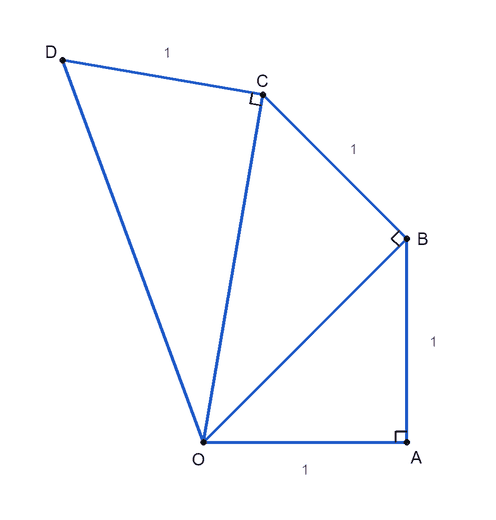
(a) Find the exact lengths of and .
(b) Find the length of . Which of the lengths , , and are rational numbers?
(c) Sita goes on in the same way, always drawing a new segment of 1 unit perpendicular to the last hypotenuse and naming the new points E, F, G, and so on. After , which is the next hypotenuse whose length is a whole number? What is that length?
- 404 marks
Question 40
Competency: Application & Evaluation
Case study — A triangular sail
A sailmaker cuts a triangular sail whose three sides are m, m and m. (Hypothetical data.)
(a) Write each side in the simplest surd form.
(b) Find the perimeter of the sail in the simplest surd form. Then find its value correct to two decimal places, taking .
(c) Show that the sail has a right angle. Then find its area, and the length of the straight seam from the right-angled corner perpendicular to the longest side, in simplest surd form with a rational denominator.