
Question 193 marksMedium
Represent each of the following on different number lines :
, , , and .
Confirming your payment
Sign up now and get 250 free tokens.
Rational and Irrational Numbers · Question 19 of 66
Represent each of the following on different number lines :
, , , and .
Solution:
Concept: An irrational length such as can be drawn exactly with Pythagoras' theorem: in a right triangle, . A pair of compasses then carries that length onto the number line.
Step 1 — Part (a): mark 2√3.
Notice that and . So is the base of a right triangle whose hypotenuse is 4 and height is 2. At O (the point 0) draw OQ = 2 units perpendicular to the number line. With Q as centre and radius 4 units, draw an arc to cut the number line at P.
So OP is , and P represents .

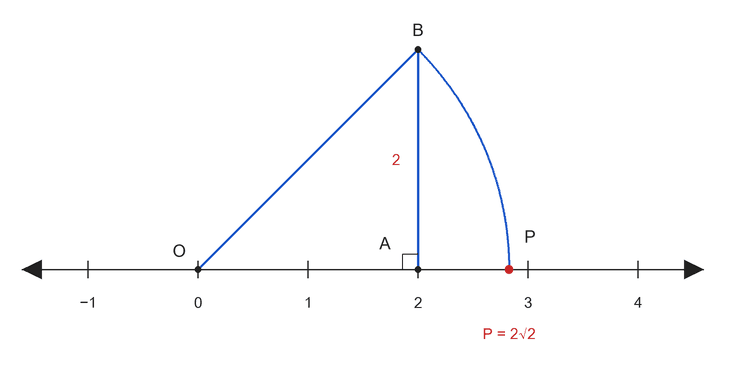
Step 2 — Part (b): mark 2√2.
At A (the point 2) draw AB = 2 units perpendicular to the number line, and join OB.
So OB is . With O as centre and radius OB, draw an arc to cut the number line at P. Then P represents .
Step 3 — Part (c): mark 3 + √2.
Let A be the point 3 and B the point 4. At B draw BC = 1 unit perpendicular to the number line, and join AC.
So AC is . With A as centre and radius AC, draw an arc to cut the number line to the right of A at P. Then P is to the right of 3, so it represents .

Step 4 — Part (d): mark 3 − √2.
We draw the same triangle as in part (c), so AC is again . With A as centre and radius AC, draw an arc to cut the number line to the left of A at P. Then P is to the left of 3, so it represents .

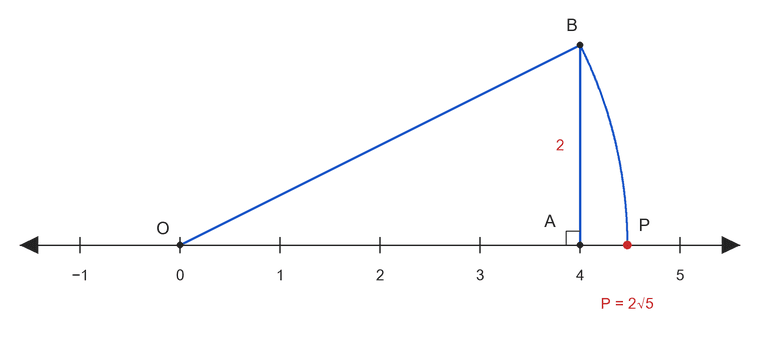
Step 5 — Part (e): mark 2√5.
At A (the point 4) draw AB = 2 units perpendicular to the number line, and join OB.
So OB is . With O as centre and radius OB, draw an arc to cut the number line at P. Then P represents .
Watch out: In parts (b) to (e) the compass point goes on O or A, where the length starts on the line; in part (a) it goes on Q, because the known length is the hypotenuse QP.
Therefore, in each figure, the point P represents the required number.