
Opening your dashboard
Class 9 Maths Chapter 1 Rational and Irrational Numbers: Practice Questions
50 questions on Chapter 1, each worked through on its own page with the AI tutor. Class 9 Maths, ICSE 2026-27.
50 questions
1–5 marks · Mixed difficulty
- 11 mark
Question 1
Bloom's level: Remember
Which of the following is an imaginary number?
- 21 mark
Question 2
Bloom's level: Remember
The set of whole numbers (W) is :
- 31 mark
Question 3
Bloom's level: Remember
The order of the surd is :
- 41 mark
Question 4
Bloom's level: Understand
Which of the following numbers is rational but not an integer?
- 51 mark
Question 5
Bloom's level: Apply
Which of the following rational numbers has a terminating decimal representation?
- 61 mark
Question 6
Bloom's level: Apply
The lowest rationalizing factor of is :
- 71 mark
Question 7
Bloom's level: Apply
If and , then is equal to :
- 81 mark
Question 8
Bloom's level: Apply
Which of the following is an irrational number?
- 91 mark
Question 9
Bloom's level: Understand
In proving that is irrational, we assume , where and are integers with no common factor other than 1, and obtain . Which conclusion follows directly from ?
- 101 mark
Question 10
Bloom's level: Understand
Assertion (A) : The number is a real number.
Reason (R) : The set of real numbers is the union of the set of rational numbers and the set of irrational numbers.
- 111 mark
Question 11
Bloom's level: Evaluate
Assertion (A) : is a rational number, because 7 and 0 are both integers.
Reason (R) : A number is rational only if and are integers and .
- 121 mark
Question 12
Bloom's level: Analyse
Assertion (A) : is a rational number.
Reason (R) : The product of two irrational numbers is always an irrational number.
- 131 mark
Question 13
Bloom's level: Remember
Define a rational number and an irrational number. Give one example of each.
- 142 marks
Question 14
Bloom's level: Apply
Insert three rational numbers between and so that all five numbers are in ascending order.
- 152 marks
Question 15
Bloom's level: Understand
Without actual division, state whether each of the following has a terminating or a non-terminating decimal representation. Give a reason in each case.
(i)
(ii)
(iii)
- 162 marks
Question 16
Bloom's level: Apply
Find one rational number and two irrational numbers lying between and .
- 172 marks
Question 17
Bloom's level: Understand
Explain why
(i) is an irrational number but not a surd;
(ii) is not a surd.
- 182 marks
Question 18
Bloom's level: Apply
Simplify by rationalizing the denominator :
- 192 marks
Question 19
Bloom's level: Apply
Meera wants to show on the number line. She marks O at 0 and A at 3, then draws AB perpendicular to the number line at A.
(i) How long must AB be, and why?
(ii) With centre O and radius OB she draws an arc to cut the number line at P. Between which two consecutive integers does P lie?
- 202 marks
Question 20
Bloom's level: Analyse
Rohan copies the proof for to "prove" that is irrational. He writes: let with , co-prime integers; then , so is even. Put ; then , i.e. .
At which point does his argument break down, and why does this not happen for ?
- 211 mark
Question 21
Bloom's level: Understand
Classify each number as rational or irrational, with a reason : , ,
- 222 marks
Question 22
Bloom's level: Evaluate
Aman says : "The set of rational numbers is closed for division, because the quotient of two rational numbers is always rational." Is Aman's statement fully correct? Justify your answer with an example, and state the correct property.
- 234 marks
Question 23
Bloom's level: Apply
If and , find the values of
(i)
(ii)
(iii)
- 243 marks
Question 24
Bloom's level: Understand
Study the following proof that is irrational.
Step 1: Suppose is rational. Then , where , are integers, , and , have no common factor other than 1.
Step 2: Squaring, .
Step 3: So is divisible by 11. Let .
Step 4: Then , i.e. , so is divisible by 11.
Step 5: Hence is irrational.
(a) Why may we assume in Step 1 that and have no common factor?
(b) Explain why Step 3 follows from Step 2.
(c) Write the missing sentence that should come between Step 4 and Step 5.
- 254 marks
Question 25
Bloom's level: Create
(a) Find a surd of order 2, a surd of order 3 and a surd of order 4, each lying between 2 and 3. Justify each choice.
(b) Arrange your three surds in ascending order without using a calculator.
- 264 marks
Question 26
Bloom's level: Analyse
Case study: A rectangular flower bed in a school garden is 3 m long and 2 m wide. The gardener stretches a rope along one diagonal of the bed.
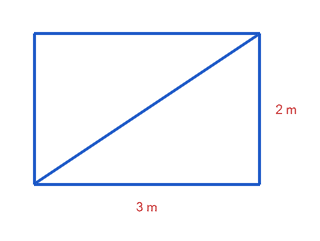
(a) Find the length of the rope along the diagonal.
(b) Is this length rational or irrational? Give a reason.
(c) Describe how the same right triangle can be used to mark this length on a number line, and decide, without finding a square root, whether the point lies nearer to 3 or to 4.
- 274 marks
Question 27
Bloom's level: Analyse
It is given that
(a) Without dividing, write the decimal forms of and , and explain the pattern you used.
(b) Explain why has one digit that does not repeat before the repeating block starts.
(c) When any whole number is divided by 7, explain why the period (the repeating block) can never have more than 6 digits.
- 284 marks
Question 28
Bloom's level: Evaluate
Two students simplify .
Priya: "The common denominator is , so the sum is ."
Kabir: " and , so the sum is ."
(a) Who is correct? Point out the exact error in the other method.
(b) Check the correct answer using and .
- 295 marks
Question 29
Bloom's level: Analyse
Case study: In a maths quiz, a teacher holds up seven cards :
(a) Simplify the cards and .
(b) Sort the seven cards into rational and irrational numbers, giving a reason for each irrational number.
(c) All seven cards are real numbers. Arrange them in ascending order, explaining how you placed and
- 304 marks
Question 30
Bloom's level: Create
(a) Find the integer for which .
(b) Show that, in general, exactly when .
(c) Use this rule to make up your own example of such a fraction with , and verify it by rationalizing the denominator.
- 314 marks
Question 31
If and , find :
(i)
(ii)
- 323 marks
Question 32
State, with reason, which of the following are surds and which are not :
(i)
(ii)
(iii)
- 333 marks
Question 33
If and , find the value of .
- 343 marks
Question 34
Find the values of and , if :
where and are rational numbers.
- 353 marks
Question 35
Find three rational numbers between and .
- 363 marks
Question 36
Express in the form , where and are integers and .
- 374 marks
Question 37
Simplify :
- 383 marks
Question 38
Rationalise the denominator of and hence find its value, correct to two decimal places, taking and .
- 394 marks
Question 39
Insert four rational numbers between and .
- 403 marks
Question 40
Rationalise the denominator and simplify :
- 411 mark
Question 41
The decimal representation of the rational number is :
- 421 mark
Question 42
On a number line, O represents 0 and A represents 2. A line segment AB of length 3 units is drawn perpendicular to OA at A. With centre O and radius OB, an arc is drawn to cut the number line to the right of O at the point P. The point P represents :
- 431 mark
Question 43
The simplest form of is :
- 442 marks
Question 44
If , and , verify that .
- 452 marks
Question 45
Find a rational number lying between and , and show that it does lie between them.
- 463 marks
Question 46
State, with a reason, whether each of the following numbers is rational or irrational :
(i)
(ii)
(iii)
- 472 marks
Question 47
Arrange the numbers , and in ascending order.
- 484 marks
Question 48
(i) Prove that is an irrational number.
(ii) Hence prove that is also an irrational number.
- 493 marks
Question 49
Consider the real numbers : , , , , and .
(i) Which of them are rational numbers ?
(ii) Which of them are irrational numbers ?
(iii) Which of them are integers ?
- 504 marks
Question 50
If , find :
(i) , with the denominator rationalized
(ii)
(iii)