
Opening your dashboard
Class 9 Chemistry Chapter 7: Study of Gas Laws Solutions
84 textbook questions with step-by-step answers, free to read, for ICSE 2026-27.
Get talked through Ch 7, not just shown the answer
Reading a finished solution is not the same as being able to do it. The AI tutor takes one question at a time and works it with you, in your own words, until you can.
- Ask it out loud, in your own words
- It gives you the next step, not the answer
- Stuck on part (ii)? Start there
84 questions with solutions
1–5 marks · Mixed difficulty
The first 55 solutions are on this page. This chapter is a long one, so the rest open on their own page to keep this one quick to load.
- 13 marks
Question 1
Volume of certain amount of a gas at 25°C and 100 cm Hg pressure is 80 mL. The gas is expanded to 160 mL keeping the temperature constant. Calculate the pressure of the expanded gas.
Solve with AIWritten solution
Solution:
Concept: Boyle's law says that at constant temperature the volume of a fixed mass of a dry gas is inversely proportional to its pressure. So the product of pressure and volume stays the same: .
Step 1 — Write down the data.
The temperature (25 °C) stays the same, so only pressure and volume change and Boyle's law applies.
- Initial pressure, cm Hg
- Initial volume, mL
- Final volume, mL
- Final pressure, = ?
Step 2 — Rearrange the law and substitute.
We divide both sides of by to get on its own, then put in the numbers.
Step 3 — Check that the answer makes sense.
The volume has doubled (80 mL to 160 mL), so the pressure must fall to half. Half of 100 cm Hg is 50 cm Hg, which agrees.
Watch out: Pressure and volume may be in any units (cm Hg, mm Hg, atm; mL, cm³, litres), but each quantity must be in the same unit on both sides of the equation, because the units cancel.
Therefore, the pressure of the expanded gas is 50 cm of Hg.
- 23 marks
Question 2
At a particular temperature, a certain quantity of gas occupies a volume of 74 cm³ at a pressure of 760 mm. If the pressure is decreased to 740 mm, what will be the volume of the gas at the same temperature ?
Solve with AIWritten solution
Solution:
Concept: Boyle's law says that at constant temperature the volume of a fixed mass of a dry gas is inversely proportional to its pressure. So the product of pressure and volume stays the same: .
Step 1 — Write down the data.
The temperature does not change, so Boyle's law applies.
- Initial pressure, mm Hg
- Initial volume, cm³
- Final pressure, mm Hg
- Final volume, = ?
Step 2 — Rearrange the law and substitute.
Dividing both sides of by gives the new volume.
Step 3 — Check that the answer makes sense.
The pressure has decreased slightly, so the volume should increase slightly. It rises from 74 cm³ to 76 cm³, which fits.
Watch out: Pressure and volume may be in any units (cm Hg, mm Hg, atm; mL, cm³, litres), but each quantity must be in the same unit on both sides of the equation, because the units cancel.
Therefore, the volume of the gas at 740 mm pressure is 76 cm³.
- 33 marks
Question 3
A student performed an experiment to measure pressure and volume of a gas at constant temperature and noted the following :
Pressure (mm of Hg) 100 125 200 Volume (cm³) 80 40 32 Calculate the value of and . Which law was used in the calculations ? Draw graphs to show :
(i) volume plotted against pressure.
(ii) PV plotted against pressure
Solve with AIWritten solution
Solution:
Concept: Boyle's law says that at constant temperature the volume of a fixed mass of a dry gas is inversely proportional to its pressure. So the product of pressure and volume stays the same: . The product is therefore the same for every reading taken at that temperature.
Step 1 — Find the constant value of PV.
The first reading is complete (100 mm of Hg and 80 cm³), so we use it to find .
Step 2 — Find x.
At 125 mm of Hg the volume is . Since must also equal 8000, we divide 8000 by 125.
Step 3 — Find y.
At volume 32 cm³ the pressure is . Since must equal 8000, we divide 8000 by 32.
Step 4 — Check with the third reading.
The third reading gives the same product, which confirms the constant.
Step 5 — Name the law.
The temperature was constant and stayed constant, so the student used Boyle's law: at constant temperature, the volume of a given mass of a dry gas is inversely proportional to its pressure.
Step 6 — Draw graph (i): volume against pressure.
We plot the four points (100, 80), (125, 64), (200, 40) and (250, 32) with pressure on the x-axis and volume on the y-axis. As pressure rises the volume falls, so the points lie on a smooth falling curve (a hyperbola), not a straight line.

Step 7 — Draw graph (ii): PV against pressure.
For every reading , so when is plotted against pressure all the points are at the same height. The graph is a straight line parallel to the pressure axis.
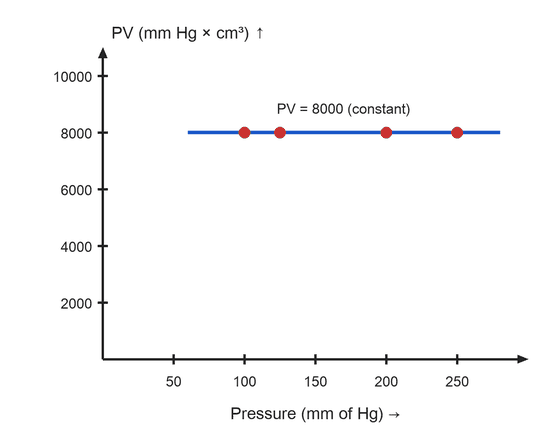
Watch out: Use a complete reading to find the constant; do not average readings that contain the unknowns.
Therefore, x = 64 cm³ and y = 250 mm of Hg, found by Boyle's law; V against P is a hyperbola and PV against P is a straight line parallel to the pressure axis.
- 43 marks
Question 4
At a constant temperature, volume of a gas was found to be 400 cm³ at a pressure of 760 mm Hg. If the pressure of the gas is increased by 25%, find the new volume.
Solve with AIWritten solution
Solution:
Concept: Boyle's law says that at constant temperature the volume of a fixed mass of a dry gas is inversely proportional to its pressure. So the product of pressure and volume stays the same: .
Step 1 — Find the new pressure.
The pressure is increased by 25%, so we add 25% of 760 mm Hg to 760 mm Hg.
Step 2 — Write down the data.
The temperature is constant, so Boyle's law applies.
- mm Hg
- cm³
- mm Hg
- = ?
Step 3 — Rearrange the law and substitute.
Dividing both sides of by gives the new volume.
Step 4 — Check that the answer makes sense.
The pressure became times as large, so the volume must become of 400 cm³, which is 320 cm³.
Watch out: "Increased by 25%" means the new pressure is 125% of the old one (950 mm Hg), not 25% of it.
Therefore, the new volume of the gas is 320 cm³.
- 53 marks
Question 5
A vessel of capacity 600 cm³ contains hydrogen gas at a pressure of 330 cm Hg. What will be the pressure of hydrogen gas, when the vessel is connected to another vessel of 300 cm³ capacity ?
Solve with AIWritten solution
Solution:
Concept: Boyle's law says that at constant temperature the volume of a fixed mass of a dry gas is inversely proportional to its pressure. So the product of pressure and volume stays the same: .
Step 1 — Find the new volume of the gas.
When the two vessels are connected, the hydrogen spreads into both of them, so its new volume is the total capacity.
Step 2 — Write down the data.
The temperature is taken as constant, so Boyle's law applies.
- cm Hg
- cm³
- cm³
- = ?
Step 3 — Rearrange the law and substitute.
Dividing both sides of by gives the new pressure.
Watch out: The new volume is 600 + 300 = 900 cm³, not 300 cm³: the gas fills BOTH vessels.
Therefore, the pressure of the hydrogen becomes 220 cm of Hg.
- 63 marks
Question 6
At constant temperature, a gas is at a pressure of 1080 mm Hg. If the volume is decreased by 40%, find the new pressure of the gas.
Solve with AIWritten solution
Solution:
Concept: Boyle's law says that at constant temperature the volume of a fixed mass of a dry gas is inversely proportional to its pressure. So the product of pressure and volume stays the same: .
Step 1 — Express the new volume in terms of the old one.
Let the original volume be . A 40% decrease removes , so the new volume is what is left.
Step 2 — Rearrange the law and substitute.
The temperature is constant, so . Dividing by gives ; the unknown cancels.
Watch out: A 40% decrease leaves 60% of the volume (0.6V), not 0.4V.
Therefore, the new pressure of the gas is 1800 mm of Hg.
- 73 marks
Question 7
At a constant temperature, the pressure of a gas is 940 mm of Hg. Calculate its pressure if the volume of the gas is decreased by 20%.
Solve with AIWritten solution
Solution:
Concept: Boyle's law says that at constant temperature the volume of a fixed mass of a dry gas is inversely proportional to its pressure. So the product of pressure and volume stays the same: .
Step 1 — Express the new volume in terms of the old one.
Let the original volume be . A 20% decrease removes , so the new volume is .
Step 2 — Rearrange the law and substitute.
The temperature is constant, so . Dividing by gives , and cancels.
Watch out: A smaller volume means a LARGER pressure; if your answer is less than 940 mm Hg, you have multiplied by 0.8 instead of dividing.
Therefore, the new pressure of the gas is 1175 mm of Hg.
- 83 marks
Question 8
If the pressure of 800 cm³ of a gas is tripled, what will be the change in its volume ?
Solve with AIWritten solution
Solution:
Concept: Boyle's law says that at constant temperature the volume of a fixed mass of a dry gas is inversely proportional to its pressure. So the product of pressure and volume stays the same: .
Step 1 — State the assumption.
The question does not mention temperature. A pressure–volume change is worked with Boyle's law, so we take the temperature (and the mass of gas) as constant.
Step 2 — Write down the data.
Let the original pressure be ; tripling it makes the new pressure .
- cm³
- = ?
Step 3 — Rearrange the law and substitute.
Dividing both sides of by gives ; the unknown cancels.
Step 4 — Find the change in volume.
The volume falls from 800 cm³ to about 266.67 cm³, so the decrease is the difference.
Watch out: Pressure and volume change in opposite directions: tripling the pressure makes the volume one-third, not three times.
Therefore, the volume becomes one-third of its value, about 266.67 cm³, a decrease of about 533.33 cm³.
- 93 marks
Question 9
Convert the following :
(i) 37 K to °C
(ii) 273 K to °C
(iii) –27°C to K
(iv) 27°C to K
Solve with AIWritten solution
Solution:
Concept: The Kelvin and Celsius scales have degrees of the same size; only their zeros differ. 0 K is −273 °C, so and .
Step 1 — Convert 37 K to °C.
To go from kelvin to degrees Celsius we subtract 273.
Step 2 — Convert 273 K to °C.
Again we subtract 273 from the kelvin value.
Step 3 — Convert −27 °C to K.
To go from degrees Celsius to kelvin we add 273; the minus sign is kept.
Step 4 — Convert 27 °C to K.
We add 273 to the Celsius value.
Watch out: With a negative Celsius temperature, add 273 to the negative number (−27 + 273 = 246); do not add 27 and 273.
Therefore, (i) 37 K = −236 °C, (ii) 273 K = 0 °C, (iii) −27 °C = 246 K, (iv) 27 °C = 300 K.
- 103 marks
Question 10
20 mL of hydrogen gas at –13°C is heated to 117°C at constant pressure. Find the new volume of hydrogen.
Solve with AIWritten solution
Solution:
Concept: Charles' law says that at constant pressure the volume of a fixed mass of a dry gas is directly proportional to its absolute (kelvin) temperature. So , where every temperature must be in kelvin.
Step 1 — Convert the temperatures to kelvin.
To change degrees Celsius to kelvin we add 273 (); to go back we subtract 273.
Step 2 — Write down the data.
The pressure is constant, so Charles' law applies.
- mL
- K
- K
- = ?
Step 3 — Rearrange the law and substitute.
Multiplying both sides of by gives .
Watch out: Never put degrees Celsius into Charles' law. Change every temperature to kelvin first; otherwise the proportion is wrong (and at 0 °C you would be dividing by zero).
Therefore, the new volume of hydrogen is 30 mL.
- 113 marks
Question 11
At what temperature in degree centigrade will the volume of a gas, which is originally at 0°C, double itself, pressure remaining constant ?
Solve with AIWritten solution
Solution:
Concept: Charles' law says that at constant pressure the volume of a fixed mass of a dry gas is directly proportional to its absolute (kelvin) temperature. So , where every temperature must be in kelvin.
Step 1 — Write down the data.
Let the original volume be . The gas starts at 0 °C, which is 273 K, and its volume is to become .
- K (0 °C)
- = ?
Step 2 — Rearrange the law and substitute.
Cross-multiplying gives ; the unknown cancels.
Step 3 — Convert back to degrees Celsius.
The question asks for the temperature in degrees centigrade, so we subtract 273.
Watch out: Doubling the volume doubles the KELVIN temperature, not the Celsius one: 0 °C doubled would still be 0 °C.
Therefore, the gas must be heated to 273 °C (546 K) for its volume to double.
- 123 marks
Question 12
Calculate the volume (in cm³) of air expelled from a vessel containing 0·4 litres of it at 250 K, when it is heated to 27°C at the same pressure.
Solve with AIWritten solution
Solution:
Concept: Charles' law says that at constant pressure the volume of a fixed mass of a dry gas is directly proportional to its absolute (kelvin) temperature. So , where every temperature must be in kelvin. When an open vessel is heated, the air expands; whatever does not fit in the vessel is pushed out.
Step 1 — Convert the data to suitable units.
The answer is wanted in cm³, and 1 litre = 1000 cm³. The final temperature must be in kelvin.
Step 2 — Find the volume the air would occupy at 300 K.
The pressure is constant, so by Charles' law we multiply by .
Step 3 — Find the volume expelled.
The vessel can hold only 400 cm³, so the extra volume leaves the vessel.
Watch out: The answer is the air pushed OUT (80 cm³), not the expanded volume (480 cm³).
Therefore, 80 cm³ of air is expelled from the vessel.
- 133 marks
Question 13
What will be the volume of a gas when 3 litres of it is cooled down from 27°C to –73°C at constant pressure ?
Solve with AIWritten solution
Solution:
Concept: Charles' law says that at constant pressure the volume of a fixed mass of a dry gas is directly proportional to its absolute (kelvin) temperature. So , where every temperature must be in kelvin.
Step 1 — Convert the temperatures to kelvin.
To change degrees Celsius to kelvin we add 273 (); to go back we subtract 273.
Step 2 — Write down the data.
The pressure is constant, so Charles' law applies.
- litres
- K
- K
- = ?
Step 3 — Rearrange the law and substitute.
Multiplying both sides of by gives .
Watch out: Never put degrees Celsius into Charles' law. Change every temperature to kelvin first; otherwise the proportion is wrong (and at 0 °C you would be dividing by zero).
Therefore, the gas occupies 2 litres at −73 °C.
- 143 marks
Question 14
To what temperature must a gas at 300 K be cooled down in order to reduce its volume to 1/3 of its original volume, pressure remaining constant ?
Solve with AIWritten solution
Solution:
Concept: Charles' law says that at constant pressure the volume of a fixed mass of a dry gas is directly proportional to its absolute (kelvin) temperature. So , where every temperature must be in kelvin.
Step 1 — Write down the data.
Let the original volume be ; the new volume is one-third of it.
- K
- = ?
Step 2 — Rearrange the law and substitute.
Cross-multiplying gives ; the unknown cancels.
Step 3 — Give the temperature in degrees Celsius as well.
Subtracting 273 gives the same temperature on the Celsius scale.
Watch out: One-third of the volume needs one-third of the KELVIN temperature; one-third of 27 °C (9 °C) would be wrong.
Therefore, the gas must be cooled to 100 K (−173 °C).
- 153 marks
Question 15
Prove that the volume of a gas at 273°C is twice its volume at 273 K, at constant pressure.
Solve with AIWritten solution
Solution:
Concept: Charles' law says that at constant pressure the volume of a fixed mass of a dry gas is directly proportional to its absolute (kelvin) temperature. So , where every temperature must be in kelvin.
Step 1 — Write the two temperatures in kelvin.
The first temperature is already in kelvin. The second must be converted by adding 273.
- K, with volume
Step 2 — Apply Charles' law.
The pressure is constant, so multiplying by gives .
Step 3 — Conclude.
The volume at 273 °C is , which is twice the volume at 273 K.
Watch out: 273 °C and 273 K are different temperatures: 273 °C is 546 K, which is twice 273 K.
Therefore, at constant pressure the volume of a gas at 273 °C is twice its volume at 273 K. Hence proved.
- 163 marks
Question 16
A gas occupies 3 litres at 0°C. What volume will it occupy at –20°C, pressure remaining constant ?
Solve with AIWritten solution
Solution:
Concept: Charles' law says that at constant pressure the volume of a fixed mass of a dry gas is directly proportional to its absolute (kelvin) temperature. So , where every temperature must be in kelvin.
Step 1 — Convert the temperatures to kelvin.
To change degrees Celsius to kelvin we add 273 (); to go back we subtract 273.
Step 2 — Write down the data.
The pressure is constant, so Charles' law applies.
- litres
- K
- K
- = ?
Step 3 — Rearrange the law and substitute.
Multiplying both sides of by gives .
Watch out: Never put degrees Celsius into Charles' law. Change every temperature to kelvin first; otherwise the proportion is wrong (and at 0 °C you would be dividing by zero).
Therefore, the gas occupies about 2.78 litres at −20 °C.
- 171 mark
Question 17
The graph of PV vs P for a gas is :
Solve with AIAnswer
(A) parabolic
(B) hyperbolic
- Correct
(C) a straight line parallel to X-axis
(D) a straight line passing through origin
Answer: (C) a straight line parallel to X-axis
Concept: By Boyle's law, at constant temperature the volume of a fixed mass of gas is inversely proportional to its pressure, so the product is constant.
Step 1 — Write what is plotted.
On this graph pressure goes along the x-axis and the product goes up the y-axis.
Step 2 — Use Boyle's law.
At constant temperature has the same value at every pressure, so every point is at the same height. Points at one height form a horizontal straight line, parallel to the x-axis.
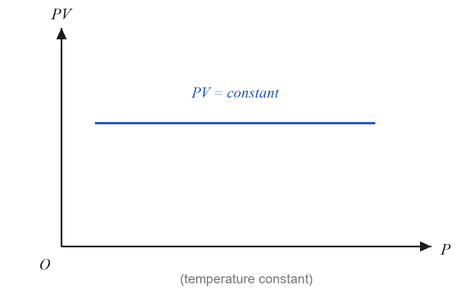
Watch out: A hyperbola is the graph of P against V; it is not the graph of PV against P.
Why the other options are wrong:
- (A) parabolic: This would need one quantity to vary as the square of the other; here PV does not vary at all.
- (B) hyperbolic: This is the shape of the P against V graph, not of PV against P.
- (D) a straight line passing through origin: This is the shape of the V against 1/P (or P against 1/V) graph; PV does not grow with P.
Therefore, the graph of PV against P is a straight line parallel to the X-axis, option (C).
- 181 mark
Question 18
The absolute temperature value that corresponds to 27°C is :
Solve with AIAnswer
(A) 200 K
- Correct
(B) 300 K
(C) 400 K
(D) 246 K
Answer: (B) 300 K
Concept: The absolute (kelvin) temperature is found by adding 273 to the Celsius temperature: .
Step 1 — Add 273 to the Celsius value.
We convert 27 °C to kelvin.
Watch out: Add 273; do not subtract it. Subtracting gives 246 K, which is −27 °C.
Why the other options are wrong:
- (A) 200 K: This is 200 − 273 = −73 °C, not 27 °C.
- (C) 400 K: This is 400 − 273 = 127 °C, not 27 °C.
- (D) 246 K: This is the result of subtracting 27 from 273, and 246 K is really −27 °C.
Therefore, 27 °C corresponds to 300 K, option (B).
- 191 mark
Question 19
Volume-temperature relationship is given by :
Solve with AIAnswer
(A) Boyle
(B) Gay Lussac
(C) Dalton
- Correct
(D) Charles
Answer: (D) Charles
Concept: Charles' law relates the volume of a fixed mass of gas to its temperature when the pressure is constant (, with in kelvin).
Step 1 — Pick out the two quantities.
The question asks for the law linking volume and temperature.
Step 2 — Match the law.
The law that links volume with temperature at constant pressure is Charles' law.
Why the other options are wrong:
- (A) Boyle: This law (Boyle's) links pressure and volume at constant temperature.
- (B) Gay Lussac: In this course Gay-Lussac's law is the law of combining volumes of reacting gases. Gay-Lussac did publish the volume–temperature result in 1802, but he credited Charles, and that law is named after Charles.
- (C) Dalton: This law (Dalton's) is about the partial pressures of the gases in a mixture.
Therefore, the volume–temperature relationship is given by Charles, option (D).
- 201 mark
Question 20
If pressure is doubled for a fixed mass of a gas, its volume will become :
Solve with AIAnswer
(A) 4 times
- Correct
(B) ½ times
(C) 2 times
(D) No change
Answer: (B) ½ times
Concept: By Boyle's law, at constant temperature the volume of a fixed mass of gas is inversely proportional to its pressure, so the product is constant.
Step 1 — Set up Boyle's law.
Let the first pressure and volume be and ; the new pressure is .
Step 2 — Solve for the new volume.
Dividing both sides by gives the new volume.
Watch out: Pressure and volume change in opposite directions: more pressure means less volume.
Why the other options are wrong:
- (A) 4 times: This would happen only if the pressure fell to one-fourth.
- (C) 2 times: This would happen only if the pressure were halved.
- (D) No change: This cannot be right, because the volume of a gas does change when its pressure changes.
Therefore, doubling the pressure makes the volume ½ times, option (B).
- 211 mark
Question 21
The S.I. unit of temperature is :
Solve with AIAnswer
(A) Pascal
(B) °C
- Correct
(C) Kelvin
(D) °F
Answer: (C) Kelvin
Concept: The S.I. base unit of temperature is the kelvin (K), the unit of the absolute scale.
Step 1 — Recall the S.I. base units.
The S.I. system has seven base units; the one for thermodynamic temperature is the kelvin.
Step 2 — Match the option.
Of the four options, only Kelvin is the S.I. unit of temperature.
Watch out: Degree Celsius is allowed alongside S.I. units, but it is not the S.I. base unit.
Why the other options are wrong:
- (A) Pascal: This is the S.I. unit of pressure, not of temperature.
- (B) °C: This is a common unit of temperature, but the S.I. unit is the kelvin.
- (D) °F: This is a non-S.I. unit still used in a few countries.
Therefore, the S.I. unit of temperature is the kelvin, option (C).
- 221 mark
Question 22
Which of the following temperatures is known as the steam point ?
Solve with AIAnswer
(A) 273 K
- Correct
(B) 373 K
(C) 290 K
(D) 273°C
Answer: (B) 373 K
Concept: The steam point is the boiling point of pure water at standard atmospheric pressure, 100 °C.
Step 1 — Convert 100 °C to kelvin.
We add 273 to change degrees Celsius to kelvin.
Watch out: 273 K is the ICE point (0 °C); the steam point is 100 degrees higher.
Why the other options are wrong:
- (A) 273 K: This is 0 °C, the ice point (melting point of ice).
- (C) 290 K: This is 17 °C, an ordinary room temperature.
- (D) 273°C: This is 546 K, far above the boiling point of water.
Therefore, the steam point is 373 K, option (B).
- 231 mark
Question 23
The graph shown below gives the statement for :
 Solve with AI
Answer
(A) Henry's law
(B) Charles' law
- Correct
(C) Boyle's law
(D) Daltons' law
Answer: (C) Boyle's law
Concept: By Boyle's law, at constant temperature the volume of a fixed mass of gas is inversely proportional to its pressure, so the product is constant. So , and a graph of against is a straight line through the origin.
Step 1 — Read the graph.
The graph plots against and is marked "temperature is constant". The points (1, 1), (2, 2), (3, 3), (4, 4) lie on a straight line through the origin.
Step 2 — Name the law.
A straight line through the origin means is directly proportional to , that is, inversely proportional to , at constant temperature. This is Boyle's law.
Why the other options are wrong:
- (A) Henry's law: This law (Henry's) is about how much gas dissolves in a liquid, not about V and P.
- (B) Charles' law: This law (Charles') links V and T at constant pressure, but here the temperature is constant.
- (D) Daltons' law: This law (Dalton's) is about the partial pressures of the gases in a mixture.
Therefore, the graph shows Boyle's law, option (C).
- 241 mark
Question 24
'The volume of a given amount of a gas is directly proportional to its absolute temperature at a constant pressure' is the statement of :
Solve with AIAnswer
(A) Gay-Lussac's law
(B) Boyle's law
- Correct
(C) Charles' law
(D) Mendeleev's law
Answer: (C) Charles' law
Concept: Charles' law: at constant pressure, the volume of a given amount of gas is directly proportional to its absolute temperature.
Step 1 — Compare the statement with the laws.
The statement links volume with absolute temperature while the pressure is fixed. That is exactly Charles' law.
Why the other options are wrong:
- (A) Gay-Lussac's law: In this course Gay-Lussac's law is the law of combining volumes of reacting gases. Gay-Lussac did publish the volume–temperature result in 1802, but he credited Charles, and that law is named after Charles.
- (B) Boyle's law: This law (Boyle's) links volume and pressure at constant temperature.
- (D) Mendeleev's law: This law (Mendeleev's periodic law) is about the properties of elements, not gases.
Therefore, the statement is Charles' law, option (C).
- 251 mark
Question 25
The volume of a given mass of a gas at constant temperature and 10 atmospheric pressure is 10 litres. Its volume at 5 atmospheres will be :
Solve with AIAnswer
(A) 5 litres
(B) 10 litres
(C) 15 litres
- Correct
(D) 20 litres
Answer: (D) 20 litres
Concept: By Boyle's law, at constant temperature the volume of a fixed mass of gas is inversely proportional to its pressure, so the product is constant. So .
Step 1 — Write down the data.
The first state is 10 atm and 10 litres; the new pressure is 5 atm.
- atm, litres
- atm, = ?
Step 2 — Rearrange and substitute.
Dividing by gives the new volume.
Watch out: Halving the pressure doubles the volume; it does not halve it.
Why the other options are wrong:
- (A) 5 litres: This would be the volume if the pressure were doubled to 20 atm.
- (B) 10 litres: This would mean no change, but the volume must change when the pressure changes.
- (C) 15 litres: This would make the product of 5 atm and 15 litres only 75, not the constant 100.
Therefore, the volume at 5 atmospheres is 20 litres, option (D).
- 261 mark
Question 26
STP is called standard temperature and pressure. The sandard temperature and standard pressure respectively are :
Solve with AIAnswer
- Correct
(A) 273 K and 760 mm
(B) 0°C and 760 cm
(C) 273°C and 1 atmosphere
(D) 373 K and 76 cm
Answer: (A) 273 K and 760 mm
Concept: In the ICSE course, S.T.P. means a temperature of 0 °C (273 K) and a pressure of 760 mm of mercury (76 cm Hg, 1 atm).
Step 1 — Check the temperature in each option.
Standard temperature is 273 K. Options (A) and (B) have it (0 °C is 273 K); (C) and (D) do not.
Step 2 — Check the pressure.
Standard pressure is 760 mm Hg. Option (A) gives 760 mm; option (B) gives 760 cm, which is ten times too large.
Watch out: 760 mm and 76 cm are the same pressure; 760 cm is not.
Why the other options are wrong:
- (B) 0°C and 760 cm: This has the right temperature, but 760 cm of mercury is ten times standard pressure.
- (C) 273°C and 1 atmosphere: This has the right pressure, but 273 °C (546 K) is not standard temperature.
- (D) 373 K and 76 cm: This uses 373 K, the boiling point of water, not standard temperature.
Therefore, standard temperature and pressure are 273 K and 760 mm, option (A).
- 275 marks
Question 27
Match the following
Column A Column B (a) Cm³ (i) pressure (b) Kelvin (ii) (c) Torr. (iii) Volume (d) Boyle's law (iv) (e) Charles's law (v) (vi) temperature Solve with AIWritten solution
Solution:
Concept: Match each unit with the quantity it measures, and each law with its mathematical form.
Step 1 — Match the units.
Cubic centimetre is a unit of volume, kelvin is a unit of temperature and torr is a unit of pressure (1 torr = 1 mm of Hg).
Step 2 — Match the laws.
Boyle's law keeps constant, so it matches item (ii), .
Charles' law keeps constant, so it matches item (iv), .
Item (v) is the combined gas equation and is not needed.
Step 3 — Write the matched pairs.
The table puts each item of Column A beside its partner.
Column A Column B (a) Cm³ (iii) Volume (b) Kelvin (vi) temperature (c) Torr. (i) pressure (d) Boyle's law (ii) (e) Charles's law (iv) Watch out: Item (v) has P, V and T together, so it is the gas equation, not Charles' law.
Therefore, (a)–(iii), (b)–(vi), (c)–(i), (d)–(ii), (e)–(iv).
- 284 marks
Question 28
Fill in the blanks :
(a) The average kinetic energy of the molecules of a gas is proportional to the ________
(b) The temperature on the Kelvin scale at which molecular motion completely ceases is called ________
(c) If temperature is reduced to half, ________ would also reduce to half.
(d) The melting point of ice is ________ Kelvin.
Solve with AIWritten solution
Solution:
Concept: The kinetic theory links the motion of gas molecules to the absolute temperature; Charles' law links the volume of a gas to it.
Step 1 — Blank (a).
The average kinetic energy of the molecules rises in step with the kelvin temperature, so the blank is absolute (kelvin) temperature.
Step 2 — Blank (b).
The temperature 0 K (−273 °C), at which molecular motion would stop in the simple kinetic picture, is called absolute zero. (Modern physics says a tiny 'zero-point' motion remains even there.)
Step 3 — Blank (c).
By Charles' law, at constant pressure the volume of a given mass of gas is proportional to its kelvin temperature, so halving the kelvin temperature halves the volume. The average kinetic energy of the molecules would also halve.
Step 4 — Blank (d).
Ice melts at 0 °C, and 0 + 273 gives 273 kelvin.
Watch out: In (c) the temperature means the KELVIN temperature; halving a Celsius temperature does not halve the volume.
Therefore, (a) absolute temperature, (b) absolute zero, (c) volume (at constant pressure), (d) 273.
- 295 marks
Question 29
Correct the following statements, wherever necessary.
(a) Volume of a gas is inversely proportional to its pressure at constant temperature.
(b) Volume of a fixed mass of a gas is directly proportional to its temperature, pressure remaining constant.
(c) 0°C is equal to zero Kelvin.
(d) Standard temperature is 25°C.
(e) Boiling point of water is 273 K.
Solve with AIWritten solution
Solution:
Concept: Each statement is checked against Boyle's law, Charles' law and the Kelvin scale; a gas law always refers to a fixed (given) mass of gas.
Step 1 — Statement (a).
Boyle's law holds only for a fixed mass of gas, so these words must be added: The volume of a given mass of a gas is inversely proportional to its pressure at constant temperature.
Step 2 — Statement (b).
Volume is proportional to the ABSOLUTE temperature, not the Celsius one: The volume of a fixed mass of a gas is directly proportional to its absolute (kelvin) temperature, pressure remaining constant.
Step 3 — Statement (c).
Adding 273 to 0 °C gives 273 K: 0 °C is equal to 273 K (zero kelvin is −273 °C).
Step 4 — Statement (d).
S.T.P. uses 0 °C, not 25 °C: Standard temperature is 0 °C (273 K).
Step 5 — Statement (e).
Water boils at 100 °C, which is 100 + 273 = 373 K: The boiling point of water is 373 K (273 K is the melting point of ice).
Watch out: 25 °C is a common 'room temperature' used for other purposes; it is not the standard temperature of S.T.P.
Therefore, the corrected statements are: (a) add 'a given mass of', (b) absolute temperature, (c) 0 °C = 273 K, (d) 0 °C, (e) 373 K.
- 302 marks
Question 30
State (i) the three variables for gas laws (ii) S.I. units of these variables.
Solve with AIWritten solution
Solution:
Concept: The state of a fixed mass of gas is described by three measurable quantities, linked by the gas laws.
Step 1 — Name the three variables.
The gas laws connect the pressure (P), the volume (V) and the temperature (T) of a gas.
Step 2 — Give their S.I. units.
Each quantity has its own S.I. unit:
- pressure: pascal (Pa), which is 1 newton per square metre;
- volume: cubic metre (m³);
- temperature: kelvin (K).
Watch out: The S.I. unit of temperature is the kelvin, not the degree Celsius.
Therefore, the variables are pressure, volume and temperature, with S.I. units pascal, cubic metre and kelvin.
- 315 marks
Question 31
Write the value of :
(a) standard temperature in :
(i) °C (ii) K
(b) standard pressure in :
(i) atm (ii) mm Hg (iii) cm Hg (iv) torr
Solve with AIWritten solution
Solution:
Concept: In the ICSE course, S.T.P. (standard temperature and pressure) means 0 °C and 760 mm of mercury.
Step 1 — Standard temperature.
Standard temperature is the melting point of ice, 0 °C. Adding 273 gives the kelvin value, 273 K.
Step 2 — Standard pressure.
Standard pressure is one atmosphere, the pressure that holds up a mercury column 760 mm (76 cm) tall. One torr is 1 mm of mercury, so it is also 760 torr.
Watch out: 76 cm and 760 mm are the same height; do not write 760 cm.
Therefore, (a) (i) 0 °C, (ii) 273 K; (b) (i) 1 atm, (ii) 760 mm Hg, (iii) 76 cm Hg, (iv) 760 torr.
- 325 marks
Question 32
State the following :
(a) Volume of a gas at 0 Kelvin.
(b) Absolute temperature of a gas at 7°C.
(c) Gas equation.
(d) Ice point in absolute temperature.
(e) S.T.P. conditions
Solve with AIWritten solution
Solution:
Concept: Use for kelvin temperatures, and the gas laws for the other parts.
Step 1 — Part (a): volume of a gas at 0 K.
By Charles' law the volume falls by of its 0 °C value for every degree of cooling, so at 0 K (−273 °C) the volume would be zero. This is a theoretical value: every real gas turns into a liquid or solid before reaching 0 K.
Step 2 — Part (b): absolute temperature at 7 °C.
We add 273 to the Celsius temperature.
Step 3 — Part (c): gas equation.
Combining Boyle's and Charles' laws gives the gas equation, which holds for a fixed mass of gas:
Step 4 — Part (d): ice point.
Ice melts at 0 °C, which is 0 + 273 = 273 K.
Step 5 — Part (e): S.T.P. conditions.
S.T.P. means a temperature of 0 °C (273 K) and a pressure of 760 mm of Hg (1 atm).
Watch out: In the gas equation T must be in kelvin.
Therefore, (a) zero (theoretically), (b) 280 K, (c) P₁V₁/T₁ = P₂V₂/T₂, (d) 273 K, (e) 0 °C and 760 mm of Hg.
- 332 marks
Question 33
What do you understand by gas ?
Solve with AIWritten solution
Solution:
Concept: Matter exists as solid, liquid and gas; a gas is the state whose particles are farthest apart and move most freely.
Step 1 — Describe a gas by its shape and volume.
A gas has neither a definite shape nor a definite volume. It takes the shape of its container and spreads to fill all of it.
Step 2 — Describe its particles.
The molecules of a gas are very far apart, the forces of attraction between them are negligible, and they move freely and randomly at high speed in all directions.
Step 3 — State what follows from this.
Because there is so much empty space between the molecules, a gas is highly compressible, has a low density and diffuses quickly.
Therefore, a gas is a state of matter with no fixed shape or volume, whose widely spaced, fast-moving molecules fill any container.
- 342 marks
Question 34
What is diffusion ? Give an example to illustrate it.
Solve with AIWritten solution
Solution:
Concept: Particles of gases (and liquids) are always moving at random, so they spread out on their own.
Step 1 — Define diffusion.
Diffusion is the spreading and intermixing of the particles of one substance among those of another, on its own, because of the random motion of the particles.
Step 2 — Give an example.
When a bottle of perfume is opened in one corner of a room, its smell is soon noticed all over the room. The perfume vapour molecules move among the air molecules and spread through the whole room.
Therefore, diffusion is the self-mixing of particles by their random motion, as when the smell of an opened perfume bottle spreads through a room.
- 352 marks
Question 35
How is molecular motion related with temperature ?
Solve with AIWritten solution
Solution:
Concept: The kinetic molecular theory says that the average kinetic energy of gas molecules is directly proportional to the absolute (kelvin) temperature.
Step 1 — Effect of heating.
When a gas is heated its kelvin temperature rises, so the average kinetic energy of the molecules rises and they move faster.
Step 2 — Effect of cooling.
When it is cooled, the average kinetic energy falls and the molecules move more slowly.
Step 3 — At absolute zero.
In this simple picture, molecular motion would stop at absolute zero (0 K). (Modern physics shows a tiny 'zero-point' motion remains, but 0 K can never actually be reached.)
Watch out: It is the KELVIN temperature that is proportional to the kinetic energy; doubling 20 °C to 40 °C does not double it.
Therefore, the higher the absolute temperature, the faster the molecules move: their average kinetic energy is directly proportional to the kelvin temperature.
- 362 marks
Question 36
Define absolute zero and absolute scale of temperature.
Solve with AIWritten solution
Solution:
Concept: By Charles' law a gas shrinks by of its 0 °C volume for every 1 °C of cooling, so its volume would become zero at −273 °C.
Step 1 — Define absolute zero.
Absolute zero is the temperature −273 °C (0 K), more exactly −273.15 °C. At this temperature the volume of a gas would theoretically become zero and molecular motion would (in the simple kinetic picture) stop. It is the lowest temperature possible.
Step 2 — Define the absolute scale.
The absolute (Kelvin) scale is the temperature scale that starts from absolute zero, taken as 0 K, and whose degree is the same size as one Celsius degree. So a kelvin temperature is the Celsius temperature plus 273: .
Watch out: The kelvin scale has no negative values, because nothing can be colder than 0 K.
Therefore, absolute zero is −273 °C (0 K), the lowest possible temperature, and the absolute scale measures temperature from that zero in Celsius-sized degrees.
- 374 marks
Question 37
(a) Define S.T.P.
(b) Why is it necessary to compare gases at S.T.P. ?
Solve with AIWritten solution
Solution:
Concept: The volume of a gas depends on both its temperature and its pressure.
Step 1 — Define S.T.P.
S.T.P. (standard temperature and pressure) means a temperature of 0 °C (273 K) and a pressure of 760 mm of mercury (76 cm Hg, 1 atm).
Step 2 — Explain why gases are compared at S.T.P.
A given mass of gas has a different volume at every different temperature and pressure. So two gas volumes can be compared fairly only if both are measured under the same fixed conditions. S.T.P. is the agreed common set of conditions, and any volume can be converted to it with the gas equation.
Note: The ICSE course uses 1 atm (760 mm Hg) as standard pressure. Since 1982 IUPAC has defined standard pressure as 1 bar (100 kPa), which is very slightly lower.
Therefore, S.T.P. is 0 °C and 760 mm of Hg, and gases are compared at S.T.P. because their volumes change with temperature and pressure.
- 384 marks
Question 38
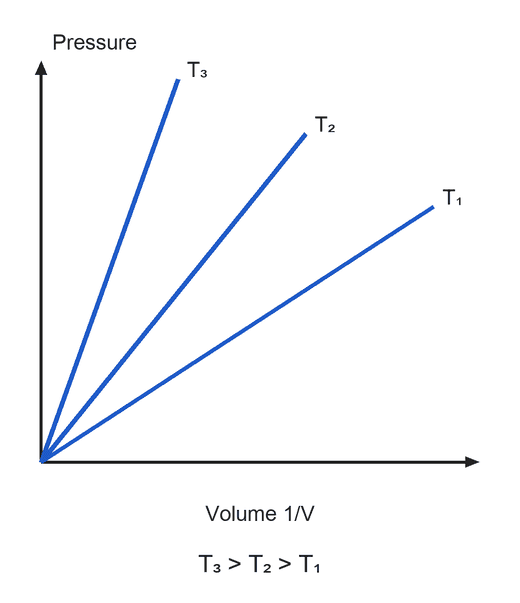
State the laws which are represented by the following graphs.
(a)

(b)
 Solve with AI
Written solution
Solution:
Concept: To name a gas law from a graph, look at which two quantities are plotted and which quantity is held constant for each line.
Step 1 — Read graph (a).
Graph (a) plots volume against temperature in °C, with one line for each fixed pressure P₁, P₂, P₃. Each line is straight, and when extended all three meet the temperature axis at about −273 °C, where the volume would become zero.
Step 2 — Name the law for graph (a).
Volume rising in a straight line with temperature at constant pressure is Charles' law: pressure remaining constant, the volume of a given mass of a dry gas is directly proportional to its absolute temperature.
Step 3 — Read graph (b).
Graph (b) plots pressure against , with one line for each fixed temperature T₁, T₂, T₃. Each line is straight and passes through the origin, so is proportional to .
Step 4 — Name the law for graph (b).
Pressure inversely proportional to volume at constant temperature is Boyle's law: temperature remaining constant, the volume of a given mass of a dry gas is inversely proportional to its pressure.
Watch out: In graph (a) the steepest line belongs to the LOWEST pressure (P₁), because a gas at lower pressure has a larger volume.
Therefore, graph (a) represents Charles' law and graph (b) represents Boyle's law.
- 392 marks
Question 39
What is the relationship between the Celsius and the Kelvin scales of temperature ?
Solve with AIWritten solution
Solution:
Concept: The Celsius and Kelvin scales use degrees of the same size; only their starting points (zeros) differ.
Step 1 — Compare the zeros.
0 K is absolute zero, which is −273 °C. So the Kelvin reading is always 273 more than the Celsius reading.
Step 2 — Write the relationship.
Adding 273 changes Celsius to kelvin, and subtracting 273 changes kelvin to Celsius.
Step 3 — Give an example.
Ice melts at 0 °C, which is 273 K; water boils at 100 °C, which is 373 K. Both scales have 100 degrees between these points.
Watch out: A change of 1 °C is the same as a change of 1 K; only the zeros differ.
Therefore, T (K) = t (°C) + 273, with one kelvin equal in size to one Celsius degree.
- 404 marks
Question 40
The molecular theory states that the pressure exerted by a gas in a closed vessel results from the gas molecules striking against the walls of the vessel. How will the pressure change if :
(a) the temperature is doubled keeping the volume constant ?
(b) the volume is made half of its original value keeping the temperature constant ?
Solve with AIWritten solution
Solution:
Concept: Gas pressure comes from molecules striking the walls; it depends on how often they hit and how hard.
Step 1 — Part (a): temperature doubled at constant volume.
Doubling the absolute temperature doubles the average kinetic energy of the molecules, so they move faster and strike the walls more often and harder. At constant volume the pressure is proportional to the kelvin temperature, so the pressure doubles.
Step 2 — Part (b): volume halved at constant temperature.
The same number of molecules now moves in half the space, at the same average speed. Twice as many strike each square centimetre of wall every second, so by Boyle's law the pressure doubles.
Watch out: In (a) 'doubled' must mean the kelvin temperature; doubling a Celsius temperature does not double the pressure.
Therefore, the pressure is doubled in both cases: in (a) because the molecules hit harder and more often, in (b) because more molecules hit each unit area.
- 414 marks
Question 41
(a) What is the need for the Kelvin scale of temperature?
(b) What is the boiling point of water on the Kelvin scale ? Convert it into centigrade scale.
Solve with AIWritten solution
Solution:
Concept: The gas laws are simple proportions only when temperature is measured from absolute zero.
Step 1 — Part (a): why the Kelvin scale is needed.
On the Celsius scale temperatures can be zero or negative. Charles' law written with Celsius values would then give zero or negative volumes, which is impossible. On the Kelvin scale every temperature is positive and the volume is directly proportional to the kelvin temperature, so gas-law calculations are simple and correct.
Step 2 — Part (b): boiling point of water in kelvin.
Water boils at 100 °C at normal pressure, which is 100 + 273 = 373 K.
Step 3 — Convert it back to the centigrade scale.
Subtracting 273 from the kelvin value gives the centigrade value.
Therefore, the Kelvin scale is needed because it has no zero or negative values and makes V proportional to T; water boils at 373 K, which is 100 °C.
- 425 marks
Question 42
Give reasons for the following :
(a) All temperatures in the absolute (Kelvin) scale are in positive figures.
(b) Gases have lower density compared to that of solids or liquids.
(c) Gases exert pressure in all directions.
(d) It is necessary to specify the pressure and temperature of a gas while stating its volume.
(e) Inflating a balloon seems to violate Boyle's law.
(f) Mountaineers carry oxygen cylinders with them.
(g) Gas fills completely the vessel in which it is kept.
Solve with AIWritten solution
Solution:
Concept: Each reason follows from the kinetic theory (fast, widely spaced molecules) and the gas laws.
Step 1 — Reason (a).
The Kelvin scale starts at absolute zero (−273 °C), the lowest possible temperature. No temperature is below it, so every kelvin temperature is positive.
Step 2 — Reason (b).
Gas molecules are very far apart, with large spaces between them. So a given volume of gas contains very little mass, and density is mass divided by volume.
Step 3 — Reason (c).
Gas molecules move randomly in all directions and strike every part of the container wall, so the gas pushes equally on all sides.
Step 4 — Reason (d).
The volume of a gas changes with both pressure and temperature, so a volume means something only when the pressure and temperature at which it was measured are stated.
Step 5 — Reason (e).
As a balloon is blown up, both its volume and the pressure inside increase, which seems to go against Boyle's law (). But Boyle's law applies only to a fixed mass of gas; here more air is being added, so the law is not broken.
Step 6 — Reason (f).
At high altitudes the atmospheric pressure is low, so the air is less dense. Each breath therefore contains less oxygen, and mountaineers carry oxygen cylinders to breathe enough of it.
Step 7 — Reason (g).
Gas molecules have negligible forces of attraction and move freely at high speed in all directions, so they spread into all the space available.
Watch out: In (e), Boyle's law needs a fixed mass of gas; blowing into a balloon adds gas.
Therefore, each property follows from widely spaced, fast, randomly moving gas molecules and from the gas laws applying only to a fixed mass of gas.
- 433 marks
Question 43
Give the assumptions of the kinetic molecular theory.
Solve with AIWritten solution
Solution:
Concept: The kinetic molecular theory explains the behaviour of gases by treating a gas as a huge number of tiny, fast-moving particles. Its assumptions describe what those particles are like.
Step 1 — Assumptions about the molecules themselves.
These assumptions describe the size and spacing of the particles.
- A gas is made of a very large number of tiny particles (molecules).
- The molecules are far apart; their own volume is negligible compared with the volume of the gas.
- The forces of attraction between the molecules are negligible.
Step 2 — Assumptions about their motion.
These assumptions describe how the particles move and collide.
- The molecules are in constant, rapid, random motion in straight lines in all directions.
- They collide with one another and with the walls; the collisions are perfectly elastic (no kinetic energy is lost overall).
Step 3 — Assumptions linking motion to pressure and temperature.
These two connect the particles to what we measure.
- The pressure of a gas is caused by its molecules striking the walls of the container.
- The average kinetic energy of the molecules is directly proportional to the absolute (kelvin) temperature.
Watch out: The theory says the molecules' OWN volume is negligible, not that the gas has no volume.
Therefore, the theory assumes tiny, widely spaced molecules with no attraction, moving rapidly and randomly with elastic collisions, whose wall collisions cause pressure and whose average kinetic energy is proportional to the absolute temperature.
- 443 marks
Question 44
Explain Boyle's Law on the basis of the kinetic theory of matter.
Solve with AIWritten solution
Solution:
Concept: Pressure is caused by molecules striking the walls. At constant temperature their average speed does not change, so only the number of hits per second on each unit area of wall can change.
Step 1 — Fix the temperature.
At constant temperature the average kinetic energy, and so the average speed, of the molecules stays the same. Each collision with the wall is therefore just as hard as before.
Step 2 — Decrease the volume.
If the volume is halved, the same number of molecules is crowded into half the space. The number of molecules per unit volume doubles, so the number of collisions on each unit area of wall per second doubles, and the pressure doubles.
Step 3 — Increase the volume.
In the same way, if the volume is increased the molecules are more spread out, they strike each unit area less often, and the pressure falls.
Step 4 — Conclude.
At constant temperature, pressure rises as volume falls in the same ratio, so , which is Boyle's law.
Watch out: The molecules do not move faster when the gas is compressed at constant temperature; they hit more often, not harder.
Therefore, at constant temperature a smaller volume means more molecular collisions per unit area of wall each second and so a higher pressure, which is Boyle's law.
- 453 marks
Question 45
Explain Charles's law on the basis of the kinetic theory of matter.
Solve with AIWritten solution
Solution:
Concept: The average kinetic energy of gas molecules is proportional to the absolute temperature, and pressure comes from molecules striking the walls. In Charles' law the pressure is kept constant.
Step 1 — Heat the gas.
On heating, the molecules move faster, so they would strike the walls more often and with greater force. That would raise the pressure.
Step 2 — Keep the pressure constant.
For the pressure to stay the same, the gas must expand. In a larger volume the faster molecules hit each unit area of wall less often, which brings the pressure back to its original value.
Step 3 — Cool the gas.
On cooling the reverse happens: the molecules slow down and the volume decreases to keep the pressure the same.
Step 4 — Conclude.
So at constant pressure the volume increases with the absolute temperature, , which is Charles' law.
Watch out: In Charles' law the PRESSURE is constant; the temperature is what changes.
Therefore, at constant pressure the gas must expand when heated, because its faster molecules would otherwise raise the pressure, and this is Charles' law.
- 463 marks
Question 46
How did Charles's law lead to the concept of absolute scale of temperature ?
Solve with AIWritten solution
Solution:
Concept: By Charles' law, at constant pressure a gas contracts by of its volume at 0 °C for every 1 °C fall in temperature.
Step 1 — Write Charles' law as an equation.
If is the volume at 0 °C, the volume at °C is:
Step 2 — Cool the gas step by step.
At −1 °C the gas has lost of ; at −100 °C it has lost of . The volume keeps falling as the gas is cooled.
Step 3 — Find where the volume becomes zero.
We put into the equation.
Step 4 — Recognise absolute zero.
Below −273 °C the volume would be negative, which is impossible. So −273 °C (more exactly −273.15 °C) is the lowest possible temperature, called absolute zero. (Real gases turn into liquids before this, so the zero volume is found by extending the graph.)

Step 5 — Build the new scale.
Kelvin started a scale at this point, 0 K = −273 °C, with degrees the same size as Celsius degrees. On this absolute (Kelvin) scale , and Charles' law becomes simply .
Watch out: Absolute zero is predicted by EXTENDING the V–t line; no gas has actually been cooled to zero volume.
Therefore, Charles' law predicts zero volume at −273 °C, which made −273 °C the lowest possible temperature and the zero of the absolute (Kelvin) scale.
- 475 marks
Question 47
(a) State Boyle's Law.
(b) Give its
(i) mathematical expression,
(ii) graphical representation and
(iii) significance.
Solve with AIWritten solution
Solution:
Concept: Boyle's law links the pressure and volume of a fixed mass of gas when its temperature does not change.
Step 1 — (a) State the law.
Temperature remaining constant, the volume of a given mass of a dry gas is inversely proportional to its pressure.
Step 2 — (b)(i) Write the mathematical expression.
Inverse proportion means the volume equals a constant divided by the pressure.
For two states of the same gas at the same temperature:
Step 3 — (b)(ii) Show the graphs.
Graph (a) below is P against V, a curve called a hyperbola. Graph (b) is V against , a straight line through the origin.

A third graph, PV against P (not drawn here), is a straight line parallel to the P-axis, because PV does not change.
Step 4 — (b)(iii) Give its significance.
Boyle's law explains several everyday facts:
- When the pressure on a gas is increased its volume decreases, so the gas becomes denser: at constant temperature the density of a gas is directly proportional to its pressure.
- At high altitudes the air pressure is low, so the air is less dense and each breath holds less oxygen; mountaineers carry oxygen cylinders.
- Gases are compressible, so large amounts of gas can be stored under high pressure in small cylinders (oxygen, L.P.G.).
Watch out: Boyle's law needs BOTH a fixed mass of gas and a constant temperature.
Therefore, at constant temperature V ∝ 1/P, so PV = k and P₁V₁ = P₂V₂; P against V is a hyperbola and V against 1/P a straight line through the origin.
- 485 marks
Question 48
(a) State Charles' law.
(b) Give its
(i) graphical representation,
(ii) mathematical expression and
(iii) significance.
Solve with AIWritten solution
Solution:
Concept: Charles' law links the volume and temperature of a fixed mass of gas when its pressure does not change.
Step 1 — (a) State the law.
Pressure remaining constant, the volume of a given mass of a dry gas increases or decreases by of its volume at 0 °C for each 1 °C rise or fall in temperature. In other words, at constant pressure the volume of a given mass of a dry gas is directly proportional to its absolute temperature.
Step 2 — (b)(i) Show the graphs.
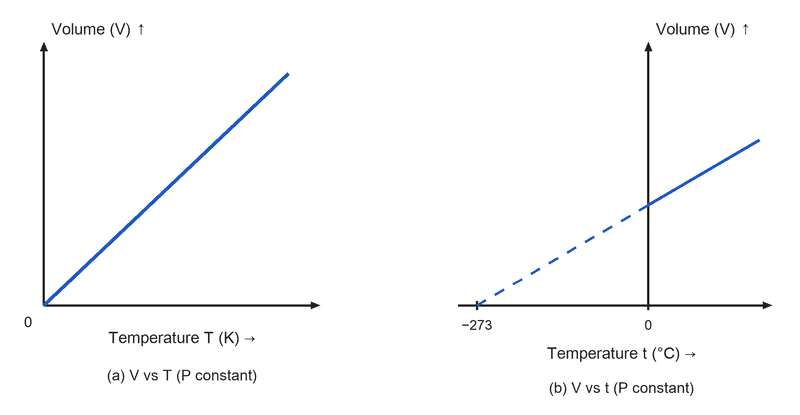
Graph (a) is V against T in kelvin: a straight line through the origin. Graph (b) is V against t in °C: a straight line which, extended (dashed), meets the temperature axis at −273 °C.
Step 3 — (b)(ii) Write the mathematical expression.
Direct proportion means the volume divided by the kelvin temperature is a constant .
For two states of the same gas at the same pressure:
Step 4 — (b)(iii) Give its significance.
Charles' law explains these facts:
- A gas heated at constant pressure expands, so its density decreases. Hot air is lighter than the cooler air around it and rises; this lifts hot-air balloons and drives convection currents and winds.
- It led to the idea of absolute zero (−273 °C) and to the Kelvin scale of temperature.
Watch out: In the formula, T must be in kelvin; V is not proportional to the Celsius temperature.
Therefore, at constant pressure V ∝ T (kelvin), so V/T = k and V₁/T₁ = V₂/T₂; V against T is a straight line through the origin.
- 493 marks
Question 49
What is meant by aqueous tension ? How is the pressure exerted by a gas corrected to account for aqueous tension ?
Solve with AIWritten solution
Solution:
Concept: A gas collected over water is moist: it contains water vapour, and by Dalton's law of partial pressures the measured pressure is the sum of the pressures of the dry gas and the vapour.
Step 1 — Define aqueous tension.
Aqueous tension is the pressure exerted by water vapour (its partial pressure) in a gas collected over water, at a given temperature. It depends only on the temperature.
Step 2 — Write the total pressure.
The measured (total) pressure of the moist gas is the sum of two parts.
Step 3 — Correct for it.
To find the pressure of the dry gas alone, we subtract the aqueous tension at that temperature from the measured pressure. This corrected pressure is then used in the gas-law calculation.
Watch out: Subtract the aqueous tension; do not add it.
Therefore, aqueous tension is the pressure of the water vapour in a gas collected over water, and it is subtracted from the observed pressure to give the pressure of the dry gas.
- 503 marks
Question 50
During the chemistry practical when hydrogen sulphide gas having offensive odour is prepared for some test in the laboratory, we can smell the gas from even 50 metres away. Explain the phenomenon.
Solve with AIWritten solution
Solution:
Concept: Gas molecules move rapidly and randomly and have negligible attraction for each other, so a gas spreads through other gases by diffusion.
Step 1 — Name the phenomenon.
The smell reaches us because hydrogen sulphide diffuses through the air.
Step 2 — Explain how it happens.
Molecules of hydrogen sulphide move rapidly and randomly in all directions. There are large spaces between air molecules, so the H₂S molecules move into these spaces and mix with the air. Air currents in the room help to carry them further.
Step 3 — Explain why we notice it so far away.
Our noses can detect hydrogen sulphide (a rotten-egg smell) even when only a tiny amount of it is in the air, so even the few molecules that have spread 50 metres are enough to smell.
Watch out: Hydrogen sulphide is poisonous; it is prepared only in a fume cupboard.
Therefore, we smell the gas 50 metres away because its molecules diffuse rapidly through the air.
- 514 marks
Question 51
(a) State the law verified by the following figure.

(b) Draw P-V isotherm for the above law.
Solve with AIWritten solution
Solution:
Concept: In the figure the temperature and the mass of gas are constant. Adding a second weight raises the gauge reading from 1.0 to 2.0, and the gas volume falls from to the smaller .
Step 1 — (a) Read the figure.
The pressure on the gas doubles (1.0 to 2.0), and the piston comes down so that the gas column is half as tall: the volume halves. Pressure up, volume down in the same ratio, at constant temperature, is Boyle's law.
Step 2 — (a) State the law.
Boyle's law: temperature remaining constant, the volume of a given mass of a dry gas is inversely proportional to its pressure, so .
Step 3 — (b) Draw the P–V isotherm.
We plot pressure on the y-axis against volume on the x-axis at one constant temperature. Since is constant, the curve falls steeply at small volumes and flattens at large volumes: a hyperbola, called an isotherm (a curve at one temperature).
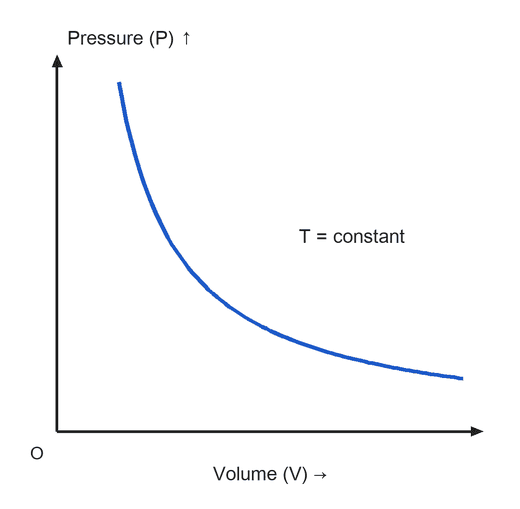
Watch out: The isotherm is a curve, not a straight line; the straight line is V against 1/P.
Therefore, the figure verifies Boyle's law (P₁V₁ = P₂V₂), and its P–V isotherm is a hyperbola.
- 525 marks
Question 52
(a) State the law which the following graph verifies.
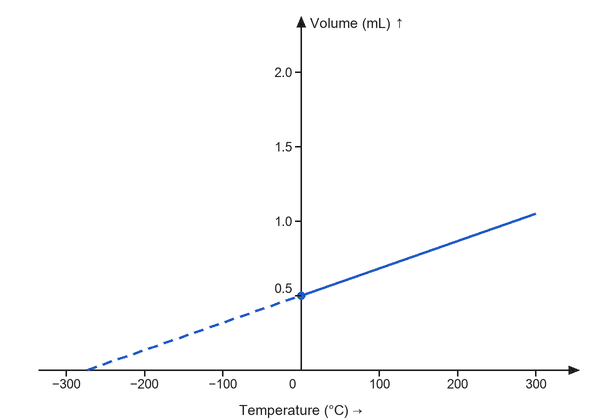
(b) Derive the mathematical expression for it.
(c) Give one application/use where the above law is employed.
Solve with AIWritten solution
Solution:
Concept: The graph shows volume rising in a straight line with temperature, and the line extended back reaches zero volume at about −273 °C. That is the volume–temperature law at constant pressure.
Step 1 — (a) State the law.
The graph verifies Charles' law: pressure remaining constant, the volume of a given mass of a dry gas increases or decreases by of its volume at 0 °C for each 1 °C rise or fall in temperature.
Step 2 — (b) Write the volume at t °C.
Let be the volume at 0 °C and the volume at °C, at constant pressure. For each degree the volume grows by , so for degrees:
Step 3 — (b) Change to kelvin temperatures.
Now is the kelvin temperature , and 273 K is the kelvin temperature at 0 °C. Putting these in gives:
Step 4 — (b) Write the law as a constant ratio.
Since and are fixed numbers, dividing both sides by gives a constant .
So , and for any two states of the same gas at the same pressure:
Step 5 — (c) Give an application.
Hot-air balloons: the air inside the balloon is heated and expands at (nearly) constant pressure. Some air leaves through the opening, so the air inside becomes less dense than the cooler air outside, and the balloon rises.
Watch out: The graph is a straight line but NOT through the origin when t is in °C; it passes through the origin only when the temperature is in kelvin.
Therefore, the graph verifies Charles' law, whose expression is V₁/T₁ = V₂/T₂, and it is used in hot-air balloons.
- 535 marks
Question 53
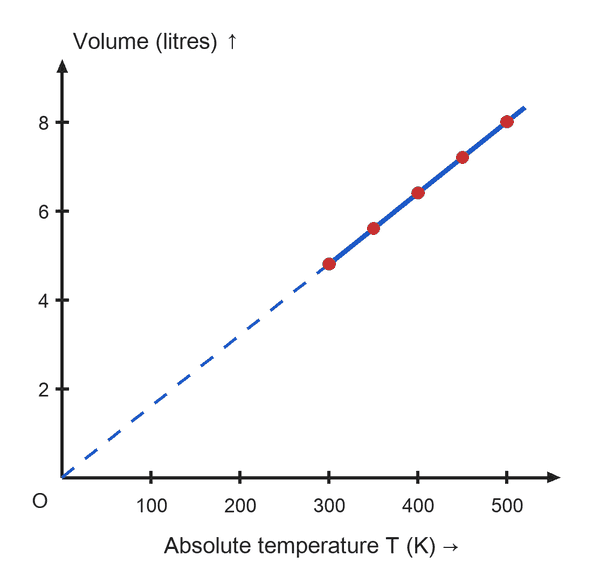
Plot V versus absolute T (K) by the given data :
Temperature Volume in litres 27°C 4.8 77°C 5.6 127°C 6.4 177°C 7.2 227°C 8.0 (a) The graph between V and T is a ________ .
(b) Check whether the line passes through the origin.
(c) Which law is obeyed ?
Solve with AIWritten solution
Solution:
Concept: Charles' law: at constant pressure (kelvin), so is the same for every reading and the V–T graph is a straight line through the origin.
Step 1 — Convert each temperature to kelvin and find V/T.
We add 273 to each Celsius temperature, then divide each volume by its kelvin temperature.
t T (K) V (litres) V/T (litre per K) 27 °C 300 4.8 0.016 77 °C 350 5.6 0.016 127 °C 400 6.4 0.016 177 °C 450 7.2 0.016 227 °C 500 8.0 0.016 Step 2 — Plot the graph.
We plot V (y-axis) against T in kelvin (x-axis). The five points lie on one straight line; extending it backwards (dashed) takes it to the origin O.
Step 3 — (a) Describe the graph.
The points lie on a single straight line.
Step 4 — (b) Check the origin.
Every reading gives the same ratio, so the volume is a fixed multiple of the kelvin temperature:
Putting into this equation gives zero volume, so the line, extended, does pass through the origin.
Step 5 — (c) Name the law.
Volume directly proportional to absolute temperature, at constant pressure, is Charles' law.
Watch out: Plot against KELVIN temperature; against °C the line would not pass through the origin.
Therefore, (a) the V–T graph is a straight line, (b) it passes through the origin when extended, and (c) Charles' law is obeyed.
- 543 marks
Question 54
Convert : (i) 273°C to Kelvin (ii) 293 K to °C.
Solve with AIWritten solution
Solution:
Concept: The kelvin and Celsius degrees are the same size, and 0 °C is 273 K, so .
Step 1 — Convert 273 °C to kelvin.
To change degrees Celsius to kelvin we add 273.
Step 2 — Convert 293 K to °C.
To change kelvin to degrees Celsius we subtract 273.
Watch out: 273 °C is not 273 K; it is twice that, 546 K.
Therefore, (i) 273 °C = 546 K and (ii) 293 K = 20 °C.
- 553 marks
Question 55
What will be the minimum pressure required to compress 500 dm³ of air at 1 bar to 200 dm³ if temperature is kept constant ?
Solve with AIWritten solution
Solution:
Concept: Boyle's law: at constant temperature the volume of a fixed mass of a dry gas is inversely proportional to its pressure, so .
Step 1 — Write down the data.
The temperature is kept constant, so Boyle's law applies.
- bar
- dm³
- dm³
- = ?
Step 2 — Rearrange the law and substitute.
Dividing both sides of by gives the pressure needed.
Step 3 — Explain 'minimum'.
At exactly 2.5 bar the air has been squeezed to 200 dm³; any smaller pressure would leave it larger than 200 dm³. So 2.5 bar is the least pressure that does the job.
Watch out: Keep each quantity in the same unit on both sides; the units then cancel.
Therefore, the minimum pressure required is 2.5 bar.
- 563 marks
Question 56
2 litres of a gas is enclosed in a vessel at a pressure of 760 mm Hg. If temperature remains constant, calculate pressure when volume changes to 4 dm³.
- 573 marks
Question 57
800 cm³ of gas is collected at 654 mm pressure. At what pressure would the volume of the gas reduce by 40% of its original volume, temperature remaining constant ?
- 583 marks
Question 58
At constant temperature, the effect of change of pressure on volume of a gas was as given below :
Pressure in atmospheres Volume in litres 1.0 12 1.5 8.0 2.0 6.0 2.5 4.8 3.0 4.0 (a) Plot the following graphs :
- P vs V 2. P vs 1/V 3. PV vs P.
(b) Assuming that the pressure values given above are correct, find the correct measurement of the volume at 2·3 atmosphere pressure.
- 593 marks
Question 59
A cylinder of 20 litres capacity contains a gas at 100 atmospheric pressure. How many flasks of 200 cm³ capacity can be filled from it at 1 atmosphere pressure, temperature remaining constant ?
- 603 marks
Question 60
A steel cylinder of internal volume 20 litres is filled with hydrogen at 29 atmospheric pressure. If hydrogen is used to fill a balloon at 1·25 atmospheric pressure at the same temperature, what volume will the gas occupy ?
- 613 marks
Question 61
561 dm³ of a gas at S.T.P. is filled in a 748 dm³ container. If temperature is constant, calculate the percentage change in pressure required.
- 623 marks
Question 62
88 cm³ of nitrogen is at a pressure of 770 mm mercury. If the pressure is raised to 880 mm Hg, find by how much the volume will diminish, temperature remains constant.
- 633 marks
Question 63
A gas at 240 K is heated to 127°C. Find the percentage change in the volume of the gas (pressure remaining constant).
- 643 marks
Question 64
Certain amount of a gas occupies a volume of 0·4 litre at 17°C. To what temperature should it be heated so that its volume gets (a) doubled (b) reduced to half, pressure remaining constant ?
- 653 marks
Question 65
A given mass of a gas occupies 143 cm³ at 27°C and 700 mm Hg pressure. What will be its volume at 300 K and 280 mm Hg pressure ?
- 663 marks
Question 66
A gas occupies 500 cm³ at S.T.P. At what temperature will the volume of the gas be reduced by 20% of its original volume, pressure being constant ?
- 673 marks
Question 67
Calculate the final volume of a gas 'X', if the original pressure of the gas, at S.T.P. is doubled and its temperature is increased three times.
- 683 marks
Question 68
A sample of carbon dioxide occupies 30 cm³ at 15°C and 740 mm pressure. Find its volume at S.T.P.
- 693 marks
Question 69
What temperature would be necessary to double the volume of a gas, initially at S.T.P., if the pressure is decreased to 50% ?
- 703 marks
Question 70
At 0°C and 760 mm Hg pressure, a gas occupies a volume of 100 cm³. Kelvin temperature of the gas is increased by one-fifth and the pressure is increased one and a half times. Calculate the final volume of the gas.
- 713 marks
Question 71
It is found, on heating a gas, its volume increases by 50% and pressure decreases to 60% of its original value. If the original temperature was –15°C, find the temperature to which it was heated ?
- 723 marks
Question 72
A certain mass of a gas occupies 2 litres at 27 °C and 100 pascal. Find the temperature when volume and pressure become half of their initial values.
- 733 marks
Question 73
2500 cm³ of hydrogen is taken at S.T.P. The pressure of this gas is further increased by two and a half times (temperature remaining constant). What volume will hydrogen occupy now ?
- 743 marks
Question 74
Taking the volume of hydrogen as calculated in Q.19, what change must be made in Kelvin (absolute) temperature to return the volume to 2500 cm³ (pressure remaining constant).
- 753 marks
Question 75
A given amount of gas A is confined in a chamber of constant volume. When the chamber is immersed in a bath of melting ice, the pressure of the gas is 100 cm Hg.
(a) What is the temperature, when the pressure is 10 cm Hg ?
(b) What will be the pressure, when the chamber is brought to 100°C ?
- 763 marks
Question 76
A gas is to be filled from a tank of capacity 10,000 litres into cylinders each having capacity of 10 litres. The condition of the gas in the tank is as follows :
(a) pressure inside the tank is 800 mm of Hg.
(b) temperature inside the tank is –3°C.
When the cylinder is filled, the pressure gauge reads 400 mm of Hg and the temperature is 270 K. Find the number of cylinders required to fill the gas.
- 773 marks
Question 77
A sealed tube (able to withstand a pressure of 3 atmospheres) is filled with air at 27°C and one atmosphere pressure. Find the temperature above which it will burst.
- 783 marks
Question 78
Calculate the temperature at which the volume of a gas is doubled if its pressure at the same time increases from 70 cm of Hg to 80 cm of Hg.
- 793 marks
Question 79
Calculate the volume occupied by 2 g of hydrogen at 27°C and 4 atmosphere pressure, if at S.T.P. it occupies 22·4 litres.
- 803 marks
Question 80
Which will have greater volume when the following gases are compared at S.T.P.
(a) 1·2 N at 25°C and 748 mm Hg
(b) 1·25 O at S.T.P. ?
- 813 marks
Question 81
50 cm³ of hydrogen is collected over water at 17°C and 750 mm Hg pressure. Calculate the volume of dry gas at S.T.P. The water vapour pressure at 17°C is 14 mm Hg.
- 823 marks
Question 82
Calculate the volume of dry air at S.T.P. that occupies 28 cm³ at 14°C and 750 mm Hg pressure when saturated with water vapour. The vapour pressure of water at 14°C is 12 mm Hg.
- 833 marks
Question 83
L.P.G. cylinder can withstand a pressure of 14.9 atmosphere. The pressure gauge of the cylinder indicates 12 atmosphere at 27°C. Due to a sudden fire in the building the temperature rises. At what temperature will the cylinder explode ?
- 843 marks
Question 84
22.4 litres of a gas weighs 70 g at S.T.P. Calculate the weight of the gas if it occupies a volume of 20 litres at 27°C and 700 mm Hg of pressure.
What Class 9 Chemistry Ch 7 covers
The sections of the chapter, in the order the book takes them. Every question above comes from one of these.
- 01Behaviour and Characteristic Properties of Gases
- 02Molecular Motion
- 03The Gas Laws
- 04Pressure and Volume Relationship in Gases
- 05Temperature-Volume Relationship in Gases
- 06Absolute or Kelvin Scale of Temperature
More ways to study this chapter
The same chapter asked three other ways. Practise it, revise it, and see what the board has set on Ch 7 before.
Class 9 Chemistry Ch 7 questions students ask
How many questions are there in Class 9 Chemistry Ch 7?
84 questions. Every one is solved step by step on this page.
Are these Class 9 Chemistry solutions free?
Yes. Every question and its full working is free to read, with no account needed.
Can I download the Class 9 Chemistry Ch 7 solutions as a PDF?
There is no PDF to download. Every solution is on this page instead, which means it is searchable, always the current syllabus, and readable on a phone. Use your browser's print option if you want it on paper.