
Question 485 marksMedium
(a) State Charles' law.
(b) Give its
(i) graphical representation,
(ii) mathematical expression and
(iii) significance.
Confirming your payment
Sign up now and get 250 free tokens.
Study of Gas Laws · Question 48 of 84
(a) State Charles' law.
(b) Give its
(i) graphical representation,
(ii) mathematical expression and
(iii) significance.
Solution:
Concept: Charles' law links the volume and temperature of a fixed mass of gas when its pressure does not change.
Step 1 — (a) State the law.
Pressure remaining constant, the volume of a given mass of a dry gas increases or decreases by of its volume at 0 °C for each 1 °C rise or fall in temperature. In other words, at constant pressure the volume of a given mass of a dry gas is directly proportional to its absolute temperature.
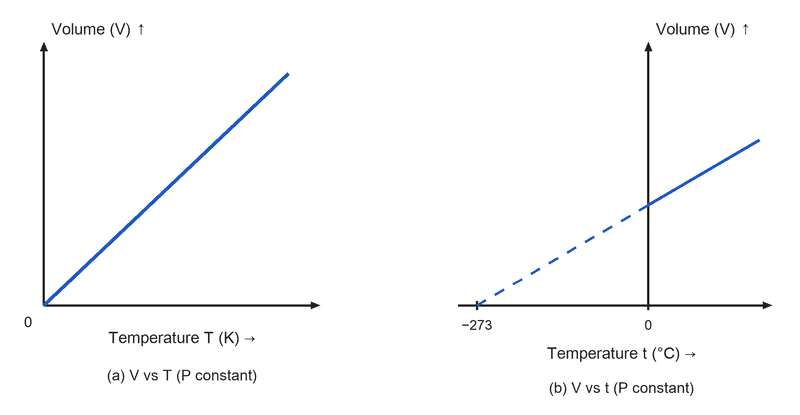
Step 2 — (b)(i) Show the graphs.
Graph (a) is V against T in kelvin: a straight line through the origin. Graph (b) is V against t in °C: a straight line which, extended (dashed), meets the temperature axis at −273 °C.
Step 3 — (b)(ii) Write the mathematical expression.
Direct proportion means the volume divided by the kelvin temperature is a constant .
For two states of the same gas at the same pressure:
Step 4 — (b)(iii) Give its significance.
Charles' law explains these facts:
Watch out: In the formula, T must be in kelvin; V is not proportional to the Celsius temperature.
Therefore, at constant pressure V ∝ T (kelvin), so V/T = k and V₁/T₁ = V₂/T₂; V against T is a straight line through the origin.