Solution:
Concept: Boyle's law says that at constant temperature the volume of a fixed mass of a dry gas is inversely proportional to its pressure. So the product of pressure and volume stays the same: P1V1=P2V2. The product PV is therefore the same for every reading taken at that temperature.
Step 1 — Find the constant value of PV.
The first reading is complete (100 mm of Hg and 80 cm³), so we use it to find PV.
PV=100×80=8000
Step 2 — Find x.
At 125 mm of Hg the volume is x. Since 125×x must also equal 8000, we divide 8000 by 125.
x=1258000=1258000=64 cm3
Step 3 — Find y.
At volume 32 cm³ the pressure is y. Since y×32 must equal 8000, we divide 8000 by 32.
y=328000=328000=250 mm of Hg
Step 4 — Check with the third reading.
The third reading gives the same product, which confirms the constant.
200×40=8000
Step 5 — Name the law.
The temperature was constant and PV stayed constant, so the student used Boyle's law: at constant temperature, the volume of a given mass of a dry gas is inversely proportional to its pressure.
Step 6 — Draw graph (i): volume against pressure.
We plot the four points (100, 80), (125, 64), (200, 40) and (250, 32) with pressure on the x-axis and volume on the y-axis. As pressure rises the volume falls, so the points lie on a smooth falling curve (a hyperbola), not a straight line.

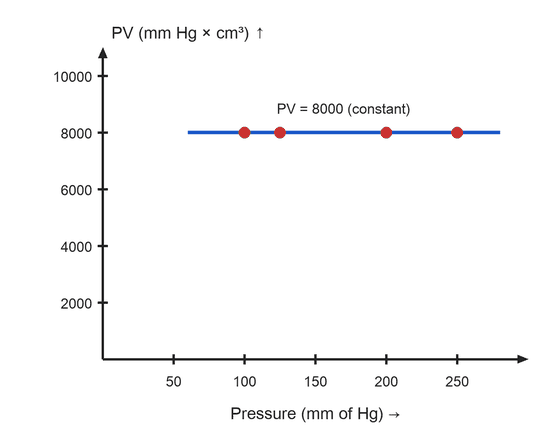
Step 7 — Draw graph (ii): PV against pressure.
For every reading PV=8000, so when PV is plotted against pressure all the points are at the same height. The graph is a straight line parallel to the pressure axis.
Watch out: Use a complete reading to find the constant; do not average readings that contain the unknowns.
Therefore, x = 64 cm³ and y = 250 mm of Hg, found by Boyle's law; V against P is a hyperbola and PV against P is a straight line parallel to the pressure axis.
