
Opening your dashboard
Class 9 Chemistry Chapter 7 Study of Gas Laws: Competency-Based Questions (CBQ)
40 questions on Chapter 7, each worked through on its own page with the AI tutor. Class 9 Chemistry, ICSE 2026-27.
40 questions
1–5 marks · Mixed difficulty
- 11 mark
Question 1
Cognitive domain: Application
The fuel in an LPG cylinder is a liquid: it can be heard splashing when the cylinder is shaken. Yet the same fuel burns at the stove as a gas. At the bottling plant, the gas is turned into a liquid by compressing it into the cylinder.
According to the kinetic theory, why can a gas be turned into a liquid by compressing it?
- 21 mark
Question 2
Cognitive domain: Application
A veterinary centre has three cold stores: a deep freezer at 250 K, a box of dry ice at −78 °C and a flask of liquid nitrogen at 77 K.
Which list arranges the three in order from the coldest to the least cold?
- 31 mark
Question 3
Cognitive domain: Understanding
A well-pumped football feels equally hard whichever part of it is pressed.
Which statement explains this?
- 41 mark
Question 4
Cognitive domain: Analysis
The same mass of a gas is studied at two constant pressures, 1 atm and 2 atm. At each pressure its volume is measured at four temperatures and plotted. The two straight lines obtained, X and Y, are produced backwards as dashed lines.
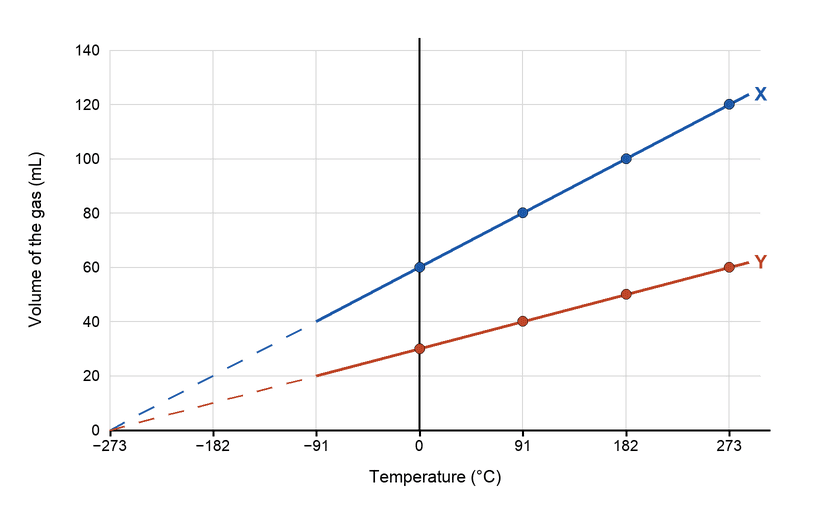
Which conclusion is correct?
- 51 mark
Question 5
Cognitive domain: Understanding
Assertion (A): The volume of a gas collected in an experiment is usually converted to its volume at S.T.P. before it is compared with the volume of gas collected in another experiment.
Reason (R): The volume of a given mass of a gas changes when its temperature or its pressure changes.
- 61 mark
Question 6
Cognitive domain: Understanding
Assertion (A): When hydrogen is collected over water, the pressure of the dry hydrogen in the gas jar is less than the total pressure of the gas in the jar.
Reason (R): Hydrogen is only very slightly soluble in water.
- 71 mark
Question 7
Cognitive domain: Application
On the day of an experiment, the mercury column of the barometer in Arnav's school laboratory stands 74.1 cm high. Fill in the blanks in his record.
Atmospheric pressure = ________ mm Hg = ________ torr. This is ________ (more / less) than one standard atmosphere.
- 81 mark
Question 8
Cognitive domain: Recall
Rehan presses the piston of a sealed syringe of air very slowly, so that the temperature of the air does not change, and plots its volume against its pressure.
Name the shape of the curve he obtains, and give the general term used for a graph drawn at constant temperature.
- 91 mark
Question 9
Cognitive domain: Application
An empty, soft plastic water bottle is capped tightly in a warm kitchen at 32 °C and is then left in a refrigerator at 4 °C for an hour.
Predict what will be seen when the bottle is taken out, and give the reason.
- 102 marks
Question 10
Cognitive domain: Application
In the laboratory of a cement factory, a weighed sample of limestone is heated and the carbon dioxide given off is collected in a gas syringe. Its volume is 380 cm³ at 39 °C and 800 mm Hg. According to the factory's chart, a pure sample of this mass should give 400 cm³ of carbon dioxide measured at S.T.P.
Find the volume of the collected gas at S.T.P., and express it as a percentage of the volume expected from a pure sample.
- 112 marks
Question 11
Cognitive domain: Understanding
A table-tennis ball has a dent but no crack. When it is dropped into a mug of hot water, the dent soon pops out and the ball becomes round again.
Explain this in terms of the motion of the air molecules inside the ball. Why is it important that the ball has no crack?
- 122 marks
Question 12
Cognitive domain: Analysis
A steel cylinder of fixed volume, filled with dry nitrogen and fitted with a pressure gauge, stands in a school laboratory. The gauge reads 728 mm Hg at 7 °C in the morning and 780 mm Hg at 27 °C in the afternoon.
Deepak says, "The temperature has become nearly four times as high, but the pressure has gone up by only 52 mm Hg. Some gas must have leaked out."
Use the gas equation to decide whether any gas has leaked, and point out the mistake in Deepak's reasoning.
- 134 marks
Question 13
Cognitive domain: Analysis
On a school trek in the Himalayas, Tenzin carries a sealed packet of potato chips, which is filled with nitrogen to keep the chips fresh. He notices that the packet looks more and more puffed up as the group climbs. At each halt he reads the atmospheric pressure from the guide's barometer and finds the volume of the packet by dipping it in a measuring jar of water. All the readings are taken inside a tent at the same temperature. The thin packet stretches easily, so the gas inside it is at the pressure of the air outside.
Halt Atmospheric pressure (mm Hg) Volume of the packet (cm³) Base town 750 240 Forest camp 600 300 High camp 500 360 (a) Show that the readings follow one of the gas laws. Name the law, and state the two quantities that stayed the same for the gas in the packet.
(b) The seal of the packet gives way if its volume goes above 390 cm³. The trek ends at a pass where the atmospheric pressure is 450 mm Hg. Will the packet reach the pass unopened? Show your working, taking the temperature to be the same as before.
(c) At constant temperature, the density of a gas is directly proportional to its pressure. Compare the density of the air at the high camp with that at the base town, and use your answer to explain why the trekkers become breathless at the high camp.
- 144 marks
Question 14
Cognitive domain: Evaluation
At a Makar Sankranti fair, a stall sells paper sky lanterns. Each lantern is a light paper bag of volume 300 litres, open at the bottom, with a small wick fixed below the opening. When the wick is lit, the air in the bag is heated from 27 °C to 87 °C, and the lantern slowly lifts off the ground. The stall owner tells the children, "Heating makes the air molecules lighter, so the lantern floats up." Sky lanterns can start fires where they land, so flying them is not allowed in some cities.
(a) The bag is open at the bottom. Which quantity therefore stays constant for the air inside it while it is heated, and which gas law applies?
(b) Calculate the volume that the 300 litres of air would occupy at 87 °C. Hence find the fraction of the air first in the bag that is still inside it when the lantern lifts off.
(c) Evaluate the stall owner's explanation, and give the correct reason why the lantern rises.
- 155 marks
Question 15
Cognitive domain: Creativity
Sugar cubes dissolve in water, so their volume cannot be found by dipping them in a measuring cylinder of water. Mitali plans to find it with the help of Boyle's law instead. She has a large plastic syringe marked in cm³, a cap that seals its nozzle, and a pressure gauge that can be fitted to the syringe.
(a) Explain the idea on which her method can be based.
(b) Describe the steps she should follow and the readings she should take.
(c) In a trial with six sugar cubes, the syringe reads 50 cm³ when the gauge shows 1 atm, and 36 cm³ when the gauge shows 1.5 atm. Calculate the total volume of the six cubes.
(d) State two precautions she must take so that Boyle's law can be applied, each with its reason.
- 161 mark
Question 16
Cognitive domain: Application
A teacher keeps two identical sealed flasks of the same gas. Flask P stands in the laboratory at 27 °C and flask Q is kept in a water bath at 127 °C. She asks the class to compare the molecules in the two flasks.
Which statement is correct?
- 171 mark
Question 17
Cognitive domain: Analysis
A student studies a fixed mass of a gas in a closed cylinder with a movable piston. She changes the pressure P at three different constant temperatures and plots the product PV against P for each temperature. The three lines X, Y and Z are shown below. Line Y was obtained at 300 K. (Hypothetical data.)

At what temperatures were lines X and Z obtained?
- 181 mark
Question 18
Cognitive domain: Application
In a chemistry club demonstration, four groups each collect the gas given off in the same reaction. All the gas is measured at the same temperature and pressure, but each group reads a measuring vessel marked in a different unit.
Group Volume of gas collected A B C D Which group collected the largest volume of gas?
- 191 mark
Question 19
Cognitive domain: Analysis
Assertion (A): The molecules of a gas at 0 °C have no kinetic energy.
Reason (R): The average kinetic energy of the molecules of a gas is directly proportional to its absolute temperature.
- 201 mark
Question 20
Cognitive domain: Analysis
Assertion (A): When a fixed mass of gas in a closed, rigid vessel is heated so that its Kelvin temperature doubles, the pressure of the gas also doubles.
Reason (R): The temperature of a gas on the Kelvin scale is obtained by adding 273 to its temperature on the Celsius scale.
- 211 mark
Question 21
Cognitive domain: Analysis
Students in four towns do the same experiment on the same day. Each group collects hydrogen over water at 27 °C in a gas jar, with the water level inside the jar equal to the level outside. The table gives the barometer reading in each town and the volume of moist gas collected. The aqueous tension at 27 °C is 27 mm Hg. (Hypothetical data.)
Town Barometer reading (mm Hg) Volume of moist gas () Shimla 590 130 Pune 705 105 Chennai 765 100 Mumbai 762 95 Which town's students collected the largest amount of hydrogen, leaving out the water vapour?
- 221 mark
Question 22
Cognitive domain: Understanding
Priya lists four everyday observations and, separately, four characteristic properties of gases.
Observations
- Air pumped into a bicycle tyre takes the shape of the tube.
- The smell of an incense stick reaches the next room.
- Hundreds of litres of oxygen are filled into one small hospital cylinder.
- A bucket full of air has very little mass compared with a bucket full of water.
Properties of gases
- K. Gases are highly compressible.
- L. Gases have a low density.
- M. Gases have no fixed shape.
- N. Gases mix with one another by diffusion.
Which option pairs every observation with the property that it shows?
- 231 mark
Question 23
Cognitive domain: Application
A narrow glass tube with the same bore all along is closed at one end. It traps a column of dry air 12.0 cm long behind a short thread of mercury, in a room at 27 °C. The open end of the tube stays at atmospheric pressure. The tube is then dipped in a warm water bath until the air column is 12.8 cm long. (Hypothetical data.)
What is the temperature of the water bath?
- 241 mark
Question 24
Cognitive domain: Evaluation
Three students convert 250 of a gas, measured at 27 °C and 740 mm Hg, to its volume at S.T.P. Their working is shown below.
Student Working 1 2 3 Which option correctly judges the working?
- 251 mark
Question 25
Cognitive domain: Analysis
A student keeps a fixed mass of air at constant temperature in a syringe and measures its volume at several pressures. She plots the volume V against , where P is in atm. (Hypothetical data.)

She now raises the pressure on the air from 2 atm to 5 atm, at the same temperature. What happens to the volume?
- 262 marks
Question 26
Cognitive domain: Application
At an air-separation plant, air is compressed and cooled to obtain liquid oxygen, which boils at −183 °C. Rohan asks why the plant cannot get liquid oxygen by only compressing the air at room temperature.
(a) Express −183 °C on the Kelvin scale.
(b) Use the kinetic theory to explain why a gas has to be cooled as well as compressed to change it into a liquid.
- 272 marks
Question 27
Cognitive domain: Evaluation
A newspaper in Leh reported, "The afternoon was twice as warm as the morning: the temperature was 20 °C in the afternoon and 10 °C in the morning."
(a) Express the two temperatures on the Kelvin scale and find the ratio of the afternoon temperature to the morning temperature.
(b) Evaluate the newspaper's claim. By what percentage was the average kinetic energy of the air molecules greater in the afternoon than in the morning?
- 282 marks
Question 28
Cognitive domain: Understanding
In a laboratory, a teacher squeezes the rubber bulb of a dropper, dips its tip in coloured water and then lets go of the bulb. Coloured water rises into the dropper.
(a) Use Boyle's law to explain why the pressure of the air inside the bulb falls when the bulb is released.
(b) Explain what pushes the coloured water up into the dropper.
- 292 marks
Question 29
Cognitive domain: Application
In a crash-test laboratory, a car airbag is filled with nitrogen gas. The hot gas fills the bag to a volume of 60 L at 127 °C. After a few minutes the gas cools to 27 °C. Assume that the pressure in the bag stays constant and that no gas escapes. (Hypothetical data.)
(a) Calculate the volume of the bag after it has cooled.
(b) Explain, in terms of the motion of the molecules, why the bag shrinks when the gas cools.
- 302 marks
Question 30
Cognitive domain: Analysis
A syringe holds 40 of dry air at 1.0 atm and 27 °C. The plunger is pushed in until the volume is 30 , and the syringe is placed in an ice and salt mixture. The pressure gauge then reads 1.2 atm. (Hypothetical data.)
Find the final temperature of the air in °C, and say whether the air was heated or cooled overall.
- 312 marks
Question 31
Cognitive domain: Evaluation
Aman traps 40 of air at 1.0 atm and 27 °C in a sealed syringe. He pushes the plunger in quickly until the gauge reads 2.0 atm. The syringe then shows 22 , and the barrel feels warm. Aman says, "Boyle's law is wrong, because it predicts 20 ." (Hypothetical data.)
(a) Use the gas equation to find the temperature of the air at the end, in °C.
(b) Evaluate Aman's statement, and say how he should repeat the experiment to test Boyle's law.
- 323 marks
Question 32
Cognitive domain: Application
A football has a fixed inside volume of 5.0 L and is filled with air at the atmospheric pressure of 1.0 atm. Arjun pumps more air into it with a hand pump. Each stroke of the pump delivers 500 of air at 1.0 atm. He wants the pressure inside the ball to be 1.6 atm. Assume that the temperature stays constant. (Hypothetical data.)
(a) What volume would all the air inside the ball occupy at 1.0 atm when its pressure is 1.6 atm?
(b) How much air, measured at 1.0 atm, must be added to the ball?
(c) How many strokes of the pump are needed?
- 333 marks
Question 33
Cognitive domain: Analysis
A student collects a gas over water at different temperatures. The table gives the approximate aqueous tension at each temperature. In every case the water level inside the jar is equal to the level outside, and the atmospheric pressure is 760 mm Hg.
Temperature of water (°C) 10 30 50 70 Aqueous tension (mm Hg) 9 32 92 234 (a) Find the pressure of the dry gas in the jar when the gas is collected at 10 °C and at 70 °C.
(b) What percentage of the total pressure in the jar is due to water vapour at 70 °C?
(c) At 70 °C, the jar shows 100 of moist gas. What volume would the dry gas alone occupy at 70 °C and 760 mm Hg? Is hot water a good choice for collecting a gas whose volume is to be measured?
- 343 marks
Question 34
Cognitive domain: Application
Meena notices that a refrigerator door is hard to open for a short time just after it has been closed on a hot day. Suppose that the air inside is at 30 °C and 760 mm Hg when the door is shut, and that the door seals the inside completely. The inside then cools quickly to 5 °C. Ignore any water vapour. (Hypothetical data.)
(a) Find the pressure of the air inside the refrigerator after it has cooled.
(b) Compare it with the atmospheric pressure outside, and explain why the door is hard to open.
(c) The freezer compartment cools to −18 °C in the same way. Find the pressure inside it, and say whether its door would be easier or harder to open.
- 353 marks
Question 35
Cognitive domain: Application
Pilots know that on a hot afternoon an aeroplane needs a longer runway to take off than on a cold morning at the same airport, because the air is "thinner". The lift on the wings depends on the number of air molecules that flow past them. At an airport the pressure is 760 mm Hg on both occasions, and the temperature is 7 °C on a winter morning and 37 °C on a summer afternoon. (Hypothetical data.)
(a) Express the two temperatures on the Kelvin scale.
(b) A sample of 1 of air at 7 °C is heated to 37 °C at the same pressure. Find its new volume.
(c) By what percentage is the number of molecules in each cubic decimetre of air smaller in the afternoon than in the morning? Explain why this makes take-off harder.
- 363 marks
Question 36
Cognitive domain: Analysis
The figure shows three cylinders X, Y and Z, each fitted with a movable piston. All three are at the same temperature. Each dot stands for the same large number of gas molecules, and the scale beside each cylinder gives the volume of the gas in .
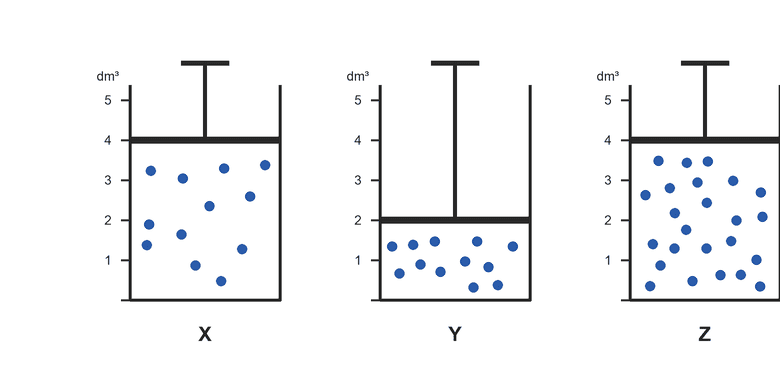
(a) For each cylinder, state the volume of the gas, the number of dots and the number of dots in each .
(b) Which cylinder has the lowest pressure, and which two have equal pressures? Explain in terms of the collisions of the molecules with the walls.
(c) At the same temperature, to what volume must the piston of cylinder Z be moved so that its pressure becomes equal to that of cylinder X?
- 374 marks
Question 37
Cognitive domain: Analysis
Sunita seals some dry air in a glass syringe whose smooth piston slides freely, so the pressure of the air always stays equal to the atmospheric pressure. She places the syringe in a water bath, heats the bath, and reads the volume of the air on the syringe scale at five temperatures. Her results are in the table. (Hypothetical data.)
Temperature (°C) 10 30 50 70 90 Volume of air () 56.6 60.6 64.6 68.6 72.6 (a) Show that the volume rises by the same amount for every rise of 20 °C. Find the rise in volume for 1 °C.
(b) Find the volume of the air at 0 °C, and show that the rise for 1 °C is of this volume. Then use the same rate to find the temperature at which the volume would fall to zero.
(c) Change the five temperatures to kelvin and show that is constant. Name the law that this shows.
- 385 marks
Question 38
Cognitive domain: Application
At a science fair, Isha makes a "Cartesian diver". A small glass dropper holding a bubble of air floats upright in a sealed plastic bottle that is full of water. When she squeezes the bottle, the diver sinks, and when she releases it, the diver rises again.
At 1.00 atm, the bubble of air in the dropper has a volume of 0.80 . The diver floats only while the bubble has a volume greater than 0.76 , and it sinks if the bubble is smaller. When the bottle is squeezed, the pressure on the air bubble rises to 1.25 atm. The temperature stays constant, and no air escapes from the dropper. (Hypothetical data.)
(a) Name the law that applies to the air bubble, and state the two things that stay constant for it.
(b) Calculate the volume of the bubble at 1.25 atm. Does the diver sink?
(c) Calculate the lowest pressure at which the diver just begins to sink. Does Isha have to squeeze the bottle hard?
(d) Explain, using the kinetic theory, why the bubble becomes smaller when the pressure on it increases.
- 394 marks
Question 39
Cognitive domain: Evaluation
At a science fair, a teacher wearing gloves and goggles dips a rubber balloon filled with 1.2 L of air at 27 °C into liquid nitrogen. Liquid nitrogen boils at 77 K. The balloon shrinks to a small, wrinkled lump, far smaller than a gas at 77 K would be expected to be. When the teacher takes it out, it swells slowly and, within a few minutes, regains its original size. (Hypothetical data for the volume.)
(a) Use Charles' law to calculate the volume that 1.2 L of air at 27 °C would have at 77 K, if it stayed a gas at constant pressure.
(b) Explain why the real balloon becomes much smaller than the volume that you calculated.
(c) Maya says, "The air in the balloon was destroyed when the balloon shrank." Evaluate her statement, and explain why the balloon swells again.
- 404 marks
Question 40
Cognitive domain: Creativity
Mrs Nair wants to show Class 7 students how Charles' law works. She marks a large square on the floor of the school hall. Three sides of the square are chalk lines, and the fourth side is a skipping rope, held at its two ends by two students, which can be pushed outwards. About thirty students stand inside the square and act as gas molecules.
(a) Describe what the students inside the square should do, and what the rope and the two students who hold it should stand for, to show a gas at a low temperature.
(b) Describe how the class should show the heating of the gas, what the audience should see happen to the rope, and why.
(c) Explain how the model keeps the pressure constant, and state one way in which the model is unlike a real gas.