
Opening your dashboard
Class 9 Chemistry Chapter 6: Study of the First Element – Hydrogen Solutions
72 textbook questions with step-by-step answers, free to read, for ICSE 2026-27.
Get talked through Ch 6, not just shown the answer
Reading a finished solution is not the same as being able to do it. The AI tutor takes one question at a time and works it with you, in your own words, until you can.
- Ask it out loud, in your own words
- It gives you the next step, not the answer
- Stuck on part (ii)? Start there
72 questions with solutions
1–5 marks · Mixed difficulty
The first 68 solutions are on this page. This chapter is a long one, so the rest open on their own page to keep this one quick to load.
- 12 marks
Question 1
Justify the position of Hydrogen in the periodic table.
Solve with AIWritten solution
Solution:
Concept: Hydrogen (atomic number 1, configuration 1) has one electron in its only shell. Like the alkali metals it can lose this electron; like the halogens it is one electron short of the nearest noble gas (helium) and can gain one.
Step 1 — Find its period.
Hydrogen has only one shell (the K shell), so it belongs to the first period.
Step 2 — Reasons for group IA (1).
Its configuration is 1, so it has one valence electron and valency 1, like Li (2, 1) and Na (2, 8, 1). Like the alkali metals it can lose this electron to form a positive ion:
Step 3 — Reasons for group VIIA (17).
Hydrogen is also one electron short of the noble gas helium, as each halogen is one short of its noble gas. It can gain an electron to form (as in sodium hydride), is a non-metal, and exists as diatomic molecules , like .
Step 4 — Decide its position.
Because it shows this dual nature, hydrogen is placed at the top of the table in period 1, above group IA, a position that keeps the symmetry of the table and reflects its one valence electron.
Watch out: Hydrogen is not an alkali metal even though it sits above group 1.
Therefore, hydrogen is placed in period 1 at the top of group IA because it has one shell and one valence electron, though its resemblance to the halogens makes its position a special one.
- 22 marks
Question 2
Why does hydrogen show dual nature ?
Solve with AIWritten solution
Solution:
Concept: Hydrogen (atomic number 1, configuration 1) has one electron in its only shell. Like the alkali metals it can lose this electron; like the halogens it is one electron short of the nearest noble gas (helium) and can gain one. Showing the properties of two different groups is called dual nature.
Step 1 — Resemblance to the alkali metals (group IA).
Hydrogen has one valence electron and valency 1. It loses this electron to form a positive ion (like ) and acts as a reducing agent.
Step 2 — Resemblance to the halogens (group 17).
Hydrogen is one electron short of helium, so it gains one electron to form (like ). It is a non-metal, a gas, and exists as diatomic molecules (like and ).
Step 3 — Conclude.
Since it resembles both group IA and group 17, hydrogen is said to show a dual nature.
Therefore, hydrogen shows dual nature because, with one electron in its only shell, it can both lose an electron like the alkali metals and gain one like the halogens.
- 35 marks
Question 3
Compare hydrogen with alkali metals on the basis of :
(i) Ion formation
(ii) Reducing power
(iii) Reaction with oxygen
(iv) Oxide formation
Solve with AIWritten solution
Solution:
Concept: Hydrogen and the alkali metals each have one valence electron, so they behave alike in many reactions.
Step 1 — (i) Ion formation.
Both lose one electron to form a unipositive ion (they are electropositive):
Step 2 — (ii) Reducing power.
Both are reducing agents: they remove oxygen from the heated oxide of a less active metal:
Step 3 — (iii) Reaction with oxygen.
Both burn in oxygen. Hydrogen burns with a pale blue flame (a pop when a small amount is lit) to form water; lithium burns to its oxide, while sodium burns mainly to sodium peroxide:
Step 4 — (iv) Oxide formation.
Both form oxides of the type : and , and both also form peroxides, and . But water is a neutral oxide, while alkali-metal oxides are basic.
Watch out: The oxides look alike in formula but differ in nature: neutral water against basic sodium oxide.
Therefore, hydrogen resembles the alkali metals in forming unipositive ions, acting as a reducing agent, burning in oxygen and forming -type oxides, but its oxide (water) is neutral while theirs are basic.
- 44 marks
Question 4
In what respect does hydrogen differ from :
(i) alkali metals
(ii) halogens ?
Solve with AIWritten solution
Solution:
Concept: Hydrogen has only one shell and is a non-metal whose oxide is neutral, so it differs from both groups it resembles.
Step 1 — (i) Differences from the alkali metals.
Hydrogen differs from the alkali metals in these ways.
- Hydrogen has only one shell; alkali metals have two or more.
- Hydrogen is a non-metal and a gas of molecules; alkali metals are solid metals.
- The oxide of hydrogen () is neutral; alkali-metal oxides (, ) are basic.
- Hydrogen readily gains an electron to form in metal hydrides; alkali metals form only positive ions in their ordinary compounds.
Step 2 — (ii) Differences from the halogens.
Hydrogen differs from the halogens in these ways.
- Hydrogen has one shell and one valence electron; halogens have two or more shells and seven valence electrons.
- The oxide of hydrogen is neutral; oxides of halogens (, ) are acidic.
- Hydrogen readily loses its electron to form (it is electropositive); halogens tend to gain electrons and do not form simple positive ions in their ordinary compounds.
Therefore, hydrogen differs from the alkali metals (one shell, non-metal, neutral oxide, forms ) and from the halogens (one valence electron, neutral oxide, forms ).
- 55 marks
Question 5
Give the general group study of hydrogen with reference to
(i) valence electrons
(ii) burning
(iii) reducing power.
Solve with AIWritten solution
Solution:
Concept: A group study describes how a family of elements behaves. Hydrogen (configuration 1) is studied in the same way: its valence electron, its burning and its reducing power.
Step 1 — (i) Valence electrons.
Hydrogen has one electron in its valence (K) shell, like the alkali metals, so its valency is 1. It can lose this electron () or gain one more () to reach the helium configuration.
Step 2 — (ii) Burning.
Hydrogen is combustible but does not support combustion. It burns in air or oxygen with a pale blue flame, forming water:
Step 3 — (iii) Reducing power.
Hydrogen is a good reducing agent. It removes oxygen from the heated oxides of less active metals and is itself oxidised to water:
Watch out: The phrase 'does not support combustion' means a burning splint is put out inside the gas, though the gas itself burns.
Therefore, hydrogen has one valence electron (valency 1), burns in air to form water without supporting combustion, and reduces heated metal oxides such as CuO to the metal.
- 62 marks
Question 6
Why was hydrogen called ‘inflammable air’ ?
Solve with AIWritten solution
Solution:
Concept: A gas that catches fire easily is called inflammable (or flammable).
Step 1 — Recall the discovery.
In 1766 Henry Cavendish prepared hydrogen by the action of acids on metals and studied it as a separate gas.
Step 2 — Give the reason for the name.
He found that the gas burns readily in air. Because of this combustible nature he called it 'inflammable air':
Watch out: Inflammable means 'catches fire easily'; it does not mean 'non-flammable'.
Therefore, hydrogen was called 'inflammable air' (by Cavendish) because it catches fire and burns readily in air.
- 72 marks
Question 7
State some sources of hydrogen.
Solve with AIWritten solution
Solution:
Concept: Free hydrogen is rare on the earth, but hydrogen is very common in compounds.
Step 1 — Sources in the free state.
Traces occur in the air and in volcanic gases and natural gas. The Sun and the stars consist mostly of hydrogen.
Step 2 — Water, the main source.
Water is the main combined source. Its hydrogen content by mass is:
Step 3 — Other compounds.
Hydrogen is present in acids and alkalis, in hydrocarbons (natural gas, petroleum) and in plant and animal tissues: carbohydrates such as sugar and starch, proteins and fats.
Therefore, hydrogen is obtained mainly from water (11.1 % hydrogen by mass) and occurs in acids, alkalis, hydrocarbons and living matter; free hydrogen occurs only in traces on the earth but abounds in the Sun and stars.
- 85 marks
Question 8
Compare hydrogen and halogens on the basis of :
(i) physical state
(ii) ion formation
(iii) valency
(iv) reaction with oxygen
Solve with AIWritten solution
Solution:
Concept: Hydrogen, like a halogen, is one electron short of a noble-gas configuration, so it resembles the halogens in several ways.
Step 1 — (i) Physical state.
Hydrogen is a gas, like fluorine and chlorine, and all of them exist as diatomic molecules: , , .
Step 2 — (ii) Ion formation.
Both gain one electron to form a uninegative ion:
Step 3 — (iii) Valency.
Both have valency 1.
Step 4 — (iv) Reaction with oxygen.
Here they differ. Hydrogen burns in oxygen to form water, a neutral oxide:
Halogens do not burn in oxygen; their oxides (such as and ) are made indirectly and are acidic.
Therefore, hydrogen and the halogens are alike as diatomic gases, in forming uninegative ions and in valency 1, but differ with oxygen: hydrogen burns to neutral water, halogens do not burn and have acidic oxides.
- 92 marks
Question 9
Which metal is preferred for preparation of hydrogen
(i) from water ?
(ii) from acid ?
Solve with AIWritten solution
Solution:
Concept: The metal chosen should give hydrogen at a steady, safe rate and should be easy to obtain.
Step 1 — (i) From water.
Calcium is preferred. It reacts steadily with cold water, not violently like sodium and potassium, so the hydrogen can be collected safely:
(Sodium is used only as sodium amalgam, which reacts smoothly with water.)
Step 2 — (ii) From acid.
Zinc (granulated) is preferred. With dilute hydrochloric or dilute sulphuric acid it gives a steady stream of hydrogen:
Therefore, (i) calcium is preferred for hydrogen from water and (ii) granulated zinc for hydrogen from dilute acid.
- 105 marks
Question 10
(i) Write the reaction of steam with red hot iron.
(ii) Why is this reaction considered a reversible reaction ?
(iii) How can the reaction proceed continuously ?
Solve with AIWritten solution
Solution:
Concept: A reversible reaction can go both ways: the products can react to give back the reactants. If a product is removed as soon as it forms, the reverse reaction cannot happen.
Step 1 — (i) Write the reaction.
Steam passed over red hot iron gives triferric tetroxide (magnetic oxide of iron) and hydrogen:
Step 2 — (ii) Why it is reversible.
The products react with each other: hydrogen reduces the triferric tetroxide back to iron and steam:
So the reaction goes in both directions, and in a closed vessel it reaches an equilibrium.
Step 3 — (iii) How to make it go on.
Pass a continuous stream of steam over the red hot iron. The steam sweeps the hydrogen away as soon as it forms, so the backward reaction cannot take place and the forward reaction continues.
Watch out: The iron must be red hot and the water must be steam; iron does not react with cold or hot water.
Therefore, (i) ; (ii) it is reversible because hydrogen reduces back to iron; (iii) it proceeds continuously if a stream of steam keeps removing the hydrogen.
- 112 marks
Question 11
Why are zinc and aluminium considered to have a unique nature ? Give balanced equations to support your answer.
Solve with AIWritten solution
Solution:
Concept: Most metals that give hydrogen do so only with acids (or water). Zinc and aluminium give hydrogen with both acids and alkalis, because their oxides and hydroxides are amphoteric. This is called their unique nature.
Step 1 — With dilute acid.
Both displace hydrogen from dilute hydrochloric acid:
Step 2 — With hot concentrated alkali.
Both also give hydrogen with sodium hydroxide solution, forming sodium zincate and sodium aluminate:
Step 3 — Conclude.
Since they displace hydrogen from acids as well as alkalis, zinc and aluminium are said to have a unique nature.
Watch out: Aluminium needs water as a reactant with the alkali; leaving it out makes the equation unbalanced.
Therefore, zinc and aluminium have a unique nature because they give hydrogen with both acids and alkalis, as the balanced equations show.
- 125 marks
Question 12
Write balanced equations for the following :
(i) Iron reacts with dil HCl
(ii) Zinc reacts with caustic soda solution
(iii) Lead reacts with potassium hydroxide
(iv) Aluminium reacts with fused sodium hydroxide.
Solve with AIWritten solution
Solution:
Concept: Iron displaces hydrogen from dilute acids. Zinc, lead and aluminium also displace it from alkalis, forming a zincate, a plumbite and an aluminate.
Step 1 — (i) Iron with dilute HCl.
Iron gives iron(II) chloride (a pale green solution) and hydrogen:
Step 2 — (ii) Zinc with caustic soda.
On heating, zinc gives sodium zincate and hydrogen:
Step 3 — (iii) Lead with potassium hydroxide.
On heating, lead gives potassium plumbite and hydrogen:
Step 4 — (iv) Aluminium with fused sodium hydroxide.
Aluminium heated with fused (molten) sodium hydroxide gives sodium aluminate and hydrogen:
Watch out: With FUSED NaOH there is no water, so the product is ; with the aqueous solution it is .
Therefore, the products are (i) iron(II) chloride and hydrogen, (ii) sodium zincate and hydrogen, (iii) potassium plumbite and hydrogen, (iv) sodium aluminate and hydrogen, as in the balanced equations above.
- 135 marks
Question 13
Write balanced equations and give your observations when the following metals react :
(i) Sodium with cold water
(ii) Calcium with cold water
(iii) Magnesium with boiling water
(iv) Magnesium with steam.
Solve with AIWritten solution
Solution:
Concept: The more reactive a metal, the milder the conditions it needs to displace hydrogen from water: sodium and calcium react with cold water, magnesium with boiling water and with steam.
Step 1 — (i) Sodium with cold water.
Sodium reacts vigorously, forming sodium hydroxide and hydrogen:
Observations: sodium floats, melts into a silvery ball that darts about on the water, and the hydrogen may catch fire with a golden yellow flame. The solution is colourless, soapy and alkaline.
Step 2 — (ii) Calcium with cold water.
Calcium reacts less vigorously, forming calcium hydroxide and hydrogen:
Observations: calcium sinks, bubbles of hydrogen rise, and the solution turns milky because calcium hydroxide is only slightly soluble. The solution turns red litmus blue.
Step 3 — (iii) Magnesium with boiling water.
Magnesium reacts slowly, forming magnesium hydroxide and hydrogen:
Observations: a few bubbles of hydrogen appear, and the solution turns red litmus blue.
Step 4 — (iv) Magnesium with steam.
Heated magnesium burns in steam, forming magnesium oxide and hydrogen:
Observations: magnesium burns with a dazzling white light, leaving a white ash of magnesium oxide, and hydrogen is set free.
Watch out: With boiling water magnesium gives the HYDROXIDE; with steam it gives the OXIDE.
Therefore, sodium reacts vigorously and calcium steadily with cold water (giving NaOH and milky ), magnesium reacts slowly with boiling water () and burns brightly in steam (MgO); hydrogen is given off each time.
- 145 marks
Question 14
(i) Under what conditions does iron react with water?
(ii) Give the balanced equation of the reaction.
(iii) What is noticed if the products are not allowed to escape ?
Solve with AIWritten solution
Solution:
Concept: Iron is less reactive than magnesium, so it reacts with water only as steam over red hot iron, and the reaction is reversible.
Step 1 — (i) Conditions.
Iron does not react with cold or hot water. It reacts only when steam is passed over red hot iron.
Step 2 — (ii) Equation.
Triferric tetroxide (magnetic oxide of iron) and hydrogen are formed:
Step 3 — (iii) If the products cannot escape.
The hydrogen formed reduces the triferric tetroxide back to iron, so the backward reaction also takes place:
After some time the forward and backward reactions go on at the same rate. A chemical equilibrium is set up: the amounts of iron, steam, triferric tetroxide and hydrogen stop changing, and the reaction appears to stop.
Watch out: At equilibrium both reactions are still going on; they only balance each other.
Therefore, (i) iron reacts only when steam is passed over red hot iron; (ii) ; (iii) if the products cannot escape, the reverse reaction sets up an equilibrium and the reaction appears to stop.
- 154 marks
Question 15
From the knowledge of activity series, name a metal which shows the following properties :
(i) It reacts readily with cold water
(ii) It displaces hydrogen from hot water
(iii) It displaces hydrogen from dilute HCl
(iv) It forms a base which is insoluble in water.
Solve with AIWritten solution
Solution:
Concept: In the activity series (K, Na, Ca, Mg, Al, Zn, Fe, Pb, H, Cu, Hg, Ag, Au) metals higher up react more readily with water and acids.
Step 1 — (i) Reacts readily with cold water.
Sodium (also potassium and calcium) reacts readily with cold water.
Step 2 — (ii) Displaces hydrogen from hot water.
Magnesium reacts with hot (boiling) water, though only very slowly with cold water.
Step 3 — (iii) Displaces hydrogen from dilute HCl.
Zinc (also magnesium, aluminium and iron), being above hydrogen in the series.
Step 4 — (iv) Forms a base insoluble in water.
Iron forms iron hydroxides, which are bases that do not dissolve in water (copper hydroxide is another example). Bases of the most active metals, NaOH and KOH, are soluble alkalis.
Therefore, (i) sodium, (ii) magnesium, (iii) zinc, (iv) iron.
- 162 marks
Question 16
Complete the following word equations :
(a) Sodium hydroxide + zinc hydrogen + ________
(b) Calcium + water calcium hydroxide + ________
Solve with AIWritten solution
Solution:
Concept: When an active metal displaces hydrogen, the metal takes the place of the hydrogen in the other compound.
Step 1 — (a) Zinc with sodium hydroxide.
Zinc displaces hydrogen from sodium hydroxide, forming sodium zincate:
Step 2 — (b) Calcium with water.
Calcium displaces hydrogen from water, forming calcium hydroxide and hydrogen:
Therefore, the missing products are (a) sodium zincate and (b) hydrogen.
- 175 marks
Question 17
Hydrogen can be prepared with the metal zinc by using :
(i) acid
(ii) alkali
(iii) water
Give an equation in each case.
Solve with AIWritten solution
Solution:
Concept: Zinc is above hydrogen in the activity series and has a unique nature: it gives hydrogen with acids, with hot concentrated alkalis and (when heated) with steam.
Step 1 — (i) With an acid.
Granulated zinc reacts with dilute hydrochloric (or dilute sulphuric) acid at room temperature:
Step 2 — (ii) With an alkali.
Zinc reacts with hot concentrated sodium hydroxide solution, forming sodium zincate:
Step 3 — (iii) With water.
Zinc does not react with cold water. When steam is passed over heated zinc, zinc oxide and hydrogen form:
Therefore, zinc gives hydrogen with dilute acid (forming ), with hot alkali (forming ) and with steam (forming ZnO).
- 185 marks
Question 18
For laboratory preparation of hydrogen, give the following :
(a) materials used
(b) method of collection
(c) chemical equation
(d) fully-labelled diagram
Solve with AIWritten solution
Solution:
Concept: In the laboratory, hydrogen is made by the action of dilute hydrochloric or dilute sulphuric acid on granulated zinc. Zinc is above hydrogen in the activity series, so it displaces hydrogen from the acid.
Step 1 — (a) Materials used.
Granulated zinc and dilute hydrochloric acid (or dilute sulphuric acid), in a flat-bottomed flask fitted with a thistle funnel and a delivery tube.
Step 2 — (b) Method of collection.
Hydrogen is collected by downward displacement of water. It is almost insoluble in water, and it is not collected by displacing air because a hydrogen–air mixture explodes with a flame.
Step 3 — (c) Chemical equation.
Zinc displaces hydrogen from the acid:
or, with dilute sulphuric acid:
Step 4 — (d) Labelled diagram.
The thistle funnel dips into the acid, the delivery tube starts just below the cork, and the gas bubbles into an inverted gas jar full of water standing on a beehive shelf:
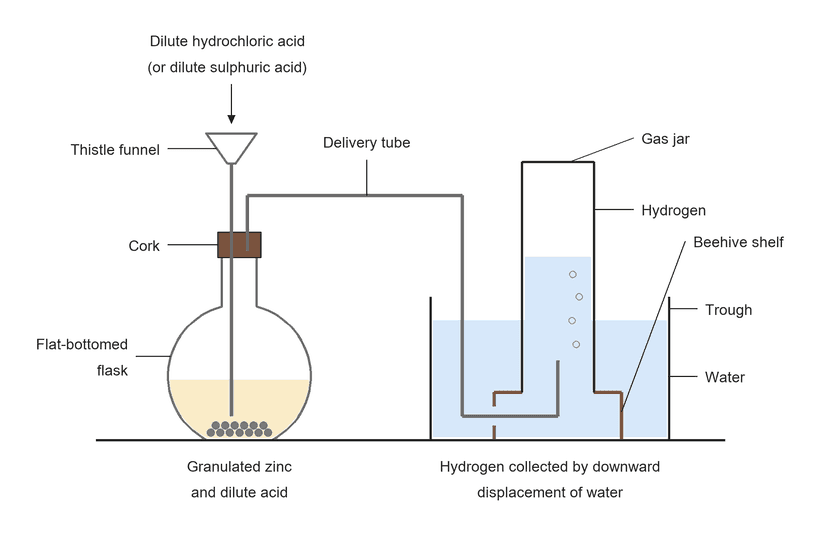
Watch out: The thistle funnel must dip into the acid, or the gas escapes through it.
Therefore, hydrogen is prepared from granulated zinc and dilute HCl (or dilute H₂SO₄) and collected by downward displacement of water, as shown in the diagram.
- 194 marks
Question 19
(a) Name the impurities present in hydrogen prepared in the laboratory.
(b) How can these impurities be removed ?
Solve with AIWritten solution
Solution:
Concept: Impurities in the zinc and in the acid give small amounts of other gases. Each is removed by passing the gas through a solution that absorbs it, and water vapour is removed by a drying agent.
Step 1 — (a) Name the impurities.
Hydrogen sulphide (), sulphur dioxide (), oxides of nitrogen, phosphine (), arsine (), carbon dioxide () and water vapour.
Step 2 — (b) Remove arsine and phosphine.
Pass the gas through silver nitrate solution, which absorbs arsine and phosphine.
Step 3 — (b) Remove hydrogen sulphide.
Pass it through lead nitrate solution, which precipitates black lead sulphide:
Step 4 — (b) Remove the acidic gases.
Pass it through caustic potash (KOH) solution, which absorbs sulphur dioxide, carbon dioxide and oxides of nitrogen:
Step 5 — (b) Dry the gas.
Pass it through a drying agent such as fused calcium chloride or phosphorus pentoxide, and collect the pure, dry gas over mercury (not over water, which would make it moist again).
Therefore, the impurities (, , oxides of nitrogen, , , , water vapour) are removed by silver nitrate, lead nitrate and caustic potash solutions and a drying agent, and the gas is collected over mercury.
- 202 marks
Question 20
Which test should be made before collecting hydrogen in a gas jar ?
Solve with AIWritten solution
Solution:
Concept: A mixture of hydrogen and air explodes when lit, so all the air must be driven out of the apparatus before the gas is collected.
Step 1 — Collect a sample.
Collect a little of the gas in a test tube by downward displacement of water.
Step 2 — Test it with a flame.
Bring the mouth of the test tube near a flame. If the gas burns quietly (without a pop), no air is left and the gas can now be collected in the gas jar.
Step 3 — Repeat if needed.
If it burns with a pop or a squeaky explosion, air is still present. Let more gas pass and repeat the test.
Watch out: Do the test away from the apparatus, never by holding a flame at the delivery tube.
Therefore, before collecting hydrogen, a test tube of the gas is lit away from the apparatus; only when it burns quietly (no pop) is all the air expelled.
- 212 marks
Question 21
Why is nitric acid not used in the preparation of hydrogen?
Solve with AIWritten solution
Solution:
Concept: Nitric acid, even when dilute, is a powerful oxidising agent.
Step 1 — See what happens to the hydrogen.
Any hydrogen formed is at once oxidised to water by the nitric acid, and the acid itself is reduced to oxides of nitrogen.
Step 2 — Write the reaction with zinc.
With dilute nitric acid, zinc gives nitric oxide instead of hydrogen:
Step 3 — Conclude.
So hydrogen is not obtained, which defeats the purpose. (Only magnesium and manganese give hydrogen, with very dilute, about 1 %, cold nitric acid.)
Therefore, nitric acid is not used because it oxidises the hydrogen to water and gives oxides of nitrogen instead.
- 222 marks
Question 22
Why is hot concentrated sulphuric acid not used in the preparation of hydrogen ?
Solve with AIWritten solution
Solution:
Concept: Hot concentrated sulphuric acid is a strong oxidising agent, unlike the dilute acid.
Step 1 — See the reaction with zinc.
With zinc it gives sulphur dioxide, not hydrogen:
Step 2 — See what happens to any hydrogen.
Any hydrogen formed is oxidised by the hot acid to water:
Step 3 — Conclude.
So no hydrogen is obtained.
Therefore, hot concentrated sulphuric acid is not used because, as an oxidising agent, it gives sulphur dioxide and oxidises any hydrogen to water.
- 234 marks
Question 23
Hydrogen is manufactured by ‘Bosch Process’.
(a) Give the equations with conditions.
(b) How can you obtain hydrogen from a mixture of hydrogen and carbon monoxide ?
Solve with AIWritten solution
Solution:
Concept: In the Bosch process, steam and hot coke give water gas (CO + ). More steam then turns the carbon monoxide into carbon dioxide and more hydrogen, and the carbon dioxide is easy to remove.
Step 1 — (a) Make water gas.
Steam is passed over red hot coke at about 1000 °C (the reaction absorbs heat):
Step 2 — (a) Convert the carbon monoxide.
Water gas is mixed with excess steam and passed over heated ferric oxide (catalyst) with chromic oxide (promoter) at about 450 °C (the reaction gives out heat):
Step 3 — (a) Remove carbon dioxide.
The gases are forced through cold water under about 30 atm, which dissolves the carbon dioxide, or passed through caustic potash solution:
Step 4 — (b) Separate hydrogen from carbon monoxide.
Pass the mixture through ammoniacal cuprous chloride solution, which absorbs carbon monoxide and leaves hydrogen:
Watch out: Caustic potash removes carbon DIOXIDE; carbon MONOXIDE needs ammoniacal cuprous chloride.
Therefore, (a) water gas from steam and coke at 1000 °C is shifted with steam over at 450 °C and the removed; (b) carbon monoxide is removed with ammoniacal cuprous chloride.
- 244 marks
Question 24
Give equations to express the reaction between :
(a) steam and red hot iron
(b) calcium and water
Solve with AIWritten solution
Solution:
Concept: Both metals displace hydrogen from water; the iron reaction needs steam and red heat and is reversible.
Step 1 — (a) Steam and red hot iron.
Triferric tetroxide and hydrogen form, and the reaction is reversible:
Step 2 — (b) Calcium and water.
Calcium reacts with cold water to give calcium hydroxide and hydrogen:
Therefore, (a) and (b) .
- 255 marks
Question 25
A small piece of calcium metal is put into a small trough containing water. There is effervescence and white turbidity is formed.
(a) Name the gas formed in the reaction. How would you test the gas ?
(b) Write an equation for the reaction.
(c) What do you observe when a few drops of red litmus solution are added to the turbid solution ?
Solve with AIWritten solution
Solution:
Concept: Calcium displaces hydrogen from cold water and forms calcium hydroxide, which is only slightly soluble (hence the white turbidity) and is alkaline.
Step 1 — (a) Name the gas.
The effervescence is due to hydrogen.
Step 2 — (a) Test the gas.
Bring a burning splint to the mouth of a test tube of the gas. The gas burns with a pop sound, and the splint itself goes out inside the tube (hydrogen does not support burning).
Step 3 — (b) Write the equation.
Calcium reacts with water as follows:
Step 4 — (c) Add red litmus.
The turbid liquid contains calcium hydroxide, an alkali, so red litmus turns blue.
Therefore, (a) the gas is hydrogen, which burns with a pop; (b) ; (c) red litmus turns blue.
- 265 marks
Question 26
Thin strips of magnesium, copper and iron are taken.
(a) Write down what happens when these metals are treated as follows :
(i) Heated in presence of air
(ii) Heated with dil. HCl
(iii) Added to an aqueous solution of zinc sulphate
(b) Arrange these metals in descending order of reactivity.
Solve with AIWritten solution
Solution:
Concept: In the activity series magnesium is above zinc, iron is below zinc but above hydrogen, and copper is below hydrogen. A metal displaces another only if it is higher in the series.
Step 1 — (a)(i) Heated in air.
Magnesium burns with a dazzling white light, forming white magnesium oxide. Copper does not burn; it is coated with black copper(II) oxide. An iron strip does not burn either; it is coated with black iron oxide:
Step 2 — (a)(ii) Heated with dilute HCl.
Magnesium reacts vigorously and iron gently (a pale green solution), both giving hydrogen. Copper does not react, as it is below hydrogen:
Step 3 — (a)(iii) Added to zinc sulphate solution.
Magnesium is above zinc, so it displaces zinc. Iron and copper are below zinc, so there is no reaction:
Step 4 — (b) Order of reactivity.
Magnesium reacts in all three tests, iron in one, and copper only slowly with oxygen, so the descending order is magnesium > iron > copper.
Therefore, magnesium burns, reacts with dilute HCl and displaces zinc; iron reacts only with dilute HCl (and tarnishes in air); copper only forms a black oxide; descending reactivity is Mg > Fe > Cu.
- 271 mark
Question 27
Hydrogen is evolved by the action of cold dil. on
Solve with AIAnswer
(A) Fe
(B) Cu
- Correct
(C) Mg
(D) Zn
Answer: (C) Mg
Concept: Nitric acid is an oxidising agent: it usually oxidises the hydrogen formed to water. Only magnesium and manganese give hydrogen, and only with very dilute (about 1 %) cold nitric acid.
Step 1 — Recall the exception.
Very dilute cold nitric acid behaves as an ordinary acid towards magnesium, so hydrogen is set free:
Step 2 — Pick the option.
Of the four metals only magnesium gives hydrogen with cold dilute nitric acid.
Why the other options are wrong:
- (A) Fe: This gives oxides of nitrogen, not hydrogen, with nitric acid.
- (B) Cu: This is below hydrogen in the activity series and never gives hydrogen with acids.
- (D) Zn: This gives nitric oxide with dilute nitric acid, because the hydrogen is oxidised to water.
Therefore, hydrogen is evolved by the action of cold dilute nitric acid on magnesium, option (C).
- 281 mark
Question 28
Which metal produces hydrogen gas on reaction with cold water ?
Solve with AIAnswer
(A) Al
(B) Fe
(C) Pd
- Correct
(D) Na
Answer: (D) Na
Concept: Only very active metals (K, Na, Ca) displace hydrogen from cold water.
Step 1 — Find the very active metal.
Sodium is near the top of the activity series and reacts vigorously with cold water:
Step 2 — Pick the option.
So sodium is the metal that gives hydrogen with cold water.
Why the other options are wrong:
- (A) Al: This reacts only with steam, and a coating of its oxide soon stops even that.
- (B) Fe: This reacts only when red hot, with steam.
- (C) Pd: This does not react with water; it only absorbs (occludes) hydrogen.
Therefore, sodium produces hydrogen with cold water, option (D).
- 291 mark
Question 29
The composition of the nucleus of deutrium is
Solve with AIAnswer
(A) 1 and 1 P
- Correct
(B) 1 P and 1 n
(C) 1 n and 1 e
(D) 2 P and 1
Answer: (B) 1 P and 1 n
Concept: Deuterium (printed 'deutrium') is the isotope of hydrogen with mass number 2. The nucleus contains protons and neutrons only; electrons move outside it.
Step 1 — Count the protons.
Deuterium is hydrogen, so its atomic number is 1: the nucleus has 1 proton.
Step 2 — Count the neutrons.
Neutrons are the mass number minus the atomic number:
Why the other options are wrong:
- (A) 1 and 1 P: Electrons are outside the nucleus, so this cannot describe a nucleus.
- (C) 1 n and 1 e: This leaves out the proton every hydrogen nucleus has, and puts an electron in the nucleus.
- (D) 2 P and 1 : Two protons would make the atom helium, and electrons are never in the nucleus.
Therefore, the nucleus of deuterium has 1 proton and 1 neutron, option (B).
- 301 mark
Question 30
Elements which show unique nature in the preparation of hydrogen are
Solve with AIAnswer
(A) Na, K, Li
(B) Mg, Ca, Ba
- Correct
(C) Al, Zn, Pb
(D) Fe, Cu, Ag
Answer: (C) Al, Zn, Pb
Concept: Metals with a unique nature give hydrogen with both acids and alkalis, because their oxides and hydroxides are amphoteric.
Step 1 — Recall the metals.
Zinc, aluminium and lead react with hot concentrated alkalis to give hydrogen, as well as with acids. For zinc:
Step 2 — Pick the option.
The set Al, Zn, Pb is the one with a unique nature.
Why the other options are wrong:
- (A) Na, K, Li: These give hydrogen with water and acids, but not with alkalis.
- (B) Mg, Ca, Ba: These do not react with alkalis to give hydrogen.
- (D) Fe, Cu, Ag: Iron does not react with alkalis, and copper and silver do not give hydrogen even with dilute acids.
Therefore, aluminium, zinc and lead show a unique nature, option (C).
- 315 marks
Question 31
Give reason for the following :
(a) Zinc granules are used in lab preparation of hydrogen.
(b) Purified and dried hydrogen is collected over mercury.
(c) The end of the thistle funnel should be dipped under acid.
(d) Dilute sulphuric acid cannot be replaced by concentrated acid in the preparation of hydrogen.
Solve with AIWritten solution
Solution:
Concept: Each step of the laboratory method is chosen to give pure hydrogen safely and at a good rate.
Step 1 — (a) Zinc granules.
Granulated zinc has a large surface area and contains copper as an impurity, which acts as a catalyst and speeds up the reaction. Pure zinc reacts very slowly with dilute acid.
Step 2 — (b) Collected over mercury.
If the purified, dried gas were collected over water it would become moist again. Mercury does not react with hydrogen and gives off almost no vapour, so the gas stays pure and dry.
Step 3 — (c) Thistle funnel under the acid.
The end of the funnel dips under the acid so that the acid acts as a seal; otherwise the hydrogen would escape through the funnel.
Step 4 — (d) Not concentrated acid.
Concentrated sulphuric acid is an oxidising agent. With zinc it gives sulphur dioxide instead of hydrogen:
Therefore, (a) granulated zinc reacts faster (copper impurity, more surface); (b) mercury keeps the dried gas dry; (c) the dipped funnel stops the gas escaping; (d) concentrated acid gives , not hydrogen.
- 324 marks
Question 32
(a) Where does hydrogen occur in free state ?
(b) How did the name ‘hydrogen’ originate ?
Solve with AIWritten solution
Solution:
Concept: Free (uncombined) hydrogen is rare on the earth because it is very light and escapes from the atmosphere, but it is the most abundant element in the universe.
Step 1 — (a) Where free hydrogen occurs.
Hydrogen occurs free only in traces on the earth: in the atmosphere (about 0.5 parts per million by volume), in volcanic gases and in some natural gas. The Sun and the stars are made mostly of hydrogen.
Step 2 — (b) Origin of the name.
Lavoisier (1783) named the gas hydrogen, from Greek words meaning 'water former' (hydro = water, genes = producing), because it burns in air to form water:
Note: Free hydrogen is sometimes quoted as "about 0.01 % of the atmosphere"; the measured value is only about 0.00005 % (0.5 parts per million).
Therefore, (a) free hydrogen occurs only in traces in the air and in volcanic gases, but abundantly in the Sun and stars; (b) Lavoisier named it hydrogen, 'water former', because it burns to form water.
- 334 marks
Question 33
Hydrogen can be prepared with the help of cold water. Give a reaction of hydrogen with :
(a) a monovalent metal
(b) a divalent metal.
Solve with AIWritten solution
Solution:
Concept: Very active metals displace hydrogen from cold water and form their hydroxides. A monovalent metal (valency 1) forms MOH; a divalent metal (valency 2) forms .
Step 1 — (a) A monovalent metal: sodium.
Sodium (valency 1) reacts vigorously with cold water:
Step 2 — (b) A divalent metal: calcium.
Calcium (valency 2) reacts steadily with cold water:
Watch out: A divalent metal needs 2 molecules of water for each atom; a monovalent one needs 2 atoms for each .
Therefore, (a) ; (b) .
- 345 marks
Question 34
Which metal is preferred for preparing hydrogen from :
(a) cold water ?
(b) hot water ?
(c) steam ?
Write balanced equation for each case.
Solve with AIWritten solution
Solution:
Concept: The activity series lists metals from most to least reactive: K, Na, Ca, Mg, Al, Zn, Fe, Pb, (H), Cu, Hg, Ag, Au. Only metals above hydrogen displace it from dilute acids, and the higher the metal, the milder the conditions it needs with water. The preferred metal gives hydrogen steadily and safely.
Step 1 — (a) Cold water: calcium.
Calcium reacts steadily with cold water, not violently like sodium and potassium:
Step 2 — (b) Hot water: magnesium.
Magnesium hardly reacts with cold water but reacts with boiling water:
Step 3 — (c) Steam: iron.
With magnesium, aluminium and zinc the oxide formed coats the metal and the reaction soon stops. With red hot iron, hydrogen is obtained continuously if a stream of steam keeps sweeping it away:
Therefore, the preferred metals are (a) calcium for cold water, (b) magnesium for hot water and (c) red hot iron for steam.
- 355 marks
Question 35
Hydrogen may be prepared in the laboratory by the action of a metal with an acid.
(a) Which of the metals copper, zinc, magnesium or sodium would be the most suitable ?
(b) Which of the acids dilute sulphuric, concentrated sulphuric, dilute nitric and concentrated nitric would you choose ? Explain why you would not use the acids you rejected.
(c) How would you modify your apparatus to collect dry hydrogen ? Which drying agent would you employ for this purpose ?
Solve with AIWritten solution
Solution:
Concept: The best metal–acid pair gives a steady stream of hydrogen at a low cost and safely; the acid must not be an oxidising agent.
Step 1 — (a) Choose the metal.
Zinc (granulated) is the most suitable. Copper is below hydrogen and does not react; sodium reacts violently (explosively) with acids; magnesium is costly and reacts very fast.
Step 2 — (b) Choose the acid.
Dilute sulphuric acid is chosen:
Step 3 — (b) Why not the others.
The other acids are not used, for the reasons below.
- Concentrated sulphuric acid is an oxidising agent; it gives sulphur dioxide instead of hydrogen.
- Dilute and concentrated nitric acid are powerful oxidising agents; they oxidise the hydrogen to water and give oxides of nitrogen instead.
Step 4 — (c) Collect dry hydrogen.
Pass the gas from the delivery tube through a U-tube or drying tower packed with the drying agent, and collect it over mercury instead of over water. The drying agent is fused calcium chloride (or phosphorus pentoxide).
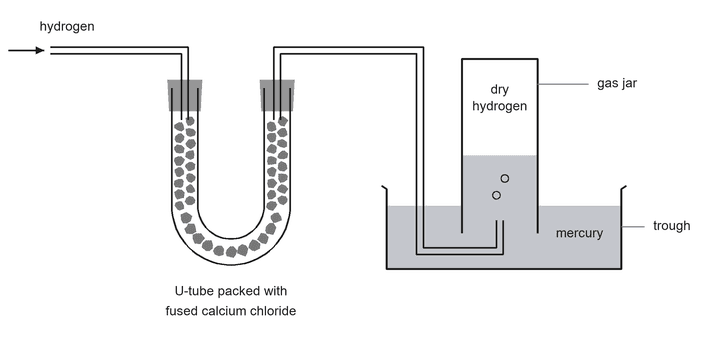
Watch out: Concentrated sulphuric acid is not used as the drier, because it can oxidise some hydrogen to water and give sulphur dioxide.
Therefore, (a) zinc, (b) dilute sulphuric acid (the others are oxidising agents), (c) dry the gas with fused calcium chloride in a U-tube and collect it over mercury.
- 365 marks
Question 36
Why are the following metals not used in the lab. preparation of hydrogen ?
(a) calcium
(b) iron
(c) aluminium
(d) sodium
Solve with AIWritten solution
Solution:
Concept: Zinc is preferred because each of these metals is too costly, too slow, too violent, or soon stops reacting.
Step 1 — (a) Calcium.
Calcium is expensive, and it reacts vigorously with acids.
Step 2 — (b) Iron.
Iron reacts slowly and has to be warmed, and the hydrogen it gives contains impurities such as hydrogen sulphide (from sulphur in the iron).
Step 3 — (c) Aluminium.
Aluminium has a great affinity for oxygen and is covered by a protective layer of aluminium oxide (), so at first it hardly reacts with the dilute acid.
Step 4 — (d) Sodium.
Sodium reacts violently (explosively) with acids, which is dangerous.
Therefore, calcium is too costly, iron too slow and gives impure gas, aluminium is protected by its oxide layer, and sodium reacts dangerously, so none is used.
- 372 marks
Question 37
Based on the reactions of water on metals, arrange the following metals in increasing order of reactivity : Iron, sodium, magnesium, zinc, calcium.
Solve with AIWritten solution
Solution:
Concept: The activity series lists metals from most to least reactive: K, Na, Ca, Mg, Al, Zn, Fe, Pb, (H), Cu, Hg, Ag, Au. Only metals above hydrogen displace it from dilute acids, and the higher the metal, the milder the conditions it needs with water.
Step 1 — Recall how each reacts with water.
Sodium reacts violently and calcium steadily with cold water; magnesium reacts with boiling water; zinc reacts only when steam is passed over the heated metal; iron reacts only when red hot, with steam.
Step 2 — Arrange them.
The milder the conditions needed, the more reactive the metal. In increasing order: iron < zinc < magnesium < calcium < sodium.
Watch out: The question asks for INCREASING order, so start with the least reactive metal.
Therefore, the increasing order of reactivity is iron < zinc < magnesium < calcium < sodium.
- 382 marks
Question 38
Hydrogen is evolved when dilute HCl reacts with magnesium, but nothing happens in the case of mercury and silver. Explain.
Solve with AIWritten solution
Solution:
Concept: The activity series lists metals from most to least reactive: K, Na, Ca, Mg, Al, Zn, Fe, Pb, (H), Cu, Hg, Ag, Au. Only metals above hydrogen displace it from dilute acids, and the higher the metal, the milder the conditions it needs with water.
Step 1 — Magnesium.
Magnesium is above hydrogen in the activity series, so it displaces hydrogen from dilute HCl:
Step 2 — Mercury and silver.
Mercury and silver are below hydrogen. They are less reactive than hydrogen, so they cannot displace it from the acid, and there is no reaction.
Therefore, magnesium gives hydrogen with dilute HCl because it is above hydrogen in the activity series, while mercury and silver, being below hydrogen, cannot displace it.
- 392 marks
Question 39
Steam can react with a metal and a non-metal to liberate hydrogen. Give necessary conditions and equations for the same.
Solve with AIWritten solution
Solution:
Concept: Steam gives up its oxygen to a substance that has a stronger hold on oxygen at high temperature, and hydrogen is set free.
Step 1 — A metal: iron.
Steam is passed over red hot iron; the reaction is reversible:
Step 2 — A non-metal: carbon.
Steam is passed over red hot coke at about 1000 °C, giving water gas (CO + ):
Therefore, steam gives hydrogen with red hot iron (forming ) and with red hot coke at about 1000 °C (forming water gas).
- 404 marks
Question 40
Hydrogen is obtained by displacement from :
(a) dilute sulphuric acid
(b) dilute hydrochloric acid
Write equations using zinc and Iron.
Why does not copper show a similar behaviour ?
Solve with AIWritten solution
Solution:
Concept: The activity series lists metals from most to least reactive: K, Na, Ca, Mg, Al, Zn, Fe, Pb, (H), Cu, Hg, Ag, Au. Only metals above hydrogen displace it from dilute acids, and the higher the metal, the milder the conditions it needs with water.
Step 1 — (a) Dilute sulphuric acid.
Zinc and iron, both above hydrogen, displace it to form their sulphates:
Step 2 — (b) Dilute hydrochloric acid.
They displace hydrogen to form their chlorides:
Step 3 — Why copper does not react.
Copper is below hydrogen in the activity series. It is less reactive than hydrogen, so it cannot displace hydrogen from dilute acids.
Watch out: Iron forms iron(II) salts here (, ), not iron(III) salts.
Therefore, zinc and iron displace hydrogen from both dilute acids (forming their sulphates and chlorides), but copper cannot, being below hydrogen in the activity series.
- 414 marks
Question 41
Give reason for the following :
(a) Though lead is above hydrogen in the activity series, it is not used to prepare hydrogen.
(b) Potassium and sodium are not used for reaction with dilute hydrochloric acid or dilute sulphuric acid in laboratory preparation of hydrogen.
Solve with AIWritten solution
Solution:
Concept: A metal used to prepare hydrogen must react steadily and keep on reacting.
Step 1 — (a) Lead.
Lead reacts with dilute hydrochloric or sulphuric acid to form lead chloride or lead sulphate, which are insoluble. This coating covers the lead and stops further reaction.
Step 2 — (b) Potassium and sodium.
These metals are so reactive that they react violently (explosively) with dilute acids, which is dangerous.
Therefore, (a) lead is not used because an insoluble coating of lead chloride or sulphate stops the reaction; (b) potassium and sodium are not used because they react explosively with acids.
- 422 marks
Question 42
Name two alkalies that can displace hydrogen. Give balanced equations for the same. Why are the metals you have used considered to have unique nature ?
Solve with AIWritten solution
Solution:
Concept: Hot concentrated alkalis give hydrogen with zinc, aluminium and lead, whose oxides and hydroxides are amphoteric.
Step 1 — Name two alkalis.
Sodium hydroxide and potassium hydroxide.
Step 2 — Write the equations.
Zinc with sodium hydroxide forms sodium zincate, and aluminium with potassium hydroxide forms potassium aluminate:
Step 3 — Explain 'unique nature'.
Zinc and aluminium (like lead) give hydrogen with both acids and alkalis, which most metals cannot do. This is called their unique nature.
Therefore, sodium hydroxide and potassium hydroxide displace hydrogen with zinc and aluminium, which have a unique nature because they give hydrogen with both acids and alkalis.
- 435 marks
Question 43
Complete and balance the following reactions.
(a) ________ + ________
(b) ________ + ________
(c) ________ + ________
(d) ________ + ________
(e) ________ + ________
(f) ________ + ________
(g) ________ + ________
(h) ________ + ________
(i) ________ + ________
(j) ________ + ________
Solve with AIWritten solution
Solution:
Concept: In each reaction the metal displaces hydrogen. The other product is the hydroxide or oxide (with water), the salt (with an acid), or the zincate or aluminate (with an alkali).
Step 1 — (a) Sodium and water.
Sodium gives sodium hydroxide and hydrogen:
Step 2 — (b) Calcium and water.
Calcium gives calcium hydroxide and hydrogen:
Step 3 — (c) Magnesium and water.
With steam, magnesium gives magnesium oxide and hydrogen (with boiling water it gives magnesium hydroxide instead):
Step 4 — (d) Zinc and water.
With steam, zinc gives zinc oxide and hydrogen:
Step 5 — (e) Iron and water.
Red hot iron and steam give triferric tetroxide and hydrogen (reversible):
Step 6 — (f) Zinc and hydrochloric acid.
Zinc gives zinc chloride and hydrogen:
Step 7 — (g) Aluminium and sulphuric acid.
Aluminium (valency 3) gives aluminium sulphate and hydrogen:
Step 8 — (h) Iron and hydrochloric acid.
Iron gives iron(II) chloride and hydrogen:
Step 9 — (i) Zinc and sodium hydroxide.
Zinc gives sodium zincate and hydrogen:
Step 10 — (j) Aluminium, potassium hydroxide and water.
Aluminium gives potassium aluminate and hydrogen:
Watch out: Balance the hydrogen last: count the H atoms on both sides after the metal and the other atoms are equal.
Therefore, the products are (a) NaOH + , (b) + , (c) MgO + , (d) ZnO + , (e) + , (f) + , (g) + , (h) + , (i) + , (j) + , balanced as shown.
- 444 marks
Question 44
If the following are kept in closed vessels at over 400°C, what would happen to them ?
(a) iron filings and steam,
(b) hydrogen and magnetic oxide of iron ?
Solve with AIWritten solution
Solution:
Concept: The reaction of iron with steam is reversible. In a closed vessel neither product can escape, so the reaction reaches the same equilibrium whichever side it starts from.
Step 1 — (a) Iron filings and steam.
Iron reacts with steam to form magnetic oxide of iron and hydrogen:
The products cannot escape, so the hydrogen reduces some of the oxide back. An equilibrium is set up in which iron, steam, and hydrogen are all present.
Step 2 — (b) Hydrogen and magnetic oxide of iron.
Hydrogen reduces the magnetic oxide to iron and steam (the backward reaction):
Again the products cannot escape, so the same equilibrium is reached, with all four substances present.
Watch out: The reaction does not go to completion in a closed vessel in either direction.
Therefore, in both vessels an equilibrium is reached in which iron, steam, magnetic oxide of iron and hydrogen are all present.
- 455 marks
Question 45
(a) A metal in the powdered form reacts very slowly with boiling water, but it decomposes with steam. Name the metal.
(b) Write a balanced equation for the reaction of the named metal with (i) boiling water (ii) steam.
Solve with AIWritten solution
Solution:
Concept: Magnesium is below calcium in the activity series: it reacts only very slowly with boiling water but burns brightly in steam.
Step 1 — (a) Name the metal.
The metal is magnesium.
Step 2 — (b)(i) With boiling water.
Magnesium hydroxide and hydrogen form slowly:
Step 3 — (b)(ii) With steam.
Magnesium oxide and hydrogen form:
Watch out: Boiling water gives the hydroxide, steam gives the oxide.
Therefore, the metal is magnesium: with boiling water it gives and hydrogen, and with steam MgO and hydrogen.
- 462 marks
Question 46
What do you observe when hydrogen gas is passed through soap solution ?
Solve with AIWritten solution
Solution:
Concept: Hydrogen is the lightest gas, about 14 times lighter than air.
Step 1 — Describe what is seen.
Bubbles of soap solution filled with hydrogen form at the end of the tube, break free and rise up in the air.
Step 2 — Explain it.
The bubbles rise because the hydrogen inside them is much lighter than the air they push aside.
Therefore, soap bubbles filled with hydrogen rise in the air, which shows that hydrogen is lighter than air.
- 475 marks
Question 47
Under what conditions can hydrogen be made to combine with
(a) nitrogen
(b) chlorine
(c) sulphur
(d) oxygen
Name the products in each case and write the equation for each reaction.
Solve with AIWritten solution
Solution:
Concept: Hydrogen combines with non-metals only under suitable conditions of temperature, pressure, light, catalyst or ignition.
Step 1 — (a) Nitrogen.
One volume of nitrogen and three volumes of hydrogen are passed over finely divided iron (catalyst, with molybdenum as promoter) at 450–500 °C and 200–900 atm (Haber process). The product is ammonia:
Step 2 — (b) Chlorine.
Equal volumes react slowly in diffused sunlight (explosively in direct sunlight). The product is hydrogen chloride:
Step 3 — (c) Sulphur.
Hydrogen is passed through molten (boiling) sulphur. The product is hydrogen sulphide:
Step 4 — (d) Oxygen.
The mixture is ignited with a flame or an electric spark; hydrogen burns with a pale blue flame. The product is water:
Watch out: The reaction with nitrogen is reversible, so the ammonia formed is only part of the mixture.
Therefore, hydrogen forms (a) ammonia with nitrogen (Fe catalyst, 450–500 °C, high pressure), (b) hydrogen chloride with chlorine (diffused sunlight), (c) hydrogen sulphide with molten sulphur and (d) water with oxygen (on ignition).
- 485 marks
Question 48
When hydrogen is passed over a black solid compound A, the products are ‘a colourless liquid’ and ‘a reddish brown metal B.’
Substance B is divided into two parts, each placed in separate test tubes.
Dilute HCl is added to one part of substance B and dilute to the other.
(a) Name the substances A and B.
(b) Give two tests for the colourless liquid formed in the experiment.
(c) What happens to substance A when it reacts with hydrogen ? Give reasons for your answer.
(d) Write an equation for the reaction between hydrogen and substance A.
(e) Is there any reaction between substance B and dilute hydrochloric acid ? Give reasons for your answer.
Solve with AIWritten solution
Solution:
Concept: Hydrogen reduces the heated oxide of a less active metal: it removes the oxygen, leaving the metal, and is itself oxidised to water.
Step 1 — (a) Identify A and B.
A black oxide that gives a reddish brown metal and a colourless liquid with hydrogen is copper(II) oxide (CuO), so this is substance A. The reddish brown metal B is copper (Cu).
Step 2 — (b) Tests for the colourless liquid (water).
The liquid is shown to be water by these tests.
- It turns white anhydrous copper sulphate blue.
- It turns blue cobalt chloride paper pink.
Step 3 — (c) What happens to A.
Substance A is reduced to copper, because hydrogen removes oxygen from it (removal of oxygen is reduction). The black solid turns reddish brown, and hydrogen, the reducing agent, is oxidised to water.
Step 4 — (d) Equation.
Hydrogen reacts with heated copper(II) oxide as follows:
Step 5 — (e) B with dilute hydrochloric acid.
There is no reaction. Copper is below hydrogen in the activity series, so it cannot displace hydrogen from dilute hydrochloric acid.
Note: The stem also adds dilute nitric acid to copper but asks nothing about it. (Copper does react with dilute nitric acid, giving nitric oxide, because the acid is an oxidising agent.)
Therefore, (a) A is copper(II) oxide and B is copper; (b) the liquid (water) turns anhydrous copper sulphate blue and cobalt chloride paper pink; (c) A is reduced; (d) ; (e) copper does not react with dilute HCl, being below hydrogen.
- 491 mark
Question 49
Helium is preferred to hydrogen for filling balloons because it is :
Solve with AIAnswer
(A) lighter than air
(B) almost as light as hydrogen
- Correct
(C) non-combustible
(D) inflammable.
Answer: (C) non-combustible
Concept: A gas for balloons must be lighter than air and safe. Hydrogen is the lighter of the two, but it catches fire and forms an explosive mixture with air.
Step 1 — Compare the two gases.
Both gases are lighter than air, and hydrogen is lighter still. So lightness is not why helium is preferred.
Step 2 — Find the deciding property.
Helium is a noble gas and does not burn, while hydrogen is highly inflammable. Helium is therefore safe to use in balloons.
Why the other options are wrong:
- (A) lighter than air: This is true of hydrogen as well, so it is no reason to prefer helium.
- (B) almost as light as hydrogen: Helium is about twice as dense as hydrogen; a gas that is only nearly as light is not chosen for its lightness.
- (D) inflammable: Helium is not inflammable; it is hydrogen that is inflammable, which is the danger.
Therefore, helium is preferred because it is non-combustible, option (C).
- 501 mark
Question 50
Upon reacting with water, an active metal produces :
Solve with AIAnswer
(A) oxygen
(B) nitric acid
- Correct
(C) a base
(D) none of these.
Answer: (C) a base
Concept: An active metal displaces hydrogen from water and forms the metal hydroxide, which is a base (an alkali if it dissolves).
Step 1 — Take an example.
Sodium reacts with water as follows:
Step 2 — Identify the product.
Sodium hydroxide is a base, so an active metal produces a base (along with hydrogen).
Why the other options are wrong:
- (A) oxygen: Hydrogen, not oxygen, is set free from the water.
- (B) nitric acid: Nitric acid contains nitrogen, which is present in neither the metal nor the water.
- (D) none of these: This is wrong because a base is formed.
Therefore, an active metal reacting with water produces a base, option (C).
- 511 mark
Question 51
A metal oxide that is reduced by hydrogen is :
Solve with AIAnswer
(A)
- Correct
(B) CuO
(C) CaO
(D)
Answer: (B) CuO
Concept: Hydrogen reduces the heated oxides of less active metals (below zinc in the activity series, such as copper, lead and iron). It cannot reduce oxides of very active metals (K, Na, Ca, Mg, Al).
Step 1 — Find the less active metal.
Copper is below hydrogen in the activity series, so hydrogen removes the oxygen from heated copper(II) oxide:
Step 2 — Pick the option.
So CuO is the oxide reduced by hydrogen.
Why the other options are wrong:
- (A) : Aluminium holds oxygen very strongly, so this oxide is not reduced by hydrogen.
- (C) CaO: Calcium is a very active metal, so this oxide is not reduced by hydrogen.
- (D) : Sodium is a very active metal, so this oxide is not reduced by hydrogen.
Therefore, the metal oxide reduced by hydrogen is CuO, option (B).
- 521 mark
Question 52
Which of the following statements about hydrogen is incorrect ?
Solve with AIAnswer
(A) It is an inflammable gas
(B) It is the lightest gas.
(C) It is not easily liquefied.
- Correct
(D) It is a strong oxidizing agent.
Answer: (D) It is a strong oxidizing agent.
Concept: Hydrogen removes oxygen from metal oxides and is itself oxidised to water, so it is a reducing agent, not an oxidising agent.
Step 1 — Check each statement.
Hydrogen burns readily (it is inflammable), it is the lightest gas, and it is hard to liquefy. All three statements are correct.
Step 2 — Find the incorrect one.
Hydrogen reduces CuO to copper, so it is a strong reducing agent. The statement that it is a strong oxidising agent is incorrect:
Watch out: The question asks for the INCORRECT statement.
Why the other options are wrong:
- (A) It is an inflammable gas: This statement is correct: hydrogen burns readily, which is why Cavendish called it inflammable air.
- (B) It is the lightest gas: This statement is correct: hydrogen is the lightest of all gases.
- (C) It is not easily liquefied: This statement is correct: hydrogen boils at −253 °C and cannot be liquefied above about −240 °C, however much it is compressed.
Therefore, the incorrect statement is that hydrogen is a strong oxidising agent, option (D).
- 531 mark
Question 53
For the reaction , which of the following statements is wrong ?
Solve with AIAnswer
(A) is the reducing agent.
(B) PbO is the oxidizing agent.
- Correct
(C) PbO is oxidized to Pb
(D) is oxidized to .
Answer: (C) PbO is oxidized to Pb
Concept: Oxidation is the addition of oxygen (or removal of hydrogen), or the loss of electrons. Reduction is the removal of oxygen (or addition of hydrogen), or the gain of electrons. The substance that is reduced is the oxidising agent; the substance that is oxidised is the reducing agent.
Step 1 — Look at PbO.
PbO loses its oxygen and becomes Pb, so PbO is reduced (and it is the oxidising agent):
Step 2 — Look at hydrogen.
Hydrogen gains oxygen and becomes water, so it is oxidised (and it is the reducing agent).
Step 3 — Find the wrong statement.
The statement 'PbO is oxidised to Pb' is wrong; PbO is reduced.
Watch out: The question asks for the WRONG statement.
Why the other options are wrong:
- (A) is the reducing agent: This is correct: hydrogen removes oxygen from PbO, so it is the reducing agent.
- (B) PbO is the oxidizing agent: This is correct: PbO gives its oxygen to hydrogen, so it is the oxidising agent.
- (D) is oxidized to : This is correct: hydrogen gains oxygen to become water, which is oxidation.
Therefore, the wrong statement is 'PbO is oxidised to Pb', option (C).
- 541 mark
Question 54
Which metal gives hydrogen with all of the following : water, acids, alkalis ?
Solve with AIAnswer
(A) Fe
- Correct
(B) Zn
(C) Mg
(D) Pb
Answer: (B) Zn
Concept: Zinc has a unique nature: besides acids and steam, it gives hydrogen with hot concentrated alkalis, because its oxide is amphoteric.
Step 1 — Check zinc with all three.
Zinc gives hydrogen with steam, with dilute acid and with hot sodium hydroxide:
Step 2 — Pick the option.
Only zinc reacts with all three of water, acids and alkalis.
Why the other options are wrong:
- (A) Fe: This reacts with steam and with acids, but not with alkalis.
- (C) Mg: This reacts with water and with acids, but not with alkalis.
- (D) Pb: This reacts with alkalis and acids, but not with water, even as steam.
Therefore, zinc gives hydrogen with water, acids and alkalis, option (B).
- 551 mark
Question 55
Which of the following metals does not give hydrogen with acids ?
Solve with AIAnswer
(A) Iron
- Correct
(B) Copper
(C) Magnesium
(D) Zinc
Answer: (B) Copper
Concept: Only metals above hydrogen in the activity series displace hydrogen from dilute acids.
Step 1 — Place each metal.
Magnesium, zinc and iron are above hydrogen; copper is below it.
Step 2 — Pick the option.
Copper is less reactive than hydrogen, so it does not give hydrogen with dilute acids.
Why the other options are wrong:
- (A) Iron: This is above hydrogen and gives hydrogen with dilute acids.
- (C) Magnesium: This is above hydrogen and gives hydrogen vigorously with dilute acids.
- (D) Zinc: This is above hydrogen and is the metal used to prepare hydrogen from dilute acids.
Therefore, copper does not give hydrogen with acids, option (B).
- 565 marks
Question 56
Choose terms from the options given in brackets to complete these sentences.
(a) When CuO reacts with hydrogen, ________ is reduced to ________ and ________ is oxidized to ________. (CuO, , Cu, )
(b) Hydrogen is ________ soluble in water. (sparingly, highly, moderately)
(c) Metals like ________, ________ and ________ give with steam. (iron, magnesium, aluminium, sodium, calcium)
(d) Sodium ________ reacts smoothly with cold water. (metal, amalgam, in the molten state)
(e) A metal ________ hydrogen in the activity series gives hydrogen with ________ acid or ________ acid. (above, below, dilute hydrochloric, concentrated hydrochloric, dilute sulphuric).
Solve with AIWritten solution
Solution:
Concept: Hydrogen is a reducing agent and is only sparingly soluble in water; the activity series tells which metals give hydrogen with steam or acids.
Step 1 — (a) CuO and hydrogen.
CuO loses oxygen and hydrogen gains it:
So CuO is reduced to Cu and hydrogen is oxidised to water.
Step 2 — (b) Solubility.
Hydrogen is only sparingly soluble in water, which is why it is collected over water.
Step 3 — (c) Metals that give hydrogen with steam.
Iron, magnesium and aluminium react with steam. (Sodium and calcium already react with cold water.)
Step 4 — (d) Smooth reaction with cold water.
Sodium amalgam (sodium dissolved in mercury) reacts smoothly, not violently, with cold water.
Step 5 — (e) Metals above hydrogen.
A metal above hydrogen in the activity series gives hydrogen with dilute hydrochloric acid or dilute sulphuric acid.
Therefore, (a) CuO is reduced to Cu and is oxidised to ; (b) sparingly; (c) iron, magnesium, aluminium; (d) amalgam; (e) above, dilute hydrochloric, dilute sulphuric.
- 575 marks
Question 57
Name :
(a) an oxidizing agent that does not contain oxygen.
(b) a substance that oxidizes concentrated HCl to chlorine.
(c) a substance that will reduce aqueous Iron (III) ions to Iron (II) ions.
(d) a liquid that is an oxidizing as well as a reducing agent.
(e) a gas that is an oxidizing as well as a reducing agent.
(f) a solid that is an oxidizing agent.
Solve with AIWritten solution
Solution:
Concept: Oxidation is the addition of oxygen (or removal of hydrogen), or the loss of electrons. Reduction is the removal of oxygen (or addition of hydrogen), or the gain of electrons. The substance that is reduced is the oxidising agent; the substance that is oxidised is the reducing agent.
Step 1 — (a) An oxidising agent without oxygen.
Chlorine () removes hydrogen or electrons from other substances, e.g. it oxidises to sulphur.
Step 2 — (b) Oxidises concentrated HCl to chlorine.
Manganese dioxide () removes hydrogen from HCl:
Step 3 — (c) Reduces iron(III) ions to iron(II) ions.
Hydrogen sulphide () does this, being itself oxidised to sulphur:
Step 4 — (d) A liquid that oxidises and reduces.
Hydrogen peroxide () can either give oxygen or take it up, depending on what it reacts with.
Step 5 — (e) A gas that oxidises and reduces.
Sulphur dioxide () usually acts as a reducing agent, but it oxidises to sulphur.
Step 6 — (f) A solid oxidising agent.
Potassium permanganate (); manganese dioxide and lead dioxide are other examples.
Therefore, (a) chlorine, (b) manganese dioxide, (c) hydrogen sulphide, (d) hydrogen peroxide, (e) sulphur dioxide, (f) potassium permanganate.
- 585 marks
Question 58
Correct the following statements :
(a) Hydrogen is separated from CO by passing the mixture through caustic potash solution.
(b) All metals react with acids to give hydrogen.
(c) Hydrogen is dried by passing it through conc. .
(d) Very dilute nitric acid reacts with iron to produce hydrogen.
(e) Conc. reacts with zinc to liberate hydrogen.
Solve with AIWritten solution
Solution:
Concept: Correct only the part of each statement that is wrong, and keep the rest.
Step 1 — (a) Separating hydrogen from CO.
Hydrogen is separated from CO by passing the mixture through ammoniacal cuprous chloride solution, which absorbs CO. (Caustic potash removes carbon dioxide, not carbon monoxide.)
Step 2 — (b) Metals with acids.
Only metals above hydrogen in the activity series react with dilute acids to give hydrogen.
Step 3 — (c) Drying hydrogen.
Hydrogen is dried by passing it through fused calcium chloride (or phosphorus pentoxide). Concentrated sulphuric acid is avoided because it can oxidise some of the hydrogen:
Step 4 — (d) Very dilute nitric acid.
Very dilute nitric acid reacts with magnesium (or manganese) to produce hydrogen; with iron it gives oxides of nitrogen.
Step 5 — (e) Zinc and sulphuric acid.
Dilute sulphuric acid reacts with zinc to liberate hydrogen; concentrated sulphuric acid gives sulphur dioxide.
Therefore, (a) ammoniacal cuprous chloride, (b) only metals above hydrogen, (c) fused calcium chloride, (d) magnesium (or manganese), (e) dilute are the corrected words.
- 595 marks
Question 59
Divide the following redox reactions into oxidation and reduction half reactions.
(i)
(ii)
(iii)
Solve with AIWritten solution
Solution:
Concept: Oxidation is the addition of oxygen (or removal of hydrogen), or the loss of electrons. Reduction is the removal of oxygen (or addition of hydrogen), or the gain of electrons. The substance that is reduced is the oxidising agent; the substance that is oxidised is the reducing agent. In a half reaction, electrons are written on the right for oxidation (lost) and on the left for reduction (gained); the charge must balance on both sides.
Step 1 — (i) Zinc and lead ions.
Zinc loses 2 electrons (oxidation) and the lead ion gains them (reduction):
Step 2 — (ii) Zinc and copper ions.
Zinc loses 2 electrons (oxidation) and the copper ion gains them (reduction):
Step 3 — (iii) Chlorine and bromide ions.
Two bromide ions lose one electron each (oxidation) and the chlorine molecule gains them (reduction):
Watch out: In each pair the electrons lost must equal the electrons gained.
Therefore, the oxidation half reactions are the loss of electrons by Zn, Zn and , and the reduction half reactions the gain of electrons by , and .
- 604 marks
Question 60
(a) Write the equation in the ionic form
(b) Divide the above equation into oxidation and reduction half reactions.
Solve with AIWritten solution
Solution:
Concept: In the ionic form every soluble ionic compound is written as its ions. Ions that do not change (spectator ions) can then be left out.
Step 1 — (a) Write all the ions.
Copper sulphate and iron(II) sulphate are written as ions:
Step 2 — (a) Leave out the spectator ion.
The sulphate ion is unchanged, so the ionic equation is:
Step 3 — (b) Oxidation half reaction.
Iron loses two electrons:
Step 4 — (b) Reduction half reaction.
The copper ion gains two electrons:
Therefore, (a) ; (b) iron is oxidised () and copper ions are reduced ().
- 615 marks
Question 61
Select the odd one out and justify your answer.
(a) Zn, Fe, Mg and Na
(b) , , and
(c) Fe, Zn, Cu and Mg
(d) Fe, Pb, Al and Zn
Solve with AIWritten solution
Solution:
Concept: Look for the one property shared by three of the four; the fourth is the odd one out.
Step 1 — (a) Zn, Fe, Mg, Na.
Na is the odd one out. It is a monovalent alkali metal that reacts vigorously with cold water; zinc, iron and magnesium (valency usually 2) do not react with cold water (magnesium only very slowly).
Step 2 — (b) SO₂, H₂S, NH₃, CO₂.
is the odd one out: , and are reducing agents, but is not. (Another accepted answer is , the only basic gas; the other three are acidic.)
Step 3 — (c) Fe, Zn, Cu, Mg.
Cu is the odd one out: it is below hydrogen in the activity series and does not give hydrogen with dilute acids, while Fe, Zn and Mg do.
Step 4 — (d) Fe, Pb, Al, Zn.
Fe is the odd one out: Pb, Al and Zn have a unique nature (they give hydrogen with alkalis as well as acids), but iron does not react with alkalis.
Therefore, the odd ones out are (a) Na, (b) (or by acid–base nature), (c) Cu and (d) Fe.
- 625 marks
Question 62
Give reasons :
(a) Hydrogen is collected by the downward displacement of water and not of air, even though it is lighter than air.
(b) A candle brought near the mouth of a jar containing hydrogen gas starts burning but is extinguished when pushed inside the jar.
(c) Apparatus for laboratory preparation of hydrogen should be air tight and away from a naked flame.
Solve with AIWritten solution
Solution:
Concept: Hydrogen burns but does not support burning, it is only sparingly soluble in water, and a hydrogen–air mixture explodes near a flame.
Step 1 — (a) Collected over water, not air.
Hydrogen is lighter than air, but collecting it by displacing air would leave it mixed with air, and such a mixture explodes with a flame. Because hydrogen is only sparingly soluble in water, it can be collected safely over water.
Step 2 — (b) The candle.
Hydrogen is combustible, so it burns at the mouth of the jar where it meets air. But it does not support combustion, so the candle goes out when pushed inside the jar.
Step 3 — (c) Airtight and away from flames.
A mixture of hydrogen and air explodes violently near a flame. The apparatus is kept airtight so that no hydrogen leaks out to form such a mixture, and away from naked flames so that nothing can ignite it.
Therefore, (a) hydrogen forms an explosive mixture with air but is sparingly soluble in water; (b) it burns but does not support burning; (c) a hydrogen–air mixture explodes near a flame.
- 635 marks
Question 63
Write half reactions for the following reaction :
and name the following :
(a) oxidizing agent
(b) substance oxidized
(c) reducing agent.
Solve with AIWritten solution
Solution:
Concept: Oxidation is the addition of oxygen (or removal of hydrogen), or the loss of electrons. Reduction is the removal of oxygen (or addition of hydrogen), or the gain of electrons. The substance that is reduced is the oxidising agent; the substance that is oxidised is the reducing agent. In a half reaction, electrons are written on the right for oxidation (lost) and on the left for reduction (gained); the charge must balance on both sides.
Step 1 — Write the half reactions.
B loses one electron (oxidation) and gains it (reduction):
Step 2 — (a) Oxidising agent.
gains the electron (it is reduced), so it is the oxidising agent.
Step 3 — (b) Substance oxidised.
B loses an electron, so B is oxidised.
Step 4 — (c) Reducing agent.
B gives the electron to , so B is the reducing agent.
Watch out: The substance oxidised is the reducing agent, not the oxidising agent.
Therefore, the half reactions are and ; (a) is the oxidising agent, (b) B is oxidised, (c) B is the reducing agent.
- 645 marks
Question 64
State whether the following conversions are oxidation or reduction reactions.
(a)
(b)
(c)
(d)
Solve with AIWritten solution
Solution:
Concept: Oxidation is the addition of oxygen (or removal of hydrogen), or the loss of electrons. Reduction is the removal of oxygen (or addition of hydrogen), or the gain of electrons. The substance that is reduced is the oxidising agent; the substance that is oxidised is the reducing agent.
Step 1 — (a) Lead dioxide with sulphur dioxide.
Sulphur dioxide gains oxygen and becomes a sulphate, so for this is oxidation. At the same time gives up oxygen and is reduced, so the whole change is a redox reaction.
Step 2 — (b) A copper ion gaining electrons.
The copper ion gains electrons, so this is reduction.
Step 3 — (c) Potassium forming its ion.
Potassium loses an electron, so this is oxidation.
Step 4 — (d) Chloride ions to chlorine.
Chloride ions lose electrons (the stem writes this as subtracting 2e⁻), so this is oxidation:
Therefore, (a) oxidation (of ), (b) reduction, (c) oxidation, (d) oxidation.
- 655 marks
Question 65
State, giving reasons, whether the substances printed in bold letters have been oxidised or reduced.
(a)
(b)
(c)
(d)
Solve with AIWritten solution
Solution:
Concept: Oxidation is the addition of oxygen (or removal of hydrogen), or the loss of electrons. Reduction is the removal of oxygen (or addition of hydrogen), or the gain of electrons. The substance that is reduced is the oxidising agent; the substance that is oxidised is the reducing agent.
Step 1 — (a) Lead monoxide with carbon monoxide.
PbO is reduced, because oxygen is removed from it and it becomes Pb.
Step 2 — (b) Magnesium with hydrochloric acid.
Mg is oxidised, because it loses two electrons and becomes :
Step 3 — (c) Hydrogen sulphide with chlorine.
is oxidised, because hydrogen is removed from it and it becomes sulphur.
Step 4 — (d) Chlorine with hydrogen sulphide.
is reduced, because hydrogen is added to it and it becomes HCl.
Watch out: (c) and (d) are the same reaction; one bold substance is oxidised and the other reduced.
Therefore, (a) PbO is reduced, (b) Mg is oxidised, (c) is oxidised, (d) is reduced.
- 663 marks
Question 66
Is it essential that oxidation and reduction must occur side by side in a chemical reaction ? Explain.
Solve with AIWritten solution
Solution:
Concept: Whatever one substance gains (oxygen or electrons) must come from another substance, which loses it. So oxidation and reduction always occur together, in a redox reaction.
Step 1 — State the answer.
Yes. When one substance is oxidised, another must be reduced at the same time.
Step 2 — Oxygen view.
When a substance gains oxygen, that oxygen comes from another substance, which is reduced. Here hydrogen is oxidised to water while copper(II) oxide is reduced to copper:
Step 3 — Electron view.
Electrons lost in oxidation are gained at the same moment in reduction. Here zinc loses 2 electrons and the copper ion gains them:
Step 4 — Name the reaction.
A reaction in which oxidation and reduction take place together is called a redox reaction.
Therefore, yes: oxidation and reduction always occur side by side, because what one substance loses another must gain; such reactions are redox reactions.
- 673 marks
Question 67
Describe briefly the ionic concept of oxidation and reduction. Give an equation to illustrate.
Solve with AIWritten solution
Solution:
Concept: In the electronic (ionic) concept, oxidation is the loss of electrons and reduction is the gain of electrons.
Step 1 — Define the terms.
Oxidation: an atom or ion loses electron(s). Reduction: an atom or ion gains electron(s).
Step 2 — Give the example.
When zinc is added to copper sulphate solution, zinc displaces copper:
Step 3 — Split into half reactions.
Zinc loses two electrons and the copper ion gains them:
Step 4 — Name the agents.
Zinc is oxidised, so it is the reducing agent; copper ions are reduced, so they are the oxidising agent.
Therefore, in the ionic concept oxidation is the loss and reduction the gain of electrons, as in .
- 683 marks
Question 68
State the similarities of hydrogen with group 1 elements and group 17 elements.
Solve with AIWritten solution
Solution:
Concept: Hydrogen has one valence electron (like group 1) and is one electron short of a noble gas (like group 17).
Step 1 — Similarities with group 1 (alkali metals).
Hydrogen resembles the alkali metals in these ways.
- One electron in the outermost shell; valency 1.
- It forms a positive ion by losing one electron, as sodium does.
- It acts as a reducing agent, e.g. it reduces heated CuO to copper.
- It burns in oxygen to form an oxide and combines with non-metals: , , HCl, like , , NaCl.
Step 2 — Similarities with group 17 (halogens).
Hydrogen resembles the halogens in these ways.
- One electron short of the nearest noble gas (H 1, He 2; Cl 2, 8, 7, Ar 2, 8, 8); valency 1.
- It forms a negative ion by gaining one electron, as chlorine does.
- It is a non-metal (electronegative character).
- It is a gas, like fluorine and chlorine, made of diatomic molecules: , , .
Therefore, hydrogen resembles group 1 in having one valence electron, forming a positive ion and acting as a reducing agent, and group 17 in being one electron short of a noble gas, forming a negative ion and existing as diatomic gas molecules.
- 693 marks
Question 69
Which is the most preferred metal for the laboratory preparation of hydrogen? Why is any other metal not used?
- 703 marks
Question 70
Describe the laboratory preparation of hydrogen with a labelled diagram. How are the impurities removed ?
- 713 marks
Question 71
How is hydrogen manufactured ? Describe with the equation(s) involved.
- 725 marks
Question 72
Look at the following figure and answer the questions that follow :
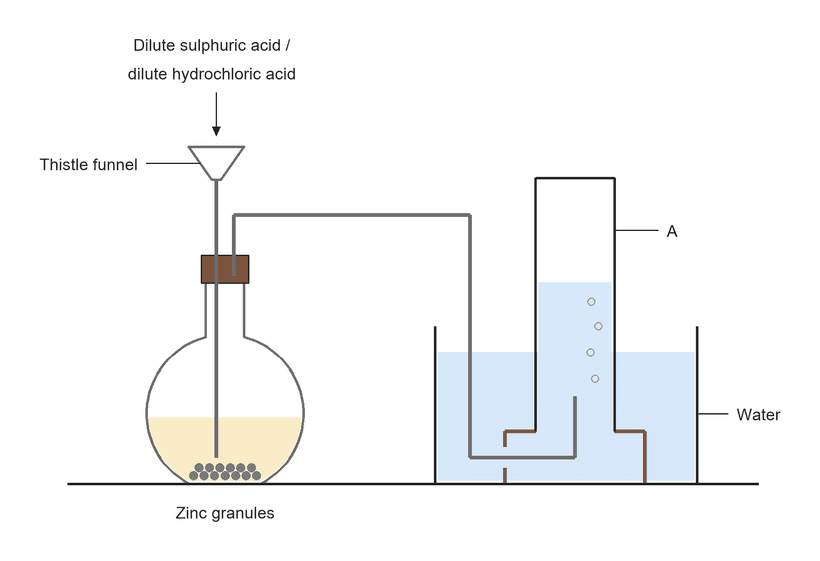
(a) Which gas is prepared by this method marked as A.
(b) Name this method of collection. Why is this method used ?
(c) Why is nitric acid not used as a reactant in the above method ?
(d) Conc. is a good drying agent. However, it is not used here. Why ?
What Class 9 Chemistry Ch 6 covers
The sections of the chapter, in the order the book takes them. Every question above comes from one of these.
- 01Position of Hydrogen in Periodic Table
- 02Discovery
- 03Occurrence
- 04Preparation of Hydrogen
- 05Activity Series in the Preparation of Hydrogen
- 06Laboratory Preparation of Hydrogen
More ways to study this chapter
The same chapter asked three other ways. Practise it, revise it, and see what the board has set on Ch 6 before.
Class 9 Chemistry Ch 6 questions students ask
How many questions are there in Class 9 Chemistry Ch 6?
72 questions. Every one is solved step by step on this page.
Are these Class 9 Chemistry solutions free?
Yes. Every question and its full working is free to read, with no account needed.
Can I download the Class 9 Chemistry Ch 6 solutions as a PDF?
There is no PDF to download. Every solution is on this page instead, which means it is searchable, always the current syllabus, and readable on a phone. Use your browser's print option if you want it on paper.