
Question 703 marksMedium
Describe the laboratory preparation of hydrogen with a labelled diagram. How are the impurities removed ?
Confirming your payment
Sign up now and get 250 free tokens.
Study of the First Element – Hydrogen · Question 70 of 72
Describe the laboratory preparation of hydrogen with a labelled diagram. How are the impurities removed ?
Solution:
Concept: Granulated zinc and dilute acid give hydrogen, which is collected over water. The impurities are absorbed by suitable solutions, the gas is dried, and pure dry hydrogen is collected over mercury.
Step 1 — Set up the apparatus.
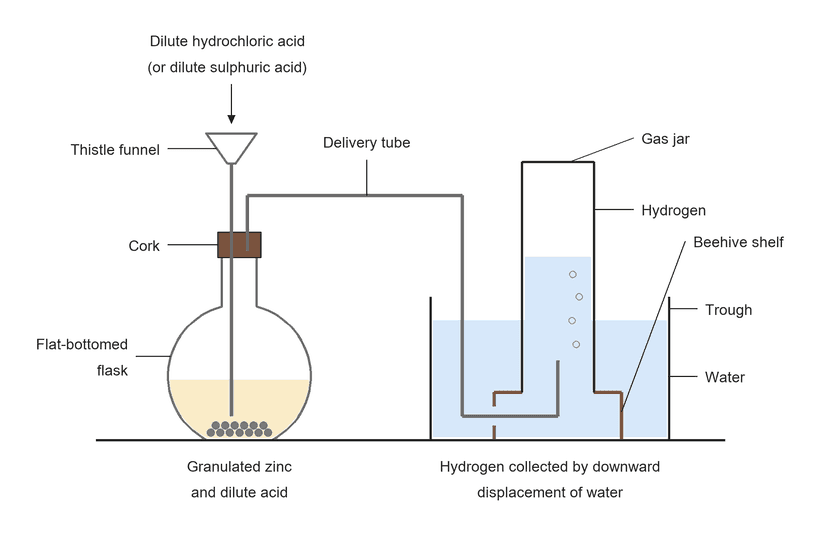
Place granulated zinc in a flat-bottomed flask fitted with an airtight cork with two holes. Through one hole pass a thistle funnel whose stem dips into the acid; through the other, a delivery tube that starts just below the cork.
Step 2 — Start the reaction.
Pour dilute hydrochloric acid (or dilute sulphuric acid) through the funnel. Effervescence starts:
Step 3 — Collect the gas.
When all the air has been driven out (a test tube of gas burns quietly), collect the gas by downward displacement of water, since hydrogen is sparingly soluble in water and forms an explosive mixture with air:
Step 4 — Remove arsine and phosphine.
Pass the gas through silver nitrate solution (book's equation for arsine):
Step 5 — Remove hydrogen sulphide.
Pass it through lead nitrate solution:
Step 6 — Remove the acidic gases.
Pass it through caustic potash solution, which absorbs sulphur dioxide, carbon dioxide and nitrogen dioxide:
Step 7 — Dry and collect.
Pass it through a drying agent (fused calcium chloride or phosphorus pentoxide) and collect the pure, dry hydrogen over mercury.
Therefore, hydrogen is prepared from granulated zinc and dilute acid and collected over water; its impurities are removed by silver nitrate, lead nitrate and caustic potash solutions, and the dried gas is collected over mercury.