Solution:
Concept: The best metal–acid pair gives a steady stream of hydrogen at a low cost and safely; the acid must not be an oxidising agent.
Step 1 — (a) Choose the metal.
Zinc (granulated) is the most suitable. Copper is below hydrogen and does not react; sodium reacts violently (explosively) with acids; magnesium is costly and reacts very fast.
Step 2 — (b) Choose the acid.
Dilute sulphuric acid is chosen:
Zn+H2SO4→ZnSO4+H2↑
Step 3 — (b) Why not the others.
The other acids are not used, for the reasons below.
- Concentrated sulphuric acid is an oxidising agent; it gives sulphur dioxide instead of hydrogen.
- Dilute and concentrated nitric acid are powerful oxidising agents; they oxidise the hydrogen to water and give oxides of nitrogen instead.
Step 4 — (c) Collect dry hydrogen.
Pass the gas from the delivery tube through a U-tube or drying tower packed with the drying agent, and collect it over mercury instead of over water. The drying agent is fused calcium chloride (or phosphorus pentoxide).
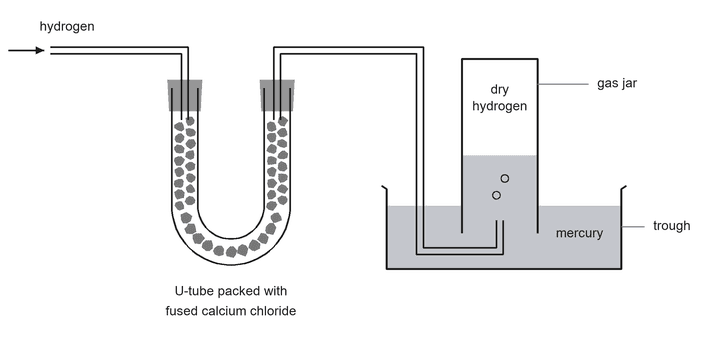
Watch out: Concentrated sulphuric acid is not used as the drier, because it can oxidise some hydrogen to water and give sulphur dioxide.
Therefore, (a) zinc, (b) dilute sulphuric acid (the others are oxidising agents), (c) dry the gas with fused calcium chloride in a U-tube and collect it over mercury.
