
Opening your dashboard
Class 9 Chemistry Chapter 6 Study of the First Element – Hydrogen: Competency-Based Questions (CBQ)
40 questions on Chapter 6, each worked through on its own page with the AI tutor. Class 9 Chemistry, ICSE 2026-27.
40 questions
1–5 marks · Mixed difficulty
- 11 mark
Question 1
Cognitive domain: Application
The aluminium pressure cooker in Farida's kitchen has held boiling water and steam almost every day for ten years, yet its walls have not been eaten away. In the chemistry class, however, her teacher says that aluminium reacts with steam and gives hydrogen.
Which statement best explains why the cooker lasts so long?
- 21 mark
Question 2
Cognitive domain: Analysis
A laboratory attendant has to label four metal samples W, X, Y and Z. She knows that they are copper, lead, magnesium and zinc, but not which is which. She tests a little of each metal with dilute hydrochloric acid and, separately, with hot concentrated sodium hydroxide solution.
Metal With dilute hydrochloric acid With hot concentrated sodium hydroxide solution W very brisk effervescence no gas X steady effervescence effervescence Y no gas no gas Z a few bubbles, then the reaction stops; a white coating is left on the metal effervescence In every case where a gas is given off, it burns with a pop sound. Which option identifies W and Z correctly?
- 31 mark
Question 3
Cognitive domain: Understanding
Arjun is preparing hydrogen from granulated zinc and dilute sulphuric acid. Soon after the fizzing starts, he collects a test tube of the gas over water and carries it to a flame kept well away from the apparatus. The gas burns with a loud pop. A test tube collected a few minutes later burns quietly with a pale blue flame.
What should Arjun conclude?
- 41 mark
Question 4
Cognitive domain: Application
The white paint used in many old oil paintings contains a compound of lead. Over the years, traces of hydrogen sulphide in the air change it into black lead sulphide, and the painting darkens. A restorer treats the dark patches with dilute hydrogen peroxide, which turns the black lead sulphide into white lead sulphate.
Which statement about this reaction is correct?
- 51 mark
Question 5
Cognitive domain: Understanding
Assertion (A): Soap bubbles blown with hydrogen rise up in the air instead of sinking to the floor.
Reason (R): Hydrogen is a combustible gas that burns in air with a pale blue flame.
- 61 mark
Question 6
Cognitive domain: Understanding
Assertion (A): When a strip of lead is put into dilute sulphuric acid, a little hydrogen is given off at first, but the reaction soon stops.
Reason (R): Lead lies below hydrogen in the activity series of metals.
- 71 mark
Question 7
Cognitive domain: Recall
A workshop in Jaipur makes synthetic rubies and repairs platinum jewellery. The owner explains his two hydrogen torches to a group of visiting students. Fill in the blanks in his talk.
"To melt platinum and to fuse alumina into rubies, I use the ________ torch. It burns a mixture of hydrogen and ________ and gives a very high temperature. For welding alloys that contain tungsten, I need the still hotter ________ torch."
- 81 mark
Question 8
Cognitive domain: Application
Steam is passed over a heated grey metal powder in a hard-glass tube. A gas comes out which burns with a pop sound. The solid left in the tube is yellow while it is hot but turns white when the tube cools.
Name the metal and the solid left in the tube.
- 91 mark
Question 9
Cognitive domain: Application
Yellow lead monoxide (litharge) is heated strongly in a hard-glass tube while a stream of pure, dry hydrogen is passed over it. The far end of the tube is cool.
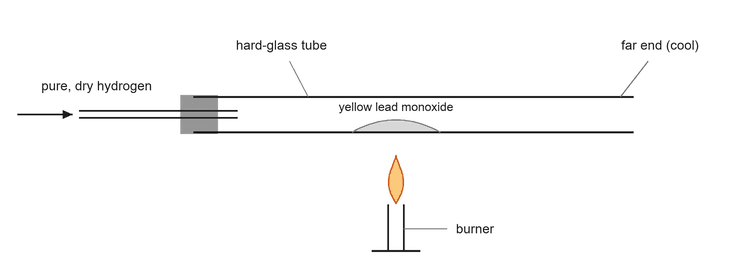
Predict the two things that will be seen.
- 102 marks
Question 10
Cognitive domain: Understanding
Three formulae are written on the board: common salt, ; hydrogen chloride, ; and sodium hydride, . Ritika notices that in one of the last two compounds hydrogen has taken the place of the sodium of common salt, and in the other it has taken the place of the chlorine.
Use Ritika's observation to explain why hydrogen is said to show a dual nature. State the ion that hydrogen forms when it behaves like each of the two elements.
- 112 marks
Question 11
Cognitive domain: Application
The safety chart of a fireworks factory says: "Never throw water on burning magnesium powder. Cover it with dry sand."
(a) Write the balanced equation for the reaction that takes place when water falls on burning magnesium and turns into steam.
(b) Use the products of this reaction to explain why water makes such a fire worse.
- 122 marks
Question 12
Cognitive domain: Analysis
Steam is passed over red-hot iron in a closed vessel. Two reactions then go on in the vessel at the same time.
Forward reaction:
Backward reaction:
(a) In the forward reaction, name the substance that is oxidised and the oxidising agent. Give a reason for each.
(b) Compare the part played by water in the forward reaction with the part played by hydrogen in the backward reaction. What does this comparison show about calling a substance an oxidising agent or a reducing agent?
- 134 marks
Question 13
Cognitive domain: Analysis
The students of Class 9 in a school in Pune want to compare how quickly different metals give hydrogen with an acid. They put 1 g of each metal, in pieces of about the same size, into 25 cm³ of dilute sulphuric acid taken from the same bottle. The gas is collected over water in an inverted measuring cylinder, and its volume is read after two minutes. Copper is included for comparison. The teacher does not allow sodium to be tested.
Metal Volume of gas in 2 minutes (cm³) What is seen Copper 0 no change Iron 7 slow effervescence Lead 1 a few bubbles, which stop within seconds Magnesium 46 very brisk effervescence Zinc 18 steady effervescence (a) Arrange the five metals in decreasing order of reactivity as shown by the readings. Which of them lies below hydrogen in the activity series, and how do the readings show this?
(b) Write the balanced equation for the reaction of iron. In the activity series, lead comes just after iron. Explain why its reading is so much lower than that of iron.
(c) Magnesium gave the most gas, yet the school uses zinc to prepare hydrogen. Give one reason for this choice, and explain why the teacher did not allow sodium to be tested.
- 145 marks
Question 14
Cognitive domain: Evaluation
In January 2023 the Government of India approved the National Green Hydrogen Mission, which aims to produce 5 million tonnes of green hydrogen a year by 2030. Hydrogen is called 'green' when it is made by passing electricity from the sun or the wind through acidulated water. Most hydrogen today is still made from fossil fuels, for example by the Bosch process, in which steam reacts with hot coke. Hydrogen burns to give only water, so it is being tried as a fuel for buses and trains.
(a) Write the two equations of the Bosch process, with their conditions. Name the gas formed along with hydrogen in the second step, and state one way of removing it.
(b) In the 'green' method, why is a little sulphuric acid added to the water? At which electrode is hydrogen set free, and what is the other product? Write the overall equation.
(c) When the two Bosch equations are added, 12 g of coke (carbon) is found to give 4 g of hydrogen. Calculate the mass of carbon dioxide, a greenhouse gas, that is formed for every 1 kg of hydrogen made. (C = 12, O = 16) Then evaluate the statement: "Hydrogen is a clean fuel, whichever way it is made."
- 155 marks
Question 15
Cognitive domain: Creativity
The textbook says that granulated zinc is preferred to pure zinc for preparing hydrogen, because the copper present in it as an impurity acts as a catalyst and speeds up the reaction.
Design an investigation to test this statement in the school laboratory. You are given pure zinc foil, granulated zinc, clean copper turnings, dilute sulphuric acid, four conical flasks fitted with delivery tubes, a trough of water, measuring cylinders, filter paper, a balance and a stopwatch.
(a) Describe the four set-ups you will make, and state what you will keep the same in all of them.
(b) State how you will collect the gas and what you will measure.
(c) What results would support the textbook's statement? How will you show that the copper only speeds up the reaction and is not itself used up?
(d) State two safety precautions, each with its reason.
- 161 mark
Question 16
Cognitive domain: Evaluation
A poster at a school science exhibition says: "Every 9 kg of water contains 1 kg of hydrogen." A visitor doubts it, because hydrogen is the lightest of all gases. (Relative atomic masses: H = 1, O = 16.)
Which statement about the poster is correct ?
- 171 mark
Question 17
Cognitive domain: Application
A workshop kept four salt solutions in four identical iron buckets. After a week, one bucket had pits in its wall and a reddish-brown coating inside; the other three were unchanged. The four solutions were zinc sulphate, magnesium sulphate, copper sulphate and aluminium sulphate.
Which solution was in the damaged bucket ?
- 181 mark
Question 18
Cognitive domain: Analysis
Hydrogen prepared from commercial zinc and dilute sulphuric acid contains hydrogen sulphide, sulphur dioxide and carbon dioxide, as well as water vapour. A student passes the impure gas through the three vessels shown, and then collects it.
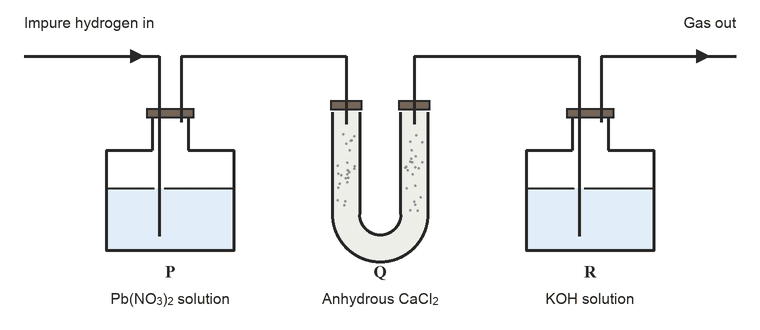
Which statement about the gas that leaves the train is correct ?
- 191 mark
Question 19
Cognitive domain: Analysis
At a plant that makes hydrogen by the Bosch process, a technician notices that the converter in which steam is passed over white-hot coke at needs a constant supply of heat from burning fuel. The converter in which water gas and steam are passed over heated ferric oxide at needs hardly any extra heating.
Which statement explains the difference ?
- 201 mark
Question 20
Cognitive domain: Understanding
Assertion (A): Sodium and potassium are stored under kerosene oil.
Reason (R): Kerosene reacts with sodium and potassium and forms a protective coating on the metals.
- 211 mark
Question 21
Cognitive domain: Evaluation
Assertion (A): Heating calcium oxide in a stream of dry hydrogen gives calcium metal.
Reason (R): Hydrogen is a strong reducing agent.
- 221 mark
Question 22
Cognitive domain: Application
In a vegetable-oil research laboratory, two flasks hold the same number of molecules of an unsaturated hydrocarbon: ethene, , in the first flask and ethyne, , in the second. Excess hydrogen is passed into each in the presence of finely divided nickel, at high pressure, until each hydrocarbon has changed completely into ethane, .
How do the numbers of hydrogen molecules used in the two flasks compare ?
- 231 mark
Question 23
Cognitive domain: Application
In a demonstration carried out only by trained staff behind a safety screen, two sealed hard-glass flasks, P and Q, each hold equal volumes of hydrogen and chlorine. Flask P is kept in diffused sunlight and flask Q is exposed to direct sunlight. In P the gases react slowly over a long time. In Q the flask explodes at once.
Which statement about the two flasks is correct ?
- 241 mark
Question 24
Cognitive domain: Analysis
Some chemical factories turn their waste hydrogen chloride gas back into useful chlorine. The gas is mixed with air and passed over a heated catalyst, and this reaction takes place:
Which statement about this reaction, in terms of the removal and addition of hydrogen, is correct ?
- 251 mark
Question 25
Cognitive domain: Understanding
Priya made a table of some elements in their free state at room temperature. One row contains a mistake. (Hypothetical table.)
Row Element Physical state Formula of what is present in the free element 1 Fluorine gas 2 Hydrogen gas 3 Lithium solid 4 Chlorine gas Which row is wrong ?
- 262 marks
Question 26
Cognitive domain: Application
Henry Cavendish noticed in 1766 that a liquid is formed when his 'inflammable air' burns in air. A student wants to show the same thing in the school laboratory with hydrogen made from zinc and dilute hydrochloric acid, and a delivery tube with a jet. She first checks that a test tube of the gas burns quietly, and only then lights the jet.
(a) Before it reaches the jet, the gas is passed through a U-tube packed with anhydrous calcium chloride. Why must the gas be dried for this experiment to prove anything ?
(b) A cold, dry glass beaker is held upside down over the burning jet. State what is seen on the inside of the beaker, and what this shows about the product and about the name 'hydrogen'.
- 272 marks
Question 27
Cognitive domain: Evaluation
At a town meeting a speaker says: "Water gas is as clean a fuel as hydrogen. It is made from steam, and when it burns it gives only water." Water gas is the mixture of carbon monoxide and hydrogen formed when steam is passed over white-hot coke. Carbon monoxide is a poisonous gas.
Use equations for the burning of the two gases in water gas to evaluate the speaker's claim.
- 282 marks
Question 28
Cognitive domain: Analysis
When tin(II) chloride solution is added to a yellow-brown solution of iron(III) chloride, the solution turns pale green, because iron(II) chloride is formed:
Rohit says: "This is not a redox reaction, because no oxygen or hydrogen is added or removed." Use the ideas of electronegative ions to show that he is wrong. Name the substance oxidised and the substance reduced.
- 292 marks
Question 29
Cognitive domain: Analysis
Some weather teams in the hills carry calcium hydride, , to fill small balloons. The hydride is made by heating calcium in hydrogen. In the field, water is added to it and the hydrogen that comes off is collected.
(a) Write balanced equations for the making of calcium hydride and for its reaction with water.
(b) The team finds that the hydrogen they collect is twice the hydrogen that was used in making the hydride. Explain where the extra hydrogen comes from.
- 302 marks
Question 30
Cognitive domain: Understanding
Zainab drops a piece of magnesium ribbon into very dilute nitric acid, containing about 1 % of the acid, in tube X. She drops a second piece into stronger dilute nitric acid in tube Y. In X, a colourless gas that burns with a pop is collected. In Y, the magnesium dissolves but no gas that burns with a pop can be collected. (Hypothetical test results.)
Explain the difference between the two tubes.
- 312 marks
Question 31
Cognitive domain: Application
One volume of finely divided palladium takes up about 900 volumes of hydrogen at room temperature. A laboratory wants to store litres of hydrogen without using a cylinder.
(a) Name the property of hydrogen shown here.
(b) What volume of finely divided palladium would be needed to hold the litres of hydrogen ?
- 323 marks
Question 32
Cognitive domain: Analysis
A student has four metals, P, Q, R and S, and solutions of their salts. She places a clean strip of one metal in the solution of the salt of another and notes what happens. (Hypothetical data.)
Test Strip of metal Placed in the salt solution of Result 1 Q S a deposit of S forms on the strip 2 S P a deposit of P forms on the strip 3 P R a deposit of R forms on the strip 4 R P no change 5 P S no change 6 S Q no change She also finds that metal S gives hydrogen with dilute hydrochloric acid, but metal P does not.
(a) Arrange the four metals in decreasing order of reactivity.
(b) Predict, with a reason, whether Q and R give hydrogen with dilute hydrochloric acid.
(c) Predict what will be seen if a strip of Q is placed in a solution of the salt of R.
- 333 marks
Question 33
Cognitive domain: Understanding
Sodium reacts too violently with water to be a safe source of hydrogen: a piece of pure sodium put into water melts, darts about and may catch fire. Its amalgam, an alloy of sodium with mercury, reacts smoothly with water instead, and the hydrogen comes off steadily.
(a) Why is it safer to use sodium amalgam than pure sodium ?
(b) A piece of sodium amalgam that contains g of sodium is added to excess water. The mercury takes no part in the reaction. Write the balanced equation for the reaction, and find the mass of hydrogen given off. (Relative atomic masses: H = 1, O = 16, Na = 23.)
(c) Why should students not carry out the amalgam experiment themselves ?
- 343 marks
Question 34
Cognitive domain: Application
Meena heats g of black copper(II) oxide in a tube in a stream of dry hydrogen until the black solid has changed completely into reddish-brown copper. After the tube has cooled, the solid in it has a mass of g. (Relative atomic masses: H = 1, O = 16, Cu = 63.5. Hypothetical readings.)
(a) Find the loss in mass, and say what it is.
(b) In a second run, Meena heats another g of the same oxide but stops the hydrogen too early, when the solid in the tube has a mass of g. What mass of copper(II) oxide is still unreduced ?
(c) What mass of water was formed in the first run ?
- 353 marks
Question 35
Cognitive domain: Analysis
The school laboratory staff, working behind a safety screen, drop a small piece of each of three metals, one at a time, into a trough of cold water, and the class reads the record of what happens. The densities are given in the table; the density of water is g/cm³. (Hypothetical class record.)
Metal Density (g/cm³) What is seen Potassium 0.86 melts into a silvery ball, darts about, and the gas catches fire at once with a lilac flame Sodium 0.97 melts into a silvery ball, darts about, and the gas catches fire only after a few seconds, with a golden yellow flame Calcium 1.55 stays as a lump and makes a steady stream of bubbles, and the water turns milky (a) Using the densities, say which metals float and which sinks.
(b) Arrange the three metals in decreasing order of reactivity with cold water, giving the evidence from the table.
(c) The water in the calcium trough turns milky, but the water in the sodium trough stays clear. Explain the difference, naming the substance that makes the calcium water milky.
- 363 marks
Question 36
Cognitive domain: Application
A metallurgy class is given five metal oxides: zinc oxide, lead(II) oxide, aluminium oxide, magnesium oxide and copper(II) oxide. The teacher says that some of the metals can be obtained from their oxides by heating them with a reducing agent such as carbon, carbon monoxide or hydrogen, and the others only by electrolysis.
(a) Which oxides can be reduced by heating with a reducing agent, and which need electrolysis ?
(b) Zinc oxide can be reduced by heating it in carbon monoxide, which changes into carbon dioxide. Write the balanced equation for this reaction.
(c) In the reaction of part (b), name the substance oxidised, the substance reduced and the reducing agent. Give a reason for each in terms of oxygen.
- 374 marks
Question 37
Cognitive domain: Analysis
Rakesh passes steam over iron wool that is heated strongly in a hard-glass tube. In the first run the outlet of the tube is closed by a gas syringe, so the gas formed stays in contact with the hot iron. In the second run the tube is open, and the hydrogen is led away and collected over water. He measures the volume of hydrogen formed in each run every 2 minutes and draws the graph below. (Hypothetical data.)

(a) From the graph, after how many minutes does the closed tube stop giving more hydrogen, and what volume of hydrogen has formed by then ?
(b) The iron and steam in the closed tube are not used up at this point. Explain why the graph is flat, and why the graph for the open tube goes on rising.
(c) How many times as much hydrogen has formed in the open tube as in the closed tube after 10 minutes ?
- 384 marks
Question 38
Cognitive domain: Evaluation
The cook of a hostel mess cleans a burnt aluminium vessel by boiling strong caustic soda (sodium hydroxide) solution in it. Colourless bubbles rise, the vessel gets hot, and after a few cleanings its surface is pitted. The same vessel has been used for years for boiling water, and for steaming idlis, without being damaged. In a school laboratory, a student finds how long 1 g of aluminium foil takes to give 100 cm³ of gas in hot caustic soda solutions of different strengths. (Hypothetical data.)
Strength of the caustic soda solution 5 % 10 % 20 % Time to give 100 cm³ of gas 40 minutes 20 minutes 10 minutes (a) Name the gas and write the balanced equation for the reaction of aluminium with caustic soda solution and water.
(b) Steam does not damage the vessel, but caustic soda does. Explain, using the oxide of aluminium.
(c) Describe the trend in the table. Should the cook use a stronger solution to clean the vessel faster ? Give a reason.
- 394 marks
Question 39
Cognitive domain: Analysis
In an experiment, different masses of granulated zinc are added to cm³ of the same dilute sulphuric acid, and the volume of hydrogen collected is measured each time. The results are shown in the graph. (Hypothetical data.)
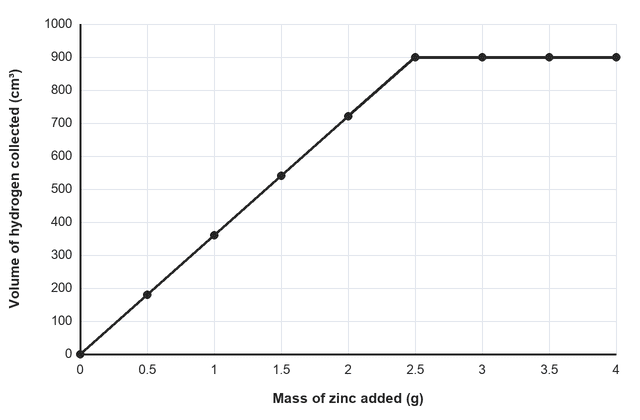
(a) How much zinc gives the largest volume of gas, and what is that volume ?
(b) Why does the graph become flat ? How much zinc is left over when g of zinc is used ?
(c) The experiment is repeated with cm³ of the same acid. What volume of hydrogen will be collected with g of zinc ?
- 405 marks
Question 40
Cognitive domain: Creativity
A research team discovers a new metal X, which forms a divalent ion, , and whose oxide is basic. In the activity series it is placed between calcium and magnesium. (Hypothetical metal.)
Write a short data sheet for X, using what the activity series tells you.
(a) Predict how X reacts with cold water and with dilute hydrochloric acid, and write a balanced equation for each reaction.
(b) Can hydrogen reduce the oxide of X to the metal ? How would X be obtained from its oxide ?
(c) How would you expect X to occur in nature, and how should it be stored ?