
Opening your dashboard
Class 9 Chemistry Chapter 3: Water Solutions
67 textbook questions with step-by-step answers, free to read, for ICSE 2026-27.
Get talked through Ch 3, not just shown the answer
Reading a finished solution is not the same as being able to do it. The AI tutor takes one question at a time and works it with you, in your own words, until you can.
- Ask it out loud, in your own words
- It gives you the next step, not the answer
- Stuck on part (ii)? Start there
67 questions with solutions
1–5 marks · Mixed difficulty
- 12 marks
Question 1
Water exists in all the three states. Discuss.
Solve with AIWritten solution
Solution:
Concept: A substance can exist as a solid, a liquid or a gas. Which state it is in depends on its temperature, and heating or cooling changes one state into another.
Step 1 — Solid state — ice.
Below 0 °C water exists as solid ice. We see it in the polar ice caps, in glaciers and as snow on high mountains.
Step 2 — Liquid state — water.
Between 0 °C and 100 °C (at normal pressure) water is a liquid. Seas, oceans, rivers, lakes, wells, underground water and rain are all liquid water.
Step 3 — Gaseous state — water vapour and steam.
Water evaporates from seas, rivers and the leaves of plants at all temperatures, so the air always holds some water vapour. At 100 °C water boils and forms steam.
Step 4 — Link the three states.
These states keep changing into one another. Ice melts into water, water evaporates into vapour, and the vapour condenses into clouds that fall back as rain or snow. This continuous change is the water cycle.
Watch out: Water vapour is invisible; the white 'steam' we see above a kettle is really tiny drops of water formed when the vapour cools.
Therefore, water exists in nature as solid ice (below 0 °C), liquid water (0–100 °C) and gaseous water vapour or steam, and the three states change into one another in the water cycle.
- 22 marks
Question 2
Why is water considered a compound ?
Solve with AIWritten solution
Solution:
Concept: A compound is formed when two or more elements combine chemically in a fixed proportion by mass. Its properties differ from those of its elements, and it can be split into them only by chemical methods.
Step 1 — Show that water is formed by chemical combination.
Hydrogen burns in oxygen and the two elements combine chemically to form water:
Step 2 — Show that the proportion is fixed.
Hydrogen and oxygen always combine in the same ratio: 2 volumes of hydrogen with 1 volume of oxygen. By mass, one molecule has 2 × 1 = 2 u of hydrogen and 16 u of oxygen, so the ratio is fixed:
Step 3 — Compare the properties.
Hydrogen is a combustible gas and oxygen is a gas that supports combustion. Water is a liquid that neither burns nor supports burning, so its properties are quite different from those of its elements.
Step 4 — Separate the elements.
Water cannot be split into hydrogen and oxygen by physical methods such as filtration or distillation. A chemical method, such as electrolysis of acidified water, is needed.
Watch out: A mixture of hydrogen and oxygen gases is not water; only after they react chemically do we get the compound.
Therefore, water is a compound: hydrogen and oxygen combine chemically in a fixed ratio (1 : 8 by mass), its properties differ from theirs, and it can be split only by a chemical method.
- 34 marks
Question 3
(a) Why does temperature in Mumbai and Chennai not fall as low as it does in Delhi ?
(b) Give the properties of water responsible for controlling the temperature of our body.
Solve with AIWritten solution
Solution:
Concept: Water has a very high specific heat capacity (4.2 J/g °C), so a large mass of water heats up and cools down very slowly. It also has a high latent heat of vaporisation (about 2260 J/g).
Step 1 — (a) Notice where the cities are.
Mumbai and Chennai lie on the sea coast, while Delhi is far inland, away from any large body of water.
Step 2 — (a) Use the specific heat of sea water.
Because of its high specific heat capacity, the huge mass of sea water stores a lot of heat in summer and gives it out slowly in winter. The air over the coastal cities is warmed by this heat, and sea breezes carry it inland, so their temperature does not fall very low.
Step 3 — (a) Compare with Delhi.
Delhi has no sea nearby to give out heat, and land cools quickly, so its winter temperature falls much lower.
Step 4 — (b) Specific heat capacity in the body.
About two-thirds of our body is water. Because water has a high specific heat capacity, the body can take in or lose a lot of heat with only a small change in its temperature.
Step 5 — (b) Latent heat of vaporisation in sweating.
When sweat evaporates from the skin, each gram takes about 2260 J/g from the body. This large heat loss gives a cooling effect in hot weather.
Watch out: A high specific heat does not stop a body of water from warming; it only makes the warming (and cooling) slow.
Therefore, (a) the sea's high specific heat capacity keeps coastal Mumbai and Chennai from getting very cold, unlike inland Delhi; (b) the high specific heat capacity and high latent heat of vaporisation of water control our body temperature.
- 42 marks
Question 4
'Water is a universal solvent'. Comment.
Solve with AIWritten solution
Solution:
Concept: A solvent is a liquid that dissolves other substances. Water is called the universal solvent because it dissolves more kinds of substances, and in larger amounts, than any other liquid.
Step 1 — List what water dissolves.
Water dissolves solids (common salt, sugar), liquids (alcohol) and gases (oxygen, carbon dioxide), forming aqueous solutions.
Step 2 — Explain why it dissolves so much.
A water molecule is polar: the oxygen end carries a slight negative charge and the hydrogen ends carry slight positive charges. These charged ends attract ions and polar molecules. Water also has a high dielectric constant, which weakens the attraction between positive and negative ions, so even ionic (electrovalent) compounds such as sodium chloride break apart and dissolve.
Step 3 — Note the traces it dissolves.
Even substances we call 'insoluble' dissolve in water in traces. Distilled water kept for a long time in a glass bottle dissolves a little of the glass and leaves etchings on it.
Step 4 — Draw the conclusion.
Because water dissolves so many substances, absolutely pure water is hardly ever found in nature.
Watch out: The word 'universal' is an exaggeration: water does not dissolve everything (oil, wax and most plastics do not dissolve), but no other common liquid dissolves as many substances.
Therefore, water is called a universal solvent because, being polar with a high dielectric constant, it dissolves a very wide range of solids, liquids and gases.
- 52 marks
Question 5
What causes the violence associated with torrential rain ?
Solve with AIWritten solution
Solution:
Concept: When water vapour condenses into liquid water, it gives out its latent heat of vaporisation (about 2260 J/g) without any fall in temperature.
Step 1 — Describe what happens in torrential rain.
In torrential rain a huge mass of water vapour in the clouds condenses into water drops in a short time.
Step 2 — Find the heat released.
Every gram of vapour that condenses gives out about 2260 J/g. So a very large amount of heat is released suddenly into the surrounding air.
Step 3 — Link the heat to the violence.
This heat warms the air strongly, so the air expands and rises fast. The rapid movement of air sets up violent winds and storms, which cause the violence associated with torrential rain.
Therefore, the violence of torrential rain is caused by the sudden release of the large latent heat of vaporisation when a huge mass of water vapour condenses.
- 65 marks
Question 6
(a) Which property of water enables it to modify the climate ?
(b) Density of water varies with temperature. What are its consequences ?
(c) What is the effect of impurities present in water on melting point and boiling point of water ?
Solve with AIWritten solution
Solution:
Concept: Water has a high specific heat capacity, shows anomalous expansion (it is densest at 4 °C) and its melting and boiling points change when substances are dissolved in it.
Step 1 — (a) Name the property that modifies climate.
The property is the high specific heat capacity of water. A large body of water absorbs heat in summer and gives it out in winter, so nearby land stays cooler in summer and warmer in winter.
Step 2 — (b) Describe how density changes.
Water is densest at 4 °C. Below 4 °C it expands instead of contracting, and on freezing about 92 volumes of water become 100 volumes of ice, so ice (relative density about 0.92) is lighter than water.
Step 3 — (b) State the consequences.
These density changes have three important results:
- Ice floats, so ponds and lakes freeze from the top. The ice layer is a bad conductor of heat, the water below stays at about 4 °C, and aquatic life survives the winter.
- Water pipes may burst in very cold weather, because the water in them expands as it freezes.
- Water in the cracks of rocks freezes, expands and breaks the rocks (weathering).
Step 4 — (c) Effect of impurities.
Dissolved (non-volatile) impurities lower the melting (freezing) point of water below 0 °C and raise its boiling point above 100 °C. This is why salt is spread on icy roads and why salt water boils above 100 °C.
Watch out: The melting point is lowered, not raised, by dissolved impurities; only the boiling point goes up.
Therefore, (a) its high specific heat capacity lets water modify climate; (b) because water is densest at 4 °C and expands on freezing, ice floats (saving aquatic life), pipes burst and rocks crack; (c) dissolved impurities lower the melting point and raise the boiling point.
- 72 marks
Question 7
How do fishes and aquatic animals survive in winters when the pond gets covered with thick ice ?
Solve with AIWritten solution
Solution:
Concept: Water shows anomalous expansion: it is densest at 4 °C and expands when cooled below 4 °C. Ice is also a bad conductor of heat.
Step 1 — Cool the pond down to 4 °C.
In winter the cold air cools the surface water. This water becomes denser and sinks, and warmer water rises to take its place. This goes on until the whole pond is at 4 °C.
Step 2 — Cool the surface below 4 °C.
When the surface water cools below 4 °C it becomes lighter, so it stays on top. It freezes at 0 °C and the ice floats, forming a layer on the surface.
Step 3 — Explain why the water below stays liquid.
Ice is a bad conductor of heat, so the ice layer stops the water below from losing much heat. The water at the bottom stays liquid at about 4 °C, and fishes and other aquatic animals live in it safely.
Watch out: The pond does not freeze from the bottom up; it freezes from the top because water colder than 4 °C is lighter.
Therefore, fishes survive because water is densest at 4 °C: the ice forms only on top and, being a bad conductor, keeps the water below liquid at about 4 °C.
- 82 marks
Question 8
The properties of water are different from the properties of the elements of which it is formed. Discuss.
Solve with AIWritten solution
Solution:
Concept: Water is a compound of hydrogen and oxygen. A compound has properties that are different from those of the elements it is made from.
Step 1 — Compare the properties.
The table compares water with its two elements:
Property Hydrogen Oxygen Water State at room temperature Gas Gas Liquid Burning Burns (combustible) Supports combustion Neither burns nor supports burning; used to put out fires Solubility in water Almost insoluble Slightly soluble — Use as a solvent Not a solvent Not a solvent A universal solvent Step 2 — Draw the conclusion.
Water does not show the properties of hydrogen or of oxygen. This shows that the two elements have combined chemically to form a new substance, a compound, and not a mixture.
Therefore, water is a liquid that neither burns nor supports burning and dissolves many substances, quite unlike the gases hydrogen and oxygen, which shows it is a compound.
- 92 marks
Question 9
How is aquatic life benefitted by the fact that water has maximum density at 4°C ?
Solve with AIWritten solution
Solution:
Concept: Water has its maximum density at 4 °C. So water at 4 °C sinks to the bottom of a pond, and colder water stays on top.
Step 1 — Follow the pond as it cools.
In winter the densest water, at 4 °C, collects at the bottom of the pond. Water colder than 4 °C is lighter, so it stays at the top and freezes there into ice, which floats.
Step 2 — Explain the protection.
Ice is a poor conductor of heat, so the ice layer insulates the water below it and stops it from freezing.
Step 3 — State the benefit.
The water at the bottom stays liquid at about 4 °C through the winter, so fishes and other aquatic animals and plants survive.
Therefore, because water is densest at 4 °C, the bottom of a pond stays liquid at about 4 °C under a floating layer of ice, and aquatic life survives the winter.
- 102 marks
Question 10
What are your observations and conclusion when tap water is boiled and evaporated in watch glass ?
Solve with AIWritten solution
Solution:
Concept: Tap water is not pure; it contains dissolved solids (salts and minerals). When the water evaporates, these solids are left behind.
Step 1 — Do the experiment.
We take a few drops of tap water on a clean watch glass and heat it gently over a beaker of boiling water until all the water evaporates.
Step 2 — Record the observation.
When the dry watch glass is held against the light, a number of concentric rings of solid matter are seen on it.
Step 3 — State the conclusion.
These rings are the dissolved solids (salts and minerals) left behind after the water evaporated. So tap water contains dissolved solids.
Therefore, concentric rings of solid are left on the watch glass, which shows that tap water contains dissolved solids.
- 112 marks
Question 11
What is the importance of dissolved salts in water ?
Solve with AIWritten solution
Solution:
Concept: Natural water contains small amounts of dissolved salts and minerals, picked up from the rocks and soil it flows over.
Step 1 — Importance for plants.
Plants absorb water containing dissolved salts through their roots. These salts supply the minerals needed for the growth and development of plants.
Step 2 — Importance for taste.
The dissolved salts (with dissolved air) give taste to drinking water; water without them tastes flat.
Step 3 — Importance for our body.
Dissolved salts supply some of the essential minerals our body needs, such as calcium and magnesium for bones and teeth.
Therefore, dissolved salts in water help plants grow, give water its taste and supply essential minerals to our bodies.
- 122 marks
Question 12
State the importance of the solubility of and in water.
Solve with AIWritten solution
Solution:
Concept: Oxygen and carbon dioxide dissolve in water in small amounts. These dissolved gases support life in water.
Step 1 — Importance of dissolved oxygen.
Fishes and other aquatic animals take in the oxygen dissolved in water through their gills and use it for respiration. Water in contact with air holds only about 6–10 cm³ of oxygen per litre, so this small supply is very important.
Step 2 — Carbon dioxide for photosynthesis.
Aquatic plants use the dissolved carbon dioxide, with water and sunlight, for photosynthesis to make their food (glucose):
Step 3 — Carbon dioxide for shells.
Water containing carbon dioxide dissolves limestone and forms calcium hydrogen carbonate:
Marine animals such as snails and oysters use the dissolved calcium salts to build their shells of calcium carbonate.
Note: Some books quote about 40 cm³ of oxygen per litre; that is the figure for pure oxygen gas, not for water exposed to air, so it is not used here.
Therefore, dissolved oxygen lets aquatic animals breathe, and dissolved carbon dioxide lets aquatic plants carry out photosynthesis and helps marine animals build their shells.
- 132 marks
Question 13
How is air dissolved in water different from ordinary air ?
Solve with AIWritten solution
Solution:
Concept: Gases dissolve in water to different extents. Oxygen is about twice as soluble in water as nitrogen, so air dissolved in water has a different composition from ordinary air.
Step 1 — Compare the solubility of the gases.
Air is mostly nitrogen and oxygen. When it dissolves, a larger share of the oxygen goes into the water than of the nitrogen, and carbon dioxide, which is far more soluble than both, is also enriched.
Step 2 — Compare the compositions.
The approximate percentages by volume are:
Gas Air dissolved in water Ordinary air Oxygen about 33–35% about 21% Nitrogen about 63–66% about 78% Carbon dioxide about 1–2% about 0.04% Step 3 — State the difference.
So dissolved air is richer in oxygen (about one-third oxygen instead of one-fifth) and in carbon dioxide, and poorer in nitrogen.
Note: Older books give 0.03% carbon dioxide in air; today's value is about 0.04%. The small remainder in both is mainly argon.
Therefore, air dissolved in water contains a much higher proportion of oxygen (about 33–35% against 21%) and of carbon dioxide than ordinary air, because these gases are more soluble than nitrogen.
- 143 marks
Question 14
Identify A, B, C and D; first one is done for you.
 Solve with AI
Written solution
Solution:
Concept: A substance takes in heat when it melts or boils and gives out the same heat when it freezes or condenses, all without any change in temperature. This heat is called latent heat.
Step 1 — Read arrow A (given).
Arrow A goes from solid to liquid. Heat is absorbed, and this is the latent heat of fusion (about 336 J/g for ice).
Step 2 — Identify B.
Arrow B goes from liquid to gas. The heat absorbed when a liquid changes into vapour at its boiling point is the latent heat of vaporisation (about 2260 J/g for water).
Step 3 — Identify C.
Arrow C goes from gas back to liquid. The same heat is now given out, and it is called the latent heat of condensation.
Step 4 — Identify D.
Arrow D goes from liquid to solid. The heat given out on freezing is the latent heat of solidification (about 336 J/g for water).
Watch out: The heat given out in C and D equals the heat taken in for B and A; only the direction of heat flow changes.
Therefore, A = latent heat of fusion, B = latent heat of vaporisation, C = latent heat of condensation and D = latent heat of solidification (freezing).
- 155 marks
Question 15
Explain why :
(a) Boiled or distilled water tastes flat.
(b) Ice at zero degree centigrade has greater cooling effect than water at 0°C.
(c) Burns caused by steam are more severe than burns caused by boiling water.
(d) Rivers and lakes do not freeze easily.
(e) Air dissolved in water contains a higher proportion of oxygen.
(f) If distilled water is kept in a sealed bottle for a long time, it leaves etchings on the surface of the glass.
(g) Rain water does not leave behind concentric rings when boiled.
Solve with AIWritten solution
Solution:
Concept: These facts follow from the substances dissolved in natural water, from water's high latent heats and specific heat capacity, and from its power as a solvent.
Step 1 — (a) Boiled or distilled water tastes flat.
The pleasant taste of drinking water comes from the air, carbon dioxide and minerals dissolved in it. Boiling drives out the dissolved gases, and distilled water has neither gases nor salts, so both taste flat.
Step 2 — (b) Ice at 0 °C cools more than water at 0 °C.
To melt, each gram of ice at 0 °C first takes about 336 J/g (latent heat of fusion) from its surroundings without any rise in its own temperature. Water at 0 °C does not need this extra heat. So ice takes much more heat from the surroundings and cools more.
Step 3 — (c) Steam burns are worse.
When steam at 100 °C condenses on the skin, each gram gives out about 2260 J/g (latent heat of condensation) and then, as hot water, gives out more heat while cooling. Boiling water gives only the second part. So steam gives far more heat to the skin and causes more severe burns.
Step 4 — (d) Rivers and lakes do not freeze easily.
Water has a high specific heat capacity and a high latent heat of solidification (about 336 J/g), so a very large amount of heat must be removed before it freezes. The ice that does form floats and, being a bad conductor of heat, keeps the water below from freezing.
Step 5 — (e) Dissolved air is richer in oxygen.
Oxygen is more soluble in water than nitrogen, so a larger share of the oxygen dissolves. Air dissolved in water has about 33–35% oxygen, against about 21% in ordinary air.
Step 6 — (f) Distilled water etches glass.
Water is a universal solvent. Distilled water, which has nothing dissolved in it, slowly dissolves traces of the glass, and over a long time this leaves etchings on the inner surface of the bottle.
Step 7 — (g) Rain water leaves no rings.
Rain water is almost pure, because it forms by natural evaporation and condensation (a natural distillation). It has no dissolved solids, so nothing is left behind as rings when it is boiled away.
Watch out: In (b) both are at 0 °C; the difference comes only from the latent heat that the ice must take in to melt.
Therefore, (a) boiling removes dissolved gases; (b) ice needs latent heat to melt; (c) steam gives out latent heat on condensing; (d) high specific heat and floating ice slow freezing; (e) oxygen is more soluble than nitrogen; (f) water slowly dissolves glass; (g) rain water has no dissolved solids.
- 165 marks
Question 16
Explain the terms :
(a) solution
(b) solute
(c) solvent.
Solve with AIWritten solution
Solution:
Concept: A solution is made of two parts: the solute (the substance that dissolves) and the solvent (the medium it dissolves in). In short, solution = solute + solvent.
Step 1 — (a) Define a solution.
A solution is a homogeneous mixture of two or more substances, whose composition can be changed gradually by changing the relative amounts of its parts. For example, salt dissolved in water forms a salt solution.
Step 2 — (b) Define a solute.
The solute is the substance that dissolves in the solvent to form the solution. In salt solution, the salt is the solute.
Step 3 — (c) Define a solvent.
The solvent is the medium of dissolution: the substance in which the solute dissolves. In salt solution, water is the solvent.
Watch out: The solvent is usually the component present in the larger amount; it need not be water.
Therefore, a solution is a homogeneous mixture of a solute dissolved in a solvent; the solute is the substance that dissolves and the solvent is the medium it dissolves in.
- 172 marks
Question 17
Explain why a hot saturated solution of potassium nitrate forms crystals as it cools.
Solve with AIWritten solution
Solution:
Concept: A saturated solution holds the maximum mass of solute that can dissolve at that temperature. The solubility of potassium nitrate falls sharply as the temperature falls.
Step 1 — Look at the hot saturated solution.
The hot solution holds the largest mass of potassium nitrate that can dissolve at the high temperature.
Step 2 — See what cooling does to the solubility.
On cooling, the solubility of potassium nitrate drops steeply: about 110 g dissolves in 100 g of water at 60 °C, but only about 31.6 g at 20 °C.
Step 3 — Explain the crystals.
The cooled solution now holds more solute than it can keep dissolved. The extra potassium nitrate separates out of the solution as crystals.
Therefore, a hot saturated potassium nitrate solution forms crystals on cooling because the solubility of potassium nitrate decreases sharply with fall in temperature, and the excess solute crystallises out.
- 182 marks
Question 18
Give three factors which affect the solubility of a solid solute in a solvent.
Solve with AIWritten solution
Solution:
Concept: Solubility of a substance at a given temperature is the maximum mass of it (in grams) that dissolves in 100 g of the solvent at that temperature to form a saturated solution. It is a fixed amount for a given solute, solvent and temperature.
Step 1 — Factor 1 — temperature.
The solubility of most solids increases with rise in temperature (for example potassium nitrate), though for a few (such as calcium hydroxide) it decreases.
Step 2 — Factor 2 — nature of the solute.
Different solutes dissolve to different extents in the same solvent. At room temperature, about 36 g of sodium chloride but only about 0.2 g of calcium sulphate dissolves in 100 g of water.
Step 3 — Factor 3 — nature of the solvent.
The same solute dissolves to different extents in different solvents. Common salt dissolves well in water but hardly at all in kerosene or benzene, while sulphur dissolves in carbon disulphide but not in water.
Watch out: Do not confuse solubility (how much dissolves) with the rate of dissolving (how fast it dissolves).
Note: Some answer keys list the size of the solute particles and stirring here; these change only how fast a solid dissolves, not how much of it can dissolve, so they are not factors of solubility.
Therefore, the solubility of a solid in a solvent depends on the temperature, the nature of the solute and the nature of the solvent.
- 194 marks
Question 19
(a) If you are given some copper sulphate crystals, how would you proceed to prepare its saturated solution at room temperature ?
(b) How can you show that your solution is really saturated ?
Solve with AIWritten solution
Solution:
Concept: A saturated solution at a given temperature is one that cannot dissolve any more of the solute at that temperature.
Step 1 — (a) Take water at room temperature.
We take about 50 mL of water in a beaker and note the room temperature.
Step 2 — (a) Add the solute a little at a time.
We add powdered copper sulphate crystals a little at a time, stirring after each addition. Powdering and stirring make the crystals dissolve faster.
Step 3 — (a) Stop when no more dissolves.
We keep adding until no more dissolves and some crystals stay undissolved at the bottom even after stirring. We then filter the solution; the clear blue filtrate is a saturated solution of copper sulphate at room temperature.
Step 4 — (b) Test the solution.
Keeping the temperature the same, we add a few more crystals of copper sulphate to the filtrate and stir. If the crystals do not dissolve (and their mass is unchanged), the solution is saturated; if they dissolve, it was unsaturated.
Watch out: The test must be done at the same temperature; warming the solution would let more crystals dissolve even if it was saturated.
Therefore, (a) add powdered copper sulphate to water at room temperature with stirring until some remains undissolved, then filter; (b) the solution is saturated if more crystals added at the same temperature do not dissolve.
- 205 marks
Question 20
(a) Define (i) Henry's law (ii) Crystallization (iii) Seeding.
(b) State any three methods of crystallization.
Solve with AIWritten solution
Solution:
Concept: Henry's law describes how much gas a liquid dissolves; crystallisation and seeding describe how crystals are obtained from solutions.
Step 1 — (a) Define Henry's law.
Henry's law: at a constant temperature, the mass of a gas dissolved by a given volume of a liquid is directly proportional to the pressure of the gas on the surface of the liquid.
Step 2 — (a) Define crystallisation.
Crystallisation is the process by which crystals of a substance are obtained from its solution, usually by cooling a hot saturated solution so that the solute separates out as crystals.
Step 3 — (a) Define seeding.
Seeding is the process of starting crystallisation by dropping a small crystal of the pure substance into its saturated (or supersaturated) solution; the crystals grow on this 'seed'.
Step 4 — (b) State three methods of crystallisation.
Crystals can be obtained in any of these ways (any three):
- by cooling a hot saturated solution;
- by slow evaporation of a saturated solution at room temperature;
- by cooling a fused (molten) mass, e.g. sulphur;
- by sublimation, e.g. iodine, where the vapour condenses directly into crystals.
Therefore, (a) Henry's law: at constant temperature the mass of gas dissolved in a given volume of liquid is directly proportional to the pressure; crystallisation is obtaining crystals from a solution; seeding is adding a crystal to start crystallisation; (b) cooling a hot saturated solution, slow evaporation and cooling a fused mass (or sublimation).
- 212 marks
Question 21
What would you observe when crystals of copper (II) sulphate are heated in a test tube strongly ?
Solve with AIWritten solution
Solution:
Concept: Blue copper (II) sulphate crystals contain water of crystallisation, . Heating drives this water off.
Step 1 — Observe the crystals.
On strong heating, the blue crystals turn into a white powder (anhydrous copper sulphate) and lose their crystalline shape.
Step 2 — Observe the test tube.
Drops of a colourless liquid (water) collect on the cooler upper part of the test tube.
Step 3 — Write the equation.
The change is the loss of the five molecules of water of crystallisation:
Step 4 — Reverse the change.
If a few drops of water are added to the cooled white powder, it turns blue again and becomes warm.
Watch out: Very strong and prolonged heating (above about 650 °C) goes further: the white powder decomposes into black copper (II) oxide and sulphur trioxide.
Therefore, the blue crystals turn into a white powder and drops of water collect on the cooler part of the test tube, because the crystals lose their water of crystallisation.
- 224 marks
Question 22
Give the names and formulae of two substances in each case
(a) hydrated substance
(b) anhydrous substance
(c) liquid drying agent
(d) a basic drying agent
Solve with AIWritten solution
Solution:
Concept: A hydrated substance has water of crystallisation in its crystals; an anhydrous one has none. A drying agent absorbs moisture from other substances without reacting with them; a basic drying agent is used to dry basic gases such as ammonia.
Step 1 — (a) Hydrated substances.
Washing soda, , and blue vitriol, , contain water of crystallisation.
Step 2 — (b) Anhydrous substances.
Sodium chloride (common salt), , and potassium nitrate, , form crystals that contain no water of crystallisation.
Step 3 — (c) Liquid drying agents.
Concentrated sulphuric acid, , and concentrated (syrupy) phosphoric acid, , are liquids that absorb moisture strongly.
Step 4 — (d) Basic drying agents.
Quicklime (calcium oxide), , and solid caustic potash (potassium hydroxide), , are basic, so they can dry basic gases like ammonia without reacting with them.
Watch out: Concentrated sulphuric acid cannot be used to dry ammonia, because the acid reacts with this basic gas; that is why basic drying agents are needed.
Therefore, (a) washing soda Na₂CO₃·10H₂O and blue vitriol CuSO₄·5H₂O; (b) sodium chloride NaCl and potassium nitrate KNO₃; (c) concentrated sulphuric acid H₂SO₄ and concentrated phosphoric acid H₃PO₄; (d) quicklime CaO and caustic potash KOH.
- 232 marks
Question 23
What is the effect of temperature on solubility of and in water ?
Solve with AIWritten solution
Solution:
Concept: Solubility of a substance at a given temperature is the maximum mass of it (in grams) that dissolves in 100 g of the solvent at that temperature to form a saturated solution. A solubility curve shows how this changes with temperature.
Step 1 — Potassium nitrate.
The solubility of potassium nitrate increases rapidly with rise in temperature: about 31.6 g dissolves in 100 g of water at 20 °C, but about 110 g at 60 °C.
Step 2 — Calcium sulphate.
The solubility of hydrated calcium sulphate (gypsum) is very low (only about 0.2 g per 100 g of water). It increases slightly at first, reaches its highest value at about 40 °C, and then decreases with further rise in temperature.
Therefore, the solubility of KNO₃ increases rapidly with temperature, while that of CaSO₄ (hydrated) first increases slightly and then decreases.
- 242 marks
Question 24
Solubility of NaCl at 40°C is 36·5 g. What is meant by this statement ?
Solve with AIWritten solution
Solution:
Concept: Solubility of a substance at a given temperature is the maximum mass of it (in grams) that dissolves in 100 g of the solvent at that temperature to form a saturated solution.
Step 1 — Apply the definition.
The statement gives the solubility of sodium chloride at 40 °C as 36.5 g, so 36.5 g is the largest mass of sodium chloride that dissolves in 100 g of water at 40 °C.
Step 2 — Describe the solution formed.
When exactly this mass is dissolved, the solution is saturated at 40 °C: no more sodium chloride will dissolve in it at that temperature.
Watch out: Solubility is measured per 100 g of the solvent (water), not per 100 g of the solution.
Therefore, the statement means that at 40 °C at most 36.5 g of sodium chloride dissolves in 100 g of water to form a saturated solution.
- 252 marks
Question 25
Which test will you carry out to find out if a given solution is saturated or unsaturated or supersaturated ?
Solve with AIWritten solution
Solution:
Concept: An unsaturated solution can dissolve more solute, a saturated one cannot, and a supersaturated one holds more solute than it normally can, so it is unstable.
Step 1 — Do the test.
We add a small crystal of the same solute to the solution, keeping the temperature constant, stir gently, and watch the crystal.
Step 2 — Read the result.
The three possible results tell the three kinds apart:
- If the crystal dissolves, the solution is unsaturated.
- If the crystal does not dissolve and nothing else happens, the solution is saturated.
- If the crystal does not dissolve and more solute crystallises out around it, the solution is supersaturated.
Therefore, add a crystal of the solute at constant temperature: it dissolves in an unsaturated solution, stays unchanged in a saturated one, and makes more crystals separate from a supersaturated one.
- 262 marks
Question 26
What is the effect of pressure on solubility of gases. Explain with an example.
Solve with AIWritten solution
Solution:
Concept: Henry's law: at constant temperature, the mass of a gas dissolved in a given volume of a liquid is directly proportional to the pressure of the gas on the liquid.
Step 1 — State the effect.
An increase in pressure increases the solubility of a gas in a liquid, and a decrease in pressure decreases it.
Step 2 — Give the example — soda water.
Soda water is made by dissolving carbon dioxide in water under high pressure, so a large amount of the gas dissolves. When the bottle is opened, the pressure on the water falls suddenly, the solubility falls, and the extra carbon dioxide escapes as bubbles (effervescence).
Therefore, the solubility of a gas increases with pressure, as in soda water, where carbon dioxide dissolved under high pressure bubbles out when the pressure is released.
- 275 marks
Question 27
State the term : (Do not give examples)
(a) A solution where solvent is a liquid other than water.
(b) When a substance absorbs moisture on exposure to moist air and dissolves in the absorbed water and turned to solution.
(c) A substance which contains water of crystallisation.
(d) When a substance absorbs moisture from the atmosphere, but does not form a solution.
(e) When a compound loses its water of crystallisation on exposure to dry air.
(f) The substance that can remove hydrogen and oxygen atoms in the ratio of 2 : 1 (in the form of water) from the compounds.
Solve with AIWritten solution
Solution:
Concept: Each description is the definition of a term from this chapter; we match each one to its name.
Step 1 — (a) Solvent other than water.
A solution in which the solvent is a liquid other than water (such as alcohol or benzene) is a non-aqueous solution.
Step 2 — (b) Absorbs moisture and dissolves in it.
The property of absorbing moisture from moist air and dissolving in it to form a solution is deliquescence.
Step 3 — (c) Contains water of crystallisation.
A substance that contains water of crystallisation is a hydrated substance (hydrate).
Step 4 — (d) Absorbs moisture but forms no solution.
The property of absorbing moisture from the air without forming a solution is hygroscopy (such a substance is hygroscopic).
Step 5 — (e) Loses water of crystallisation in dry air.
The property of losing water of crystallisation on exposure to dry air is efflorescence.
Step 6 — (f) Removes hydrogen and oxygen as water.
A substance that removes hydrogen and oxygen in the ratio 2 : 1 (as water) from compounds is a dehydrating agent.
Watch out: Do not mix up (b) and (d): a deliquescent substance ends up as a solution, a hygroscopic one stays solid (or liquid) without dissolving.
Therefore, (a) non-aqueous solution; (b) deliquescence; (c) hydrated substance; (d) hygroscopy; (e) efflorescence; (f) dehydrating agent.
- 285 marks
Question 28
Explain why :
(a) water is an excellent liquid to use in cooling systems.
(b) a solution is always clear and transparent.
(c) lakes and rivers do not suddenly freeze in the winters.
(d) the solute cannot be separated from a solution by filtration.
(e) fused or conc. is used in a desiccator.
(f) effervescence is seen on opening a bottle of soda water.
(g) Table salt becomes sticky on exposure to humid air during the rainy season.
Solve with AIWritten solution
Solution:
Concept: Each fact follows from a property of water (high specific heat, high latent heat, anomalous expansion), of solutions (tiny solute particles) or of substances that absorb moisture.
Step 1 — (a) Water in cooling systems.
Water has a high specific heat capacity (4.2 J/g °C), so it takes in a large amount of heat with only a small rise in its own temperature. It is also cheap and easily available, so it is used as a coolant, for example in car radiators.
Step 2 — (b) A solution is clear and transparent.
A solution is homogeneous: its solute particles are single molecules or ions, far too small to be seen or to scatter light, and they never settle. So a solution is clear and transparent (it may still be coloured, like copper sulphate solution).
Step 3 — (c) Lakes and rivers do not freeze suddenly.
Water has a high specific heat and a high latent heat of solidification (about 336 J/g), so a great deal of heat must be lost before it freezes. Also, the ice floats and, being a bad conductor of heat, keeps the water below from freezing.
Step 4 — (d) Filtration cannot separate the solute.
The solute particles are molecules or ions, far smaller than the pores of filter paper, so they pass through the paper along with the solvent.
Step 5 — (e) Fused calcium chloride or conc. sulphuric acid in a desiccator.
Both absorb moisture strongly (they are drying agents). Placed in a desiccator, they take up the water vapour from the air inside and keep the substances kept there dry.
Step 6 — (f) Effervescence in soda water.
Carbon dioxide is dissolved in soda water under high pressure. On opening the bottle the pressure falls, so by Henry's law the solubility of the gas falls and the extra carbon dioxide escapes as bubbles: effervescence.
Step 7 — (g) Table salt becomes sticky.
Table salt contains small amounts of magnesium chloride and calcium chloride, which are deliquescent. They absorb moisture from humid air and dissolve in it, making the salt sticky. Pure sodium chloride does not do this.
Therefore, (a) high specific heat; (b) tiny, evenly spread solute particles; (c) high specific and latent heat and floating ice; (d) solute particles smaller than filter pores; (e) they absorb moisture; (f) lower pressure lowers the gas's solubility; (g) deliquescent impurities MgCl₂ and CaCl₂.
- 295 marks
Question 29
Normally, solubility of a crystalline solid increases with temperature. Does it increase uniformly in all cases ? Name a substance whose solubility :
(a) increases rapidly with temperature.
(b) increases gradually with temperature.
(c) increases slightly with temperature.
(d) initially increases then decreases with rise in temperature.
Solve with AIWritten solution
Solution:
Concept: The solubility of most crystalline solids increases with temperature, but the shape of the solubility curve differs from one substance to another.
Step 1 — Answer the first question.
No, the solubility does not increase uniformly. For some solids it rises steeply, for others only slightly, and for a few it even rises and then falls.
Step 2 — Name an example for each kind.
The solubility curves give these examples:
Behaviour of solubility Substance (a) increases rapidly Potassium nitrate, (b) increases gradually Potassium chloride, (c) increases slightly Sodium chloride, (d) first increases, then decreases Hydrated calcium sulphate, Therefore, solubility does not increase uniformly: (a) potassium nitrate, (b) potassium chloride, (c) sodium chloride, (d) hydrated calcium sulphate.
- 302 marks
Question 30
What are drying or desiccating agents. Give examples.
Solve with AIWritten solution
Solution:
Concept: A drying (desiccating) agent removes moisture (water that is only mixed in, not chemically combined) from other substances.
Step 1 — Define a drying agent.
Drying or desiccating agents are substances that readily absorb moisture from other substances without reacting chemically with them. They are used to dry gases and to keep solids dry in desiccators.
Step 2 — Give examples.
Common drying agents are concentrated sulphuric acid, anhydrous (fused) calcium chloride, quicklime, phosphorus pentoxide and silica gel.
Watch out: A drying agent must not react with the substance being dried, so the choice depends on that substance.
Therefore, drying agents absorb moisture from other substances without reacting with them, e.g. concentrated sulphuric acid, fused calcium chloride, quicklime, phosphorus pentoxide and silica gel.
- 315 marks
Question 31
Complete the following table :
Common Name Chemical Name Formula Acid, base or salt Efflorescent, hygroscopic or deliquescent substance Solid caustic potash Quick lime Oil of vitriol Washing soda Solid caustic soda Blue vitriol Solve with AIWritten solution
Solution:
Concept: We identify each compound from its common name, write its formula, decide whether it is an acid, a base or a salt, and recall how it behaves when exposed to air.
Step 1 — Recall the three behaviours in air.
An efflorescent substance loses water of crystallisation to dry air, a hygroscopic substance absorbs moisture without dissolving, and a deliquescent substance absorbs so much moisture that it dissolves.
Step 2 — Complete the table.
Using these ideas, the completed table is:
Common Name Chemical Name Formula Acid, base or salt Behaviour in air Solid caustic potash Potassium hydroxide Base Deliquescent Quick lime Calcium oxide Base Hygroscopic Oil of vitriol Sulphuric acid (concentrated) Acid Hygroscopic Washing soda Sodium carbonate decahydrate Salt Efflorescent Solid caustic soda Sodium hydroxide Base Deliquescent Blue vitriol Copper (II) sulphate pentahydrate Salt Efflorescent (only slightly, in very dry air) Therefore, KOH and NaOH are deliquescent bases, CaO is a hygroscopic base, H₂SO₄ is a hygroscopic acid, and washing soda and blue vitriol are efflorescent salts.
- 323 marks
Question 32
In which of the following substances will there be :
(a) increase in mass
(b) decrease in mass
(c) no change in mass when they are exposed to air ?
- Sodium chloride
- Iron
- Conc. sulphuric acid
- Table salt
- Sodium carbonate crystals
Solve with AIWritten solution
Solution:
Concept: A substance gains mass in air if it takes up moisture (or oxygen) from it, and loses mass if it gives out water of crystallisation (efflorescence).
Step 1 — (a) Find the substances that gain mass.
Three substances take something up from the air:
- 2. Iron rusts by combining with oxygen and moisture, so its mass increases.
- 3. Conc. sulphuric acid is hygroscopic and absorbs moisture.
- 4. Table salt contains deliquescent impurities (magnesium and calcium chlorides) that absorb moisture.
Step 2 — (b) Find the substance that loses mass.
5. Sodium carbonate crystals (washing soda) are efflorescent: in dry air they lose nine of their ten molecules of water of crystallisation:
Step 3 — (c) Find the substance with no change.
1. Sodium chloride (pure) is neither hygroscopic, deliquescent nor efflorescent, so its mass does not change.
Watch out: Table salt and pure sodium chloride behave differently only because of the impurities in table salt.
Therefore, (a) iron, conc. sulphuric acid and table salt gain mass; (b) sodium carbonate crystals lose mass; (c) pure sodium chloride shows no change.
- 332 marks
Question 33
State the methods by which hydrated salts can be made anhydrous ?
Solve with AIWritten solution
Solution:
Concept: A hydrated salt becomes anhydrous when its water of crystallisation is removed. The water is held loosely, so gentle methods are enough.
Step 1 — Method 1 — direct heating.
Heating the hydrated salt drives off its water of crystallisation, for example:
Step 2 — Method 2 — heating in a current of dry, hot air.
Passing dry, hot air over the salt carries away the water vapour as it is released.
Step 3 — Method 3 — heating under vacuum.
Under reduced pressure the water leaves at a lower temperature, so the salt is not overheated or decomposed.
Step 4 — Method 4 — using a dehydrating agent.
Keeping the salt with a strong dehydrating agent, such as warm concentrated sulphuric acid, removes its water of crystallisation.
Watch out: Heat gently; very strong heating can decompose the salt itself, not just remove its water.
Therefore, hydrated salts are made anhydrous by direct heating, heating in dry hot air, heating under vacuum or using a dehydrating agent such as concentrated sulphuric acid.
- 341 mark
Question 34
Sodium sulphate is soluble in :
Solve with AIAnswer
(A) Ether
- Correct
(B) Water
(C) Alcohol
(D) Benzene
Answer: (B) Water
Concept: Ionic (electrovalent) salts such as sodium sulphate dissolve in polar solvents like water, which has a high dielectric constant, but not in non-polar organic solvents.
Step 1 — Identify the type of substance.
Sodium sulphate, , is an ionic salt made of and ions.
Step 2 — Pick the solvent that dissolves ionic salts.
Water is polar and has a high dielectric constant, so it weakens the attraction between the ions and dissolves the salt. The other liquids are organic solvents of low polarity.
Why the other options are wrong:
- (A) Ether: This is a non-polar organic solvent, so it does not dissolve ionic salts.
- (C) Alcohol: This is far less polar than water, and sodium sulphate is practically insoluble in it.
- (D) Benzene: This is a non-polar organic liquid, so it does not dissolve ionic salts.
Therefore, sodium sulphate is soluble in water, option (B).
- 351 mark
Question 35
Water acts as a universal solvent because :
Solve with AIAnswer
(A) It is an organic compound.
- Correct
(B) It is polar and has a high dielectric constant.
(C) It is liquid at room temperature.
(D) It boils at 100°C.
Answer: (B) It is polar and has a high dielectric constant.
Concept: A good solvent must attract the particles of the solute and pull them apart from one another.
Step 1 — Look at the water molecule.
Water is polar: its oxygen end is slightly negative and its hydrogen ends are slightly positive, so it attracts ions and polar molecules.
Step 2 — Look at its dielectric constant.
Water's high dielectric constant weakens the force between positive and negative ions, so ionic solids break apart and dissolve. Together these make water dissolve more substances than any other liquid.
Why the other options are wrong:
- (A) It is an organic compound: This is false: water is an inorganic compound, and being organic would not make a liquid a good solvent.
- (C) It is liquid at room temperature: This does not explain it: many liquids at room temperature (such as kerosene) are poor solvents.
- (D) It boils at 100°C: This does not explain it: the boiling point has nothing to do with the power to dissolve substances.
Therefore, water is a universal solvent because it is polar and has a high dielectric constant, option (B).
- 361 mark
Question 36
Permanent hardness of water is removed by :
Solve with AIAnswer
(A) Adding calcium sulphate
(B) Boiling with potassium chloride
(C) Boiling
- Correct
(D) Adding sodium carbonate.
Answer: (D) Adding sodium carbonate.
Concept: Water is hard when it contains dissolved salts of calcium and magnesium. Their hydrogen carbonates cause temporary hardness (removed by boiling); their chlorides and sulphates cause permanent hardness (not removed by boiling). Permanent hardness is removed by adding washing soda (sodium carbonate).
Step 1 — Recall what causes permanent hardness.
Permanent hardness comes from dissolved calcium and magnesium chlorides and sulphates, which boiling cannot remove.
Step 2 — Apply washing soda.
Sodium carbonate turns the calcium and magnesium ions into insoluble carbonates, which are filtered off:
The sodium salts left in solution do not cause hardness.
Watch out: Boiling removes only temporary hardness; it does not touch chlorides and sulphates.
Why the other options are wrong:
- (A) Adding calcium sulphate: This would add more calcium sulphate, which is itself a cause of permanent hardness.
- (B) Boiling with potassium chloride: This does not precipitate calcium or magnesium ions, so the water stays hard.
- (C) Boiling: This removes only temporary hardness (hydrogen carbonates), not chlorides and sulphates.
Therefore, permanent hardness is removed by adding sodium carbonate, option (D).
- 371 mark
Question 37
Solid solutions are called :
Solve with AIAnswer
(A) Allotropes
(B) Isotopes
- Correct
(C) Alloys
(D) Isotones
Answer: (C) Alloys
Concept: A solid solution is a homogeneous mixture in which the solvent is a solid; most alloys are solid solutions.
Step 1 — Recall an example.
Brass is zinc dissolved in copper. It is the same all through (homogeneous), so it is a solid solution.
Step 2 — Name the group.
Homogeneous mixtures of metals (or of a metal with a non-metal) made by melting them together are called alloys.
Why the other options are wrong:
- (A) Allotropes: This means different forms of the same element (such as diamond and graphite), not mixtures.
- (B) Isotopes: This means atoms of the same element with different mass numbers.
- (D) Isotones: This means atoms of different elements with the same number of neutrons.
Therefore, solid solutions are called alloys, option (C).
- 381 mark
Question 38
With a rise in temperature, the solubility of sodium chloride will :
Solve with AIAnswer
(A) Increase rapidly
(B) Decrease
(C) Remain the same
- Correct
(D) Increase slightly
Answer: (D) Increase slightly
Concept: A solubility curve shows how solubility changes with temperature; the curve of sodium chloride is almost flat.
Step 1 — Read the values.
About 36 g of sodium chloride dissolves in 100 g of water at room temperature and only about 39 g at 100 °C.
Step 2 — Describe the change.
So the solubility of sodium chloride increases only slightly with rise in temperature.
Why the other options are wrong:
- (A) Increase rapidly: This is the behaviour of potassium nitrate, not of sodium chloride.
- (B) Decrease: This is wrong: the solubility of sodium chloride does not fall with rise in temperature.
- (C) Remain the same: This is wrong: the solubility does change, though only a little.
Therefore, the solubility of sodium chloride increases slightly with rise in temperature, option (D).
- 391 mark
Question 39
The solubility of which of the following substances decreases with a rise in temperature :
Solve with AIAnswer
(A) Potassium chloride
(B) Hydrated sodium sulphate
- Correct
(C) Calcium hydroxide
(D) Potassium nitrate
Answer: (C) Calcium hydroxide
Concept: For most solids solubility rises with temperature. Calcium hydroxide (slaked lime) is the common exception: it dissolves with evolution of heat (an exothermic process), so its solubility falls as the temperature rises.
Step 1 — Check each substance.
Potassium chloride and potassium nitrate become more soluble on heating, and hydrated sodium sulphate becomes more soluble up to about 32 °C.
Step 2 — Pick the exception.
Calcium hydroxide dissolves less at higher temperatures: lime water made with hot water holds less calcium hydroxide than lime water made with cold water.
Why the other options are wrong:
- (A) Potassium chloride: This is wrong: the solubility of potassium chloride increases steadily with temperature.
- (B) Hydrated sodium sulphate: This is not the best answer: the solubility of Glauber's salt rises up to about 32 °C; only above that, where it changes into the anhydrous salt, does it fall slightly.
- (D) Potassium nitrate: This is wrong: the solubility of potassium nitrate increases rapidly with temperature.
Therefore, the substance whose solubility decreases with rise in temperature is calcium hydroxide, option (C).
- 401 mark
Question 40
The crystalline substance that does not contain water of crystallisation is :
Solve with AIAnswer
(A) Plaster of Paris
(B) Potash alum
- Correct
(C) Potassium permanganate
(D) Epsom salt
Answer: (C) Potassium permanganate
Concept: Water of crystallisation is the fixed number of water molecules held in the crystals of a hydrated salt. Some crystals, such as , and , contain none.
Step 1 — Write the formula of each crystal.
Plaster of Paris is , potash alum is , Epsom salt is and potassium permanganate is .
Step 2 — Pick the one without water.
Only potassium permanganate has no water molecules in its formula, so its crystals contain no water of crystallisation.
Why the other options are wrong:
- (A) Plaster of Paris: This contains half a molecule of water per formula unit of calcium sulphate.
- (B) Potash alum: This contains 24 molecules of water of crystallisation.
- (D) Epsom salt: This contains 7 molecules of water of crystallisation.
Therefore, the crystalline substance without water of crystallisation is potassium permanganate, option (C).
- 411 mark
Question 41
Table salt becomes sticky in the presence of moisture because :
Solve with AIAnswer
(A) It is deliquescent
(B) It is hygroscopic
- Correct
(C) It contains impurities which are deliquescent
(D) It is a good drying agent
Answer: (C) It contains impurities which are deliquescent
Concept: A deliquescent substance absorbs moisture from the air and dissolves in it. Pure sodium chloride is not deliquescent.
Step 1 — Recall what table salt contains.
Common table salt contains small amounts of magnesium chloride and calcium chloride as impurities.
Step 2 — Explain the stickiness.
These impurities are deliquescent: in moist air they absorb water and dissolve in it, making the salt damp and sticky.
Why the other options are wrong:
- (A) It is deliquescent: This is false: pure sodium chloride is not deliquescent.
- (B) It is hygroscopic: This is false: pure sodium chloride is not hygroscopic either.
- (D) It is a good drying agent: This is false: table salt is not used as a drying agent.
Therefore, table salt becomes sticky because it contains deliquescent impurities, option (C).
- 421 mark
Question 42
Which of the following substances can act as a dehydrating as well as a drying agent ?
Solve with AIAnswer
(A) Oxalic acid
(B) Conc. nitric acid
(C) Washing soda
- Correct
(D) Conc. sulphuric acid
Answer: (D) Conc. sulphuric acid
Concept: A drying agent removes moisture from other substances; a dehydrating agent removes hydrogen and oxygen in the ratio 2 : 1 (as water) from the molecules of a compound.
Step 1 — Check its drying action.
Concentrated sulphuric acid absorbs moisture from gases such as chlorine and sulphur dioxide, so it is a drying agent.
Step 2 — Check its dehydrating action.
It also removes the elements of water from compounds such as cane sugar, leaving black carbon:
Why the other options are wrong:
- (A) Oxalic acid: This is neither a drying nor a dehydrating agent; it is itself dehydrated by concentrated sulphuric acid.
- (B) Conc. nitric acid: This is a strong oxidising agent and is not used to dry or dehydrate substances.
- (C) Washing soda: This is a hydrated, efflorescent salt; it gives out water rather than absorbing it.
Therefore, concentrated sulphuric acid acts as both a dehydrating and a drying agent, option (D).
- 431 mark
Question 43
Which of the following is a deliquescent salt ?
Solve with AIAnswer
(A)
- Correct
(B)
(C) KCl
(D)
Answer: (B)
Concept: A deliquescent substance absorbs so much moisture from the air that it dissolves in it and forms a solution.
Step 1 — Test each salt against the definition.
Anhydrous ferric chloride, , left in air soon becomes wet and turns into a brown solution.
Step 2 — Name the deliquescent salt.
So ferric chloride is deliquescent; the other salts do not dissolve in the moisture they take from air.
Why the other options are wrong:
- (A) : This (anhydrous copper sulphate) is hygroscopic: it absorbs water to become blue crystals but does not dissolve into a solution.
- (C) KCl: This is not deliquescent; it stays a dry solid in ordinary air.
- (D) : This is not deliquescent; its crystals (white vitriol) are, if anything, slightly efflorescent.
Therefore, the deliquescent salt is FeCl₃, option (B).
- 441 mark
Question 44
If a salt on heating gives water vapour, then that salt is:
Solve with AIAnswer
(A) Hygroscopic
(B) Deliquescent
- Correct
(C) Hydrated
(D) Anhydrous
Answer: (C) Hydrated
Concept: A hydrated salt contains water of crystallisation, which is driven off as vapour when the salt is heated.
Step 1 — Link heating to water of crystallisation.
A salt that gives water vapour on heating must have water held in its crystals, for example blue vitriol:
Step 2 — Name the type of salt.
A salt holding water of crystallisation is called a hydrated salt.
Why the other options are wrong:
- (A) Hygroscopic: This describes absorbing moisture from the air, not giving out water on heating.
- (B) Deliquescent: This describes absorbing moisture from the air and dissolving in it.
- (D) Anhydrous: This describes a salt with no water of crystallisation, which cannot give out water vapour on heating.
Therefore, a salt that gives water vapour on heating is hydrated, option (C).
- 451 mark
Question 45
The salt which is the cause of hardness in water is :
Solve with AIAnswer
(A) Sodium sulphate
- Correct
(B) Magnesium bicarbonate
(C) Sodium chloride
(D) Calcium nitrate
Answer: (B) Magnesium bicarbonate
Concept: Water is hard when it contains dissolved salts of calcium and magnesium. Their hydrogen carbonates cause temporary hardness (removed by boiling); their chlorides and sulphates cause permanent hardness (not removed by boiling).
Step 1 — Look for calcium or magnesium.
Hardness needs calcium or magnesium ions. Magnesium bicarbonate, , supplies ions.
Step 2 — Name the type of hardness.
Magnesium bicarbonate is one of the salts that cause hardness in natural water (temporary hardness).
Watch out: Salts of sodium never make water hard, however much of them is dissolved.
Note: Two readings are possible here, since calcium nitrate also contains calcium; the printed key (B) is kept because it is the salt named in the book's list.
Why the other options are wrong:
- (A) Sodium sulphate: This is a sodium salt, and sodium salts do not cause hardness.
- (C) Sodium chloride: This is a sodium salt, and sodium salts do not cause hardness.
- (D) Calcium nitrate: This would in fact also make water hard, since it supplies calcium ions; but it is rarely found in natural water, and the book's list of hardness salts (hydrogen carbonates, chlorides and sulphates of calcium and magnesium) gives magnesium bicarbonate as the intended answer.
Therefore, the salt that causes hardness is magnesium bicarbonate, option (B).
- 461 mark
Question 46
Temporary hardness of water can be removed by :
Solve with AIAnswer
(A) Adding sodium chloride
- Correct
(B) Boiling
(C) Adding calcium carbonate
(D) Leaving it for a few hours.
Answer: (B) Boiling
Concept: Water is hard when it contains dissolved salts of calcium and magnesium. Their hydrogen carbonates cause temporary hardness (removed by boiling); their chlorides and sulphates cause permanent hardness (not removed by boiling).
Step 1 — Recall the cause of temporary hardness.
Temporary hardness is due to dissolved calcium and magnesium hydrogen carbonates.
Step 2 — See what boiling does.
Boiling decomposes the soluble hydrogen carbonate into insoluble carbonate, which settles and is removed:
Why the other options are wrong:
- (A) Adding sodium chloride: This does not precipitate calcium or magnesium ions, so the water stays hard.
- (C) Adding calcium carbonate: This is insoluble and does not react with the hydrogen carbonates, so it cannot remove them.
- (D) Leaving it for a few hours: This does nothing: on standing the hydrogen carbonates stay dissolved, so the hardness remains.
Therefore, temporary hardness is removed by boiling, option (B).
- 474 marks
Question 47
Name :
(a) The solute and solvent in sugar solution.
(b) The characteristic property which makes water the universal solvent.
(c) A substance whose solubility shows an anomalous behaviour.
(d) A substance whose solubility rapidly increases with the temperature.
Solve with AIWritten solution
Solution:
Concept: These are basic terms and examples from the section on solutions and solubility.
Step 1 — (a) Sugar solution.
In sugar solution the solute is sugar (the substance that dissolves) and the solvent is water (the medium it dissolves in).
Step 2 — (b) Property behind the universal solvent.
Water is polar and has a high dielectric constant, so it dissolves a very wide range of substances.
Step 3 — (c) Anomalous solubility.
Glauber's salt (sodium sulphate decahydrate, ) becomes more soluble up to about 32 °C and then less soluble. Hydrated calcium sulphate, which behaves in the same way, is also a correct answer.
Step 4 — (d) Rapid increase with temperature.
The solubility of potassium nitrate, , rises very steeply with temperature.
Therefore, (a) solute sugar, solvent water; (b) its polar nature with a high dielectric constant; (c) Glauber's salt (or hydrated calcium sulphate); (d) potassium nitrate.
- 482 marks
Question 48
What is the composition of water ? In what volume does its elements combine ?
Solve with AIWritten solution
Solution:
Concept: Water, , is a compound of hydrogen and oxygen only.
Step 1 — State the composition.
Each molecule of water has two atoms of hydrogen and one atom of oxygen. By mass, the molecule has 2 × 1 = 2 u of hydrogen and 16 u of oxygen:
Step 2 — State the combining volumes.
Hydrogen and oxygen gases combine in the ratio 2 : 1 by volume, as the equation shows (2 molecules, so 2 volumes, of hydrogen with 1 of oxygen):
Watch out: The 2 : 1 ratio is by volume; by mass the ratio is 1 : 8.
Therefore, water is made of hydrogen and oxygen (1 : 8 by mass), and the two gases combine in the ratio 2 : 1 by volume.
- 492 marks
Question 49
Name the substances which give water :
(a) temporary hardness
(b) permanent hardness.
Solve with AIWritten solution
Solution:
Concept: Water is hard when it contains dissolved salts of calcium and magnesium. Their hydrogen carbonates cause temporary hardness (removed by boiling); their chlorides and sulphates cause permanent hardness (not removed by boiling).
Step 1 — (a) Temporary hardness.
Temporary hardness is caused by calcium hydrogen carbonate, , and magnesium hydrogen carbonate, .
Step 2 — (b) Permanent hardness.
Permanent hardness is caused by the chlorides and sulphates of calcium and magnesium: , , and .
Therefore, (a) calcium and magnesium hydrogen carbonates give temporary hardness; (b) calcium and magnesium chlorides and sulphates give permanent hardness.
- 501 mark
Question 50
Name the three methods by which hydrous substances can be made anhydrous.
Solve with AIWritten solution
Solution:
Concept: A hydrous (hydrated) substance becomes anhydrous when its water of crystallisation is removed.
Step 1 — Method 1.
Direct heating drives off the water of crystallisation, e.g.
Step 2 — Method 2.
Heating in a current of dry, hot air (or under vacuum) carries the water vapour away.
Step 3 — Method 3.
Using a dehydrating agent, such as warm concentrated sulphuric acid, removes the water.
Therefore, hydrous substances are made anhydrous by direct heating, by heating in dry hot air (or under vacuum) and by using dehydrating agents.
- 512 marks
Question 51
What is the use of solubility of oxygen and carbon dioxide in water ?
Solve with AIWritten solution
Solution:
Concept: Oxygen and carbon dioxide dissolve in water in small amounts, and these dissolved gases support life in water.
Step 1 — Use of dissolved oxygen.
Fishes and other aquatic animals breathe the oxygen dissolved in water; it is needed for their respiration. Water in contact with air holds only about 6–10 cm³ of oxygen per litre.
Step 2 — Use of dissolved carbon dioxide in photosynthesis.
Aquatic plants use the dissolved carbon dioxide for photosynthesis to make their food.
Step 3 — Use of dissolved carbon dioxide for shells.
Water containing carbon dioxide dissolves limestone as calcium hydrogen carbonate, and marine animals such as snails and oysters use these calcium salts to build their shells:
Therefore, dissolved oxygen supports the respiration of aquatic animals, and dissolved carbon dioxide supports photosynthesis by aquatic plants and the building of shells by marine animals.
- 522 marks
Question 52
Hot saturated solution of sodium nitrate forms crystals, as it cools. Why ?
Solve with AIWritten solution
Solution:
Concept: A saturated solution holds the most solute that can dissolve at its temperature. The solubility of sodium nitrate decreases as the temperature falls.
Step 1 — Look at the hot solution.
The hot saturated solution holds the maximum mass of sodium nitrate that can dissolve at the high temperature.
Step 2 — See what cooling does.
On cooling, the solubility falls: about 124 g of sodium nitrate dissolves in 100 g of water at 60 °C but only about 104 g at 40 °C.
Step 3 — Explain the crystals.
The cooled solution cannot hold all the dissolved salt, so the excess sodium nitrate separates out as crystals.
Therefore, crystals form because the solubility of sodium nitrate decreases as the solution cools, so the excess salt crystallises out.
- 535 marks
Question 53
What do you understand by
(a) Soft water
(b) Hard water
(c) Temporary hard water
(d) Permanent hard water.
Solve with AIWritten solution
Solution:
Concept: Hardness of water is judged by how easily it forms lather with soap; it depends on dissolved calcium and magnesium salts.
Step 1 — (a) Soft water.
Soft water readily forms lather with soap, e.g. rain water and distilled water.
Step 2 — (b) Hard water.
Hard water does not readily form lather with soap, because it contains dissolved salts of calcium and magnesium.
Step 3 — (c) Temporary hard water.
Temporary hard water contains only the hydrogen carbonates of calcium and magnesium; its hardness is removed simply by boiling.
Step 4 — (d) Permanent hard water.
Permanent hard water contains the chlorides and sulphates of calcium and magnesium; its hardness cannot be removed by boiling (it needs, for example, washing soda).
Therefore, soft water lathers easily, hard water does not; temporary hardness (hydrogen carbonates) is removed by boiling, permanent hardness (chlorides and sulphates) is not.
- 544 marks
Question 54
What are the causes for
(a) Temporary hardness
(b) Permanent hardness
Solve with AIWritten solution
Solution:
Concept: Water picks up calcium and magnesium salts from the rocks and soil it flows over.
Step 1 — (a) Cause of temporary hardness.
Rain water contains dissolved carbon dioxide. When it flows over limestone and dolomite, it dissolves them as calcium and magnesium hydrogen carbonates:
Step 2 — (b) Cause of permanent hardness.
When water flows over rocks containing calcium and magnesium chlorides and sulphates (for example beds of gypsum, ), it dissolves a little of them; these salts (, , , ) cause permanent hardness.
Therefore, (a) temporary hardness is caused by dissolved calcium and magnesium hydrogen carbonates; (b) permanent hardness is caused by dissolved calcium and magnesium chlorides and sulphates.
- 552 marks
Question 55
State two ways by which a saturated solution can be changed to unsaturated solution.
Solve with AIWritten solution
Solution:
Concept: A saturated solution cannot dissolve more solute at its temperature; an unsaturated one can. So we must either raise the solubility or add more solvent.
Step 1 — Way 1 — heat the solution.
Raising the temperature increases the solubility of most solids, so the same solution can now dissolve more solute and becomes unsaturated.
Step 2 — Way 2 — add more solvent.
Adding more solvent (diluting the solution) lets the same amount of solute be held well below the saturation limit.
Watch out: Heating works only for solutes whose solubility rises with temperature; for calcium hydroxide it would not.
Therefore, a saturated solution becomes unsaturated by heating it (for most solids) or by adding more solvent.
- 562 marks
Question 56
What is a soap, what is it used for ?
Solve with AIWritten solution
Solution:
Concept: A soap is a salt formed from a long-chain (higher) fatty acid and sodium or potassium hydroxide.
Step 1 — Define a soap.
A soap is the sodium or potassium salt of a higher fatty acid such as stearic acid, for example sodium stearate, .
Step 2 — State its use.
Soap is used for washing and cleaning: it removes oil, grease and dirt from clothes, the body and other surfaces.
Therefore, a soap is the sodium or potassium salt of a higher fatty acid (e.g. sodium stearate), used for washing and cleaning.
- 572 marks
Question 57
What is the advantage of a detergent over soap ?
Solve with AIWritten solution
Solution:
Concept: Soap reacts with the calcium and magnesium ions of hard water, but a detergent does not form an insoluble product with them.
Step 1 — See what happens to soap in hard water.
Soap forms an insoluble scum with the calcium and magnesium ions of hard water, so much of it is wasted before any lather forms.
Step 2 — See what happens to a detergent.
The calcium and magnesium salts of a detergent are soluble, so no scum forms and the detergent lathers well even in hard water.
Step 3 — State the advantage.
So a detergent works well in hard water (and also in acidic water), while soap does not.
Therefore, the advantage of a detergent is that it forms lather and cleans well even in hard water, because its calcium and magnesium salts are soluble.
- 583 marks
Question 58
What are hydrous substances ? Explain with examples.
Solve with AIWritten solution
Solution:
Concept: Water of crystallisation is the fixed number of water molecules that are part of the crystal structure of some substances.
Step 1 — Define hydrous substances.
Hydrous (hydrated) substances are substances whose crystals contain a fixed number of molecules of water of crystallisation. This water is loosely combined and gives the crystals their shape and sometimes their colour.
Step 2 — Give examples.
Some common hydrous substances are:
Common name Formula Washing soda Blue vitriol Epsom salt Gypsum Step 3 — Show what heating does.
On heating, the water of crystallisation is driven off and the crystals lose their shape and colour. Blue copper sulphate crystals become a white powder:
Therefore, hydrous substances contain a fixed number of molecules of water of crystallisation, e.g. washing soda, blue vitriol, Epsom salt and gypsum, and they lose this water on heating.
- 593 marks
Question 59
What is the importance of dissolved impurities in water ?
Solve with AIWritten solution
Solution:
Concept: Natural water contains dissolved salts and gases; these 'impurities' are useful to living things.
Step 1 — Dissolved salts for plants.
Dissolved salts and minerals are essential for the growth and development of plants, which take them up with water through their roots.
Step 2 — Dissolved salts for us.
They give taste to drinking water and supply essential minerals to our body; calcium and magnesium salts help the growth of bones and teeth.
Step 3 — Dissolved gases.
Dissolved oxygen is used by aquatic animals for respiration. Dissolved carbon dioxide is used by aquatic plants for photosynthesis, and it dissolves limestone as calcium hydrogen carbonate, which supplies marine animals with the calcium for their shells.
Therefore, dissolved salts help plants grow, give water taste and supply minerals to our body, while dissolved oxygen and carbon dioxide support respiration, photosynthesis and shell-building in water.
- 605 marks
Question 60
What are the advantages of (i) soft water (ii) hard water ?
Solve with AIWritten solution
Solution:
Concept: Soft water is best for washing and for boilers, while the dissolved salts of hard water have some benefits.
Step 1 — (i) Advantages of soft water.
Soft water has these advantages:
- It forms lather easily with soap, so it is good for washing and bathing and saves soap.
- It does not deposit scale in boilers, kettles and pipes, so it saves fuel and is suitable for boilers and industries.
- It is suitable for laboratory work and for processes such as dyeing.
Step 2 — (ii) Advantages of hard water.
Hard water has these advantages:
- Its dissolved salts give it a pleasant taste, so it is used for drinking and in making beverages.
- Its calcium and magnesium salts supply minerals needed for the growth of bones and teeth.
- It reduces lead poisoning: the calcium salts in it form a thin insoluble layer (lead sulphate or carbonate) inside lead pipes, so much less lead dissolves in the water.
Therefore, (i) soft water saves soap and fuel and suits washing, boilers and industry; (ii) hard water tastes better, supplies minerals for bones and teeth and reduces lead poisoning from lead pipes.
- 613 marks
Question 61
What are stalagmites and stalactites? How are they formed ?
Solve with AIWritten solution
Solution:
Concept: Stalactites and stalagmites are deposits of calcium carbonate in limestone caves, formed from water containing dissolved calcium hydrogen carbonate.
Step 1 — Describe them.
Stalactites are icicle-like deposits of calcium carbonate that hang down from the roof of a limestone cave. Stalagmites are similar deposits that rise up from the floor of the cave.
Step 2 — Dissolve the limestone.
Rain water containing carbon dioxide seeps through limestone and dissolves it as calcium hydrogen carbonate:
Step 3 — Deposit calcium carbonate in the cave.
This water drips from cracks in the roof of the cave. In the cave air, some of the dissolved carbon dioxide escapes from each drop (and a little water evaporates), so the reaction runs backwards and calcium carbonate is deposited:
Step 4 — Let the deposits grow.
Over many years, the calcium carbonate left on the roof grows downwards as stalactites, and that left where the drops fall grows upwards as stalagmites. Sometimes the two meet and form a pillar.
Watch out: Stalactites hang from the ceiling (they hold on 'tight'); stalagmites grow from the ground.
Therefore, stalactites (hanging from the roof) and stalagmites (rising from the floor) are calcium carbonate deposits formed when dripping water containing calcium hydrogen carbonate loses carbon dioxide.
- 625 marks
Question 62
Give equations to show what happens when temporary hard water is (a) boiled, (b) treated with slaked lime.
Solve with AIWritten solution
Solution:
Concept: Temporary hardness is due to calcium and magnesium hydrogen carbonates. Both boiling and slaked lime change them into insoluble carbonates, which are filtered off.
Step 1 — (a) Boil the water.
On boiling, the soluble hydrogen carbonates decompose into insoluble carbonates, water and carbon dioxide:
Step 2 — (b) Treat with slaked lime (Clark's process).
A calculated amount of slaked lime turns the hydrogen carbonates into insoluble carbonates:
Step 3 — Remove the precipitate.
In both cases the precipitated carbonates are removed by filtration, and the water becomes soft.
Watch out: In Clark's process only the calculated amount of lime is added; extra lime would itself make the water hard.
Note: On prolonged boiling, or with excess lime, magnesium ends up as the even less soluble magnesium hydroxide, , rather than magnesium carbonate.
Therefore, boiling and slaked lime both convert the hydrogen carbonates of calcium and magnesium into insoluble carbonates, which are filtered off to give soft water.
- 633 marks
Question 63
State the disadvantages of using hard water.
Solve with AIWritten solution
Solution:
Concept: The calcium and magnesium salts in hard water react with soap and form scale when the water is heated.
Step 1 — Waste of soap.
Hard water does not lather easily. The soap first forms an insoluble scum with calcium and magnesium ions, so much soap is wasted.
Step 2 — Damage to clothes.
The sticky scum is hard to wash out of fabrics, and it can leave stains (rusty spots if iron salts are present).
Step 3 — Boiler scale.
On heating, the dissolved salts are deposited as scale inside boilers. Scale conducts heat badly, so fuel is wasted; it narrows the tubes, and overheated tubes may even burst.
Step 4 — Furring and damage to appliances.
Kettles become furred with scale, and taps, washing machines and geysers are damaged.
Step 5 — Unsuitable for industry.
Hard water is unsuitable for many industrial processes, such as dyeing and textile work.
Therefore, hard water wastes soap, spoils clothes, forms scale that wastes fuel and can burst boilers, furs kettles and is unsuitable for many industries.
- 645 marks
Question 64
Why does the hardness of water render it unfit for use in a (i) boiler (ii) for washing purposes ?
Solve with AIWritten solution
Solution:
Concept: Hard water deposits scale when it is heated and forms scum with soap.
Step 1 — (i) Explain the problem in a boiler.
When hard water is heated in the tubes of a boiler, the water turns into steam and the dissolved salts are deposited as scale on the inner walls.
Step 2 — (i) State the effects of scale.
The scale causes two problems:
- it is a bad conductor of heat, so more fuel is needed — waste of fuel and loss of efficiency;
- it narrows the tubes, and the metal under the scale overheats, so the tubes weaken and the boiler may burst.
Step 3 — (ii) Explain the problem in washing.
The calcium and magnesium ions react with soap (sodium stearate) to form an insoluble, sticky scum of calcium (or magnesium) stearate:
Step 4 — (ii) State the effect.
No lather forms until all these ions are used up, so a lot of soap is wasted, and the scum sticks to clothes and is hard to wash out.
Therefore, hard water is unfit (i) for boilers because it deposits heat-insulating scale that wastes fuel and can burst the tubes, and (ii) for washing because it forms scum with soap and wastes it.
- 655 marks
Question 65
Explain with equation, what is noticed when permanent hard water is treated with
(a) slaked lime
(b) washing soda
Solve with AIWritten solution
Solution:
Concept: Permanent hardness is due to calcium and magnesium chlorides and sulphates. Washing soda removes it by precipitating insoluble carbonates; slaked lime cannot remove it.
Step 1 — (a) Treat with slaked lime.
Calcium chloride and calcium sulphate do not react with slaked lime and stay dissolved. Magnesium salts give a white precipitate of magnesium hydroxide, but an equal amount of a soluble calcium salt forms in its place:
Step 2 — (a) State what is noticed.
A white precipitate may appear, but the water remains hard, because the magnesium hardness is only replaced by calcium hardness.
Step 3 — (b) Treat with washing soda.
Washing soda gives a white precipitate of calcium carbonate (and magnesium carbonate):
Step 4 — (b) Complete the removal of magnesium.
Magnesium carbonate is slightly soluble, so when magnesium salts are present some slaked lime is added along with the washing soda:
Step 5 — (b) State what is noticed.
After filtration the water becomes soft; the sodium salts left in solution do not cause hardness.
Watch out: Slaked lime softens only temporary hard water; with permanent hardness it merely swaps magnesium for calcium.
Therefore, (a) slaked lime gives at most a white precipitate of Mg(OH)₂ and the water stays hard; (b) washing soda precipitates white CaCO₃ (and MgCO₃), and the water becomes soft.
- 663 marks
Question 66
What is permutit method, how can it be used for softening hard water ?
Solve with AIWritten solution
Solution:
Concept: Ion exchange: permutit gives up its sodium ions and takes in the calcium and magnesium ions of hard water in their place.
Step 1 — Describe permutit.
Permutit is an artificial zeolite, hydrated sodium aluminium silicate, . For convenience it is written , where P stands for the whole aluminium silicate part (not for phosphorus).
Step 2 — Set up the softener.
A tall cylinder is loosely packed with lumps of permutit. Hard water is poured in at the top and trickles slowly through the lumps.
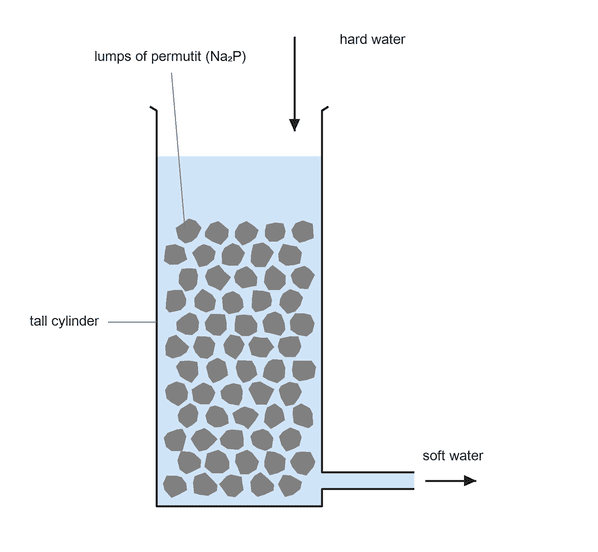
Step 3 — Exchange the ions.
The calcium and magnesium ions are taken up by the permutit and an equal charge of sodium ions goes into the water. The sodium salts formed do not cause hardness:
Step 4 — Collect soft water.
Soft water collects at the outlet. Because every calcium and magnesium salt reacts, this method removes both temporary and permanent hardness.
Step 5 — Regenerate the permutit.
When the permutit is used up, a concentrated solution of common salt (brine) is run through it. The calcium (and magnesium) chloride formed is washed away, and the permutit is ready for use again:
Therefore, in the permutit method hard water is passed through sodium aluminium silicate (Na₂P), which exchanges its sodium ions for calcium and magnesium ions, removing both temporary and permanent hardness; the permutit is regenerated with brine.
- 675 marks
Question 67
The following figure shows the solubility curves of NaCl, and hydrated calcium sulphate.

(a) Identify and label the curves with the salt it represents.
(b) State the factors on which the solubility depends.
(c) Solubility of which salt(s) shows :
(i) Endothermic process (ii) Exothermic process ?
Solve with AIWritten solution
Solution:
Concept: A solubility curve shows how the solubility of a substance changes with temperature. Potassium nitrate's solubility rises steeply, sodium chloride's rises only slightly, and that of hydrated calcium sulphate is very low and falls at higher temperatures.
Step 1 — (a) Identify the steep curve.
The steeply rising curve (about 9 g at 0 °C up to 100 g near 58 °C on the graph) is potassium nitrate, whose solubility increases rapidly with temperature.
Step 2 — (a) Identify the nearly flat line.
The almost flat line (about 36 g at 0 °C to about 44 g at 100 °C) is sodium chloride, whose solubility increases only slightly.
Step 3 — (a) Identify the low curve.
The low curve that rises a little and then falls is hydrated calcium sulphate. The labelled graph is:
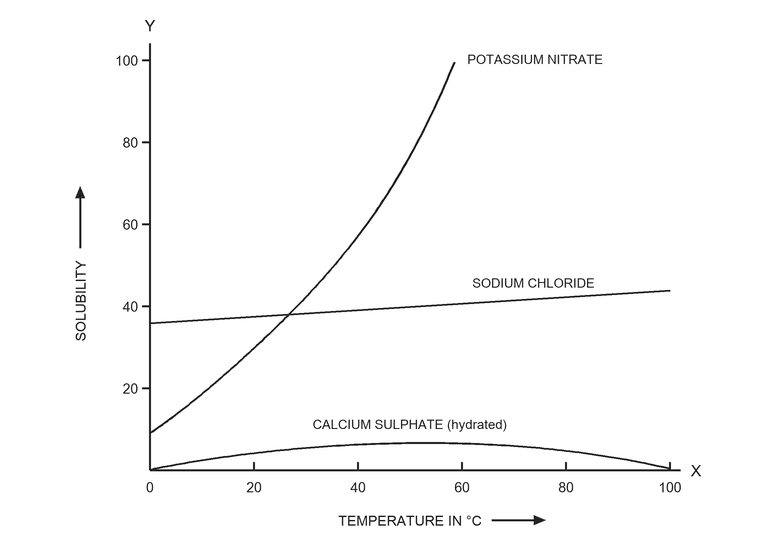
Step 4 — (b) State the factors.
The solubility of a solid in a liquid depends on the nature of the solute, the nature of the solvent and the temperature. (For a gas dissolving in a liquid, the pressure also matters.)
Step 5 — (c) Relate the slope to heat.
When dissolving absorbs heat (endothermic), raising the temperature helps it, so solubility rises with temperature. When dissolving gives out heat (exothermic), raising the temperature hinders it, so solubility falls.
Step 6 — (c) Apply this to the curves.
So (i) endothermic: potassium nitrate and sodium chloride, whose solubility increases with temperature; (ii) exothermic: hydrated calcium sulphate, whose solubility decreases at higher temperatures (beyond about 50 °C on this graph).
Watch out: Particle size and stirring change only how fast a solid dissolves, not its solubility.
Note: The calcium sulphate curve is drawn large and touching zero for clarity; its real solubility is only about 0.2 g per 100 g of water at every temperature (highest near 40 °C), and it never falls to zero.
Therefore, (a) steep curve = potassium nitrate, nearly flat line = sodium chloride, low hump = hydrated calcium sulphate; (b) solubility depends on the nature of the solute and solvent and on temperature (and pressure for gases); (c) (i) KNO₃ and NaCl, (ii) hydrated CaSO₄.
What Class 9 Chemistry Ch 3 covers
The sections of the chapter, in the order the book takes them. Every question above comes from one of these.
- 01Physical Properties of Water
- 02Water as a Universal Solvent
- 03Solutions as Mixtures of Substances in Water
- 04Saturated Solution
- 05Solubility
- 06Crystals and Crystallisation
More ways to study this chapter
The same chapter asked three other ways. Practise it, revise it, and see what the board has set on Ch 3 before.
Class 9 Chemistry Ch 3 questions students ask
How many questions are there in Class 9 Chemistry Ch 3?
67 questions. Every one is solved step by step on this page.
Are these Class 9 Chemistry solutions free?
Yes. Every question and its full working is free to read, with no account needed.
Can I download the Class 9 Chemistry Ch 3 solutions as a PDF?
There is no PDF to download. Every solution is on this page instead, which means it is searchable, always the current syllabus, and readable on a phone. Use your browser's print option if you want it on paper.