Solution:
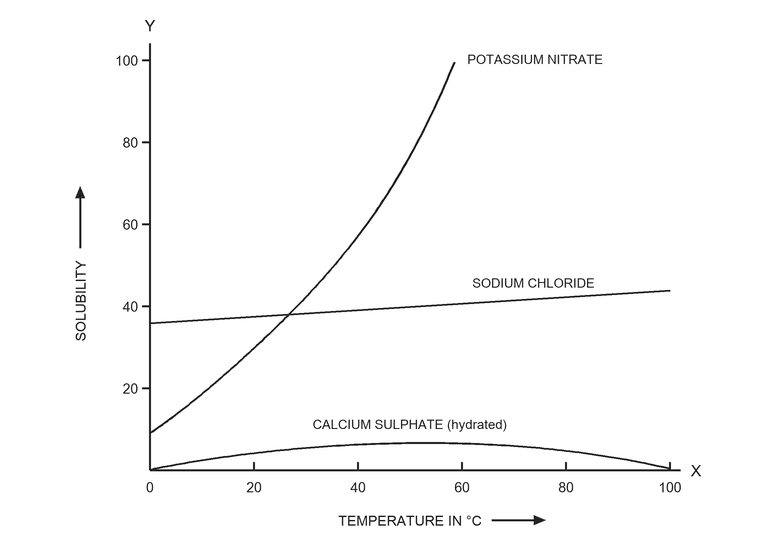
Concept: A solubility curve shows how the solubility of a substance changes with temperature. Potassium nitrate's solubility rises steeply, sodium chloride's rises only slightly, and that of hydrated calcium sulphate is very low and falls at higher temperatures.
Step 1 — (a) Identify the steep curve.
The steeply rising curve (about 9 g at 0 °C up to 100 g near 58 °C on the graph) is potassium nitrate, whose solubility increases rapidly with temperature.
Step 2 — (a) Identify the nearly flat line.
The almost flat line (about 36 g at 0 °C to about 44 g at 100 °C) is sodium chloride, whose solubility increases only slightly.
Step 3 — (a) Identify the low curve.
The low curve that rises a little and then falls is hydrated calcium sulphate. The labelled graph is:
Step 4 — (b) State the factors.
The solubility of a solid in a liquid depends on the nature of the solute, the nature of the solvent and the temperature. (For a gas dissolving in a liquid, the pressure also matters.)
Step 5 — (c) Relate the slope to heat.
When dissolving absorbs heat (endothermic), raising the temperature helps it, so solubility rises with temperature. When dissolving gives out heat (exothermic), raising the temperature hinders it, so solubility falls.
Step 6 — (c) Apply this to the curves.
So (i) endothermic: potassium nitrate and sodium chloride, whose solubility increases with temperature; (ii) exothermic: hydrated calcium sulphate, whose solubility decreases at higher temperatures (beyond about 50 °C on this graph).
Watch out: Particle size and stirring change only how fast a solid dissolves, not its solubility.
Note: The calcium sulphate curve is drawn large and touching zero for clarity; its real solubility is only about 0.2 g per 100 g of water at every temperature (highest near 40 °C), and it never falls to zero.
Therefore, (a) steep curve = potassium nitrate, nearly flat line = sodium chloride, low hump = hydrated calcium sulphate; (b) solubility depends on the nature of the solute and solvent and on temperature (and pressure for gases); (c) (i) KNO₃ and NaCl, (ii) hydrated CaSO₄.

