
Question 663 marksMedium
What is permutit method, how can it be used for softening hard water ?
Confirming your payment
Sign up now and get 250 free tokens.
Water · Question 66 of 67
What is permutit method, how can it be used for softening hard water ?
Solution:
Concept: Ion exchange: permutit gives up its sodium ions and takes in the calcium and magnesium ions of hard water in their place.
Step 1 — Describe permutit.
Permutit is an artificial zeolite, hydrated sodium aluminium silicate, . For convenience it is written , where P stands for the whole aluminium silicate part (not for phosphorus).
Step 2 — Set up the softener.
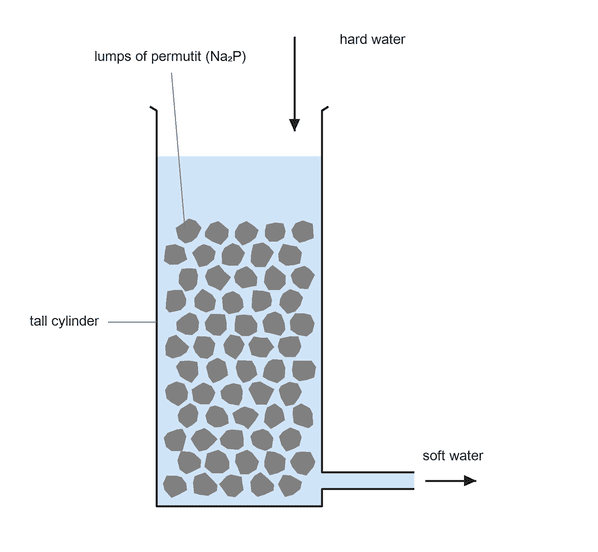
A tall cylinder is loosely packed with lumps of permutit. Hard water is poured in at the top and trickles slowly through the lumps.
Step 3 — Exchange the ions.
The calcium and magnesium ions are taken up by the permutit and an equal charge of sodium ions goes into the water. The sodium salts formed do not cause hardness:
Step 4 — Collect soft water.
Soft water collects at the outlet. Because every calcium and magnesium salt reacts, this method removes both temporary and permanent hardness.
Step 5 — Regenerate the permutit.
When the permutit is used up, a concentrated solution of common salt (brine) is run through it. The calcium (and magnesium) chloride formed is washed away, and the permutit is ready for use again:
Therefore, in the permutit method hard water is passed through sodium aluminium silicate (Na₂P), which exchanges its sodium ions for calcium and magnesium ions, removing both temporary and permanent hardness; the permutit is regenerated with brine.