
Opening your dashboard
Class 9 Chemistry Chapter 3 Water: Competency-Based Questions (CBQ)
40 questions on Chapter 3, each worked through on its own page with the AI tutor. Class 9 Chemistry, ICSE 2026-27.
40 questions
1–5 marks · Mixed difficulty
- 11 mark
Question 1
Cognitive domain: Understanding
Four students each stir a different substance into a beaker of water and note what they see.
Mixture Just after stirring After standing for an hour On filtering P cloudy and white a white solid has settled white residue on the paper, colourless filtrate Q blue and transparent no change no residue, blue filtrate R cloudy and brown a brown solid has settled brown residue on the paper, colourless filtrate S cloudy, with tiny drops two clear layers, one above the other not filtered Which mixture is a true solution?
- 21 mark
Question 2
Cognitive domain: Analysis
For a crystal-growing project, Rina has to dissolve 42 g of potassium nitrate completely in 50 g of water, using as little heating as possible. She looks up the solubility of potassium nitrate.
Temperature (°C) 20 40 50 60 Solubility (g per 100 g of water) 31.6 63 84 108 Which is the lowest temperature in the table at which all of her potassium nitrate will dissolve?
- 31 mark
Question 3
Cognitive domain: Understanding
A new camera bag has a small paper sachet of silica gel beads inside it. After a whole monsoon, the sachet is found to weigh more than before, yet the beads inside are still hard, separate and dry to the touch.
Which statement describes the behaviour of silica gel correctly?
- 41 mark
Question 4
Cognitive domain: Application
An old bungalow still has water pipes made of lead. For many years it received hard spring water, and tests never found lead in the tap water. The town now plans to supply very soft water. An engineer advises the owner to replace the lead pipes before the change.
Which is the best reason for this advice?
- 51 mark
Question 5
Cognitive domain: Understanding
Assertion (A): In an open vessel, rice takes longer to cook in a hill station such as Shimla than in Chennai, which is on the sea coast.
Reason (R): The boiling point of water becomes lower when the pressure on its surface becomes lower.
- 61 mark
Question 6
Cognitive domain: Analysis
Assertion (A): When concentrated sulphuric acid turns blue vitriol crystals white, the acid is acting only as a drying agent.
Reason (R): A drying agent removes moisture from a substance without reacting chemically with it.
- 71 mark
Question 7
Cognitive domain: Understanding
A school first-aid box has a small bottle of a brown liquid labelled Tincture of iodine. Fill in the blanks.
In this liquid the solute is ________ and the solvent is ________. Because the solvent is a liquid other than water, it is called a ________ solution.
- 81 mark
Question 8
Cognitive domain: Application
A laboratory has bought alcohol that is supposed to contain no water at all. To check this, the teacher heats a few blue vitriol crystals until they turn into a white powder, lets the powder cool and drops a pinch of it into a little of the alcohol.
Name the white powder, and state what will be seen if the alcohol does contain some water.
- 91 mark
Question 9
Cognitive domain: Application
Kavita takes two test tubes. One contains rainwater collected in a clean vessel. The other contains water from a well dug in limestone country. She adds five drops of soap solution to each and shakes both tubes equally.
Predict what she will see in each test tube.
- 102 marks
Question 10
Cognitive domain: Application
A kulfi seller pours sweetened milk into metal moulds and buries them in a pot of crushed ice. With ice alone the kulfi stays slushy. When he mixes plenty of common salt into the crushed ice, a thermometer pushed into the pot reads −12 °C and the kulfi sets hard.
(a) Why does the sweetened milk not freeze properly in ice alone?
(b) How does mixing salt with the ice help?
- 112 marks
Question 11
Cognitive domain: Evaluation
Jai says, "A saturated solution is always a concentrated solution, and a dilute solution is always unsaturated." His teacher puts two clear solutions before him.
Solution What it contains Solubility of the solute at that temperature X 0.17 g of slaked lime in 100 g of water at room temperature 0.17 g per 100 g of water Y 60 g of potassium nitrate in 100 g of water at 60 °C 108 g per 100 g of water Use the two solutions to evaluate Jai's statement.
- 122 marks
Question 12
Cognitive domain: Application
On the salt pans of the Gujarat coast, sea water is let into wide shallow pans and left in the sun and wind for weeks, until crystals of common salt separate. A visitor asks, "Why wait for weeks? Make a hot saturated solution and cool it. That is how we got potassium nitrate crystals in school."
Salt Solubility at 20 °C Solubility at 60 °C Sodium chloride about 36 g about 37 g Potassium nitrate 31.6 g 108 g (Solubility is in g per 100 g of water.)
(a) By which method do the crystals separate in the salt pans?
(b) Use the data to explain why the visitor's method suits potassium nitrate but not common salt.
- 135 marks
Question 13
Cognitive domain: Analysis
The Mehra family's house is supplied with borewell water. Their electric geyser now takes much longer to heat water, and the electricity bill has gone up. When a plumber opens the geyser, he finds the heating element coated with a thick white crust. He then tests three samples of water by counting the drops of soap solution needed to give a lasting lather with 50 mL of each.
Sample Drops of soap solution Rainwater 4 Cold water from the tap (borewell water) 30 Water from the hot outlet of the geyser, cooled 18 Finally he fits a softener filled with permutit on the inlet pipe, and tells the family to run a strong solution of common salt through it once a month.
(a) What is the white crust, and how was it formed? Give the equation. Why does it make the geyser slow and costly to run?
(b) What do the three soap readings show about the kind of hardness in the borewell water? Explain your reasoning.
(c) Explain, with equations, how the softener removes the hardness that the geyser could not remove, and why salt solution has to be run through it. (Take calcium sulphate as the dissolved salt and write permutit as .)
- 144 marks
Question 14
Cognitive domain: Evaluation
A thermal power station draws water from a river to cool its machinery and then returns it to the river, several degrees warmer. Fishermen downstream complain that their catch has fallen since the station opened. The manager replies, "We add no chemical to the water. We only warm it a little, and warm water cannot harm fish." A student looks up the greatest mass of oxygen that can stay dissolved in one litre of fresh water in contact with air.
Temperature (°C) 10 20 30 40 Dissolved oxygen (mg per litre) 11.3 9.1 7.6 6.4 (a) Describe how the solubility of oxygen changes with temperature. How is this different from the behaviour of a solid such as potassium nitrate?
(b) The river is at 20 °C above the station and at 30 °C just below it. Calculate the fall in the greatest mass of dissolved oxygen per litre, and express it as a percentage correct to one decimal place.
(c) Evaluate the manager's reply, and suggest one step the station could take.
- 155 marks
Question 15
Cognitive domain: Creativity
Water dissolves so many substances that even clear water is rarely pure. Ananya wants to compare the amount of dissolved solids in four clear samples: rainwater collected in a clean steel bowl, tap water, borewell water and distilled water from the laboratory.
She has a measuring cylinder, evaporating dishes, a balance that reads to 0.01 g, a funnel and filter paper, and a burner with a tripod and wire gauze. Design her investigation. Your plan should show:
(a) the steps for one sample, and the measurements to be taken;
(b) what must be kept the same for all four samples, and two precautions;
(c) a table for the results, how the dissolved solids in grams per litre are calculated (work it out for a 100 mL sample that leaves 0.06 g of residue), and the results you expect;
(d) a comment on her brother's remark: "The sample that leaves no residue is the best one to drink."
- 161 mark
Question 16
Cognitive domain: Analysis
At a beach in Goa, Meena records the temperature of dry sand and of sea water, lying in the same sunshine about m apart, at two times of one day. (Hypothetical data.)
Time Dry sand Sea water 2 pm 42 °C 29 °C 2 am 26 °C 28 °C At 2 pm the wind blows from the sea towards the land, and at 2 am it blows from the land towards the sea. Which statement explains both the readings and the changing wind ?
- 171 mark
Question 17
Cognitive domain: Analysis
A data booklet gives the greatest mass of four substances that dissolves in g of water at °C. For oxygen, the value is for water left open to the air.
Substance State at room temperature Mass that dissolves in g of water sugar solid about g common salt solid about g calcium carbonate solid about g oxygen gas about g The booklet also says that alcohol, a liquid, mixes with water in all proportions. Which conclusion about water is best supported by this information ?
- 181 mark
Question 18
Cognitive domain: Application
Kavya makes g of brine, a solution of common salt in water, with % of salt by mass. She boils it in an open pan until the mass of the liquid in the pan has fallen to g. No salt separates out. (Hypothetical data.) What is the concentration of the brine in the pan now ?
- 191 mark
Question 19
Cognitive domain: Analysis
The graph shows the solubility curve of a salt X in water. The point P stands for a clear solution that has g of X dissolved in g of water at °C. (Hypothetical data.)
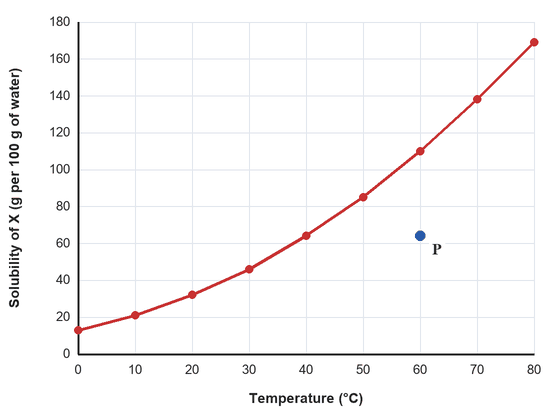
The solution P is cooled slowly. Assume that crystals appear as soon as the solution becomes saturated. At what temperature do crystals first appear ?
- 201 mark
Question 20
Cognitive domain: Application
A scuba diver breathes compressed air while deep under water, where the pressure on the body is much greater than at the surface. Some nitrogen of the air dissolves in the diver's blood. If the diver comes up to the surface too quickly, tiny bubbles of nitrogen can form in the blood and the joints and cause severe pain. Which statement best explains this ?
- 211 mark
Question 21
Cognitive domain: Application
A laboratory can obtain crystals in four ways: method 1, by cooling a hot saturated solution; method 2, by slowly evaporating a saturated solution; method 3, by cooling a fused (molten) mass; method 4, by sublimation.
Four situations are described.
P: A sweet-maker hangs a thread in hot, saturated sugar syrup and lets the syrup cool slowly overnight; rock-sugar crystals form on the thread as it cools.
Q: A saturated solution of copper sulphate is left uncovered in a shallow dish for several days, and blue crystals appear in the dish.
R: Molten sulphur is allowed to cool slowly in a dish, and needle-shaped crystals form as it freezes.
S: Iodine crystals are warmed gently in a flask; violet vapour rises and shiny crystals appear on a cold flask held above.
Which of the following matches each situation with the method by which its crystals form ?
- 221 mark
Question 22
Cognitive domain: Application
A lab assistant has three jars P, Q and R of colourless crystals whose labels have come off. The crystals are known to be washing soda (), Epsom salt () and gypsum (), but not in this order. She heats g from each jar strongly until the mass stops changing and weighs the anhydrous solid that is left. (H = 1, C = 12, O = 16, Na = 23, Mg = 24, S = 32, Ca = 40)
Jar Mass of anhydrous solid left P 7.91 g Q 3.71 g R 4.88 g Which is the correct identification of the jars ?
- 231 mark
Question 23
Cognitive domain: Analysis
Ravi tries to dry moist hydrogen chloride gas by passing it through a gas-washing (drying) bottle that holds concentrated sulphuric acid. He connects the bottle as shown. He finds that the gas coming out of the bottle is still moist, and after a few minutes drops of the acid are carried out of the bottle with the gas.
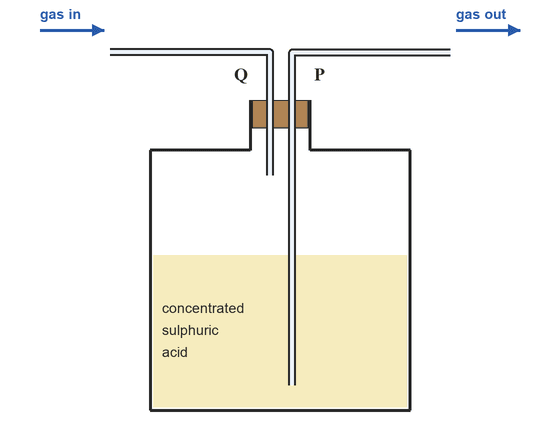
What is wrong with Ravi's set-up, and how should the bottle be connected ?
- 241 mark
Question 24
Cognitive domain: Understanding
Assertion (A): A synthetic detergent gives a good lather even in hard water, whereas ordinary soap does not.
Reason (R): The calcium and magnesium salts of a synthetic detergent are soluble in water, so they do not form scum.
- 251 mark
Question 25
Cognitive domain: Evaluation
Assertion (A): A block of ice floats on liquid water.
Reason (R): Water has its maximum density at °C.
- 262 marks
Question 26
Cognitive domain: Application
Aman has a mass of kg. His textbook says that nearly % of the body weight of a person is water, and that water occurs in nature in both a free state and a combined state.
(a) Using the percentage given in the textbook, calculate the mass of water in Aman's body.
(b) Give one example of water in the free state and one example of water in the combined state, and name the term used for the water in your second example.
- 272 marks
Question 27
Cognitive domain: Understanding
A brass key has a mass of g. Brass is a solid solution that contains % copper and % zinc by mass, and copper acts as the solvent.
(a) Name the solute and calculate its mass in the key.
(b) Tarun says, "Brass cannot be a solution, because a solution has to be a liquid." Correct his statement.
- 282 marks
Question 28
Cognitive domain: Evaluation
At °C the solubility of potassium nitrate is g per g of water. Three students each add g of potassium nitrate to g of water at °C and note how long all the solid takes to dissolve. (Hypothetical data.)
Student Condition of the solid Stirring Time to dissolve completely Asha large crystals none minutes Bilal powder none minutes Charu powder continuous minute Dev looks only at the last column and says, "Powdering and stirring increase the solubility of potassium nitrate." Evaluate his statement using the data.
- 292 marks
Question 29
Cognitive domain: Evaluation
Two open dishes each hold g of washing soda crystals, . One dish is kept for a week in a store room in Jaipur in May, where the air is hot and dry. The other is kept for a week in a store room in Kochi in July, where the air is warm and very humid. Rohan predicts, "The crystals in Kochi will lose their water of crystallisation faster, because the air there has so much water in it."
Evaluate Rohan's prediction, and write the equation for the change that the crystals undergo.
- 302 marks
Question 30
Cognitive domain: Understanding
Kavita's mother washes greasy plates in a soap solution made with soft water. Each soap particle has a long hydrocarbon tail and a negatively charged head. After rinsing, the grease is gone and does not stick back to the plates.
(a) Which part of a soap particle attaches itself to the grease, and which part stays in the water ?
(b) Explain why the small globules of grease do not join together again, but are washed away when the plates are rinsed.
- 312 marks
Question 31
Cognitive domain: Application
A student has mL of kerosene that looks cloudy because it holds tiny droplets of water. She stirs in a spoonful of anhydrous sodium sulphate, leaves it overnight and then filters the liquid. The kerosene is now clear. Her friend says, "Glauber's salt, , is cheaper and would do the job just as well."
(a) Explain how the anhydrous sodium sulphate dries the kerosene, and why the liquid is filtered.
(b) Evaluate the friend's suggestion.
- 323 marks
Question 32
Cognitive domain: Application
Doctors set a broken arm in a cast made from plaster of Paris, , a white powder. When the powder is mixed with water into a paste, it takes up water and sets hard as gypsum, . (H = 1, O = 16, S = 32, Ca = 40)
(a) Calculate the formula masses of plaster of Paris and of gypsum.
(b) Write the balanced equation for the setting, and calculate the mass of water that g of the powder takes up.
(c) Plaster of Paris is sold in sealed, airtight bags. Explain why.
- 333 marks
Question 33
Cognitive domain: Evaluation
A dyeing unit discharges its waste water into a stream. Downstream the water is clear but has a blue-green tinge, and fish are dying. The owner says, "There is no solid waste in the water, because you can see right through it. So the stream is not polluted." A student filters a sample of the downstream water and finds nothing on the filter paper. She then evaporates litre of the filtered water and gets g of solid residue; litre of water from upstream of the unit leaves only g. (Hypothetical data.)
(a) Name the property of water that lets such a substance spread through it, and say why filtration fails to remove it.
(b) Evaluate the owner's statement using the data.
(c) Name one method that can separate the dissolved solid from the water.
- 343 marks
Question 34
Cognitive domain: Application
Take the solubility of potassium nitrate at °C as g per g of water. A student has g of a saturated solution of potassium nitrate at °C.
(a) Find the mass of potassium nitrate and the mass of water in this solution.
(b) She keeps the solution at °C and lets g of water evaporate from it. Calculate the mass of potassium nitrate that crystallises out.
(c) Is the concentration (mass percent) of the solution that remains different from that of the original solution? Give a reason.
- 353 marks
Question 35
Cognitive domain: Analysis
Three crystalline solids P, Q and R are heated in separate dry test tubes. They are known to be common salt, potassium nitrate and blue vitriol (copper sulphate crystals), in some order. P and Q are white and R is blue.
Solid What is seen on heating P crackles and breaks into smaller pieces; no liquid collects in the tube Q melts to a colourless liquid; on stronger heating a gas comes off that rekindles a glowing splint, and a light yellow solid is left R colourless drops collect on the cooler part of the tube, and the blue crystals turn into a white powder (a) Identify P, Q and R, giving one reason for each.
(b) Write the balanced equation for the change that Q undergoes on strong heating.
(c) Which of the three solids contain water of crystallisation? What does the crackling of P show ?
- 363 marks
Question 36
Cognitive domain: Analysis
Carbon monoxide, a poisonous gas, is made in a fume cupboard under supervision by adding formic acid, , drop by drop to warm concentrated sulphuric acid. The sulphuric acid is not used up as a reactant. A student says, "Anhydrous calcium chloride, which is a drying agent, would work just as well as the sulphuric acid."
(a) Write the balanced equation for the change in the formic acid.
(b) Is the concentrated sulphuric acid acting as a drying agent or a dehydrating agent here? Give a reason that uses your equation.
(c) Explain why the student is wrong.
- 374 marks
Question 37
Cognitive domain: Analysis
Dhruv puts an ice cube of volume cm³ into a glass of pure water. The cube floats with a small part above the surface. Take the density of ice as g/cm³ and that of water as g/cm³. A floating body pushes aside (displaces) a mass of water equal to its own mass.
(a) Calculate the mass of the ice cube and the volume of water that it forms when it melts completely.
(b) Calculate the volume of the cube that is below the water surface, and the percentage of the cube that is above it.
(c) Will the level of water in the glass rise, fall or stay the same when the ice has melted completely? Explain your answer.
- 385 marks
Question 38
Cognitive domain: Analysis
The water in a hostel is permanently hard because it contains calcium sulphate. The warden wants to know how much washing soda to add. A student takes litre samples of the water and adds different masses of washing soda to them. She stirs each sample, lets the solid settle, filters it and counts the drops of soap solution that give a lasting lather with mL of the filtered water. Rainwater needs drops. (Hypothetical data.)
Washing soda added per litre (g) 0 0.2 0.4 0.6 0.8 1.2 Drops of soap solution needed 34 24 14 4 4 4 (a) Describe how the number of drops changes as more washing soda is added, and say why it stops changing.
(b) Write the balanced equation for the reaction of calcium sulphate with washing soda, and name the solid that settles.
(c) State the smallest mass of washing soda per litre that softens this water, and evaluate the warden's idea of adding g per litre "to be on the safe side".
- 395 marks
Question 39
Cognitive domain: Analysis
The graph shows how the solubility of sodium sulphate changes with temperature. The solid in contact with the solution is Glauber's salt, , below about °C and anhydrous sodium sulphate, , above it. The solubility is in grams of anhydrous sodium sulphate per g of water.
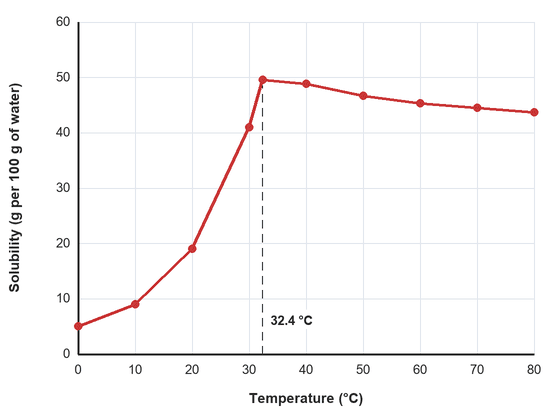
(a) Read from the graph the solubility at °C and at °C, and state the temperature at which the solubility is greatest.
(b) Use the information about the solid to explain why the curve changes direction at °C.
(c) Priya heats a clear saturated solution of sodium sulphate that contains g of water from °C to °C and sees a white solid appear. She thinks her experiment has gone wrong. Use the graph to evaluate her thought, state the approximate mass of the solid and name it.
- 405 marks
Question 40
Cognitive domain: Creativity
Tap water looks pure, but the textbook says that air is dissolved in it. Ananya wants to show this by an experiment. She has a round-bottomed flask, a two-holed cork fitted with a delivery tube and a thermometer, a trough of water, a test tube, a burner with a tripod and wire gauze, tap water, and a bottle of tap water that was boiled for minutes and cooled to room temperature in a closed container.
(a) Plan an experiment to collect the gas from tap water. Describe the set-up and the steps.
(b) Say what Ananya must keep the same, which water she should use as the comparison, and what result she should expect with it. Give a reason.
(c) A friend says, "The gas you collect is only steam." Give two pieces of evidence from the experiment to show that it is not, and state what heating does to the solubility of a gas.