
Opening your dashboard
Class 9 Biology Chapter 6: Seeds – Structure and Germination Solutions
34 textbook questions with step-by-step answers, free to read, for ICSE 2026-27.
Get talked through Ch 6, not just shown the answer
Reading a finished solution is not the same as being able to do it. The AI tutor takes one question at a time and works it with you, in your own words, until you can.
- Ask it out loud, in your own words
- It gives you the next step, not the answer
- Stuck on part (ii)? Start there
34 questions with solutions
1–15 marks · Mixed difficulty
- 15 marks
Question 1
Mention whether the following statements are True (T) or False (F)
(i) Plumule is the future root and radicle is the future shoot of the plant. (T/F)
(ii) Micropyle serves for the emergence of the radicle. (T/F)
(iii) Cotyledons in castor are a big store of food for the embryo. (T/F)
(iv) Maize grain has a large endosperm. (T/F)
(v) Tegmen is the outermost layer of the seed. (T/F)
Solve with AIWritten solution
Solution:
Concept: A seed has a seed coat (outer testa, inner tegmen) and an embryo (radicle, plumule and cotyledons). Some seeds keep a food store called endosperm; in others the cotyledons store the food.
Step 1 — Statement (i).
The plumule is the future shoot and the radicle is the future root; the statement swaps them.
False.
Step 2 — Statement (ii).
The book gives the micropyle two uses: the seed absorbs water mainly through it, and respiratory gases diffuse through it for the embryo. The radicle does not need a pore; it bursts through the softened seed coat.
False.
Step 3 — Statement (iii).
Castor is an endospermic (albuminous) seed: its cotyledons are thin and papery, and the food is stored in the endosperm.
False.
Step 4 — Statement (iv).
Most of a maize grain is a large, starchy endosperm.
True.
Step 5 — Statement (v).
The testa is the outer layer of the seed coat; the tegmen is the thin inner layer.
False.
Watch out: The radicle tip points towards the micropyle, so it comes out close to it, but it breaks through the seed coat; the micropyle's own uses are water entry and gas exchange.
Therefore, (i) F, (ii) F, (iii) F, (iv) T, (v) F.
- 26 marks
Question 2
Fill in the blanks by choosing the correct alternative
(i) In a dry seed, the embryo is in .......... state. (active/quiescent)
(ii) Water is absorbed by the seed mainly through .......... . (entire surface/micropyle)
(iii) Very low temperature .......... the growth of embryo. (inhibits/destroys)
(iv) Germination in pea is .......... . (epigeal/hypogeal)
(v) Coleoptile is a part found in the germinating .......... . (castor/maize)
(vi) Alkaline pyrogallic acid is used for absorbing .......... during experiments on germination. (oxygen/carbon dioxide)
Solve with AIWritten solution
Solution:
Concept: A dry seed is alive but resting. It germinates when it gets water, oxygen and a suitable temperature.
Step 1 — Part (i).
In a dry seed the embryo is alive but inactive, that is, quiescent.
Step 2 — Part (ii).
The seed absorbs water all over its surface but mainly through the micropyle.
Step 3 — Part (iii).
Very low temperature inhibits (slows or stops) the growth of the embryo; it is very high temperature that destroys it.
Step 4 — Part (iv).
In pea the epicotyl grows and the cotyledons stay below the soil, so germination is hypogeal.
Step 5 — Part (v).
The coleoptile is the sheath over the plumule of a grass grain, so it is found in germinating maize.
Step 6 — Part (vi).
Alkaline pyrogallic acid (alkaline pyrogallol) absorbs oxygen, so it is used to show that seeds need oxygen to germinate.
Therefore, (i) quiescent, (ii) micropyle, (iii) inhibits, (iv) hypogeal, (v) maize, (vi) oxygen.
- 31 mark
Question 3
Choose the correct answer from the options given below :
Which one of the following plant parts is correctly matched with one of its stated characteristic ?
Solve with AIAnswer
(A) Mango seed .......... aleurone layer
(B) Bean seed .......... endosperm
- Correct
(C) Maize grain .......... coleoptile
(D) Wheat grain .......... exalbuminous
Answer: (C) Maize grain .......... coleoptile
Concept: The coleoptile is the protective sheath over the plumule in the grain of a monocot such as maize.
Step 1 — Test each pair.
Check whether each seed really has the feature named beside it.
Step 2 — Find the correct pair.
A maize grain does have a coleoptile over its plumule, so option (C) is correctly matched.
Why the other options are wrong:
- (A) Mango seed .......... aleurone layer: the aleurone layer is the protein-rich outer layer of the endosperm in cereal grains; a mango seed has no endosperm.
- (B) Bean seed .......... endosperm: a bean seed has no endosperm; its food is stored in its two thick cotyledons.
- (D) Wheat grain .......... exalbuminous: wheat is an albuminous (endospermic) grain, not exalbuminous.
Therefore, the correctly matched pair is maize grain and coleoptile, option (C).
- 41 mark
Question 4
Seeds sown very deep in the soil fail to germinate because they :
Solve with AIAnswer
(A) cannot exert enough force to push the soil upward.
(B) do not get enough sunlight.
(C) get too much water.
- Correct
(D) do not get enough oxygen.
Answer: (D) do not get enough oxygen.
Concept: A germinating embryo divides and grows very fast, and the energy for this comes from respiration, which needs oxygen. Deep in the soil there is very little air.
Step 1 — Two reasons in the book.
The book gives two reasons why deeply sown seeds fail: (1) no proper supply of oxygen for respiration, and (2) too little pushing force in the hypocotyl or epicotyl to break through the thick layer of soil above.
Step 2 — Choose the key.
The first reason stops germination itself, because without oxygen the embryo cannot get the energy to grow. So the printed key is option (D).
Watch out: Option (A) is the book's second reason; it explains why a seedling may not reach the surface, but the key asks for the main reason, lack of oxygen.
Why the other options are wrong:
- (A) cannot exert enough force to push the soil upward: this is the book's second reason (weak pushing force of the hypocotyl or epicotyl); it is not the main reason keyed here.
- (B) do not get enough sunlight: light is not a condition for germination; seeds germinate in the dark.
- (C) get too much water: deep soil does not necessarily have too much water, and water is itself a need for germination.
Therefore, seeds sown very deep fail to germinate mainly because they do not get enough oxygen, option (D).
- 51 mark
Question 5
Fruit is a ripened :
Solve with AIAnswer
- Correct
(A) Ovary
(B) Embryo
(C) Ovule
(D) Zygote
Answer: (A) Ovary
Concept: After fertilisation the ovary enlarges and ripens into the fruit, and its wall becomes the fruit wall; the ovules inside become the seeds.
Step 1 — Recall what each part becomes.
The ovary gives the fruit, the ovule gives the seed, and the zygote gives the embryo.
Step 2 — Choose.
So a fruit is a ripened ovary, option (A).
Watch out: Do not confuse the ovary (which forms the fruit) with the ovule (which forms the seed).
Why the other options are wrong:
- (B) Embryo: the embryo is the young plant inside a seed; it does not ripen into a fruit.
- (C) Ovule: a ripened ovule is a seed, not a fruit.
- (D) Zygote: the zygote develops into the embryo.
Therefore, a fruit is a ripened ovary, option (A).
- 61 mark
Question 6
Which of the following is the largest seed ?
Solve with AIAnswer
(A) Watermelon
(B) Pumpkin
- Correct
(C) Double coconut
(D) Mango
Answer: (C) Double coconut
Concept: Seeds vary greatly in size: some are tiny (poppy), some are large (mango). The largest seeds are those of the coconut and the double coconut.
Step 1 — Compare the options.
The double coconut (Lodoicea) has the largest seed of any plant; it can weigh well over 10 kg.
Step 2 — Choose.
So the answer is option (C).
Why the other options are wrong:
- (A) Watermelon: watermelon seeds are small.
- (B) Pumpkin: pumpkin seeds are small and flat.
- (D) Mango: the mango seed is fairly large, but far smaller than the double coconut seed.
Therefore, the largest seed among these is the double coconut, option (C).
- 71 mark
Question 7
The distinct whitish oval scar on the concave side of the seed is termed as :
Solve with AIAnswer
(A) Scutellum
(B) Micropyle
- Correct
(C) Hilum
(D) Germpore
Answer: (C) Hilum
Concept: The hilum is the whitish oval scar on the concave side of a seed. It marks the spot where the seed was joined by its stalk to the ovary wall (placenta).
Step 1 — Read the clues.
The stem asks for an oval scar on the concave side of the seed.
Step 2 — Name it.
This scar is the hilum, option (C).
Watch out: The micropyle lies close to the hilum, but it is a tiny pore, not a scar.
Why the other options are wrong:
- (A) Scutellum: the scutellum is the single cotyledon of a maize grain.
- (B) Micropyle: the micropyle is a tiny pore close to the hilum, not an oval scar.
- (D) Germpore: a germ pore is a thin spot in the wall of a pollen grain, not a part of a seed.
Therefore, the oval scar on the concave side of the seed is the hilum, option (C).
- 81 mark
Question 8
The single cotyledon of a maize grain is called :
Solve with AIAnswer
(A) Hypocotyl
- Correct
(B) Scutellum
(C) Coleorhiza
(D) Embryo
Answer: (B) Scutellum
Concept: The embryo of a maize grain has only one cotyledon, which is shield-shaped and called the scutellum. It absorbs food from the endosperm for the embryo.
Step 1 — Recall the parts of the maize embryo.
The maize embryo has a scutellum, a plumule covered by the coleoptile and a radicle covered by the coleorhiza.
Step 2 — Choose.
The single cotyledon is the scutellum, option (B).
Why the other options are wrong:
- (A) Hypocotyl: the hypocotyl is the part of the embryo axis below the cotyledon.
- (C) Coleorhiza: the coleorhiza is the sheath covering the radicle.
- (D) Embryo: the embryo is the whole young plant, of which the scutellum is only one part.
Therefore, the single cotyledon of a maize grain is the scutellum, option (B).
- 91 mark
Question 9
The outermost hard brownish layer of the seed coat is :
Solve with AIAnswer
- Correct
(A) Testa
(B) Tegmen
(C) Epicotyl
(D) Aleurone layer
Answer: (A) Testa
Concept: The seed coat has two layers: the outer, hard, brownish testa and the thin, inner tegmen.
Step 1 — Read the clues.
The stem asks for the outermost, hard, brownish layer.
Step 2 — Name it.
This is the testa, option (A).
Why the other options are wrong:
- (B) Tegmen: the tegmen is the thin inner layer of the seed coat.
- (C) Epicotyl: the epicotyl is the part of the embryo axis above the cotyledons.
- (D) Aleurone layer: the aleurone layer is the protein-rich outer layer of the endosperm in cereal grains.
Therefore, the outermost hard brownish layer of the seed coat is the testa, option (A).
- 101 mark
Question 10
The part of an embryo which develops into root is :
Solve with AIAnswer
(A) Coleorhiza
(B) Plumule
(C) Coleoptile
- Correct
(D) Radicle
Answer: (D) Radicle
Concept: The embryo has two growing tips: the radicle, which forms the root, and the plumule, which forms the shoot.
Step 1 — Recall the roles.
The radicle grows downwards into the soil and becomes the primary root.
Step 2 — Choose.
So the part that develops into the root is the radicle, option (D).
Watch out: The coleorhiza covers the radicle but does not itself become the root.
Why the other options are wrong:
- (A) Coleorhiza: the coleorhiza is only a protective sheath over the radicle (in maize).
- (B) Plumule: the plumule forms the shoot.
- (C) Coleoptile: the coleoptile is the protective sheath over the plumule.
Therefore, the part of the embryo that develops into the root is the radicle, option (D).
- 111 mark
Question 11
Which of the following statement holds true for a maize grain ?
Solve with AIAnswer
(A) The maize grain is a ripened ovary containing a single seed.
(B) The fruit wall and seed coat are fused together.
(C) The outermost layer of the endosperm is rich in protein.
- Correct
(D) All of the above.
Answer: (D) All of the above.
Concept: A maize grain is a one-seeded fruit: it forms from the ovary, its fruit wall is fused with the seed coat, and the outer layer of its endosperm is the protein-rich aleurone layer.
Step 1 — Check statement (A).
The grain develops from the whole ovary and holds only one seed, so (A) is true.
Step 2 — Check statement (B).
The fruit wall (pericarp) and the seed coat are fused into one layer, so (B) is true.
Step 3 — Check statement (C).
The outermost layer of the endosperm, the aleurone layer, is rich in protein, so (C) is true.
Step 4 — Choose.
All three statements are true, so the answer is option (D).
Watch out: When every statement is true, 'all of the above' is the only complete answer.
Why the other options are wrong:
- (A) The maize grain is a ripened ovary containing a single seed: it is true, but it is only one of the three true statements.
- (B) The fruit wall and seed coat are fused together: it is true, but it is only one of the three true statements.
- (C) The outermost layer of the endosperm is rich in protein: it is true (the aleurone layer), but it is only one of the three true statements.
Therefore, all of the above hold true for a maize grain, option (D).
- 121 mark
Question 12
The kind of germination in which the cotyledons remain underground is :
Solve with AIAnswer
(A) Viviparous germination
(B) Epigeal germination
(C) Vegetative germination
- Correct
(D) Hypogeal germination
Answer: (D) Hypogeal germination
Concept: Hypo means below and geo means earth. In hypogeal germination the epicotyl elongates, so the cotyledons stay under the ground.
Step 1 — Read the stem.
The cotyledons remain underground.
Step 2 — Name it.
This is hypogeal germination, option (D), as in pea, gram and maize.
Watch out: In epigeal germination it is the hypocotyl that grows, lifting the cotyledons above the soil.
Why the other options are wrong:
- (A) Viviparous germination: in viviparous germination the seed germinates inside the fruit while it is still on the parent plant, as in Rhizophora.
- (B) Epigeal germination: in epigeal germination the hypocotyl elongates and pushes the cotyledons above the ground.
- (C) Vegetative germination: 'vegetative germination' is not a kind of seed germination.
Therefore, germination in which the cotyledons remain underground is hypogeal germination, option (D).
- 135 marks
Question 13
Correct the following false statements by changing the first/last word only.
(a) Plumule develops into the root system.
(b) Testa is the thin inner layer of the seed coat.
(c) Endothelium separates the endosperm and embryonic region in the maize grain.
(d) Hypocotyl elongates faster in hypogeal germination.
(e) Germination is the period of rest in a seed.
Solve with AIWritten solution
Solution:
Concept: Each statement becomes true when the first word (the wrong term) is replaced; the rest stays as printed.
Step 1 — Part (a).
The radicle, not the plumule, forms the root system.
Radicle develops into the root system.
Step 2 — Part (b).
The thin inner layer of the seed coat is the tegmen; the testa is the outer layer.
Tegmen is the thin inner layer of the seed coat.
Step 3 — Part (c).
In maize a thin epithelium (epithelial layer) separates the endosperm from the embryo.
Epithelium separates the endosperm and embryonic region in the maize grain.
Step 4 — Part (d).
In hypogeal germination it is the epicotyl that grows faster, keeping the cotyledons below.
Epicotyl elongates faster in hypogeal germination.
Step 5 — Part (e).
The period of rest in a seed is dormancy; germination is its awakening.
Dormancy is the period of rest in a seed.
Therefore, the corrected first words are (a) radicle, (b) tegmen, (c) epithelium, (d) epicotyl, (e) dormancy.
- 146 marks
Question 14
Name the following :
(a) A monocotyledonous endospermic seed.
(b) A chemical used in experiments, which absorbs oxygen.
(c) Part of the plumule above the embryonic axis of the seed.
(d) A plant which shows viviparous germination.
(e) The layer of endosperm of maize, rich in protein.
(f) A seed with folded plumule leaves.
Solve with AIWritten solution
Solution:
Concept: Each part needs one name or example from the chapter.
Step 1 — Part (a).
A monocot seed that keeps its endosperm is maize (also wheat, rice).
Step 2 — Part (b).
The chemical that absorbs oxygen in germination experiments is alkaline pyrogallic acid (alkaline pyrogallol).
Step 3 — Part (c).
The part of the axis above the cotyledons, ending in the plumule, is the epicotyl.
Step 4 — Part (d).
A plant showing viviparous germination is Rhizophora, a mangrove.
Step 5 — Part (e).
The protein-rich outer layer of the maize endosperm is the aleurone layer.
Step 6 — Part (f).
A seed whose plumule has two small folded leaves is the bean seed.
Therefore, (a) maize, (b) alkaline pyrogallic acid, (c) epicotyl, (d) Rhizophora, (e) aleurone layer, (f) bean.
- 155 marks
Question 15
Fill in the blanks :
(a) In bean seeds, .......... grows faster and the seeds are brought .......... ground.
(b) .......... is a protective layer of radicle and .......... protects the rolled plumule.
(c) A seed is protected by .......... and .......... .
(d) Seeds absorb water through .......... which also helps in diffusion of respiratory gases.
(e) Rice, wheat, and maize are rich in .......... food.
Solve with AIWritten solution
Solution:
Concept: Bean shows epigeal germination. In maize the radicle and plumule have their own protective sheaths.
Step 1 — Part (a).
In bean the hypocotyl grows faster, so the seeds (cotyledons) are brought above the ground.
Step 2 — Part (b).
The coleorhiza protects the radicle and the coleoptile protects the rolled plumule.
Step 3 — Part (c).
A seed is protected by its two seed-coat layers, the testa and the tegmen.
Step 4 — Part (d).
Seeds absorb water through the micropyle, which also lets respiratory gases diffuse.
Step 5 — Part (e).
Rice, wheat and maize are rich in starchy (carbohydrate) food.
Therefore, (a) hypocotyl, above the; (b) coleorhiza, coleoptile; (c) testa, tegmen; (d) micropyle; (e) starchy.
- 163 marks
Question 16
Arrange the following set of terms in order, so as to be in logical sequence. Rewrite the correct order.
(a) Embryo, 1st male gamete, zygote, egg cell, micropyle.
(b) Zygote, embryo, seed, allogamy, fusion of gametes.
(c) Seed coat bursts, hypocotyl elongates, radicle grows downward, hypocotyl forms loop above the soil, epicotyl elongates.
Solve with AIWritten solution
Solution:
Concept: Put the events in the order in which they really happen, from the first event to the last.
Step 1 — Part (a): fertilisation.
The pollen tube enters through the micropyle; the first male gamete fuses with the egg cell to form the zygote, which grows into the embryo.
Micropyle → 1st male gamete → egg cell → zygote → embryo
Step 2 — Part (b): from pollination to seed.
Pollen is carried to another plant (allogamy), the gametes fuse, the zygote forms, it grows into the embryo, and the ovule becomes the seed.
Allogamy → fusion of gametes → zygote → embryo → seed
Step 3 — Part (c): epigeal germination.
The seed coat bursts and the radicle comes out first and grows down; then the hypocotyl lengthens, arches as a loop above the soil, straightens, and finally the epicotyl grows.
Seed coat bursts → radicle grows downward → hypocotyl elongates → hypocotyl forms loop above the soil → epicotyl elongates
Watch out: In germination the radicle always comes out first, before the shoot parts grow.
Therefore, the three sequences are as written in Steps 1 to 3.
- 175 marks
Question 17
Give two examples of each of the following :
(a) Monocot albuminous seed.
(b) Dicot albuminous seed.
(c) Monocot non-endospermic seed.
(d) Dicot non-endospermic seed.
(e) Viviparous plant.
Solve with AIWritten solution
Solution:
Concept: Albuminous (endospermic) seeds keep their endosperm; in exalbuminous (non-endospermic) seeds the food is stored in the cotyledons. Viviparous plants germinate their seeds on the parent.
Step 1 — Part (a): monocot albuminous.
Maize and wheat (also rice, palm).
Step 2 — Part (b): dicot albuminous.
Castor and poppy (also custard apple).
Step 3 — Part (c): monocot non-endospermic.
Vallisneria and orchids (also Amorphophallus).
Step 4 — Part (d): dicot non-endospermic.
Gram and pea (also bean, mango, mustard).
Step 5 — Part (e): viviparous plants.
Rhizophora and Sonneratia, both mangroves.
Watch out: Most monocot seeds are albuminous and most dicot seeds exalbuminous, but parts (b) and (c) are the exceptions.
Therefore, (a) maize, wheat; (b) castor, poppy; (c) Vallisneria, orchids; (d) gram, pea; (e) Rhizophora, Sonneratia.
- 185 marks
Question 18
Match the terms given in column A with those of column B.
Column A Column B (a) Coleoptile (i) Root system (b) Coleorhiza (ii) Cotyledon (c) Radicle (iii) Radicle (d) Plumule (iv) Plumule (e) Scutellum (v) Shoot system Solve with AIWritten solution
Solution:
Concept: The coleoptile and coleorhiza are sheaths over the plumule and the radicle; the radicle and plumule grow into the root and shoot; the scutellum is the cotyledon of maize.
Step 1 — Parts (a) and (b).
The coleoptile covers the plumule (iv) and the coleorhiza covers the radicle (iii).
Step 2 — Parts (c) and (d).
The radicle forms the root system (i) and the plumule forms the shoot system (v).
Step 3 — Part (e).
The scutellum is the single cotyledon of maize (ii).
Therefore, (a)–(iv), (b)–(iii), (c)–(i), (d)–(v), (e)–(ii).
- 195 marks
Question 19
Name the following :
(a) Two types of seeds on the basis of the number of cotyledons.
(b) Two types of seeds on the basis of endosperm.
(c) Three necessary conditions for the germination of seeds.
(d) Two main types of germination.
(e) Two layers of the seed coat.
Solve with AIWritten solution
Solution:
Concept: Seeds are grouped by the number of cotyledons and by whether the endosperm remains; germination is grouped by where the cotyledons end up.
Step 1 — Part (a).
By number of cotyledons: monocotyledonous and dicotyledonous.
Step 2 — Part (b).
By endosperm: albuminous (endospermic) and exalbuminous (non-endospermic).
Step 3 — Part (c).
The three conditions are water, a suitable temperature and oxygen (air).
Step 4 — Part (d).
The two main kinds of germination are epigeal and hypogeal.
Step 5 — Part (e).
The two layers of the seed coat are the testa and the tegmen.
Therefore, (a) monocot, dicot; (b) albuminous, exalbuminous; (c) water, suitable temperature, oxygen; (d) epigeal, hypogeal; (e) testa, tegmen.
- 2010 marks
Question 20
Define the following terms :
(a) Seed
(b) Fruits
(c) Grain
(d) Dormancy
(e) Germination
Solve with AIWritten solution
Solution:
Concept: Each definition must say exactly what the thing is and where it comes from.
Step 1 — Part (a): Seed.
A seed is a ripened ovule, formed after fertilisation, that contains an embryo protected by a seed coat.
Step 2 — Part (b): Fruit.
A fruit is an enlarged, ripened ovary; the ovary wall forms the fruit wall, which encloses the seeds.
Step 3 — Part (c): Grain.
A grain is a one-seeded fruit in which the fruit wall and seed coat are fused into one protective layer, as in maize and wheat.
Step 4 — Part (d): Dormancy.
Dormancy is the period of rest of a seed, during which the embryo stays inactive and its life processes go on very slowly.
Step 5 — Part (e): Germination.
Germination is the process by which the embryo of a seed grows into a seedling when conditions are favourable.
Therefore, the five definitions are as given in Steps 1 to 5.
- 212 marks
Question 21
What is the difference between an embryo and a seed?
Solve with AIWritten solution
Solution:
Concept: The embryo is a part of the seed; the seed is the embryo together with its coverings and food store.
Step 1 — The embryo.
The embryo is the tiny young plant formed from the zygote. It has a radicle, a plumule and one or two cotyledons.
Step 2 — The seed.
The seed is the whole ripened ovule: the embryo together with the seed coat that protects it, and the endosperm if present.
Therefore, the embryo is only the young plant, while the seed is the embryo plus its seed coat (and endosperm).
- 222 marks
Question 22
Germinated grams are considered highly nutritive. What is the reason for this belief ?
Solve with AIWritten solution
Solution:
Concept: During germination, enzymes in the seed become active and break down the stored food into simpler forms for the growing embryo.
Step 1 — Food becomes easier to digest.
When grams are soaked, enzymes convert the stored starch and proteins into simpler, soluble substances such as sugars and amino acids, which our body digests and absorbs easily.
Step 2 — Vitamin content rises.
Sprouting also increases the amount of some vitamins, especially vitamin C and some B vitamins.
Therefore, germinated grams are nutritive because their food is already broken into easily digested forms and their vitamin content rises.
- 232 marks
Question 23
Why do we not use the terms maize fruit and maize seed ? What do we say instead?
Solve with AIWritten solution
Solution:
Concept: A fruit comes from the ovary and a seed from the ovule; normally the fruit wall and the seed coat are separate.
Step 1 — Why neither term fits.
In maize the fruit wall (pericarp) and the seed coat (testa) are fused into one layer, so we cannot separate a 'fruit' from a 'seed'.
Step 2 — The term used.
Such a one-seeded fruit is called a grain, so we say maize grain.
Therefore, we say 'maize grain', because its fruit wall and seed coat are fused and cannot be separated.
- 2410 marks
Question 24
Distinguish between the following pairs :
(a) Monocotyledonous and Dicotyledonous seeds
(b) Epicotyl and Hypocotyl
(c) Epigeal and Hypogeal germination
(d) Radicle and Plumule
(e) Albuminous and Exalbuminous seeds
Solve with AIWritten solution
Solution:
Concept: For each pair, compare the two on the same feature, point by point.
Step 1 — Part (a): Monocotyledonous and dicotyledonous seeds.
They differ in the number of cotyledons and usually in the endosperm.
Monocotyledonous seeds Dicotyledonous seeds Embryo has one cotyledon. Embryo has two cotyledons. Usually endospermic, e.g. maize, wheat. Usually non-endospermic, e.g. pea, gram, bean. Step 2 — Part (b): Epicotyl and hypocotyl.
They differ in position on the embryo axis and in when they grow.
Epicotyl Hypocotyl Part of the axis above the cotyledons, up to the plumule. Part of the axis below the cotyledons, down to the radicle. Elongates in hypogeal germination. Elongates in epigeal germination. Step 3 — Part (c): Epigeal and hypogeal germination.
They differ in where the cotyledons go.
Epigeal germination Hypogeal germination Cotyledons are pushed above the ground. Cotyledons remain underground. Hypocotyl elongates faster, e.g. bean, castor. Epicotyl elongates faster, e.g. pea, gram, maize. Step 4 — Part (d): Radicle and plumule.
They differ in what they form and which way they grow.
Radicle Plumule Forms the root. Forms the shoot. Grows downwards; comes out first. Grows upwards; bears tiny leaves. Step 5 — Part (e): Albuminous and exalbuminous seeds.
They differ in where the food is stored.
Albuminous seeds Exalbuminous seeds Endosperm persists and stores the food. No endosperm in the mature seed. Cotyledons thin, e.g. castor, maize. Cotyledons thick and fleshy, storing food, e.g. pea, gram. Watch out: Epi = above and hypo = below the cotyledons; the part that grows names the kind of germination the other way round (hypocotyl → epigeal).
Therefore, the five pairs differ as shown in the tables of Steps 1 to 5.
- 2515 marks
Question 25
What are the functions of the following in a seed?
(a) Seed coat
(b) Micropyle
(c) Cotyledons
(d) Radicle
(e) Plumule
Solve with AIWritten solution
Solution:
Concept: Each part of a seed either protects, feeds or forms the young plant.
Step 1 — Part (a): Seed coat.
It protects the delicate parts inside from injury and from attack by bacteria, fungi and insects; the hard testa also helps the seed survive drying.
Step 2 — Part (b): Micropyle.
It lets water into the seed for germination and allows respiratory gases to diffuse in and out for the growing embryo.
Step 3 — Part (c): Cotyledons.
They store food (in seeds like bean) or absorb food from the endosperm (the scutellum of maize) and pass it to the growing embryo. In epigeal germination they also turn green and make food for a short time.
Step 4 — Part (d): Radicle.
It grows downwards and forms the root system, which fixes the seedling and absorbs water and minerals.
Step 5 — Part (e): Plumule.
It grows upwards and forms the shoot system, the stem and leaves.
Therefore, (a) protection, (b) entry of water and exchange of gases, (c) food store or food supply, (d) root system, (e) shoot system.
- 263 marks
Question 26
Suggest an experiment to prove that a suitable temperature is necessary for germination.
Solve with AIWritten solution
Solution:
Concept: A fair test changes only one condition. Both sets get water and air; only the temperature is different.
Step 1 — Set-up.
Take two beakers, A and B, and place some soaked gram (or green gram) seeds on wet cotton wool in each.
Step 2 — Procedure.
Keep beaker A in an ordinary warm room and beaker B in a refrigerator. Leave both for a few days, keeping the cotton wool moist.
Step 3 — Observation.
The seeds in beaker A germinate. The seeds in beaker B do not germinate, or only very slightly after several days.
Step 4 — Conclusion.
Both sets had water and air, and only the temperature differed. Hence a suitable (moderately warm) temperature, about 25 °C to 35 °C, is necessary for germination.
Watch out: Keep the cotton wool in B moist too; otherwise B differs in water as well, and the test is not fair.
Therefore, seeds germinate in the warm beaker but not in the cold one, so a suitable temperature is necessary for germination.
- 272 marks
Question 27
Sometimes the potatoes kept in a basket during the late rainy season start giving out small shoots. Would you call it germination ? Give reason in support of your answer.
Solve with AIWritten solution
Solution:
Concept: Germination means the growth of the embryo of a seed into a seedling.
Step 1 — What a potato is.
A potato is not a seed. It is an underground stem (tuber), and it has no embryo.
Step 2 — Where the shoots come from.
The small shoots grow from the buds ('eyes') on the tuber in the moist weather. This is sprouting of buds, a kind of vegetative growth.
Therefore, no, it is not germination, because the shoots come from buds of a stem tuber, not from the embryo of a seed.
- 286 marks
Question 28
Give two differences in each of the following pairs :
(a) Coleorhiza and coleoptile.
(b) Bean seed and maize grain.
(c) Germination and vivipary.
Solve with AIWritten solution
Solution:
Concept: Give two clear points of contrast for each pair, compared on the same feature.
Step 1 — Part (a): Coleorhiza and coleoptile.
Both are sheaths in the maize embryo, but they cover different parts.
Coleorhiza Coleoptile Sheath covering the radicle. Sheath covering the plumule. Lies towards the pointed (lower) end of the grain. Lies towards the upper, broader side of the embryo. Step 2 — Part (b): Bean seed and maize grain.
One is a true seed, the other a one-seeded fruit.
Bean seed Maize grain Two cotyledons; no endosperm. One cotyledon (scutellum); large endosperm. A true seed; hilum and micropyle visible. A fruit with fruit wall and seed coat fused; hilum and micropyle not visible. Step 3 — Part (c): Germination and vivipary.
They differ in where and when the seed germinates.
Germination Vivipary Seed germinates after it is shed from the parent plant. Seed germinates inside the fruit while still on the parent plant. Takes place in the soil, e.g. pea, bean. The seedling drops into the mud and fixes itself there, e.g. Rhizophora. Therefore, the two differences for each pair are shown in the tables of Steps 1 to 3.
- 293 marks
Question 29
Justify the statement that the maize grain is a 'one seeded fruit'.
Solve with AIWritten solution
Solution:
Concept: A fruit develops from the ovary, while a seed develops from an ovule inside it.
Step 1 — It forms from the whole ovary.
The maize grain develops from the whole ovary; a small point on the grain is the remains of the style, which belongs to the ovary, not to an ovule.
Step 2 — Its covering is a fruit wall.
Its outer covering is the fruit wall (pericarp) fused with the seed coat (testa).
Step 3 — It holds only one seed.
Inside there is only one seed: one embryo with its endosperm.
Therefore, the maize grain is a ripened ovary with a single seed inside, so it is a one-seeded fruit.
- 303 marks
Question 30
What is the role played by the hypocotyl in epigeal germination ?
Solve with AIWritten solution
Solution:
Concept: In epigeal germination the hypocotyl is the part that elongates, and it carries the cotyledons above the soil.
Step 1 — It forms a protective loop.
The hypocotyl elongates rapidly and grows up as an arch (loop) through the soil, so the delicate plumule is pulled up behind it and is not damaged.
Step 2 — It lifts the cotyledons.
Once above the soil it straightens and lifts the cotyledons above the ground, where they turn green and act as the first leaves for a short time.
Therefore, in epigeal germination the hypocotyl grows as a loop that protects the plumule and then lifts the cotyledons above the ground.
- 316 marks
Question 31
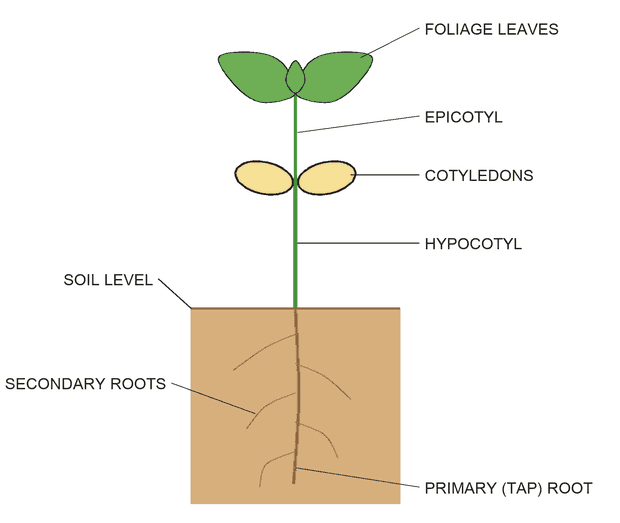
Draw a neat and labelled diagram of :
(a) A twig of viviparous plant showing its germination.
(b) A seedling growing in soil.
Solve with AIWritten solution
Solution:
Concept: Draw simple, well-proportioned outline figures with straight, non-crossing label lines, and write every label the stem asks for.
Step 1 — Part (a): twig of a viviparous plant.
In Rhizophora the seed germinates inside the fruit while it is still on the twig, and long hypocotyls hang down from the fruits. Label leaf, stem, fruit, hypocotyl and radicle.

Step 2 — Part (b): a seedling growing in soil.
A bean seedling (epigeal germination) shows the cotyledons above the soil, the hypocotyl below them and the epicotyl above them. Label foliage leaves, epicotyl, cotyledons, hypocotyl, soil level, primary (tap) root and secondary roots.
Watch out: In a viviparous twig the hypocotyl, not the radicle alone, makes up most of the hanging seedling.
Therefore, the two labelled diagrams are as shown in Steps 1 and 2.
- 323 marks
Question 32
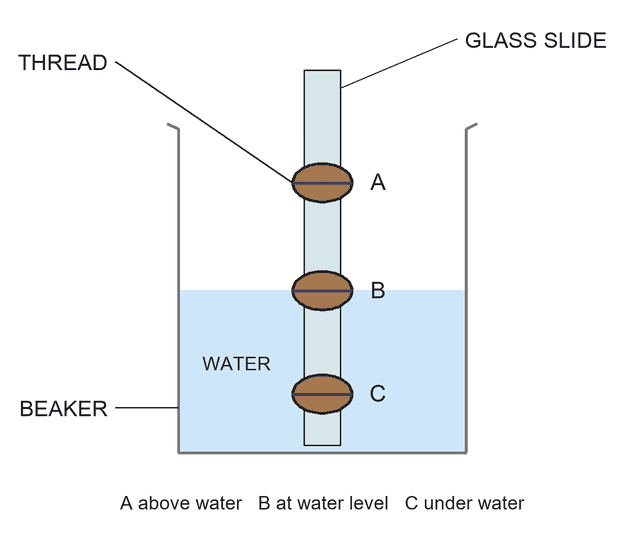
Draw a neat and labelled diagram of the 'Experimental set-up of three-bean seed experiment' and mention the necessity of each condition for the germination of seeds.
Solve with AIWritten solution
Solution:
Concept: Germination needs water, oxygen and a suitable temperature. In the three-bean experiment one slide gives three seeds three different supplies of water and air, at the same temperature.
Step 1 — Set-up.
Three air-dried bean seeds are tied with thread to a glass slide: A well above the water, B at the water level, C completely under water. The slide stands in a beaker of water kept in a warm place for a few days.
Step 2 — Result.
Only seed B germinates. Seed A (air but no water) does not germinate. Seed C (water but very little oxygen) does not germinate, or stops after a small radicle appears.
Step 3 — Why water is necessary.
Water makes the seed swell and burst its coat, and the enzymes need it to change the stored food into a dissolved form the embryo can use.
Step 4 — Why oxygen is necessary.
Oxygen is needed for respiration, which releases the energy for the rapid cell division and growth of the embryo.
Step 5 — Why a suitable temperature is necessary.
At a moderately warm temperature (about 25 °C to 35 °C) the enzymes work best. Very low temperature inhibits growth and very high temperature destroys the embryo; here all three seeds are kept equally warm.
Watch out: Seed C has water, yet fails, because the little oxygen dissolved in water is not enough.
Therefore, only the seed at the water level germinates, showing that a seed needs both water and oxygen, along with a suitable temperature.
- 336 marks
Question 33
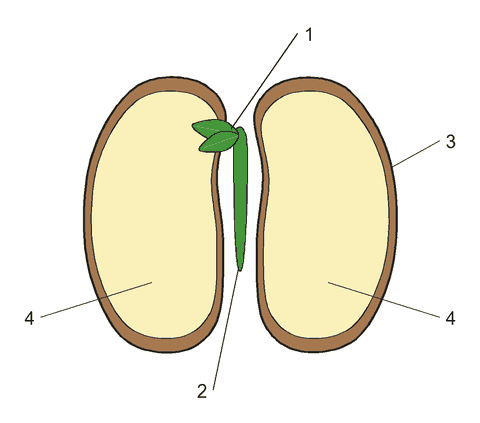
The figure shown below represents the internal structure of a certain seed. Study the figure and answer the following questions.
(a) Identify the seed and mention whether it is mono or dicotyledonous.
(b) Label the guidelines 1 to 4.
(c) Write an important role of part 2.
(d) Mention the food component found in part 4.
(e) What kind of germination takes place in the above mentioned seed ?
Solve with AIWritten solution
Solution:
Concept: Two thick halves with the embryo axis between them show an opened bean seed: a dicot seed whose food is stored in its cotyledons.
Step 1 — Part (a).
It is a bean seed, which is dicotyledonous (two cotyledons).
Step 2 — Part (b).
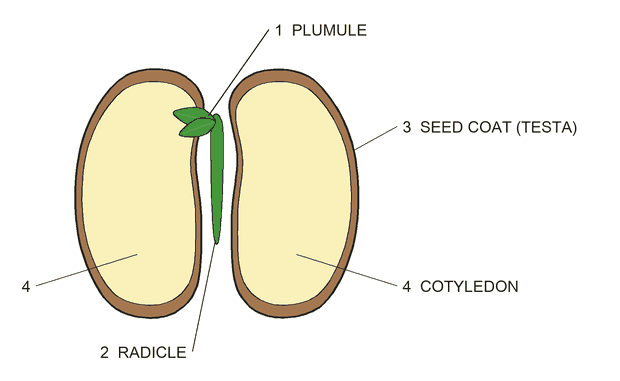
1 – Plumule; 2 – Radicle; 3 – Seed coat (testa); 4 – Cotyledon (each half).
Step 3 — Part (c).
Part 2, the radicle, grows downwards and forms the root system, which fixes the seedling and absorbs water and minerals.
Step 4 — Part (d).
The cotyledons store mainly starch (carbohydrate), together with a good amount of protein.
Step 5 — Part (e).
The bean shows epigeal germination: the hypocotyl grows and lifts the cotyledons above the ground.
Watch out: The common (French) bean is epigeal; a few beans, such as the broad bean, are hypogeal.
Therefore, (a) bean seed, dicotyledonous; (b) 1 plumule, 2 radicle, 3 seed coat, 4 cotyledon; (c) forms the root system; (d) starch, with protein; (e) epigeal.
- 346 marks
Question 34
With regard to germination in bean seed, answer the following questions :
(a) State the function of the 'Micropyle'.
(b) Name the part of the seed that grows into the seedling.
(c) Name the part of the seed that provides nutrition for the growing seedling.
(d) Draw a neat labelled diagram of a mature bean seed.
Solve with AIWritten solution
Solution:
Concept: The micropyle lets in water and gases; the embryo grows into the seedling, fed by the food in the cotyledons.
Step 1 — Part (a).
The micropyle lets water enter the seed when it is soaked, and allows the diffusion of respiratory gases for the growing embryo.
Step 2 — Part (b).
The embryo, through its radicle and plumule, grows into the seedling.
Step 3 — Part (c).
The cotyledons, which store the food of the bean seed.
Step 4 — Part (d).
View A shows the outside of the seed; view B shows it opened, with the cotyledons separated to show the embryo. Label testa, hilum, micropyle, tegmen, cotyledon, plumule and radicle.

Therefore, (a) entry of water and exchange of gases; (b) the embryo; (c) the cotyledons; (d) the labelled diagram in Step 4.
What Class 9 Biology Ch 6 covers
The sections of the chapter, in the order the book takes them. Every question above comes from one of these.
- 01What Is a Seed
- 02Classification and Structure of Seeds
- 03Germination
- 04Some Experiments on Germination
- 05Types of Germination
- 06Germination in Some Common Seeds
More ways to study this chapter
The same chapter asked three other ways. Practise it, revise it, and see what the board has set on Ch 6 before.
Class 9 Biology Ch 6 questions students ask
How many questions are there in Class 9 Biology Ch 6?
34 questions. Every one is solved step by step on this page.
Are these Class 9 Biology solutions free?
Yes. Every question and its full working is free to read, with no account needed.
Can I download the Class 9 Biology Ch 6 solutions as a PDF?
There is no PDF to download. Every solution is on this page instead, which means it is searchable, always the current syllabus, and readable on a phone. Use your browser's print option if you want it on paper.