
Opening your dashboard
Class 9 Biology Chapter 6 Seeds – Structure and Germination: Competency-Based Questions (CBQ)
40 questions on Chapter 6, each worked through on its own page with the AI tutor. Class 9 Biology, ICSE 2026-27.
40 questions
1–5 marks · Mixed difficulty
- 11 mark
Question 1
Cognitive domain: Application
A seed company packs dry bean seeds in air-tight tins. Months later a technician finds that the air inside a tin has very slightly less oxygen and very slightly more carbon dioxide than when it was sealed. The seeds look unchanged, and they germinate well when sown. Which is the best explanation ?
- 21 mark
Question 2
Cognitive domain: Analysis
The figure shows two young seedlings, X and Y, a few days after they came out of the soil.
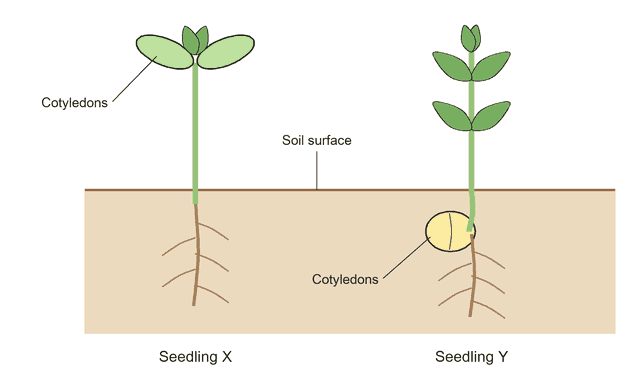
Which statement about these seedlings is correct ?
- 31 mark
Question 3
Cognitive domain: Application
To make maize grains look whiter, a miller scrapes away their outer covering together with the outermost layer of the endosperm that lies just beneath it. Which nutrient do the grains lose the most by this treatment, and why ?
- 41 mark
Question 4
Cognitive domain: Analysis
Three dishes, each with 50 soaked gram seeds on wet cotton wool, were kept at different temperatures for four days. All three dishes were then kept at 30°C for four more days. The cotton wool was kept wet throughout.
Dish First four days Seeds germinated in the first four days Seeds germinated by the end of eight days P 5°C 0 45 Q 30°C 47 47 R 55°C 0 0 Which conclusion do these results support ?
- 51 mark
Question 5
Cognitive domain: Understanding
Assertion (A): When a maize grain germinates in a field, its cotyledon is not brought above the soil.
Reason (R): In a germinating maize grain the hypocotyl does not elongate.
- 61 mark
Question 6
Cognitive domain: Application
Assertion (A): The flour obtained by grinding wheat grains comes mainly from the cotyledons of the grains.
Reason (R): A wheat grain, like a maize grain, is monocotyledonous and endospermic.
- 71 mark
Question 7
Cognitive domain: Application
To make sprouts, Farida soaks moong seeds overnight. Next morning she drains off all the water and keeps the seeds wrapped in a wet cloth. Her grandmother explains that seeds left fully under water sprout poorly.
Seeds lying fully under water get plenty of water but very little ______, just like the ______ seed in the three-bean seeds experiment.
- 81 mark
Question 8
Cognitive domain: Understanding
Meera has one whole pea pod on her plate, and it contains 6 peas. Next to it she places 6 wheat grains.
In all there are ______ fruits on her plate, because in each wheat grain the fruit wall is fused with the ______.
- 91 mark
Question 9
Cognitive domain: Analysis
A gardener took the seeds out of a freshly ripened fruit. She sowed half of them at once in moist, warm, well-aired soil, and none of them germinated. She stored the other half and sowed them in the same way three months later, and most of them germinated.
The seeds sown at once failed because a fresh seed must first pass through a period of ______, during which it undergoes physiological ______.
- 102 marks
Question 10
Cognitive domain: Application
Kiran sowed two rows in the same moist bed: one row of whole green gram (moong) seeds and one row of split, skinned moong dal from the kitchen. Seedlings came up only in the row of whole seeds.
Give two reasons, based on the structure of a seed, why the split dal could not grow into seedlings.
- 112 marks
Question 11
Cognitive domain: Evaluation
To show that water is necessary for germination, Rohit placed green gram seeds on wet cotton wool in beaker A and kept it on a table in the room. He placed similar seeds on dry cotton wool in beaker B and kept it in the refrigerator. Two days later only the seeds in beaker A had germinated, and he concluded: "Water is necessary for germination."
Is Rohit's conclusion justified by his experiment ? Give a reason and say how he should correct the experiment.
- 122 marks
Question 12
Cognitive domain: Understanding
Pea and bean seeds were sown in the same bed. Soon after the seedlings appeared, sparrows pecked off the parts showing above the ground. A few days later many pea plants had put out new shoots, but most of the bean plants had died.
Explain this difference using the type of germination in each seed.
- 135 marks
Question 13
Cognitive domain: Analysis
Case: Tanvi wanted to find out how water enters a bean seed. She took two lots of 50 dry bean seeds, each lot weighing 20 g. In lot B she sealed the micropyle of every seed with a tiny dot of wax; lot A was left untreated. She soaked both lots in water for six hours, wiped the seeds dry and weighed them again.
Lot Treatment Mass before soaking Mass after soaking A Untreated 20 g 38 g B Micropyle sealed with wax 20 g 26 g (a) Calculate the mass of water absorbed by each lot, and express it as a percentage of the dry mass.
(b) What do the results show about the way water enters a bean seed ? Why did lot B also gain some mass ?
(c) Both lots are now placed on wet cotton wool. In which lot will the radicle come out first ? Explain, mentioning the two uses of water in germination.
(d) Besides the entry of water, which other function of the micropyle would the wax hinder in lot B ?
- 145 marks
Question 14
Cognitive domain: Evaluation
Case: Volunteers want to replant a damaged belt of Rhizophora (a mangrove) on a muddy sea shore. One of them proposes: "Let us do what farmers do with wheat. We will pluck the ripe fruits, take out the dry seeds, store them in sacks for a year and then scatter them over the mud."
(a) Why will the volunteers not find dry, resting seeds in the ripe fruits of Rhizophora ? Name this mode of germination.
(b) Evaluate the proposal. What should the volunteers collect and plant instead ?
(c) Using what you know about the needs of a germinating seed, suggest why this mode of germination suits a plant growing in water-covered mud.
(d) State one difference between this mode of germination and the germination of a bean seed.
- 155 marks
Question 15
Cognitive domain: Creativity
Case: The gardening club is going to sow bean seeds in the school's vegetable bed. One member says the seeds should be pressed just below the surface; another wants to bury them very deep so that birds cannot find them. The club decides to find out by experiment which sowing depth gives the most seedlings. It has 40 bean seeds of the same lot, four tall transparent jars of the same size, garden soil, a ruler and water.
(a) Design the experiment. State the one thing the club should change and two things it must keep the same.
(b) What should the club record, and for how long ? Draw a table for the observations.
(c) Predict which jar is likely to give the fewest seedlings, and give two reasons for your prediction.
- 161 mark
Question 16
Cognitive domain: Understanding
In a pea plant, a flower has been pollinated and fertilised. A student wants to write down what happens to its parts. Which row is correct ?
- 171 mark
Question 17
Cognitive domain: Application
A student wants to cut a soaked maize grain lengthwise so that she can see the embryo. On one side of the grain she sees a small, light-coloured oval area. Why is this area a useful guide for her cut ?
- 181 mark
Question 18
Cognitive domain: Analysis
Assertion (A): Moist, warm bean seeds sealed in a jar full of nitrogen gas do not grow into seedlings.
Reason (R): The cell division and growth during germination need energy, which the seed obtains by respiration using oxygen.
- 191 mark
Question 19
Cognitive domain: Application
Mohan wants to watch, day by day, how a bean seed puts out its radicle and plumule without digging the seed out of the soil. Which arrangement should he use ?
- 201 mark
Question 20
Cognitive domain: Application
Ritu sowed a bean seed in a pot and is keeping a diary of its growth. She wants to note the stage at which her young plant stops being a seedling. Which observation should she wait for ?
- 211 mark
Question 21
Cognitive domain: Analysis
Assertion (A): Mustard seed is albuminous because its cotyledons are thin and membranous.
Reason (R): In an albuminous seed the endosperm persists and the cotyledons are thin and membranous.
- 221 mark
Question 22
Cognitive domain: Application
A vegetable bed on a hill was sown in cold December with good seeds saved from last year's crop. After a fortnight very few seedlings had come up, although the soil was moist and loose. To test whether the cold was the cause, which experiment from the book should the class repeat ?
- 231 mark
Question 23
Cognitive domain: Evaluation
Four students wrote about hypogeal and epigeal germination. Which student wrote a correct statement ?
- 241 mark
Question 24
Cognitive domain: Understanding
A student wrote five events of the germination of a pea seed on cards.
- P: The testa softens and bursts.
- Q: The seed absorbs water and swells.
- R: The radicle comes out and grows downward.
- S: The arched plumule grows upward and forms the shoot.
- T: The cotyledons wither and shrivel.
Which sequence of the cards is correct ?
- 251 mark
Question 25
Cognitive domain: Analysis
A seed bank stored dry seeds of one plant for different numbers of years. Then seeds of each lot were given water, a suitable temperature and air. The bar chart shows how many seeds of each lot germinated. (Hypothetical data.)
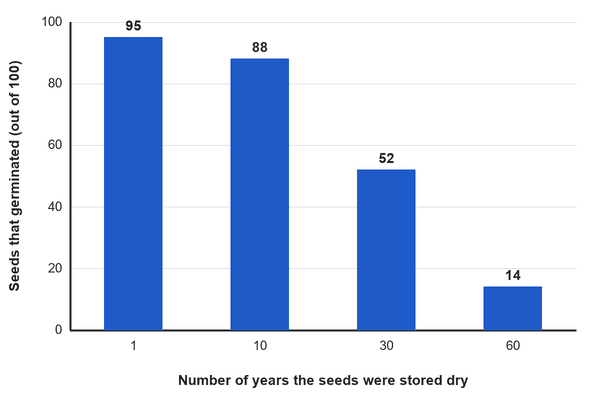
Which conclusion do the results support best ?
- 262 marks
Question 26
Cognitive domain: Analysis
Lata kept green gram seeds on wet cotton wool in beaker A and similar seeds on dry cotton wool in beaker B. Both beakers stood in an ordinary room. After two days seeds in beaker A had germinated and none in beaker B. She left beaker B for six more days and still none had germinated. On the eighth day she wetted the cotton wool in beaker B, and by the eleventh day of its seeds had germinated. (Hypothetical data.)
(i) What do these results show about the seeds in beaker B and about water ?
(ii) Find the percentage of the seeds in beaker B that germinated by the eleventh day.
- 272 marks
Question 27
Cognitive domain: Understanding
Priya grows green gram sprouts in a closed cupboard, away from light. After a week the young seedlings are still growing taller, although their foliage leaves have not yet started making food. Explain from where they get (i) the material and (ii) the energy for this growth.
- 282 marks
Question 28
Cognitive domain: Evaluation
Sanjay says, "The coleoptile of a maize grain is its seed coat, because it covers the young shoot." Is Sanjay right ? Give a reason, and say what the seed coat of a maize grain is.
- 292 marks
Question 29
Cognitive domain: Creativity
A teacher compares a seed to a travelling kit: a sleeping traveller, with a packed lunch box, inside a strong suitcase.
(a) Name the part or parts of a bean seed that match the traveller, the lunch box and the suitcase.
(b) Make a comparison of your own for the micropyle, using something from your home or school, and say what the micropyle does.
- 302 marks
Question 30
Cognitive domain: Application
Asha scattered pea seeds and bean seeds on the surface of moist soil in a tray and did not cover them with soil. A week later she noted the following. (Hypothetical data.)
- Pea: the two cotyledons were still lying on the surface of the soil, and a shoot about cm long had grown up from between them.
- Bean: the two cotyledons had been raised on a stalk about cm above the soil.
(i) Name the type of germination of the pea seeds in the tray, although their cotyledons are not under the soil. Give a reason.
(ii) Name the stalk that raised the bean cotyledons, and the type of germination of the bean.
- 312 marks
Question 31
Cognitive domain: Analysis
Imagine that the scutellum of a soaked maize grain could be removed without harming the radicle and plumule, and that these were left pressed against the endosperm of the same grain. (Imagined trial.) The grain is then placed in moist, warm, well-aired soil. Predict what will happen to the growth of the embryo and give a reason.
- 323 marks
Question 32
Cognitive domain: Application
A shopkeeper stored two lots of bean seeds in damp jute bags during the rains. In lot P the seed coats were whole. In lot Q the testa of many seeds had been scratched through by insects. After two weeks many seeds of lot Q were rotten and covered with mould, while most seeds of lot P were in good condition.
(i) Why were the seeds of lot Q more at risk ?
(ii) Name the thin inner layer of the seed coat, which lies next to the testa.
(iii) State one more function of the seed coat.
- 333 marks
Question 33
Cognitive domain: Evaluation
Rahul says, "Coconut and double coconut have the largest seeds, while a poppy seed is barely visible to the naked eye. Seeds are so different that they have nothing in common."
(i) Is Rahul right ? Give a reason.
(ii) Name the three parts of the embryo that most seeds share.
(iii) Name the part that protects the embryo of a seed.
- 343 marks
Question 34
Cognitive domain: Application
In a desert, the seeds of some small plants lie in the dry sand for several years. After a rare heavy rain the sand stays moist for a few days, and soon thousands of seedlings appear. Assume that the sand is moderately warm and well aired at that time.
(i) Which condition for germination was missing before the rain ?
(ii) In what state did the embryos stay during the dry years, and why did they not die ?
(iii) Name one more condition, other than water, that the seeds needed for germination.
- 353 marks
Question 35
Cognitive domain: Analysis
Six days after sowing, three seedlings P, Q and R were dug up and measured.
Seedling Increase in the length of the hypocotyl Increase in the length of the epicotyl P cm cm Q cm cm R cm cm (Hypothetical data.)
(a) Name the type of germination of each seedling.
(b) How many times is the increase of the hypocotyl of P as long as the increase of its epicotyl ?
(c) Where will the cotyledons of P and of Q be found, above or below the soil ?
- 363 marks
Question 36
Cognitive domain: Analysis
The graph shows the mass of dry seeds kept in water for hours. (Hypothetical data.)

(a) Find the average mass of water taken in by one seed in the first hours.
(b) From hours to hours the mass rises only a little. Say what this shows about the seeds.
(c) After hours the mass rises again. Give a likely reason.
- 374 marks
Question 37
Cognitive domain: Application
Case: Two heaps, A and B, of green gram seeds were stored in a godown during the rains, and a thermometer was placed inside each heap. The sacks of heap A stayed dry, but the sacks of heap B got wet. The room temperature was °C. The graph shows the temperature inside the two heaps for six days. (Hypothetical data.)
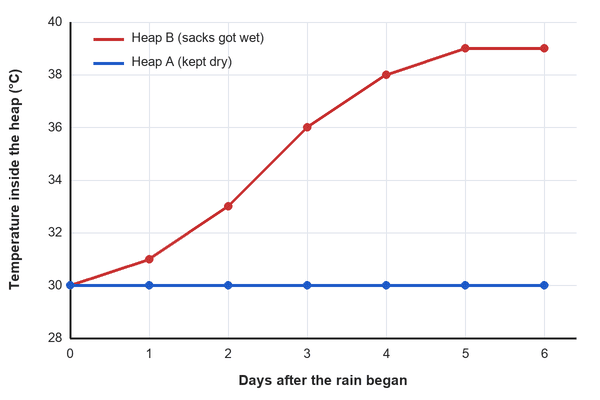
(a) By how many degrees was heap B warmer than heap A on day ?
(b) Explain why heap B became warm.
(c) Give two pieces of advice for storing seeds, with a reason for each.
- 384 marks
Question 38
Cognitive domain: Evaluation
Case: At a school science fair, two groups reported their results with soaked gram seeds in each set-up. (Hypothetical data.)
Group Set-up Result P Flask A: tube of plain water seeds germinated in days P Flask B: tube of alkaline pyrogallic acid seeds put out a very short radicle; none grew further Q Beaker A: wet cotton wool in a room seeds germinated by day Q Beaker B: wet cotton wool in a refrigerator seeds by day ; seeds by day Group P claimed, "Three seeds germinated in flask B, so oxygen is not really needed." Group Q claimed, "Seeds in beaker B germinated too, by day 8, so the cold does not stop germination and temperature does not really matter."
(a) Evaluate the claim of group P.
(b) Evaluate the claim of group Q.
(c) Name one thing that group P must do so that no air reaches the seeds in flask B.
- 394 marks
Question 39
Cognitive domain: Application
Case: A student pushes a fine pin slowly into a soaked maize grain. The pin enters on the broad side opposite the light-coloured oval area and travels straight inwards until it reaches the single cotyledon of the embryo.
(a) Name, in the order in which the pin meets them, the layers or regions that it passes through before it reaches the cotyledon.
(b) Which of these layers is rich in protein, and which region is the main store of starch ?
(c) Name the cotyledon that the pin reaches, and say what it does in germination.
- 405 marks
Question 40
Cognitive domain: Creativity
Case: The biology club is making Seed Detective cards for the school's open day. Each card gives three clues about a seed, and a visitor has to name the plant. A good card never names the plant, uses clues from different parts of the chapter (structure, food storage, germination), and does not give a clue that also fits another plant on the stall. The stall has a bean, a maize grain and the mangrove plant Rhizophora.
(a) Write three clues for the card of the bean seed.
(b) Write three clues for the card of the maize grain.
(c) Write three clues for the card of Rhizophora, and write the answer key for all three cards.