
Opening your dashboard
Class 9 Biology Chapter 6 Seeds – Structure and Germination: Practice Questions
44 questions on Chapter 6, each worked through on its own page with the AI tutor. Class 9 Biology, ICSE 2026-27.
44 questions
1–5 marks · Mixed difficulty
- 11 mark
Question 1
Bloom's level: Remember
In the embryo of a maize grain, the young shoot (plumule) is enclosed in a protective sheath called the :
- 21 mark
Question 2
Bloom's level: Remember
The embryo inside a seed develops from the :
- 31 mark
Question 3
Bloom's level: Remember
The moderately warm temperature range that is usually most favourable (optimum) for the germination of seeds is :
- 41 mark
Question 4
Bloom's level: Understand
A germinating seed needs oxygen mainly because :
- 51 mark
Question 5
Bloom's level: Understand
Gram is an exalbuminous seed. In a gram seed, the food for the embryo is stored mainly in the :
- 61 mark
Question 6
Bloom's level: Understand
When a pea seed germinates, its cotyledons stay below the soil because :
- 71 mark
Question 7
Bloom's level: Apply
On a seashore swamp, a student sees long seedlings hanging from fruits that are still attached to the branches of a mangrove tree. This mode of germination is called :
- 81 mark
Question 8
Bloom's level: Apply
Flask X contains soaked gram seeds on wet cotton and a small hanging tube of alkaline pyrogallic acid. Flask Y is set up in exactly the same way except that its tube holds plain water. Both are corked and kept in a room for three days. The most likely result is :
- 91 mark
Question 9
Bloom's level: Apply
A student cuts open a soaked seed lengthwise. She finds one shield-shaped cotyledon pressed against a large starchy mass, and the radicle covered by a sheath. The seed is most likely a :
- 101 mark
Question 10
Bloom's level: Analyse
Assertion (A): In the three-bean experiment, the seed tied at the top of the slide, well above the water, does not germinate.
Reason (R): The top seed gets oxygen but no water.
- 111 mark
Question 11
Bloom's level: Analyse
Assertion (A): The germination of a bean seed is epigeal.
Reason (R): A bean seed is dicotyledonous.
- 121 mark
Question 12
Bloom's level: Evaluate
Assertion (A): A seed freshly taken from a ripe fruit always germinates at once if it is given water, air and warmth.
Reason (R): Many fresh seeds have to pass through a period of dormancy, during which they undergo physiological maturation.
- 132 marks
Question 13
Bloom's level: Remember
(a) Name two unfavourable conditions that a seed can withstand.
(b) Up to how long are some seeds known to remain dormant ?
- 142 marks
Question 14
Bloom's level: Understand
A mango, a bean (taken out of its pod) and a wheat grain are kept on a table. Explain which of them is a fruit, which is a seed, and why the wheat grain is a special case.
- 152 marks
Question 15
Bloom's level: Understand
On a soaked bean seed you can easily see the hilum and the micropyle, but on a maize grain you cannot. Explain why.
- 162 marks
Question 16
Bloom's level: Understand
Explain two ways in which water helps a seed to germinate.
- 172 marks
Question 17
Bloom's level: Apply
A student sets up the three-bean experiment, but fills the beaker with water that was boiled and then cooled (so it holds almost no dissolved air). Predict what will happen to the middle seed and to the bottom seed, giving a reason for each.
- 182 marks
Question 18
Bloom's level: Apply
A gardener notices that the first root of her maize seedlings dies after a few days, yet the seedlings keep growing well. Explain how the maize seedling gets its root system.
- 192 marks
Question 19
Bloom's level: Apply
A farmer tests a bag of seeds by sowing 250 of them; 215 germinate.
(a) Find the germination percentage.
(b) At this rate, what is the least number of seeds he must sow to get at least 600 seedlings ?
- 202 marks
Question 20
Bloom's level: Apply
Classify the germination of each of these as hypogeal or epigeal: castor, gram, maize, bean. Name the part whose elongation decides each type.
- 212 marks
Question 21
Bloom's level: Analyse
Study the observations on four seeds and classify each on the basis of (i) the number of cotyledons and (ii) the presence of endosperm.
Seed Cotyledons Endosperm in mature seed P 2, thin and papery Large Q 1 Large R 2, thick and fleshy Absent S 1, thick Absent - 222 marks
Question 22
Bloom's level: Evaluate
A student writes: "All monocot seeds have endosperm, and no dicot seed has endosperm." Judge whether this statement is correct, giving one example from each group to support your answer.
- 233 marks
Question 23
Bloom's level: Understand
Explain the germination of a pea seed under these heads :
(a) how the radicle comes out and what it forms;
(b) why the plumule is arched in the early stage;
(c) the role and fate of the cotyledons, and the name of this type of germination.
- 244 marks
Question 24
Bloom's level: Apply
Four dishes of soaked green gram seeds were set up as follows and observed for four days.
Dish Set-up A Seeds on dry cotton, kept in a room B Seeds on wet cotton, kept in a room C Seeds on wet cotton, kept in a refrigerator D Seeds fully under boiled and cooled water covered with a layer of oil, kept in a room (a) In which dish will the seeds germinate well ?
(b) For each of the other dishes, name the condition that is missing.
(c) Which dish acts as the control for all the others? Explain why a control is needed.
- 254 marks
Question 25
Bloom's level: Apply
Case: Sunil sowed bean seeds about 15 cm deep in heavy clay soil and then watered the bed so much that water stood on it for two days. Very few seedlings came up.
(a) Give two reasons why seeds sown very deep often fail to come up.
(b) How did the standing water add to the problem ?
(c) Suggest how Sunil should sow and water the seeds next time, with a reason for each step.
- 264 marks
Question 26
Bloom's level: Analyse
Case: For a class project, Neha took 100 dry moong seeds, which weighed 5.0 g. After soaking them for 12 hours they weighed 9.5 g. She let them sprout in the dark for four days, then dried the sprouts completely in an oven; their dry mass was 4.6 g.
(a) By what percentage did the mass increase on soaking? What caused this increase ?
(b) Why was the dry mass of the sprouts less than that of the dry seeds ?
(c) Predict what would happen to the dry mass if the seedlings were moved to sunlight and allowed to grow green leaves. Explain.
- 274 marks
Question 27
Bloom's level: Analyse
A student examined two soaked seeds and noted :
- Seed P: two cotyledons; no endosperm; hilum and micropyle visible; plumule with two folded leaves.
- Seed Q: one cotyledon; large endosperm; plumule in a coleoptile and radicle in a coleorhiza; no hilum visible.
(a) Identify P and Q as far as possible (one example each from your book).
(b) Where is the food stored in each, and how does the embryo of Q obtain its food ?
(c) Predict the type of germination you would expect for Q and justify it.
- 284 marks
Question 28
Bloom's level: Evaluate
Case: To show that oxygen is necessary for germination, Arjun took one conical flask, spread wet cotton on its bottom, placed soaked gram seeds on it and poured alkaline pyrogallic acid directly onto the cotton. He corked the flask. After four days no seed had germinated, and he concluded that oxygen is necessary for germination.
(a) What is the role of alkaline pyrogallic acid in this experiment ?
(b) Point out two errors in Arjun's method.
(c) Is his conclusion reliable? Justify your answer and say how the experiment should be set up.
- 295 marks
Question 29
Bloom's level: Create
Your book shows that water, oxygen and a suitable temperature are needed for germination, but it does not test light. Design an experiment to find out whether light is necessary for the germination of green gram seeds.
(a) State a hypothesis and list the materials.
(b) Describe the set-up of the experimental and control dishes, and name two things you will keep the same in both.
(c) Prepare a results table and state how you would draw your conclusion.
- 305 marks
Question 30
Bloom's level: Create
Construct a summary table comparing a bean seed, a pea seed and a maize grain under these heads :
(a) number of cotyledons and whether endosperm is present in the mature seed;
(b) where the food is stored;
(c) type of germination and the part that elongates (or a note if neither elongates much).
Then write one sentence that states the main idea your table shows about the link between seed type and germination type.
- 311 mark
Question 31
The embryo present inside a seed consists of :
- 321 mark
Question 32
Which one of the following is true of an albuminous seed ?
- 331 mark
Question 33
Assertion (A): Dry seeds consume oxygen and give out carbon dioxide only in extremely minute quantities.
Reason (R): In a dry seed the embryo is dormant and the chemical activities of life go on very slowly.
- 342 marks
Question 34
(i) State two ways in which a fruit is useful to the seeds it encloses.
(ii) Which part of a seed protects the embryo from mechanical damage ? Name the food material that some seeds contain for the nourishment of the embryo during germination.
- 352 marks
Question 35
When a soaked bean seed is pressed gently, a drop of water oozes out of a tiny pore lying close to a whitish oval scar on the concave side of the seed.
(i) Name the pore and the scar.
(ii) The seed has developed from an ovule. State what the pore and the scar each represent in terms of that ovule.
- 362 marks
Question 36
(i) Why are both a very low temperature and a very high temperature unsuitable for the germination of seeds ?
(ii) State the range of temperature that is usually most favourable for germination. Which seeds often need a higher temperature — those of tropical plants or those of plants of the temperate regions ?
- 372 marks
Question 37
(i) In what way does the germination of a seed of Rhizophora differ from that of a bean seed ? Name this mode of germination.
(ii) What happens to the Rhizophora seedling after this ?
- 384 marks
Question 38
The figure shows a maize grain cut lengthwise.
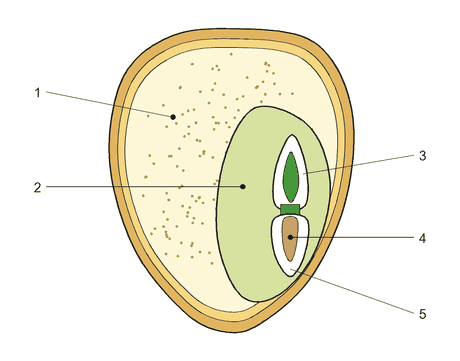
(i) Identify the five regions numbered 1 to 5.
(ii) Which numbered part is the cotyledon of this grain ? What does it do during germination ? In which food substance is part 1 rich ?
(iii) Classify this grain on the basis of the number of cotyledons and on the basis of endosperm. Name two other grains of the same type.
- 394 marks
Question 39
The figure shows two seedlings, X and Y, of two different plants growing in soil.

(i) Name the type of germination shown by X and by Y.
(ii) Name the parts numbered 1 and 3. What do these two parts have in common in the way they have grown ?
(iii) Parts 2 and 4 are the same structures in the two seedlings. Name them, and state what happens to them later in X and in Y. Give one example of a seed that germinates like X.
- 403 marks
Question 40
Three air-dried bean seeds are tied to a glass slide, one above the other. The slide is stood in a beaker of water so that seed P is well above the water, seed Q is just at the water level and seed R is completely under water. The beaker is left in a warm place for a few days.
(i) Which seed germinates normally ? Give a reason.
(ii) State what is observed in seed P and in seed R, and explain each observation.
(iii) This experiment does not fully demonstrate that oxygen is necessary for germination. Why ? Name the chemical used in another experiment to remove the oxygen from the air around the seeds.
- 412 marks
Question 41
Class 9 Sample Paper 1 · Section B
Differentiate between epigeal germination and hypogeal germination.
- 425 marks
Question 42
Class 9 Sample Paper 1 · Section E
From the given diagram, answer the following questions.
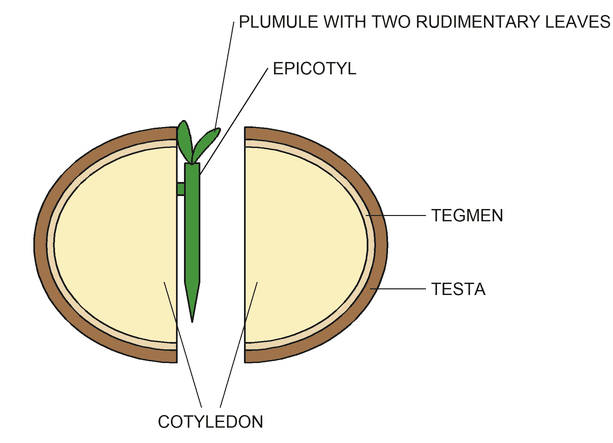
(a) What does the diagram show?
(b) Which part protects it from injury?
(c) Which part forms the root system and which part forms the shoot system?
(d) Where is food stored in the given diagram?
(e) What are the different types of seeds on the basis of cotyledons?
- 431 mark
Question 43
Class 9 Sample Paper 2 · Section A
Fill in the blank:
A seed contains a tiny living plant called the ...........
- 441 mark
Question 44
Class 9 Sample Paper 2 · Section A
Define the following:
Hypogeal germination