Solution:
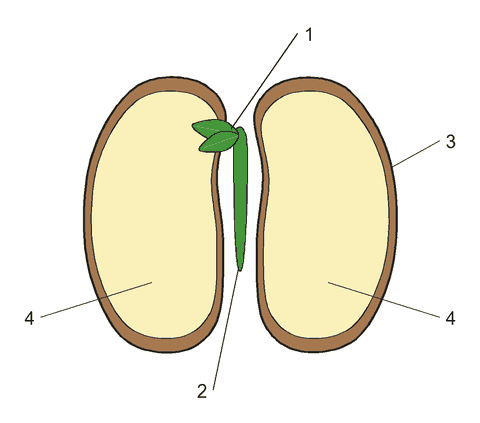
Concept: Two thick halves with the embryo axis between them show an opened bean seed: a dicot seed whose food is stored in its cotyledons.
Step 1 — Part (a).
It is a bean seed, which is dicotyledonous (two cotyledons).
Step 2 — Part (b).
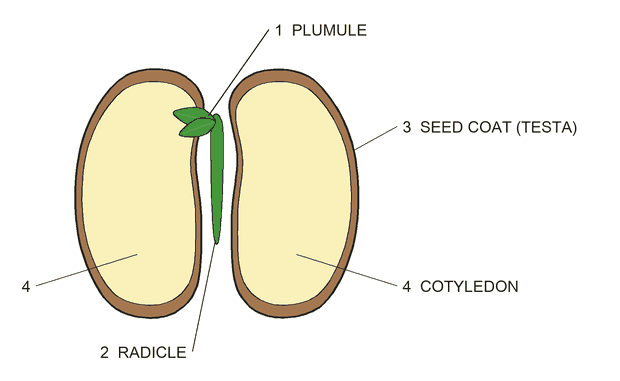
1 – Plumule; 2 – Radicle; 3 – Seed coat (testa); 4 – Cotyledon (each half).
Step 3 — Part (c).
Part 2, the radicle, grows downwards and forms the root system, which fixes the seedling and absorbs water and minerals.
Step 4 — Part (d).
The cotyledons store mainly starch (carbohydrate), together with a good amount of protein.
Step 5 — Part (e).
The bean shows epigeal germination: the hypocotyl grows and lifts the cotyledons above the ground.
Watch out: The common (French) bean is epigeal; a few beans, such as the broad bean, are hypogeal.
Therefore, (a) bean seed, dicotyledonous; (b) 1 plumule, 2 radicle, 3 seed coat, 4 cotyledon; (c) forms the root system; (d) starch, with protein; (e) epigeal.