
Opening your dashboard
Class 9 Biology Chapter 5: Pollination and Fertilization Solutions
29 textbook questions with step-by-step answers, free to read, for ICSE 2026-27.
Get talked through Ch 5, not just shown the answer
Reading a finished solution is not the same as being able to do it. The AI tutor takes one question at a time and works it with you, in your own words, until you can.
- Ask it out loud, in your own words
- It gives you the next step, not the answer
- Stuck on part (ii)? Start there
29 questions with solutions
1–10 marks · Mixed difficulty
- 14 marks
Question 1
Match the items in Column I with those in Column II
Column I Column II (i) Feathery stigma hanging out Rafflesia (ii) Different timings for maturation of anthers and stigma Entomophilous (iii) Pollination by elephant Wind-pollination (iv) Flowers produce nectar Dichogamy Solve with AIWritten solution
Solution:
Concept: Each item in Column I is a feature of one kind of pollination, or of a plant pollinated in a special way. Match each feature with the agent or the term it points to.
Step 1 — Item (i): feathery stigma hanging out.
A large, feathery stigma that hangs out of the flower traps pollen floating in the air, so it is a feature of wind-pollination.
Step 2 — Item (ii): different timings of anthers and stigma.
When the anthers and stigma of one flower ripen at different times, the condition is called dichogamy.
Step 3 — Item (iii): pollination by elephant.
The textbook's example of pollination by elephants is the huge ground-level flower of Rafflesia.
Step 4 — Item (iv): flowers produce nectar.
Nectar is food for insects, so nectar-producing flowers are entomophilous (insect-pollinated).
Note: The elephant is the textbook's example, and it is the answer expected here. Field studies show that Rafflesia is in fact pollinated mainly by carrion flies, which are drawn to the flower by its smell of rotting meat.
Therefore, (i) wind-pollination, (ii) dichogamy, (iii) Rafflesia, (iv) entomophilous.
- 26 marks
Question 2
Complete the following statements :
(i) Pollination is the process of transfer of ..........
(ii) The two kinds of pollination are .......... and .......... .
(iii) For self-pollination, the flowers need not be .......... and showy.
(iv) For self-pollination, .......... and .......... must mature at the same time.
(v) Self-pollination does not yield .......... varieties.
(vi) In .......... pollination, there is much wastage of .......... .
Solve with AIWritten solution
Solution:
Concept: Pollination is the transfer of pollen grains from an anther to a stigma. Pollen may reach the stigma of the same flower or plant (self-pollination) or of another plant of the same kind (cross-pollination).
Step 1 — Statement (i).
The definition: pollination is the process of transfer of pollen grains from the anther to the stigma.
Step 2 — Statement (ii).
The two kinds are self-pollination and cross-pollination.
Step 3 — Statement (iii).
Self-pollination needs no visiting animal, so the flowers need not attract one; they need not be large (or colourful) and showy.
Step 4 — Statement (iv).
For pollen to reach the stigma of the same flower, the anthers and the stigma must mature at the same time (homogamy).
Step 5 — Statement (v).
The pollen comes from the same plant, so the offspring carry the same characters as the parent; self-pollination does not yield new varieties.
Step 6 — Statement (vi).
In cross pollination the pollen is carried by chance agents such as wind, so a large part of the pollen never reaches a stigma and is wasted.
Watch out: Statement (iii) asks what self-pollinated flowers need not be; the answer describes cross-pollinated (insect) flowers.
Therefore, (i) pollen grains from the anther to the stigma; (ii) self-pollination, cross-pollination; (iii) large; (iv) anthers, stigma; (v) new; (vi) cross, pollen.
- 35 marks
Question 3
Mention if the following statements are true
(i) Intine is the outer wall of pollen grain.
(ii) Pollen tube enters ovule through micropyle.
(iii) Zygote gives rise to embryo.
(iv) Ovule becomes fruit.
(v) Dry sepals may persist in some fruits.
Solve with AIWritten solution
Solution:
Concept: A pollen grain has two walls, the outer exine and the inner intine. After pollination the pollen tube reaches the ovule, the zygote forms the embryo, the ovule becomes the seed and the ovary becomes the fruit.
Step 1 — Statement (i).
The exine is the outer, tough wall of the pollen grain; the intine is the thin inner wall.
False. Intine is the inner wall.
Step 2 — Statement (ii).
The pollen tube grows down the style into the ovary and enters the ovule through the micropyle.
True.
Step 3 — Statement (iii).
The zygote formed at fertilisation divides again and again to form the embryo.
True.
Step 4 — Statement (iv).
After fertilisation the ovule becomes the seed, while the ovary becomes the fruit.
False. The ovule becomes the seed.
Step 5 — Statement (v).
In some fruits the sepals stay on as dry remains, as at the top of the apple and the guava; in brinjal the calyx stays green.
True.
Watch out: The two walls are easy to swap; remember that exine and external both begin with 'ex'.
Therefore, (i) false, (ii) true, (iii) true, (iv) false, (v) true.
- 41 mark
Question 4
Exine and intine are the parts of :
Solve with AIAnswer
(A) Embryo sac
- Correct
(B) Pollen grain
(C) Stigma
(D) Seed
Answer: (B) Pollen grain
Concept: A pollen grain has a double wall: the thick outer exine and the thin inner intine.
Step 1 — Recall the parts.
Exine and intine are the two layers of the wall of the pollen grain; the pollen tube grows out of the intine through a germ pore in the exine.
Step 2 — Match with the options.
Only option (B), pollen grain, has these two layers.
Watch out: The seed coat also has two layers, but they are called testa and tegmen.
Why the other options are wrong:
- (A) Embryo sac: the embryo sac lies inside the ovule; its wall has no exine or intine.
- (C) Stigma: the stigma is the tip of the pistil that receives pollen; it is a tissue, not a two-layered wall.
- (D) Seed: the two layers of a seed coat are the testa and the tegmen.
Therefore, exine and intine are the walls of the pollen grain, option (B).
- 51 mark
Question 5
Which one of the following is one of the characteristics of self-pollinated flowers ?
Solve with AIAnswer
(A) Flowers are large and showy
(B) Flowers remain closed and do not open
- Correct
(C) Stigma and anthers mature at the same time
(D) Pollen is produced in very large quantities
Answer: (C) Stigma and anthers mature at the same time
Concept: For self-pollination the pollen of a flower must reach its own stigma while that stigma is ready, so the anthers and the stigma must mature at the same time (homogamy).
Step 1 — What self-pollination needs.
Self-pollination needs no outside agent, but it does need ripe pollen and a receptive stigma together in the same flower.
Step 2 — Pick the feature.
Option (C), stigma and anthers maturing at the same time, is exactly this need, and it is true of all self-pollinated flowers.
Watch out: Option (B) is true only of a few special flowers, so it is not the general characteristic asked for.
Why the other options are wrong:
- (A) Flowers are large and showy: large, showy flowers attract insects; they are a feature of cross-pollinated flowers.
- (B) Flowers remain closed and do not open: only a few self-pollinated flowers never open (cleistogamous flowers of Commelina, Oxalis, pansy); most self-pollinated flowers do open.
- (D) Pollen is produced in very large quantities: very large amounts of pollen are made by wind-pollinated (cross-pollinated) flowers, because most of it is lost.
Therefore, the characteristic of self-pollinated flowers is that stigma and anthers mature at the same time, option (C).
- 61 mark
Question 6
The kind of pollination in which the pollen of the same flower fall on its stigma is termed as :
Solve with AIAnswer
(A) Geitonogamy
- Correct
(B) Autogamy
(C) Homogamy
(D) Allogamy
Answer: (B) Autogamy
Concept: Auto means self and gamy means union: autogamy is pollination in which the pollen of a flower falls on the stigma of the same flower.
Step 1 — Read the stem.
The pollen comes from the same flower and lands on its own stigma.
Step 2 — Name it.
This is autogamy, option (B).
Watch out: Geitonogamy is also self-pollination, but between two flowers of the same plant.
Why the other options are wrong:
- (A) Geitonogamy: geitonogamy is pollination between two different flowers of the same plant.
- (C) Homogamy: homogamy is the ripening of anthers and stigma at the same time; it is a condition, not a kind of pollination.
- (D) Allogamy: allogamy is cross-pollination, between flowers of two different plants of the same species.
Therefore, pollen of a flower falling on its own stigma is autogamy, option (B).
- 71 mark
Question 7
Which of the following conditions favours self-pollination ?
Solve with AIAnswer
- Correct
(A) Homogamy
(B) Herkogamy
(C) Dichogamy
(D) None of these
Answer: (A) Homogamy
Concept: Self-pollination is possible only when the pollen and the stigma of a flower are ready together, which is called homogamy.
Step 1 — Test each condition.
Homogamy brings ripe pollen and a ripe stigma together in one flower, so pollen can fall on its own stigma.
Step 2 — Choose.
The other conditions keep a flower's own pollen away from its stigma, so only option (A) favours self-pollination.
Watch out: Herkogamy and dichogamy are both devices that favour cross-pollination.
Why the other options are wrong:
- (B) Herkogamy: herkogamy is a barrier (such as a hood over the stigma in pansy) that stops a flower's own pollen reaching its stigma.
- (C) Dichogamy: dichogamy means anthers and stigma ripen at different times, which favours cross-pollination.
- (D) None of these: this is wrong because one of the options, homogamy, does favour self-pollination.
Therefore, the condition that favours self-pollination is homogamy, option (A).
- 81 mark
Question 8
Pollination by birds is termed as :
Solve with AIAnswer
(A) Entomophily
(B) Anemophily
- Correct
(C) Ornithophily
(D) Elephophily
Answer: (C) Ornithophily
Concept: The names of the kinds of pollination are built from the agent: ornitho = bird, entomo = insect, anemo = wind, and phily = love of.
Step 1 — Find the root word.
Pollination by birds takes the root ornitho, bird.
Step 2 — Name it.
So it is called ornithophily, option (C).
Why the other options are wrong:
- (A) Entomophily: entomophily is pollination by insects.
- (B) Anemophily: anemophily is pollination by wind.
- (D) Elephophily: elephophily is the textbook's name for pollination by elephants.
Therefore, pollination by birds is ornithophily, option (C).
- 91 mark
Question 9
Which of the following is an example of an ornithophilous flower ?
Solve with AIAnswer
(A) Bougainvillea
(B) Vallisneria
- Correct
(C) Bignonia
(D) Rafflesia
Answer: (C) Bignonia
Concept: Ornithophilous flowers are pollinated by birds. The textbook's examples are Bignonia and Canna, whose bright tubular flowers give nectar to visiting birds.
Step 1 — Recall the examples.
Among the options, only Bignonia is listed as a bird-pollinated flower.
Step 2 — Choose.
So the answer is option (C).
Why the other options are wrong:
- (A) Bougainvillea: Bougainvillea has coloured bracts and is visited mainly by insects such as butterflies.
- (B) Vallisneria: Vallisneria is pollinated by water.
- (D) Rafflesia: Rafflesia is the book's example of pollination by elephants (really by carrion flies), not by birds.
Therefore, Bignonia is an ornithophilous flower, option (C).
- 101 mark
Question 10
Bright, showy and nectar producing flowers are needed for pollination to occur by :
Solve with AIAnswer
(A) Wind
(B) Water
- Correct
(C) Insects
(D) Elephant
Answer: (C) Insects
Concept: Insects visit flowers that they can see, smell and feed from, so insect-pollinated flowers are bright, showy and produce nectar.
Step 1 — Match feature to agent.
Bright colour and showy petals catch an insect's eye, and nectar is its food. These features only help if the pollinator is an animal that is attracted to them.
Step 2 — Choose.
Of the options, insects are the agents that need these features, option (C).
Why the other options are wrong:
- (A) Wind: wind-pollinated flowers are small and dull, with no scent or nectar, because wind is not attracted by them.
- (B) Water: water-pollinated flowers are small and inconspicuous.
- (D) Elephant: in the textbook's elephant example (Rafflesia) the pollen is said to stick to the feet of elephants that tread on the flowers, so nectar and showy colours play no part.
Therefore, bright, showy, nectar-producing flowers are pollinated by insects, option (C).
- 111 mark
Question 11
The male inflorescence of maize plant is termed as :
Solve with AIAnswer
(A) Cob
(B) Ear
- Correct
(C) Tassel
(D) Silk
Answer: (C) Tassel
Concept: Maize has separate male and female inflorescences on one plant. The male flowers are at the top of the stem in the tassel; the female flowers are on the cob lower down.
Step 1 — Locate the male flowers.
The tassel at the top of the plant sheds pollen, which the wind carries to the silks of the cobs.
Step 2 — Choose.
So the male inflorescence is the tassel, option (C).
Watch out: The 'silk' looks like a male part but it is the long styles of the female flowers.
Why the other options are wrong:
- (A) Cob: the cob is the female inflorescence.
- (B) Ear: 'ear' is another name for the female cob.
- (D) Silk: the silk is the long styles (with stigmas) of the female flowers.
Therefore, the male inflorescence of maize is the tassel, option (C).
- 121 mark
Question 12
Wing and keel petals are found in the flowers of :
Solve with AIAnswer
- Correct
(A) Pea plants
(B) Vallisneria
(C) Maize plants
(D) Dahlia
Answer: (A) Pea plants
Concept: The pea (sweet pea) flower has five unequal petals: one large standard, two side wings, and a keel formed by the two lowest petals, which encloses the stamens and the pistil.
Step 1 — Recall the flower.
Wing and keel petals are the special petals of the pea family.
Step 2 — Choose.
So they are found in pea plants, option (A).
Why the other options are wrong:
- (B) Vallisneria: Vallisneria has tiny water-pollinated flowers with no wing or keel petals.
- (C) Maize plants: maize flowers are small, wind-pollinated and have no petals of this kind.
- (D) Dahlia: a dahlia 'flower' is a head of many small florets, with no wing or keel petals.
Therefore, wing and keel petals are found in pea plants, option (A).
- 131 mark
Question 13
Which of these does not belong to the embryo sac of a flower ?
Solve with AIAnswer
- Correct
(A) Generative nucleus
(B) Antipodal cells
(C) Polar Nuclei
(D) Synergids
Answer: (A) Generative nucleus
Concept: The mature embryo sac inside the ovule has seven cells and eight nuclei: the egg and two synergids at the micropylar end, three antipodal cells at the other end, and two polar nuclei in the centre.
Step 1 — List the embryo-sac parts.
Antipodal cells, polar nuclei and synergids all belong to the embryo sac.
Step 2 — Find the odd one.
The generative nucleus belongs to the pollen grain; it divides to form the two male gametes. So option (A) does not belong to the embryo sac.
Watch out: The tube nucleus and the generative nucleus are male parts; they come from the pollen grain.
Why the other options are wrong:
- (B) Antipodal cells: antipodal cells lie at the end of the embryo sac away from the micropyle.
- (C) Polar Nuclei: the two polar nuclei lie in the centre of the embryo sac.
- (D) Synergids: the two synergids lie beside the egg at the micropylar end of the embryo sac.
Therefore, the generative nucleus does not belong to the embryo sac, option (A).
- 143 marks
Question 14
State of the chief pollinating agent against the corresponding plant by choosing from those given in brackets.
(a) Dahlia .......... (Crow, butterflies, mosquito).
(b) Maize .......... (Bees, locusts, rain, wind).
(c) Vallisneria .......... (Wind, water, ants, rabbits).
Solve with AIWritten solution
Solution:
Concept: Each flower's structure suits its pollinating agent: colourful flowers attract animals, while light, dry pollen suits wind and floating flowers suit water.
Step 1 — Part (a): Dahlia.
Dahlia has brightly coloured heads of florets that attract insects, so its chief pollinators are butterflies.
Step 2 — Part (b): Maize.
Maize has dull flowers, a tassel shedding huge amounts of light pollen and long feathery silks, so it is pollinated by wind.
Step 3 — Part (c): Vallisneria.
Vallisneria is a water plant whose male flowers float on the surface to the female flowers, so it is pollinated by water.
Therefore, (a) butterflies, (b) wind, (c) water.
- 153 marks
Question 15
Fill in the blanks with suitable words.
(a) Transfer of pollen grains from anthers to stigma of the same flower is called ..........
(b) Different timings for maturation of gynoecium and androecium, is called ..........
(c) .......... is a water-pollinated flower.
Solve with AIWritten solution
Solution:
Concept: Each blank needs the one technical term of the chapter that fits the description.
Step 1 — Part (a).
Transfer of pollen from the anthers to the stigma of the same flower is autogamy (a form of self-pollination).
Step 2 — Part (b).
Different times of ripening of the gynoecium and androecium is dichogamy.
Step 3 — Part (c).
Vallisneria is a water-pollinated flower.
Therefore, (a) autogamy, (b) dichogamy, (c) Vallisneria.
- 166 marks
Question 16
Match the items in Column A with those in Column B.
Column A Column B (a) Generative nucleus (i) Pollen tube (b) Germ pore (ii) Endosperm nucleus (c) Exine (iii) Testa (d) Secondary nucleus (iv) Fertilization (e) Integument (v) Male nuclei (f) Egg nucleus (vi) Rough Solve with AIWritten solution
Solution:
Concept: Link each part of the pollen grain or ovule with what it forms, what it does, or what it looks like.
Step 1 — Part (a): generative nucleus.
It divides into two male nuclei (gametes), so it matches (v).
Step 2 — Part (b): germ pore.
The pollen tube grows out through this thin spot in the exine, so it matches (i).
Step 3 — Part (c): exine.
The outer wall of the pollen grain is thick and often rough or spiny, so it matches (vi).
Step 4 — Part (d): secondary nucleus.
The secondary nucleus (the fused polar nuclei) fuses with the second male gamete and becomes the endosperm nucleus, so it matches (ii).
Step 5 — Part (e): integument.
After fertilisation the outer integument of the ovule becomes the testa of the seed, so it matches (iii).
Step 6 — Part (f): egg nucleus.
The egg nucleus fuses with a male nucleus at fertilization, so it matches (iv).
Therefore, (a)–(v), (b)–(i), (c)–(vi), (d)–(ii), (e)–(iii), (f)–(iv).
- 173 marks
Question 17
Name the parts of the ovary which give rise to:
(a) Seed ..........
(b) Fruit ..........
(c) Fruit wall ..........
Solve with AIWritten solution
Solution:
Concept: After fertilisation the ovary develops into the fruit. Its parts change: the ovules become seeds and the ovary wall becomes the fruit wall (pericarp).
Step 1 — Part (a): seed.
Each fertilised ovule develops into a seed.
Step 2 — Part (b): fruit.
The whole ovary enlarges and ripens into the fruit.
Step 3 — Part (c): fruit wall.
The ovary wall thickens to form the fruit wall.
Therefore, (a) ovule, (b) ovary, (c) ovary wall.
- 187 marks
Question 18
Give one word/term for the following :
(a) A flower containing both male and female parts
(b) Arrangement of flowers on a twig/stem
(c) When pollen grains of a flower reach the stigma of the same flower.
(d) When maturation time of reproductive parts in a flower is different.
(e) When stigma and anthers do not grow up to same height, what favours only cross-pollination ?
(f) Pollination of flowers by insects.
(g) Pollination of flowers by birds.
Solve with AIWritten solution
Solution:
Concept: Each description has one technical term in this chapter or in 'The Flower'.
Step 1 — Part (a).
A flower with both stamens and pistil is bisexual (hermaphrodite).
Step 2 — Part (b).
The arrangement of flowers on a twig or stem is the inflorescence.
Step 3 — Part (c).
Pollen reaching the stigma of the same flower is autogamy.
Step 4 — Part (d).
Different maturing times of the reproductive parts of a flower is dichogamy.
Step 5 — Part (e).
Stigma and anthers growing to different heights is heterostyly, which favours only cross-pollination.
Step 6 — Part (f).
Pollination by insects is entomophily.
Step 7 — Part (g).
Pollination by birds is ornithophily.
Therefore, (a) bisexual, (b) inflorescence, (c) autogamy, (d) dichogamy, (e) heterostyly, (f) entomophily, (g) ornithophily.
- 196 marks
Question 19
Explain briefly the following terms :
(a) Ornithophily.
(b) Elephophily.
(c) Artificial pollination.
Solve with AIWritten solution
Solution:
Concept: Each term tells who or what carries the pollen to the stigma: a bird, an elephant, or a person.
Step 1 — Part (a): Ornithophily.
Ornithophily is pollination by birds. Bird-pollinated flowers such as Bignonia and Canna are brightly coloured and rich in nectar; pollen sticks to the bird's head or beak while it feeds and is carried to the next flower.
Step 2 — Part (b): Elephophily.
Elephophily is the textbook's name for pollination by elephants, as in Rafflesia. Its huge flowers lie at ground level; pollen sticks to the feet of elephants that tread on them and is carried to other flowers.
Note: The elephant is the textbook's example, and it is the answer expected here. Field studies show that Rafflesia is in fact pollinated mainly by carrion flies, which are drawn to the flower by its smell of rotting meat.
Step 3 — Part (c): Artificial pollination.
Artificial pollination is the transfer of pollen to the stigma by man, to raise new varieties. The breeder removes the anthers of a young flower (emasculation), covers the flower with a bag (bagging) to keep out unwanted pollen, and later dusts its stigma with pollen of the chosen variety.
Watch out: Bagging is done right after emasculation, before the stigma is ripe, so that no stray pollen reaches it.
Therefore, (a) pollination by birds, (b) pollination by elephants (textbook example Rafflesia), (c) transfer of chosen pollen by man after emasculation and bagging.
- 2010 marks
Question 20
Define :
(a) Pollination
(b) Herkogamy
(c) Cleistogamy
(d) Emasculation
(e) Fertilization
Solve with AIWritten solution
Solution:
Concept: A definition must be one exact sentence that fits only the term defined; an example helps to fix it.
Step 1 — Part (a): Pollination.
Pollination is the transfer of pollen grains from the anther to the stigma of a flower.
Step 2 — Part (b): Herkogamy.
Herkogamy is the presence of a mechanical or structural barrier in a flower that stops its own pollen from reaching its stigma, for example the hood (flap) over the stigma of pansy.
Step 3 — Part (c): Cleistogamy.
Cleistogamy is the condition in which small bisexual flowers never open, so that self-pollination takes place inside the closed flower, as in some flowers of Commelina, Oxalis and pansy.
Step 4 — Part (d): Emasculation.
Emasculation is the removal of the anthers from a young flower, before they shed pollen, during artificial pollination.
Step 5 — Part (e): Fertilization.
Fertilization is the fusion of a male gamete with the female gamete (egg) to form a zygote.
Watch out: Pea is often quoted for cleistogamy, but pea flowers do open; pea pollinates itself earlier, inside the bud.
Therefore, the five definitions are as given in Steps 1 to 5.
- 218 marks
Question 21
What happens to the following after fertilization?
(a) Ovules
(b) Calyx
(c) Petals
(d) Stamens
Solve with AIWritten solution
Solution:
Concept: After fertilisation the flower has done its job. Only the ovary and the ovules go on growing, into the fruit and the seeds; most other parts are shed.
Step 1 — Part (a): Ovules.
Each ovule develops into a seed. Its integuments harden into the seed coat and the zygote inside grows into the embryo.
Step 2 — Part (b): Calyx.
The calyx usually falls off. In some fruits it persists, dry as in apple and guava, or green as in brinjal.
Step 3 — Part (c): Petals.
The petals are no longer needed to attract pollinators, so they wither and fall off.
Step 4 — Part (d): Stamens.
The stamens have shed their pollen, so they also wither and fall off.
Therefore, (a) ovules become seeds, (b) the calyx falls off or persists, (c) petals wither and fall, (d) stamens wither and fall.
- 222 marks
Question 22
Mention any two contrivances in flowers which favour cross-pollination.
Solve with AIWritten solution
Solution:
Concept: Contrivances for cross-pollination are features that make it hard or impossible for a flower's pollen to fertilise its own ovules.
Step 1 — First contrivance: unisexuality.
In unisexual flowers a flower has only stamens or only a pistil, so it cannot pollinate itself; in papaya, male and female flowers are even on separate plants.
Step 2 — Second contrivance: dichogamy.
In dichogamy the anthers and stigma of a flower ripen at different times: anthers first (protandry) in sunflower and Salvia, or the stigma first (protogyny) in custard apple.
Other correct answers: self-sterility (a flower's own pollen fails to grow on its stigma), herkogamy (a barrier such as the hood over the stigma of pansy), and heterostyly (stigma and anthers at different heights, as in primrose).
Therefore, two contrivances are unisexuality and dichogamy (also self-sterility, herkogamy, heterostyly).
- 2310 marks
Question 23
Distinguish between the following pairs :
(a) Autogamy and Geitonogamy
(b) Homogamy and Dichogamy
(c) Protandry and Protogyny
(d) Entomophilous and Anemophilous flowers
(e) Advantages of self and cross-pollination
Solve with AIWritten solution
Solution:
Concept: For each pair, compare the two on the same feature, point by point.
Step 1 — Part (a): Autogamy and geitonogamy.
Both are forms of self-pollination; they differ in which flower receives the pollen.
Autogamy Geitonogamy Pollen falls on the stigma of the same flower. Pollen falls on the stigma of another flower of the same plant. Step 2 — Part (b): Homogamy and dichogamy.
They differ in the timing of ripening of anthers and stigma.
Homogamy Dichogamy Anthers and stigma mature at the same time. Anthers and stigma mature at different times. Favours self-pollination. Favours cross-pollination. Step 3 — Part (c): Protandry and protogyny.
Both are kinds of dichogamy; they differ in which part ripens first.
Protandry Protogyny Anthers mature earlier than the stigma. Stigma matures earlier than the anthers. e.g. sunflower, Salvia e.g. custard apple, peepal Step 4 — Part (d): Entomophilous and anemophilous flowers.
They differ in features that suit insects or wind.
Entomophilous (insect-pollinated) Anemophilous (wind-pollinated) Flowers large, brightly coloured, scented, with nectar. Flowers small, dull, without scent or nectar. Pollen sticky or spiny, made in smaller amounts. Pollen light, dry and smooth, made in very large amounts. Stigma sticky, inside the flower. Stigma feathery, hanging out of the flower. Step 5 — Part (e): Advantages of self- and cross-pollination.
Each kind has its own benefits for the plant.
Self-pollination Cross-pollination Surer, since no outside agent is needed. Offspring are healthier. Parental characters are preserved (pure lines). Seeds are abundant and viable. Economical: little pollen wasted; no need for showy flowers, scent or nectar. New varieties can arise by crossing. Watch out: In part (e) give advantages only; the disadvantages of one kind are not the advantages of the other.
Therefore, the five pairs differ as shown in the tables of Steps 1 to 5.
- 2410 marks
Question 24
What are the advantages of the following in the flower to the plant concerned ?
(a) Long and feathery stigma
(b) Brightly coloured petals
(c) Smooth and light pollen
(d) Protruding and easily movable anthers
(e) Fragrant nectar
Solve with AIWritten solution
Solution:
Concept: Each feature helps one pollinating agent, wind or insects, to carry pollen from flower to flower.
Step 1 — Part (a): long and feathery stigma.
It hangs out of the flower and offers a large surface to trap wind-borne pollen.
Step 2 — Part (b): brightly coloured petals.
Bright colours attract insects, which carry pollen as they move from flower to flower.
Step 3 — Part (c): smooth and light pollen.
Light, dry pollen is easily carried by wind over long distances.
Step 4 — Part (d): protruding, easily movable anthers.
Anthers that hang out on long filaments and swing freely (versatile anthers) are shaken by the slightest wind and release their pollen into the air.
Step 5 — Part (e): fragrant nectar.
The scent attracts insects from a distance and the nectar is their food, so they keep visiting flowers and carrying pollen.
Therefore, (a) traps wind-borne pollen, (b) attracts insects, (c) carried by wind, (d) releases pollen into the wind, (e) attracts and feeds insects.
- 253 marks
Question 25
Describe the advantages and disadvantages of cross-pollination to the plant.
Solve with AIWritten solution
Solution:
Concept: In cross-pollination the pollen comes from another plant of the same species. This mixes the characters of two parents, but it depends on an outside agent.
Step 1 — Advantages.
The plant gains in these ways:
- The offspring are healthier and stronger.
- The seeds produced are abundant and viable.
- New varieties can be produced by crossing different varieties.
Step 2 — Disadvantages.
The plant pays for it in these ways:
- Pollination is not always certain, because an outside agent is needed.
- Pollen must be made in large amounts, and much of it is wasted.
- It is uneconomical: the plant must spend food on large, coloured, scented flowers and nectar to attract agents.
Therefore, cross-pollination gives healthier offspring, more viable seeds and new varieties, but it is uncertain, wasteful and costly for the plant.
- 263 marks
Question 26
What is the function of the pollen tube ? Explain it with the help of a diagram.
Solve with AIWritten solution
Solution:
Concept: The pollen tube is the road by which the male gametes, which cannot swim, reach the egg deep inside the ovule.
Step 1 — Function.
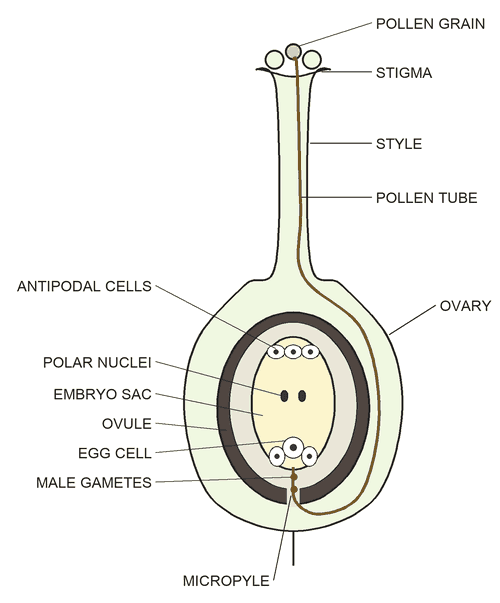
The pollen tube carries the two male gametes from the pollen grain on the stigma down to the embryo sac in the ovule, so that fertilisation can take place.
Step 2 — Germination on the stigma.
A pollen grain of the same species lands on the stigma. The stigma's sugary secretion makes it absorb water and germinate.
Step 3 — Growth of the tube.
The intine grows out as the pollen tube through a germ pore in the exine. The tube nucleus and the generative nucleus move into it, and the generative nucleus divides into two male gametes.
Step 4 — Journey to the ovule.
The tube grows down through the stigma and style, digesting its way with enzymes, reaches the ovary and enters the ovule through the micropyle.
Step 5 — Release of the gametes.
The tip enters a synergid and bursts, setting free the two male gametes. One fuses with the egg to form the zygote; the other fuses with the polar nuclei to form the endosperm nucleus.
Watch out: The tube enters the ovule through the micropyle, not by piercing the ovary or ovule wall anywhere else.
Therefore, the pollen tube carries the two male gametes from the stigma through the style and micropyle into the embryo sac, where one fertilises the egg.
- 277 marks
Question 27
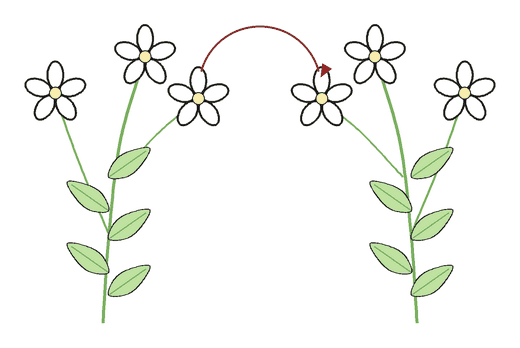
The figure shown below represents a process in flowers. Study the same and answer the following questions.
(a) Name and define the process.
(b) Write the technical term of the above mentioned process.
(c) Give two examples of plants in which this process occurs.
(d) Write one advantage and one disadvantage of the process shown.
(e) Name two agents that participate in this process.
Solve with AIWritten solution
Solution:
Concept: The arrow carries pollen from a flower of one plant to a flower of another plant of the same kind, so the figure shows cross-pollination.
Step 1 — Part (a).
The process is cross-pollination: the transfer of pollen grains from the anther of a flower of one plant to the stigma of a flower of another plant of the same species.
Step 2 — Part (b).
Its technical term is allogamy.
Step 3 — Part (c).
Two examples are papaya and maize (also sunflower, Salvia, Hibiscus).
Step 4 — Part (d).
An advantage is that the offspring are healthier (and new varieties can arise). A disadvantage is that much pollen is wasted, and pollination is not always certain.
Step 5 — Part (e).
Two agents are insects and wind (also water and birds).
Watch out: Pollination between two flowers of the SAME plant (geitonogamy) is not cross-pollination; here the flowers are on two plants.
Therefore, (a) cross-pollination, (b) allogamy, (c) papaya and maize, (d) healthier offspring; wastage of pollen, (e) insects and wind.
- 286 marks
Question 28
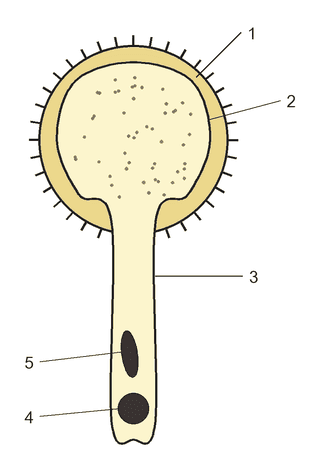
Given below is a diagrammatic sketch of the sectional view of a germinating pollen grain. Study the same and then answer the questions that follow :
(a) Name the parts labelled 1, 2, 3, 4 and 5
(b) Where does the germination of the pollen grain takes place and how ?
(c) What is the function of the part labelled '4' ?
(d) What happens to the part labelled '5' during the process ?
Solve with AIWritten solution
Solution:
Concept: A germinating pollen grain sends out a pollen tube. The tube nucleus lies near the tip and the generative nucleus behind it.
Step 1 — Part (a).
1 – Exine; 2 – Intine; 3 – Pollen tube; 4 – Tube nucleus; 5 – Generative nucleus.
Step 2 — Part (b).
Germination takes place on the stigma of a flower of the same species. The stigma secretes a sugary fluid; the pollen grain absorbs it and swells, and the intine grows out as the pollen tube through a germ pore in the exine.
Step 3 — Part (c).
Part 4, the tube nucleus, is thought to control the growth of the pollen tube towards the ovule; it later disintegrates.
Step 4 — Part (d).
Part 5, the generative nucleus, divides into two male gametes (sperm nuclei).
Watch out: The tube nucleus is at the tip of the tube; the generative nucleus, which forms the gametes, is behind it.
Therefore, (a) 1 exine, 2 intine, 3 pollen tube, 4 tube nucleus, 5 generative nucleus; (b) on the stigma, stimulated by its sugary secretion; (c) controls tube growth; (d) it divides into two male gametes.
- 296 marks
Question 29
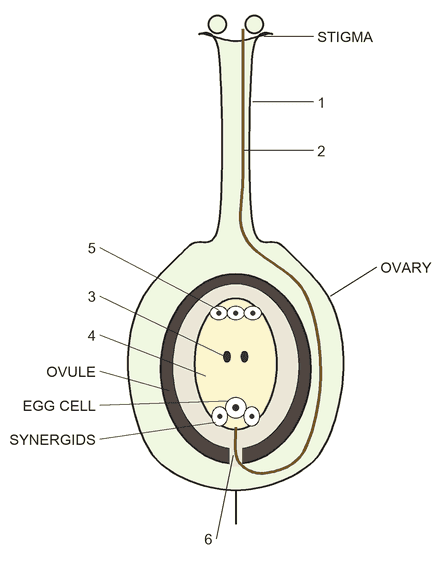
Given below is a diagrammatic representation of the process of fertilization. Study the same and then answer the questions that follow :
(a) Name the parts labelled 1, 2, 3, 4, 5 and 6.
(b) What happens to (i) Ovary (ii) Ovule after fertilization ?
(c) What is the function of the synergids ?
(d) What part does the stigma play in the process of fertilization ?
Solve with AIWritten solution
Solution:
Concept: The pollen tube grows down the style, enters the ovule through the micropyle and reaches the embryo sac, where fertilisation takes place.
Step 1 — Part (a).
1 – Style; 2 – Pollen tube; 3 – Polar nuclei; 4 – Embryo sac; 5 – Antipodal cells; 6 – Micropyle.
Step 2 — Part (b).
After fertilisation, (i) the ovary enlarges and becomes the fruit, its wall forming the fruit wall; (ii) each ovule becomes a seed, its integuments forming the seed coat.
Step 3 — Part (c).
The synergids guide the pollen tube to the egg by chemical signals. The tube enters one synergid and releases its two male gametes there, from where they pass to the egg and the polar nuclei; the synergids then degenerate.
Step 4 — Part (d).
The stigma receives the pollen and secretes a sugary fluid that makes the pollen grain germinate and send out the pollen tube. Pollen of another species usually fails to grow on it.
Therefore, (a) 1 style, 2 pollen tube, 3 polar nuclei, 4 embryo sac, 5 antipodal cells, 6 micropyle; (b) ovary becomes fruit, ovule becomes seed; (c) synergids guide the tube and receive the male gametes; (d) the stigma receives pollen and makes it germinate.
What Class 9 Biology Ch 5 covers
The sections of the chapter, in the order the book takes them. Every question above comes from one of these.
- 01Pollination
- 02Self-pollination
- 03Cross-pollination
- 04Agents of Cross-pollination
- 05Some Examples of Pollination
- 06Fertilization
More ways to study this chapter
The same chapter asked three other ways. Practise it, revise it, and see what the board has set on Ch 5 before.
Class 9 Biology Ch 5 questions students ask
How many questions are there in Class 9 Biology Ch 5?
29 questions. Every one is solved step by step on this page.
Are these Class 9 Biology solutions free?
Yes. Every question and its full working is free to read, with no account needed.
Can I download the Class 9 Biology Ch 5 solutions as a PDF?
There is no PDF to download. Every solution is on this page instead, which means it is searchable, always the current syllabus, and readable on a phone. Use your browser's print option if you want it on paper.