
Opening your dashboard
Class 9 Biology Chapter 5 Pollination and Fertilization: Practice Questions
46 questions on Chapter 5, each worked through on its own page with the AI tutor. Class 9 Biology, ICSE 2026-27.
46 questions
1–5 marks · Mixed difficulty
- 11 mark
Question 1
Bloom's level: Remember
Which term is used when pollination takes place between two different plants of the same species ?
- 21 mark
Question 2
Bloom's level: Remember
The one or two protective coverings that surround an ovule are called :
- 31 mark
Question 3
Bloom's level: Remember
In a maize plant, even a slight breeze shakes the pollen out of the anthers in the tassel. This is because the anthers are :
- 41 mark
Question 4
Bloom's level: Understand
Flowers of pea and pansy that never open are almost always self-pollinated because :
- 51 mark
Question 5
Bloom's level: Understand
Cross-pollination can give rise to new varieties of a crop because :
- 61 mark
Question 6
Bloom's level: Understand
Which pair of features would you expect to find together in a wind-pollinated flower ?
- 71 mark
Question 7
Bloom's level: Apply
A honeybee collects pollen from one flower of a mustard plant and carries it to the stigma of another flower on the same plant. This kind of pollination is :
- 81 mark
Question 8
Bloom's level: Apply
In the flowers of a certain plant, the anthers shed their pollen two days before the stigma of the same flower becomes ready to receive pollen. This condition is called :
- 91 mark
Question 9
Bloom's level: Apply
A ripe guava has a small, dry, crown-like structure at the end opposite its stalk. This structure is the remains of the :
- 101 mark
Question 10
Bloom's level: Analyse
Assertion (A): Fertilization in flowering plants is called double fertilization.
Reason (R): Of the two sperm nuclei released into the embryo sac, one fuses with the egg nucleus and the other fuses with the two polar nuclei.
- 111 mark
Question 11
Bloom's level: Analyse
Assertion (A): Insect-pollinated flowers produce fewer pollen grains than wind-pollinated flowers.
Reason (R): The stigma of an insect-pollinated flower is sticky.
- 121 mark
Question 12
Bloom's level: Evaluate
Assertion (A): Continued self-pollination, generation after generation, makes a crop variety stronger.
Reason (R): In self-pollination, the characters of the parent plant are passed on to the next generation without any intermixing.
- 131 mark
Question 13
Bloom's level: Remember
State the first step that must take place in a flower before fruit and seeds can be formed, and name the two parts of the flower between which this step occurs.
- 142 marks
Question 14
Bloom's level: Understand
In an orchard, mango and litchi trees flower together and the same bees visit both. A mango stigma therefore receives both mango and litchi pollen. Explain what happens to each kind of pollen on the mango stigma.
- 152 marks
Question 15
Bloom's level: Understand
Self-pollination is said to be economical for the plant. Explain why, giving two reasons.
- 162 marks
Question 16
Bloom's level: Understand
Explain how the flowers of the common dioecious papaya ensure that cross-pollination is the only possibility.
- 172 marks
Question 17
Bloom's level: Apply
A grass flower is small and greenish, has no scent or nectar, has long stamens hanging outside the flower and a feathery stigma. Identify its pollinating agent and give two features from the description that support your answer.
- 182 marks
Question 18
Bloom's level: Apply
A bee lands on the wing petals of a sweet pea flower and pushes its tongue in to reach the nectar. Explain how this brings about pollination.
- 192 marks
Question 19
Bloom's level: Apply
The ovary of a flower contains 15 ovules, and every ovule is fertilized normally.
(a) How many sperm nuclei (male gametes) are used in all ?
(b) How many nuclei take part in all the triple fusions together ?
- 202 marks
Question 20
Bloom's level: Apply
A plant breeder wants to cross a pea plant with red flowers (used as the female parent) with a pea plant with white flowers. Write the two things she must do to the young flowers of the female parent before dusting them with pollen, and give the reason for each.
- 212 marks
Question 21
Bloom's level: Analyse
A pea pod is opened and found to contain 7 seeds. Work out how many ovules in the ovary were fertilized, how many pollen tubes (at least) entered the ovary, and which part of the flower became the pod wall. Explain your reasoning.
- 222 marks
Question 22
Bloom's level: Evaluate
A farmer says, "Self-pollination is surer, so it is always the best kind of pollination for my crop." Do you agree fully? Give one point in favour of his claim and one point against it.
- 233 marks
Question 23
Bloom's level: Understand
A pollen grain of the right species lands on a stigma.
(a) What makes the pollen grain germinate there ?
(b) How does the pollen tube reach the embryo sac, and which nucleus guides its growth ?
(c) What happens to the tube nucleus once the tube reaches the embryo sac, and where are the two sperm nuclei released ?
- 244 marks
Question 24
Bloom's level: Apply
Study the features of three flowers P, Q and R.
Flower Features P Tiny male flowers break free and float on the water surface until they meet female flowers Q Large, red, tube-shaped flowers visited by sunbirds; no strong scent R Bright yellow, scented flowers in dense clusters; pollen sticky and spiny (a) Name the pollinating agent for each flower and the technical term for that kind of pollination.
(b) For flower R, give one reason why its pollen is sticky and spiny.
(c) Name one plant from your book that shows the same kind of pollination as P.
- 254 marks
Question 25
Bloom's level: Apply
Case: Ravi grows maize. He notices that the tassels at the top of each plant shed pollen a few days before the silky threads on the cobs lower down are ready. One season, a long spell of completely still weather came just when the cobs were ready, and many cobs had only a few grains.
(a) Name the agent that pollinates maize, and name the part of the plant where the stigmas are found.
(b) How does the earlier maturing of the male flowers help the plant ?
(c) Explain why many cobs had only a few grains that season.
- 264 marks
Question 26
Bloom's level: Analyse
Case: In a hill garden, Meera finds that primrose plants bear two kinds of flowers. In type X the stigma is at the mouth of the petal tube and the anthers sit halfway down the tube. In type Y the anthers are at the mouth and the stigma is halfway down.
(a) Name this contrivance and state whether it favours self- or cross-pollination.
(b) Explain why pollen from the anthers of a type X flower rarely reaches its own stigma.
(c) A bee pushes its head into a type X flower and then into a type Y flower. Analyse which part of the bee's body picks up pollen in each flower and how this carries pollen from one type to the other.
- 274 marks
Question 27
Bloom's level: Analyse
A student studied two plants, X and Y. On each plant, 50 flower buds were covered with fine bags before they opened, and another 50 flowers were left open. The number of flowers that later set seed is shown below.
Plant Bagged flowers that set seed Open flowers that set seed X 0 40 Y 46 47 (a) Express each result as a percentage of the 50 flowers.
(b) Which plant depends on cross-pollination and which can pollinate itself? Explain from the data.
(c) Suggest one condition in the flowers of X which could give this result.
- 284 marks
Question 28
Bloom's level: Evaluate
Case: A seed farm has grown the same self-pollinating variety of a vegetable for twenty years, always saving its own seed. The plants are now smaller and yield less each year. Two plans are suggested :
- Plan 1 : Sow twice as many seeds of the same variety.
- Plan 2 : Cross the variety with a healthy variety of the same vegetable by artificial pollination, and grow the seeds from this cross.
(a) Why have the plants become weaker over the years ?
(b) Which plan is better? Justify your choice.
(c) State one difficulty the farm may face with Plan 2.
- 295 marks
Question 29
Bloom's level: Create
Design an experiment to find out whether insects are needed for pollination in a flowering plant that grows in your school garden.
(a) State the aim and describe how you will set up the experimental and control flowers.
(b) Describe what you will observe and record, and draw up a table for your results.
(c) State the result you would expect if the plant is insect-pollinated, and the conclusion.
- 305 marks
Question 30
Bloom's level: Create
Construct a flow chart that traces the journey from a pollen grain landing on the stigma to the formation of a fruit with seeds. Your chart must include :
(a) at least four steps from pollination to the formation of the zygote and the endosperm nucleus;
(b) what the ovary, ovary wall, ovule and the two integuments become;
(c) what happens to the petals, stamens, style and stigma.
- 311 mark
Question 31
Which one of the following is not an advantage of self-pollination ?
- 321 mark
Question 32
Pollen grains whose specific gravity is almost equal to that of water are found in some flowers that are :
- 331 mark
Question 33
Assertion (A): Cross-pollination is uneconomical for the plant.
Reason (R): The seeds produced by cross-pollination are abundant and viable.
- 342 marks
Question 34
A variety of garden pea has been raised by self-pollination alone, generation after generation.
(i) State two harmful effects that this may have on the variety.
(ii) Name the two conditions that make self-pollination possible in a plant, and state what each one means.
- 352 marks
Question 35
(i) What is meant by self-sterility ? Name one plant that shows it.
(ii) In the flowers of primrose, the stigma and the anthers grow at different heights. Name this condition and state how it helps the plant.
- 362 marks
Question 36
Differentiate between wind-pollinated flowers and insect-pollinated flowers with respect to :
(i) the pollen grains (their number and nature)
(ii) the stigma
- 372 marks
Question 37
(i) Name the three kinds of petals found in a flower of sweet pea.
(ii) If cross-pollination does not take place in a sweet pea flower, there is every chance of self-pollination. Give a reason.
- 383 marks
Question 38
The figure shows two plants, A and B, of the same species. The arrows numbered 1, 2 and 3 show three ways in which pollen may reach a stigma.

(i) Write the technical term for the transfer shown by each of the arrows 1, 2 and 3.
(ii) Which of the three arrows show self-pollination ? Why is the transfer shown by arrow 2 placed in this group ?
(iii) Which of the three transfers can take place even when the flower remains closed ? What are such flowers, which never open, called ?
- 394 marks
Question 39
The figure shows an ovule, cut lengthwise, as it is just before fertilization.
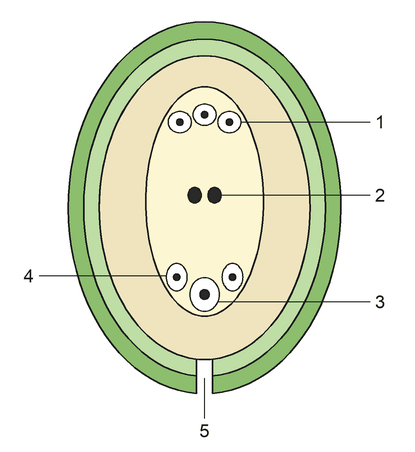
(i) Identify the five structures numbered 1 to 5.
(ii) How many cells does the embryo sac contain in all ? Show how the number is made up.
(iii) A pollen tube releases two sperm nuclei into this embryo sac. State what each of them fuses with and what is formed in each case. How many nuclei take part in triple fusion ?
- 404 marks
Question 40
(i) What is fertilization ? In a flowering plant, which structure produces the male gametes and which produces the female gamete ?
(ii) State what each of the following becomes after fertilization : the ovary wall, the outer integument, the inner integument and the egg cell.
(iii) Name one fruit on which the calyx remains in a dried and shrivelled form, and one fruit to which a green calyx remains attached.
- 411 mark
Question 41
Class 9 Sample Paper 1 · Section A
What do you mean by protandry?
- 421 mark
Question 42
Class 9 Sample Paper 1 · Section A
Fill in the blank:
.......... is the ripened ovary.
- 431 mark
Question 43
Class 9 Sample Paper 1 · Section A
Define the following:
Pollination
- 442 marks
Question 44
Class 9 Sample Paper 1 · Section B
Differentiate between self-pollination and cross-pollination.
- 451 mark
Question 45
Class 9 Sample Paper 2 · Section A
Fill in the blank:
The condition wherein the carpel matures before the stamen is called ...........
- 461 mark
Question 46
Class 9 Sample Paper 2 · Section A
Define the following:
Fertilization