
Opening your dashboard
Class 9 Biology Chapter 5 Pollination and Fertilization: Competency-Based Questions (CBQ)
40 questions on Chapter 5, each worked through on its own page with the AI tutor. Class 9 Biology, ICSE 2026-27.
40 questions
1–5 marks · Mixed difficulty
- 11 mark
Question 1
Cognitive domain: Analysis
Riya looked at the pollen grains of two garden plants under the same magnification of a microscope. Pollen P was small, dry and smooth. Pollen Q was larger, sticky and spiny.
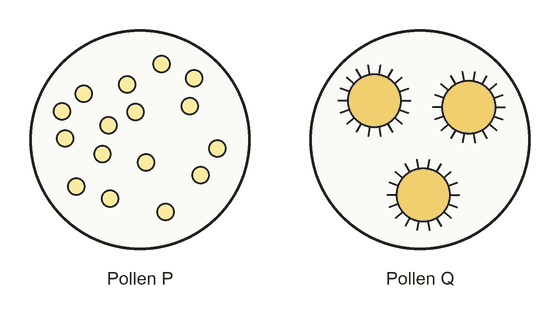
Later she examined the dust trapped on the wire-mesh of a window that faces the garden. Which pollen should she expect to find there in far greater numbers, and why ?
- 21 mark
Question 2
Cognitive domain: Analysis
A student watched one flower each of four plants P, Q, R and S for five days and noted when its anthers shed pollen and when its stigma was ready to receive pollen.
Flower Anthers shed pollen on Stigma ready to receive pollen on P Day 1 and Day 2 Day 4 and Day 5 Q Day 4 and Day 5 Day 1 and Day 2 R Day 2 and Day 3 Day 2 and Day 3 S No anthers present Day 1 to Day 3 In which flower can autogamy take place ?
- 31 mark
Question 3
Cognitive domain: Application
In a rare abnormal pollen grain, the generative nucleus fails to divide, although the pollen tube grows normally through the style and enters the embryo sac. The tube therefore releases only one male nucleus into the embryo sac. What is the most likely result in that ovule ?
- 41 mark
Question 4
Cognitive domain: Understanding
A few pots of sweet pea were kept inside a closed glass house in which there were no bees or other insects and the air was still. The flowers were left untouched, yet most of them formed pods with seeds. Which feature of the sweet pea flower best explains this ?
- 51 mark
Question 5
Cognitive domain: Understanding
Assertion (A): When a butterfly carries pollen from one flower of a hibiscus plant to the stigma of another flower of the same plant, it is still counted as self-pollination.
Reason (R): The different flowers borne on one plant have the same genetic characters.
- 61 mark
Question 6
Cognitive domain: Application
Assertion (A): A plant breeder who wants to cross two varieties of a crop removes the anthers from the young flowers of the plant chosen as the female parent.
Reason (R): Removing the anthers of a young flower makes its stigma attract more insects.
- 71 mark
Question 7
Cognitive domain: Understanding
Anil is making a clay model of the embryo sac described in his chapter. He makes three cells at the micropylar end, three cells at the opposite end and one large central cell, and he puts one bead into the model for every nucleus.
As the central cell has two polar nuclei, he needs ______ beads in all, and in double fertilization only ______ of these nuclei fuse with a sperm nucleus.
- 81 mark
Question 8
Cognitive domain: Application
A botanist finds that one flower of plant X produces about 5 lakh pollen grains and no nectar, while one flower of plant Y produces only about 5 thousand pollen grains and has plenty of nectar.
Plant X is most likely pollinated by ______, and it has to make so much pollen because most of its pollen is ______.
- 91 mark
Question 9
Cognitive domain: Application
A farmer saves his own seed every year. The plants of crop P have remained exactly like their parents for many years. The plants of crop Q grown from saved seed differ from one another in height and in grain colour, and some are sturdier than their parents.
Crop P is mainly ______-pollinated, whereas crop Q is mainly ______-pollinated.
- 102 marks
Question 10
Cognitive domain: Analysis
Zoya wrote in her notebook: "The pollen tube releases its two sperm nuclei into the embryo sac. Both of them fuse with the egg cell. The zygote so formed later divides into two parts, the embryo and the endosperm."
Find the two errors in Zoya's note and correct them.
- 112 marks
Question 11
Cognitive domain: Evaluation
Mr. Das grows cucumbers, which bear male flowers and female flowers separately on the same plant. To keep every insect away, he covered the whole patch with a fine insect-proof net from the day the first flower buds appeared. The plants flowered well but hardly any fruits were formed. Mr. Das concluded that he had been sold poor-quality seeds.
Do you agree with his conclusion ? Justify your answer and suggest one thing he could do next season.
- 122 marks
Question 12
Cognitive domain: Application
In Salvia the anthers of a flower mature earlier than its stigma. Sana wants seeds from one particular Salvia flower. On the day its anthers burst, she dusts their pollen on the stigma of the same flower with a clean brush. No pollen tubes grow on that stigma.
Explain why Sana's attempt failed, and state what she should do with this pollen so that it is able to bring about pollination.
- 135 marks
Question 13
Cognitive domain: Analysis
Case: Kabir read that a pollen grain germinates only after it falls on a stigma. To find out why, he shook the pollen of freshly opened flowers of one garden plant into four drops of liquid on glass slides and kept the slides in a warm, moist place. After two hours he examined 200 pollen grains in each drop under the microscope and counted those that had germinated.
Drop Liquid Pollen grains examined Pollen grains germinated 1 Plain water 200 6 2 5% sugar solution 200 58 3 10% sugar solution 200 152 4 20% sugar solution 200 64 (a) Calculate the percentage of pollen grains that germinated in each drop. In which liquid did the pollen germinate best ?
(b) What does the result suggest about the part played by the stigma in the germination of a pollen grain ?
(c) Describe what Kabir would see growing out of a germinated pollen grain. Name the nuclei it carries.
(d) Kabir's friend says, "The more sugar there is, the better the pollen germinates." Do the results support this ? Give a reason.
- 145 marks
Question 14
Cognitive domain: Evaluation
Case: Mr. Farooq owns a grove of 40 date palms that stands far away from any other grove. Thirty-four of his palms bear only female flowers and six bear only male flowers. Since the six male palms never bear any dates, he plans to cut them all down and plant female palms in their place, hoping for a bigger harvest.
(a) Why do the six male palms never bear dates ? Name the condition in which male and female flowers are borne on separate plants, and the only kind of pollination possible in such plants.
(b) Evaluate Mr. Farooq's plan. What is likely to happen to his harvest if he carries it out ? Give a reason.
(c) Suggest a better plan that lets him keep only a few male palms and still get a good harvest from every female palm. Name the practice you have suggested.
(d) State one advantage and one disadvantage to the palms of depending on this kind of pollination.
- 155 marks
Question 15
Cognitive domain: Creativity
Case: The school garden has a small plot of maize in full flower. Arjun has read that maize is pollinated by wind, and he wants to find out how far from the plot the wind carries maize pollen. He has ten glass slides, a little petroleum jelly, a measuring tape, wooden sticks of equal height and a microscope.
(a) Design a simple investigation for Arjun. State the one thing he should change and two things he must keep the same.
(b) What should he record ? Draw a table in which he can enter his observations.
(c) Predict the result he is likely to get. Mention two features of the maize plant that make such carriage of pollen by wind possible.
- 161 mark
Question 16
Cognitive domain: Analysis
A Salvia plant bears flowers that open on different days. Each flower sheds its pollen only on the first two days after it opens, and its stigma is ready only on its fourth and fifth days after it opens. The table shows three flowers of the same plant. (Hypothetical data.)
Flower Opens on Sheds pollen on Stigma is ready on A Day 1 Days 1 and 2 Days 4 and 5 B Day 3 Days 3 and 4 Days 6 and 7 C Day 5 Days 5 and 6 Days 8 and 9 On Day 5 a bee carries pollen from flower to flower on this plant. Which statement about the ready stigma of flower A on that day is correct ?
- 171 mark
Question 17
Cognitive domain: Application
Kiran and Sunita sowed the same variety of maize on the same day, in soil of the same kind, and watered it equally. Kiran sowed his seeds in one long single row along the edge of his plot. Sunita sowed hers in a compact block of ten rows. At harvest, most cobs in Sunita's block were full of grains, but many cobs in Kiran's row had large gaps with no grains. Which explanation fits best ?
- 181 mark
Question 18
Cognitive domain: Understanding
Rohan listed, for three plants of his chapter, the condition that favours cross-pollination in each of them. Which row has all three pairs correct ?
- 191 mark
Question 19
Cognitive domain: Application
In a laboratory trial, a thin layer of harmless wax was put over the micropyle of every ovule in some flowers of a plant. The flowers were then pollinated with pollen of the same species. The pollen grains germinated, and their tubes grew down the style into the ovary. (Hypothetical trial.) In this plant a pollen tube can enter an ovule only through the micropyle. What is most likely to happen in these ovules ?
- 201 mark
Question 20
Cognitive domain: Analysis
A new fungal disease reached a village. Field P grows a self-pollinated vegetable crop raised, year after year, from seed of one variety saved by the farmer, and all plants in it wilted. Field Q grows a cross-pollinated crop raised from the mixed seed of many plants, and only of its plants wilted. (Hypothetical data.) Which explanation fits best ?
- 211 mark
Question 21
Cognitive domain: Understanding
Assertion (A): A plant that grows in a pond and is pollinated by water makes a very large number of pollen grains.
Reason (R): Such a plant depends on the wind to carry its pollen from one flower to another.
- 221 mark
Question 22
Cognitive domain: Understanding
Assertion (A): Cross-pollination always needs an external pollinating agent.
Reason (R): The offspring produced by cross-pollination are healthier.
- 231 mark
Question 23
Cognitive domain: Application
A plant breeder has two varieties of the same crop. Variety X is tall, resists a common disease and gives little grain. Variety Y is short, gives a lot of grain and is easily attacked by the disease. She removes the anthers from the young flowers of Y, covers them with bags, later dusts them with pollen of X, covers them again, and sows the seeds that form. What can she expect from the seedlings ?
- 241 mark
Question 24
Cognitive domain: Understanding
In a mixed orchard, a bee that has just visited a mango tree lands on a guava flower and leaves mango pollen on its stigma. This mango pollen will ______ on the guava stigma, because a pollen grain grows further only on the stigma of a plant of the ______ species.
- 252 marks
Question 25
Cognitive domain: Analysis
A bee visits five flowers of the same species in this order: X1, X2 and X3 on plant X, and then Y1 and Y2 on plant Y. Each time it flies to a new flower, it leaves on the stigma some pollen that it picked up from the flower it has just left. (Hypothetical data.)
Flight From To 1 X1 X2 2 X2 X3 3 X3 Y1 4 Y1 Y2 (a) Name the kind of pollination brought about by each of the four flights.
(b) How many of the flights give cross-pollination ? Which flight could give a seed with characters of two different plants ?
- 262 marks
Question 26
Cognitive domain: Application
In a pond, the female flowers of Vallisneria float up to the surface of the water. The male flowers grow on separate male plants, break free and float on the surface.
(a) How does pollen reach the stigma of a female flower in this plant ? Name the agent.
(b) One male plant makes a large number of male flowers. Why is this useful to the plant ?
- 272 marks
Question 27
Cognitive domain: Evaluation
Rekha pollinated several flowers of a garden plant by hand. Three days later, in one flower the petals and the stamens had withered and the style and stigma had dried up, but the ovary at its base had begun to swell. Rekha said, "This flower has failed. If the pollination had worked, the petals would still be fresh."
Do you agree with Rekha ? Give two reasons from the chapter.
- 282 marks
Question 28
Cognitive domain: Analysis
A scientist treats the stigmas and styles of some flowers with a chemical that stops a pollen tube from making the enzymes that dissolve the tissues in its path. The flowers are then pollinated with pollen of the same species, and the pollen grains germinate on the stigmas. (Hypothetical trial.)
Predict what will happen to the pollen tubes and to fertilization in these flowers, and give a reason for each prediction.
- 292 marks
Question 29
Cognitive domain: Analysis
A student took flowers of a garden plant for each of two sets. In set 1 she dusted each flower with pollen from the same flower. In set 2 she first removed the anthers from the young flowers and then dusted them with pollen from a different plant of the same species. She covered every flower of both sets with a bag after dusting it. She counted the seeds that formed and sowed seeds from each set. (Hypothetical data.)
Set Seeds formed per flower (average) Seeds that germinated (out of ) 1 (pollen of the same flower) 2 (pollen of a different plant) (a) By what percentage is the number of seeds per flower in set 2 greater than in set 1 ?
(b) Which statement about cross-pollination in the book do these results support ?
- 302 marks
Question 30
Cognitive domain: Analysis
To find out what the petals of a flower do, a student chose flowers on one plant that is pollinated by bees. She removed all the petals of of the flowers and left the other untouched. Nectar and scent were the same in both groups. (Hypothetical data.)
Group Flowers Bee visits counted in one hour Flowers that formed fruit With petals Without petals (a) Find the percentage of flowers that formed fruit in each group.
(b) What do the results suggest about the work of the petals ? Give a reason.
- 312 marks
Question 31
Cognitive domain: Creativity
Neha explains pollination and fertilization to her younger brother with the help of posting a parcel. Make up your own comparison from daily life (it need not be a parcel). Match at least four parts or steps of pollination and fertilization with parts of your comparison, and state one way in which your comparison does not fit the plant.
- 323 marks
Question 32
Cognitive domain: Evaluation
Mr. Thomas keeps bee hives and can place them in only two of four neighbouring fields during the fortnight in which all the crops are in flower. The fields grow maize (field 1), fodder grass (field 2), sunflower (field 3) and sweet pea (field 4). He wants the hives to help the crops as much as possible.
Which two fields should he choose ? Which of the two should get more hives ? Why are the other two fields not good choices ? Give reasons from your book.
- 333 marks
Question 33
Cognitive domain: Evaluation
Aphids, which are small sucking insects, have settled on the tassels of Mr. Patil's maize plants. On the day the tassels begin to shed pollen, he plans to wash all the tassels every morning for a week with a strong jet of water from a hose. He says, "My plants will be clean, and the cobs will not suffer."
Do you agree with his plan ? Give three points in your answer, including one safer way of dealing with the aphids.
- 343 marks
Question 34
Cognitive domain: Application
On a terrace garden two plants flower together. Plant P is a canna with bright red, tube-shaped flowers that have no scent and plenty of nectar; it is visited mainly by sunbirds. Plant Q has yellow, scented flowers with sticky, spiny pollen; it is visited mainly by bees. A neighbour sprays the terrace with an insecticide that kills most of the bees and butterflies but does not harm the birds.
(a) Predict, with a reason, which plant will set fewer fruits this season.
(b) Which disadvantage of cross-pollination in the book does this show ?
(c) Suggest one way in which the gardener could still get fruits from the other plant.
- 353 marks
Question 35
Cognitive domain: Analysis
The table describes four kinds of flowers.
Flower Description 1 Bisexual, anthers and stigma mature at the same time, and the flower stays closed 2 Bisexual, anthers mature before the stigma, and the flower opens; the plant bears many flowers 3 Unisexual, and the male and female flowers are on the same plant 4 Unisexual, and the male and female flowers are on separate plants (a) For each flower, write whether autogamy, geitonogamy and allogamy are possible.
(b) Which flower can be pollinated only by cross-pollination ?
(c) Which flower can set seed without any outside pollinating agent ?
- 363 marks
Question 36
Cognitive domain: Analysis
The table shows, in arbitrary units, the material that a plant spends on each flower. (Hypothetical data.)
Plant Petals Scent Nectar Pollen X: self-pollinated, closed flowers Y: insect-pollinated Z: wind-pollinated (a) Find the total spent per flower by each plant.
(b) Which plant spends the least and how many times as much does plant Y spend as that plant ?
(c) In spite of this saving, why do most plants not depend on self-pollination alone ?
- 375 marks
Question 37
Cognitive domain: Analysis
Case: A student pollinated many flowers on each of two plants, P and Q, of the same species at a.m. Every hour she examined a few of these flowers under the microscope and measured how far the longest pollen tube had grown through the style. The style of P is mm long and the style of Q is mm long. Take it that a tube reaches the ovary, and at once an ovule, when it has grown the whole length of the style. The graph shows her results. (Hypothetical data.)
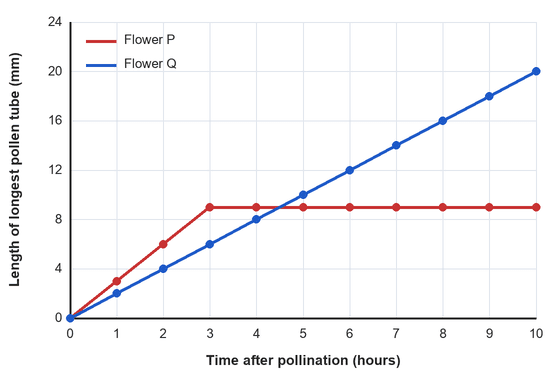
(a) How long does the pollen tube take to reach the ovary in P and in Q ? Find the rate of growth of the tube in each flower, in mm per hour.
(b) At what time of the day would the sperm nuclei of each flower be released in the embryo sac, if they are released as soon as the tube reaches the ovule ?
(c) At p.m. the gardener cuts off the style and stigma of the remaining pollinated flowers of both plants. Predict whether each flower can still form seeds, and give a reason.
- 385 marks
Question 38
Cognitive domain: Creativity
Case: The eco-club of your school has been given a bare plot of m by m and asked to make a small Pollination Garden that shows Class IX students how plants are pollinated. The club may grow at most three kinds of plants, one for each of these agents: wind, insects and birds.
(a) Choose one plant from your book for each agent. For each plant, give two features of its flower that visitors should be asked to notice.
(b) Write a signboard of about words for the insect-pollinated plant, explaining to visitors why its flowers are showy, scented and full of nectar, even though this costs the plant a lot.
(c) Plan a simple survey the club could run for a month to find out whether the garden is working. Say what will be counted and how often, and draw the outline of a table for the records.
- 394 marks
Question 39
Cognitive domain: Analysis
Case: The mango growers of a village recorded, for five seasons, the number of rainy days in the fortnight when the mango trees were in flower, and the percentage of flowers that later set fruit. The graph shows the records. (Hypothetical data.)

(a) Describe the trend. By how many percentage points did the fruit set fall between the season with rainy day and the season with rainy days ?
(b) Mango flowers are pollinated by insects. Explain the trend with the help of what you have learnt about insect-pollinated flowers.
(c) A neighbouring village grows pea, which the book gives as an example of closed flowers that pollinate themselves. Would you expect its fruit set to fall as much in the rainy seasons ? Give a reason.
- 405 marks
Question 40
Cognitive domain: Evaluation
Case: Mrs. D'Souza has a single apple tree in her garden. Every spring it is covered with flowers and bees visit it daily, yet only a few of its flowers form fruit. Her neighbour has two apple trees of different varieties standing close together, and gets a heavy crop. A farm adviser says that Mrs. D'Souza's tree is self-sterile: even if the pollen of its own flowers lands on its stigmas, the pollen does not grow further. To test this, she treated flowers in each of three ways and counted the fruits after six weeks. The flowers of treatments A and B were dusted by hand and then covered with bags. (Hypothetical data.)
Treatment Flowers Fruits formed A: pollen of the same tree B: pollen of the neighbour's tree C: left to the bees (a) Find the percentage of flowers that formed fruit in each treatment.
(b) Explain why the bees' visits do not give Mrs. D'Souza's tree a good crop.
(c) Three neighbours suggest: (i) hire more bees; (ii) plant a second apple tree of a different variety close by; (iii) brush pollen from some flowers of her tree onto the stigmas of other flowers of the same tree. Evaluate each suggestion and say which is best.