
Opening your dashboard
Class 9 Biology Chapter 2: Cell: The Unit of Life Solutions
45 textbook questions with step-by-step answers, free to read, for ICSE 2026-27.
Get talked through Ch 2, not just shown the answer
Reading a finished solution is not the same as being able to do it. The AI tutor takes one question at a time and works it with you, in your own words, until you can.
- Ask it out loud, in your own words
- It gives you the next step, not the answer
- Stuck on part (ii)? Start there
45 questions with solutions
1–20 marks · Mixed difficulty
- 12 marks
Question 1
Name the following :
(i) The kind of microscope that consists of a single biconvex lens.
(ii) The kind of mirror used for throwing light on the object in Hooke's microscope.
Solve with AIWritten solution
Solution:
Concept: Early microscopes were of two kinds: a simple microscope has only one lens, while a compound microscope uses two lenses (an objective and an eyepiece) one after the other.
Step 1 — (i) One biconvex lens.
A microscope with a single biconvex (double convex) lens is a simple microscope. Antony van Leeuwenhoek's microscopes were of this kind and magnified up to about 200 times.
Step 2 — (ii) Lighting the object in Hooke's microscope.
Robert Hooke placed the object on the stage below his two-lens microscope, and light from an oil flame was thrown on it by a concave mirror, which collects light and focuses it on the object.
Watch out: A simple microscope is not 'a microscope that is simple to use'; the word refers to its single lens.
Therefore, (i) simple microscope; (ii) concave mirror.
- 22 marks
Question 2
What is the maximum magnification that can usually be achieved by
(i) a compound microscope,
(ii) an electron microscope ?
Solve with AIWritten solution
Solution:
Concept: A light (compound) microscope bends light with glass lenses, while an electron microscope bends a beam of electrons with magnets; electrons can show much finer detail, so the magnification is far higher.
Step 1 — (i) Compound microscope.
An ordinary compound microscope can magnify an object up to a maximum of about 2,000 times. Beyond this, light cannot show finer detail, so higher magnification only gives a bigger but blurred image.
Step 2 — (ii) Electron microscope.
An electron microscope can magnify over 2,00,000 (200,000) times, which is about a hundred times more than the light microscope.
Watch out: Write the electron-microscope figure with the correct number of zeros: 2,00,000 in Indian grouping is 200,000 (two lakh).
Note: These are the figures the textbook uses. Modern electron microscopes can magnify much more, even more than 10,00,000 (one million) times.
Therefore, (i) about 2,000 times; (ii) over 2,00,000 times.
- 34 marks
Question 3
Name the following :
(i) Any two one-celled organisms.
(ii) The longest cells in animals.
(iii) Amoeboid cells in humans.
(iv) Shape of white blood cells.
Solve with AIWritten solution
Solution:
Concept: Cells differ in number (one cell or many), size and shape, and each shape suits the work the cell does.
Step 1 — (i) One-celled organisms.
Organisms whose whole body is a single cell are called unicellular; two examples are Amoeba and bacteria (others: Paramecium, Chlamydomonas, yeast).
Step 2 — (ii) Longest cells in animals.
The nerve cells are the longest cells. A single nerve cell can stretch from the tip of a finger to the spinal cord, because it must carry messages over long distances.
Step 3 — (iii) Amoeboid cells in humans.
The white blood cells (WBCs) are amoeboid: like Amoeba, they change shape and creep through tissues to reach and swallow germs.
Step 4 — (iv) Shape of white blood cells.
White blood cells have an irregular, changing (amoeboid) shape: they push out finger-like pseudopodia to move.
Watch out: Red blood cells are not amoeboid; they keep a fixed disc shape.
Therefore, (i) Amoeba and bacteria; (ii) nerve cells; (iii) white blood cells; (iv) amoeboid (irregular, changing) shape.
- 41 mark
Question 4
A large surface area/volume ratio of the cells ensure a greater diffusion of certain substances into the cell. Name such substances.
Solve with AIWritten solution
Solution:
Concept: Small cells have a large surface area / volume ratio: there is more cell surface for each unit of volume, so substances can diffuse in and out quickly enough for the whole cell.
Step 1 — See why a small size helps.
When a cube of side 2 mm is cut into 8 cubes of side 1 mm, the volume stays the same but the total surface doubles:
In the same way, a small cell has more surface through which materials can enter.
Step 2 — Name the substances.
The substances that diffuse in more easily are oxygen, nutrients (food such as glucose) and water. In the same way, wastes such as carbon dioxide diffuse out faster.
Watch out: The ratio, not the total surface, matters: a big cell has more surface in total but much less surface for each unit of its volume.
Therefore, oxygen, nutrients (food) and water diffuse into the cell more easily.
- 53 marks
Question 5
Name the part of a cell in which
(i) many chemical reactions occur with the help of enzymes.
(ii) a network of chromatin fibres occurs.
(iii) cellulose forms the main component.
Solve with AIWritten solution
Solution:
Concept: Each part of a cell has its own typical feature: the cytoplasm is the busy chemical workplace, the nucleus holds the chromatin and the plant cell wall is made of cellulose.
Step 1 — (i) Chemical reactions with enzymes.
Many chemical reactions of the cell take place in the cytoplasm, where enzymes speed them up (for example the first steps of respiration).
Step 2 — (ii) Network of chromatin fibres.
The chromatin network is found in the nucleus. When the cell divides, these fibres condense into chromosomes.
Step 3 — (iii) Made mainly of cellulose.
The cell wall of a plant cell is made mainly of cellulose, a non-living substance that gives the cell strength and shape.
Therefore, (i) cytoplasm; (ii) nucleus; (iii) cell wall.
- 62 marks
Question 6
Differentiate between
(i) an organ and an organelle
(ii) a plant cell and an animal cell pertaining to the presence of plastids.
Solve with AIWritten solution
Solution:
Concept: An organ is a part of a whole body (built of tissues), while an organelle ('little organ') is a part inside one cell. Plastids are organelles found only in plant cells.
Step 1 — (i) Organ and organelle.
Compare the two point by point:
Organ Organelle A part of the body of an organism A part inside a single cell Made of many cells and tissues Not made of cells; it is itself a part of a cell Example: heart, leaf Example: mitochondrion, ribosome Step 2 — (ii) Plant and animal cell: plastids.
A plant cell usually has plastids (chloroplasts, chromoplasts or leucoplasts), while an animal cell has no plastids.
Watch out: Do not mix up the two words: an organelle is far smaller and lies within one cell.
Therefore, an organ is a body part made of tissues while an organelle is a part of a cell; plastids are present in plant cells and absent in animal cells.
- 75 marks
Question 7
Name the cell organelles concerned with
(i) Secretion of enzymes
(ii) Trapping of solar energy
(iii) Synthesis of proteins
(iv) Intracellular digestion
(v) Production of ATP
Solve with AIWritten solution
Solution:
Concept: Each cell organelle has a particular job, and the job often gives the organelle its nickname (mitochondria, the power houses; lysosomes, the digestive bags).
Step 1 — (i) Secretion of enzymes.
The Golgi apparatus (called dictyosomes in plant cells) makes, packs and sends out secretions such as enzymes and hormones.
Step 2 — (ii) Trapping solar energy.
Chloroplasts contain chlorophyll, which traps the energy of sunlight for photosynthesis.
Step 3 — (iii) Synthesis of proteins.
Ribosomes join amino acids together to make proteins.
Step 4 — (iv) Intracellular digestion.
Lysosomes hold digestive enzymes and break down food particles, germs and worn-out parts inside the cell.
Step 5 — (v) Production of ATP.
Mitochondria oxidise food in aerobic respiration and release its energy as ATP.
Watch out: Mitochondria make ATP but do not secrete enzymes; secretion is the Golgi apparatus's work.
Therefore, (i) Golgi apparatus; (ii) chloroplasts; (iii) ribosomes; (iv) lysosomes; (v) mitochondria.
- 84 marks
Question 8
Name the cell organelle/component which is
(i) composed of cellulose
(ii) formed of an irregular network of tubular double membranes
(iii) a clear space with water or other substances in solution
(iv) visible only in cell division stages
Solve with AIWritten solution
Solution:
Concept: Each cell part can be recognised by its main feature: its material, its shape or when it can be seen.
Step 1 — (i) Composed of cellulose.
The plant cell wall is composed of cellulose.
Step 2 — (ii) Network of tubular double membranes.
The endoplasmic reticulum (ER) is an irregular network of double-membrane tubes running through the cytoplasm.
Step 3 — (iii) A clear space with a solution.
A vacuole is a clear, fluid-filled space; in plant cells it holds cell sap (water with dissolved sugars, salts and pigments).
Step 4 — (iv) Seen only during cell division.
Chromosomes become visible only when the cell divides; at other times they stay as a fine chromatin network.
Therefore, (i) cell wall; (ii) endoplasmic reticulum; (iii) vacuole; (iv) chromosomes.
- 94 marks
Question 9
Mention if the following statements are true or false. If false, suggest the change in the information underlined.
(i) Prokaryotic cells have ribosomes.
(ii) Eukaryotic cells have .
(iii) Amoeba is an example of .
(iv) Nuclear membrane is in bacteria.
Solve with AIWritten solution
Solution:
Concept: Prokaryotic cells (bacteria) have no nuclear membrane, no membrane-bound organelles such as mitochondria, and smaller ribosomes (70S); eukaryotic cells have a true nucleus, membrane-bound organelles and larger ribosomes (80S).
Step 1 — (i) Ribosomes of prokaryotes.
The statement is false. Prokaryotic cells have smaller ribosomes than eukaryotic cells, so 'larger' must be changed to 'smaller'.
Step 2 — (ii) Mitochondria in eukaryotes.
The statement is true. Eukaryotic cells have membrane-bound organelles, including mitochondria.
Step 3 — (iii) Amoeba.
The statement is false. Amoeba has a true nucleus with a nuclear membrane, so it is a eukaryote, not a prokaryote.
Step 4 — (iv) Nuclear membrane in bacteria.
The statement is false. Bacteria are prokaryotes: their DNA lies free in the cytoplasm, and the nuclear membrane is absent.
Watch out: A one-celled organism is not automatically a prokaryote; Amoeba is one-celled but eukaryotic.
Therefore, (i) false: smaller; (ii) true; (iii) false: eukaryotes; (iv) false: absent.
- 104 marks
Question 10
Column I lists a few activities of living organisms and column II the activity of cells related to them. Match the items in the two columns.
Column I (Activity of organism) Column II (Activity of cells) (i) Repair (a) Contractility of cells (ii) Cooling of body (b) Cells devour germs (iii) Movement (c) Cell division (iv) Protection from diseases (d) Gland cells give out sweat for evaporation Solve with AIWritten solution
Solution:
Concept: Every activity of a whole organism is the result of some activity of its cells.
Step 1 — (i) Repair.
Wounds heal because cells next to them divide and make new cells, so repair matches (c) cell division.
Step 2 — (ii) Cooling of body.
Sweat-gland cells give out sweat, and its evaporation takes heat from the skin, so cooling matches (d).
Step 3 — (iii) Movement.
Muscle cells can contract and relax, so movement matches (a) contractility of cells.
Step 4 — (iv) Protection from diseases.
Some white blood cells swallow (devour) germs, so protection matches (b).
Therefore, (i)–(c), (ii)–(d), (iii)–(a), (iv)–(b).
- 111 mark
Question 11
Which cell organelle is the key to the life of the cell ?
Solve with AIWritten solution
Solution:
Concept: The nucleus contains the chromosomes with the genes, and it directs every activity of the cell.
Step 1 — Recall the role of the nucleus.
The nucleus controls all the activities of the cell, such as growth, protein making and cell division.
Step 2 — See why it is the key.
If the nucleus is removed, the cell can live only for a short time and then dies, so the nucleus is the key to the life of the cell.
Therefore, the nucleus is the key to the life of the cell.
- 122 marks
Question 12
How do you say that a cell also has a life span and death like an organism ? Give one example.
Solve with AIWritten solution
Solution:
Concept: Like an organism, a cell is born (from an existing cell), lives and works for a time, grows old and dies.
Step 1 — Show that a cell has a life span.
A cell is formed from a pre-existing cell by cell division. It then carries out its work for a certain period, grows old and dies, and new cells formed by division take its place.
Step 2 — Give an example.
A human red blood cell lives for about 120 days. Old red blood cells are then destroyed (mainly in the spleen and liver), and new ones made in the bone marrow replace them.
Therefore, cells also have a life span and death; for example, a red blood cell lives for about 120 days.
- 132 marks
Question 13
All organisms excrete. Does an individual cell also do it ? Give one example.
Solve with AIWritten solution
Solution:
Concept: The chemical reactions in every living cell (its metabolism) produce waste products, which would harm the cell if they collected inside it.
Step 1 — Answer the question.
Yes, every cell excretes: it gives out its metabolic wastes, mostly by diffusion through the cell membrane.
Step 2 — Give an example.
Every respiring cell gives out carbon dioxide, the waste of respiration. Amoeba also throws out excess water and some wastes through its contractile vacuole.
Therefore, yes, a cell also excretes; for example, every respiring cell gives out carbon dioxide.
- 142 marks
Question 14
Every organism needs food. Does a cell also need it? Explain very briefly.
Solve with AIWritten solution
Solution:
Concept: Food supplies both the energy and the raw materials for life, and both are used inside the cells.
Step 1 — Answer the question.
Yes, every cell needs food (such as glucose, amino acids and fats).
Step 2 — Food for energy.
Inside the cell, food such as glucose is oxidised, mainly in the mitochondria, to release energy as ATP, which runs all the activities of the cell.
Step 3 — Food for growth and repair.
Food also gives the raw materials, such as amino acids for proteins, with which the cell grows and repairs itself.
Therefore, yes, a cell needs food, both for energy and for growth and repair.
- 151 mark
Question 15
All life starts as :
Solve with AIAnswer
(A) an egg
- Correct
(B) a single cell
(C) a gene
(D) a chromosome
Answer: (B) a single cell
Concept: Every organism starts its life as a single cell: a fertilised egg (zygote) in most plants and animals, or one cell in single-celled organisms.
Step 1 — Recall how life begins.
A human begins as one cell, the zygote; a bacterium or Amoeba is a single cell from the start.
Step 2 — Choose the option.
The option that fits every organism is a single cell.
Watch out: An egg is one kind of single cell, but not every organism starts from an egg.
Why the other options are wrong:
- (A) an egg: bacteria and Amoeba come from a dividing cell, not from an egg, so 'an egg' does not fit all life.
- (C) a gene: a gene is a short part of DNA, a unit of heredity, not a living cell.
- (D) a chromosome: a chromosome is a thread in the nucleus, only a part of a cell.
Therefore, all life starts as a single cell, option (B).
- 161 mark
Question 16
Which one of the following is found both in the cells of a mango plant and a monkey ?
Solve with AIAnswer
(A) chloroplasts
(B) centrioles
(C) cell wall
- Correct
(D) cell membrane
Answer: (D) cell membrane
Concept: All cells, plant or animal, are bounded by a cell (plasma) membrane; some parts are found only in plant cells and some only in animal cells.
Step 1 — Sort the parts.
A mango cell is a plant cell and a monkey cell is an animal cell. Chloroplasts and the cell wall are plant-only; centrioles are animal-only.
Step 2 — Find the common part.
Only the cell membrane is found in both.
Why the other options are wrong:
- (A) chloroplasts: chloroplasts occur only in green plant cells, so a monkey cell has none.
- (B) centrioles: centrioles are found in the monkey's (animal) cells, not in the cells of a flowering plant like mango.
- (C) cell wall: a cell wall is present in the mango's cells but not in the monkey's.
Therefore, the cell membrane is found in both, option (D).
- 171 mark
Question 17
Which one of the following cell organelles is correctly matched with its function ?
Solve with AIAnswer
- Correct
(A) Ribosomes — Synthesis of proteins
(B) Mitochondria — Secretion of enzymes
(C) Plasma membrane — Freely permeable
(D) Centrosome — Carries genes
Answer: (A) Ribosomes — Synthesis of proteins
Concept: Each organelle has its own function: ribosomes make proteins, mitochondria release energy, the plasma membrane controls what enters and leaves, and the chromosomes carry the genes.
Step 1 — Check each pair.
Ribosomes are the sites where amino acids are joined into proteins, so pair (A) is correct.
Step 2 — Confirm the others fail.
Each of the other pairs names a function of a different part, as shown below.
Why the other options are wrong:
- (B) Mitochondria — Secretion of enzymes: mitochondria release energy by respiration; enzymes are secreted by the Golgi apparatus.
- (C) Plasma membrane — Freely permeable: the plasma membrane is selectively permeable; it is the cell wall that is freely permeable.
- (D) Centrosome — Carries genes: genes are carried by the chromosomes; the centrosome helps in cell division.
Therefore, ribosomes – synthesis of proteins is correctly matched, option (A).
- 181 mark
Question 18
A plant cell can be identified from an animal cell by the :
Solve with AIAnswer
- Correct
(A) absence of centrosome.
(B) presence of cell membrane.
(C) presence of vacuoles
(D) none of the above
Answer: (A) absence of centrosome.
Concept: Plant and animal cells differ mainly in the cell wall, centrosome, vacuoles and plastids. A centrosome with centrioles is found in animal cells and is absent from the cells of flowering plants.
Step 1 — Look for a plant-only or animal-only feature.
A feature that helps tell the cells apart must be present in one kind of cell and absent from the other.
Step 2 — Apply it.
The absence of a centrosome marks a plant cell, because animal cells have one.
Watch out: Vacuoles are not a safe test: animal cells may also have small, temporary vacuoles.
Why the other options are wrong:
- (B) presence of cell membrane: both plant and animal cells have a cell membrane, so it cannot separate them.
- (C) presence of vacuoles: animal cells may also have vacuoles, so their mere presence proves nothing (only large, permanent vacuoles are typical of plant cells).
- (D) none of the above: option (A) is a correct basis, so 'none of the above' cannot be right.
Therefore, a plant cell is identified by the absence of a centrosome, option (A).
- 191 mark
Question 19
Plant cell has a cell wall made of :
Solve with AIAnswer
(A) Protein
(B) Fructose
- Correct
(C) Cellulose
(D) Fatty acids
Answer: (C) Cellulose
Concept: The plant cell wall is a non-living, freely permeable layer made mainly of cellulose, a carbohydrate built from many glucose units.
Step 1 — Recall the wall material.
The main component of the plant cell wall is cellulose, which gives the wall its strength.
Step 2 — Match with the options.
Cellulose is option (C).
Why the other options are wrong:
- (A) Protein: proteins (with lipids) build the cell membrane, not the plant cell wall.
- (B) Fructose: fructose is a simple sugar found in fruits; it is not a wall material.
- (D) Fatty acids: fatty acids are parts of fats and of membrane lipids, not of the cell wall.
Therefore, the plant cell wall is made of cellulose, option (C).
- 201 mark
Question 20
The cell organelle that helps in respiration of the cell is :
Solve with AIAnswer
- Correct
(A) Mitochondria
(B) Lysosome
(C) Ribosome
(D) Centrosome
Answer: (A) Mitochondria
Concept: Mitochondria are the 'power houses' of the cell: aerobic respiration is completed in them and the energy of food is released as ATP.
Step 1 — Link respiration to an organelle.
Cellular respiration, in which food is oxidised to release energy, takes place mainly in the mitochondria.
Step 2 — Choose the option.
Mitochondria are option (A).
Why the other options are wrong:
- (B) Lysosome: lysosomes carry out intracellular digestion.
- (C) Ribosome: ribosomes make proteins.
- (D) Centrosome: the centrosome helps the cell to divide by forming the spindle.
Therefore, the organelle that helps in respiration is the mitochondria, option (A).
- 211 mark
Question 21
Which of the following organelles is involved in the formation of the acrosome of a sperm ?
Solve with AIAnswer
(A) Dictyosome
(B) Centrosome
(C) Lysosome
- Correct
(D) Golgi apparatus
Answer: (D) Golgi apparatus
Concept: In animal cells the Golgi apparatus packs secretions. In a developing sperm it forms the acrosome, the cap of enzymes that helps the sperm enter the egg.
Step 1 — Recall what the acrosome is.
The acrosome is a sac of enzymes at the tip of the sperm head, a kind of packed secretion.
Step 2 — Name the organelle.
Packing secretions is the work of the Golgi apparatus, so the acrosome is formed by the Golgi apparatus.
Watch out: Dictyosome is the name used for the Golgi bodies of plant cells; for an animal sperm the book's answer is Golgi apparatus.
Why the other options are wrong:
- (A) Dictyosome: 'dictyosome' is the plant-cell name for the Golgi bodies, so it is not the name used for an animal sperm cell.
- (B) Centrosome: the centrosome forms the spindle in cell division (its centriole forms the base of the sperm tail), not the acrosome.
- (C) Lysosome: lysosomes carry digestive enzymes for intracellular digestion; they do not form the acrosome.
Therefore, the acrosome is formed by the Golgi apparatus, option (D).
- 221 mark
Question 22
Which part of the nucleus participates in protein synthesis ?
Solve with AIAnswer
(A) Nuclear membrane
- Correct
(B) Nucleolus
(C) Nuclear pore
(D) Nucleoplasm
Answer: (B) Nucleolus
Concept: Proteins are made on ribosomes, and the nucleolus inside the nucleus makes ribosomal RNA and builds the parts of ribosomes.
Step 1 — Find the nuclear part linked to ribosomes.
The nucleolus forms RNA and ribosome parts, which pass out to the cytoplasm.
Step 2 — Link it to protein synthesis.
Without ribosomes no protein can be made, so the nucleolus takes part in protein synthesis.
Why the other options are wrong:
- (A) Nuclear membrane: the nuclear membrane only encloses the nucleus and separates it from the cytoplasm.
- (C) Nuclear pore: nuclear pores only let substances pass between the nucleus and the cytoplasm.
- (D) Nucleoplasm: the nucleoplasm is the fluid that fills the nucleus.
Therefore, the nucleolus participates in protein synthesis, option (B).
- 231 mark
Question 23
The pigment which is not found in plastids is :
Solve with AIAnswer
(A) Xanthophyll
(B) Carotene
- Correct
(C) Anthocyanin
(D) Chlorophyll
Answer: (C) Anthocyanin
Concept: Plastids hold the pigments chlorophyll (green), carotene (orange) and xanthophyll (yellow). Anthocyanins (red, blue, purple) are not in plastids; they stay dissolved in the cell sap of vacuoles.
Step 1 — Sort the pigments.
Chlorophyll lies in chloroplasts; carotene and xanthophyll lie in chromoplasts (and also in chloroplasts).
Step 2 — Pick the odd one.
Only anthocyanin is outside the plastids, in the vacuole.
Why the other options are wrong:
- (A) Xanthophyll: xanthophyll, a yellow pigment, is found in plastids (chromoplasts and chloroplasts).
- (B) Carotene: carotene, an orange-red pigment, is found in plastids (chromoplasts and chloroplasts).
- (D) Chlorophyll: chlorophyll, the green pigment, is found in chloroplasts.
Therefore, the pigment not found in plastids is anthocyanin, option (C).
- 241 mark
Question 24
The tubules of Golgi complexes are technically termed as :
Solve with AIAnswer
- Correct
(A) Cisternae
(B) Microtubules
(C) Cristae
(D) Vesicles
Answer: (A) Cisternae
Concept: The Golgi complex is a stack of hollow membrane sacs (described in the book as tubular structures) called cisternae, with small vesicles and vacuoles around them.
Step 1 — Recall the parts of the Golgi complex.
Its main units are the cisternae; the vesicles budding from their edges carry the secretions away.
Step 2 — Choose the option.
The technical term asked is cisternae, option (A).
Watch out: Cisternae (Golgi) and cristae (mitochondria) sound alike; keep them apart.
Why the other options are wrong:
- (B) Microtubules: microtubules are thin protein tubes that form the asters and the spindle; they are not Golgi parts.
- (C) Cristae: cristae are the folds of the inner membrane of a mitochondrion.
- (D) Vesicles: vesicles are the small sacs that bud off the cisternae; they are not the main tubular units.
Therefore, the tubules of the Golgi complex are called cisternae, option (A).
- 256 marks
Question 25
Name the part of the cell concerned with the following :
(a) Liberation of energy
(b) Synthesis of proteins
(c) Transmission of hereditary characters from parents to offspring
(d) Initiation of cell division
(e) Hydrolytic in function
(f) Entry of only certain substances into and out of the cell.
Solve with AIWritten solution
Solution:
Concept: Every part of the cell has its own characteristic function.
Step 1 — (a) Liberation of energy.
Mitochondria release energy from food by aerobic respiration.
Step 2 — (b) Synthesis of proteins.
Ribosomes join amino acids to make proteins.
Step 3 — (c) Transmission of hereditary characters.
Chromosomes carry the genes, which pass from parents to offspring.
Step 4 — (d) Initiation of cell division.
The centrosome starts cell division in animal cells and forms the spindle.
Step 5 — (e) Hydrolytic in function.
Lysosomes contain hydrolytic (digestive) enzymes that break down large molecules.
Step 6 — (f) Entry of only certain substances.
The plasma (cell) membrane is selectively permeable, so it lets only certain substances in and out.
Watch out: The cell wall is freely permeable; the selective control in (f) is done by the cell membrane.
Therefore, (a) mitochondria; (b) ribosomes; (c) chromosomes (genes); (d) centrosome; (e) lysosomes; (f) plasma membrane.
- 267 marks
Question 26
State whether the following statements are true (T) or false (F) :
(a) All animal cells contain a cell wall. T/F
(b) The cell wall is made of protein. T/F
(c) Centrosome occurs in animal cells. T/F
(d) Plant cells contain large vacuoles. T/F
(e) Protoplasm is the part of the cell which surrounds the nucleus. T/F
(f) Genes are located in chromosomes. T/F
(g) Anthocyanins are the pigments of flowers, which are dissolved in cell-sap. T/F
Solve with AIWritten solution
Solution:
Concept: Plant cells have a cellulose cell wall and large vacuoles; animal cells have a centrosome and no cell wall. Protoplasm is all the living matter of a cell (cytoplasm + nucleus).
Step 1 — (a) Cell wall in animal cells.
False. Animal cells have no cell wall; only a cell membrane bounds them.
Step 2 — (b) Material of the cell wall.
False. The plant cell wall is made of cellulose, not protein.
Step 3 — (c) Centrosome.
True. The centrosome occurs in animal cells.
Step 4 — (d) Vacuoles in plant cells.
True. Mature plant cells have one or more large vacuoles.
Step 5 — (e) Part around the nucleus.
False. The part that surrounds the nucleus is the cytoplasm. Protoplasm includes both the cytoplasm and the nucleus.
Step 6 — (f) Location of genes.
True. Genes are located on the chromosomes.
Step 7 — (g) Anthocyanins.
True. Anthocyanins colour many flowers and stay dissolved in the cell sap.
Watch out: Protoplasm and cytoplasm are not the same: cytoplasm is protoplasm minus the nucleus.
Therefore, (a) F; (b) F; (c) T; (d) T; (e) F; (f) T; (g) T.
- 271 mark
Question 27
How many chromosome pairs are found in human cells ?
Solve with AIWritten solution
Solution:
Concept: Chromosomes occur in pairs in body cells; a human body cell has 46 chromosomes.
Step 1 — Recall the number.
Each human body cell has 46 chromosomes, half from the mother and half from the father.
Step 2 — Count the pairs.
The chromosomes form pairs, so the number of pairs is half of 46:
Watch out: The question asks for pairs (23), not the total number (46).
Therefore, human cells have 23 pairs of chromosomes.
- 281 mark
Question 28
What is the name of the chemical substance which constitutes the genes ?
Solve with AIWritten solution
Solution:
Concept: Genes are the units of heredity on the chromosomes, and they are made of a chemical substance.
Step 1 — Name the substance.
Genes are made of DNA, deoxyribonucleic acid.
Step 2 — See why it fits.
A gene is a particular stretch of the DNA of a chromosome; its sequence carries the instructions for a character.
Therefore, genes are made of DNA (deoxyribonucleic acid).
- 295 marks
Question 29
Match the items in column 'A' with those in column 'B'.
Column A Column B (a) Vacuoles (i) Intracellular digestion (b) Nucleolus (ii) Respiratory enzymes (c) Lysosomes (iii) Covered by tonoplast (d) Anthocyanin (iv) Dissolved in the cell sap (e) Cristae (v) Forms RNA Solve with AIWritten solution
Solution:
Concept: Link each cell part with its most typical feature.
Step 1 — (a) Vacuoles.
The vacuole of a plant cell is bounded by a membrane called the tonoplast, so (a) matches (iii).
Step 2 — (b) Nucleolus.
The nucleolus forms RNA (ribosomal RNA), so (b) matches (v).
Step 3 — (c) Lysosomes.
Lysosomes carry out intracellular digestion, so (c) matches (i).
Step 4 — (d) Anthocyanin.
Anthocyanin stays dissolved in the cell sap, so (d) matches (iv).
Step 5 — (e) Cristae.
The cristae, the folds of the inner mitochondrial membrane, carry the respiratory enzymes, so (e) matches (ii).
Therefore, (a)–(iii), (b)–(v), (c)–(i), (d)–(iv), (e)–(ii).
- 306 marks
Question 30
Fill in the blanks :
(a) .......... consists of membranous sacs and secretes 40 types of digestive enzymes.
(b) .......... is surrounded by microtubules, located near the nucleus.
(c) Very thin flexible, living membrane which is differentially permeable, is called ..........
(d) More than 1000 chromosomes are found in the nucleus of certain ..........
(e) .......... are hereditary units.
(f) .......... is a plastid which stores starch.
Solve with AIWritten solution
Solution:
Concept: Each blank is a cell part or term from the chapter; read the clue words (membranous sacs, microtubules, differentially permeable, hereditary units, stores starch).
Step 1 — (a) Sacs of digestive enzymes.
Membranous sacs full of digestive enzymes are lysosomes. (The book says 40 types of enzymes; today about 50 to 60 kinds are known.)
Step 2 — (b) Surrounded by microtubules near the nucleus.
The centrosome lies near the nucleus, and its centrioles are surrounded by radiating microtubules.
Step 3 — (c) Thin, living, differentially permeable membrane.
This is the plasma membrane (cell membrane).
Step 4 — (d) More than 1000 chromosomes.
Such very large numbers are found in certain ferns, such as the adder's-tongue fern Ophioglossum (about 1,260), and in some single-celled organisms.
Step 5 — (e) Hereditary units.
Genes are the units of heredity.
Step 6 — (f) Plastid that stores starch.
A leucoplast (colourless plastid) stores starch, as in potato.
Watch out: A leucoplast stores starch; a chromoplast gives colour and a chloroplast makes food.
Note: For (d) the textbook's table says 'some insects'. No insect is known with that many chromosomes (the highest is about 450, in a blue butterfly), so the correct completion is ferns; if your teacher follows the table, the expected word is 'insects'.
Therefore, (a) lysosome; (b) centrosome; (c) plasma membrane; (d) certain ferns (e.g. Ophioglossum); (e) genes; (f) leucoplast.
- 315 marks
Question 31
Write the full forms of the following abbreviations :
(a) DNA
(b) RNA
(c) ATP
(d) SER
(e) RER
Solve with AIWritten solution
Solution:
Concept: These abbreviations name the cell's key molecules and one organelle.
Step 1 — (a) DNA.
Deoxyribonucleic acid, the material of the genes.
Step 2 — (b) RNA.
Ribonucleic acid, which helps in making proteins.
Step 3 — (c) ATP.
Adenosine triphosphate, the energy carrier of the cell.
Step 4 — (d) SER.
Smooth endoplasmic reticulum, the ER without ribosomes.
Step 5 — (e) RER.
Rough endoplasmic reticulum, the ER studded with ribosomes.
Watch out: Spell 'deoxyribonucleic' with 'deoxy': the sugar has one oxygen atom fewer than ribose.
Therefore, DNA: deoxyribonucleic acid; RNA: ribonucleic acid; ATP: adenosine triphosphate; SER: smooth endoplasmic reticulum; RER: rough endoplasmic reticulum.
- 324 marks
Question 32
Name the plastid and pigment likely to be found in the cells of :
(a) petals of sunflower
(b) ripe tomato
(c) skin of green mango
(d) cells of potato.
Solve with AIWritten solution
Solution:
Concept: Coloured (non-green) parts have chromoplasts, green parts have chloroplasts, and colourless storage parts have leucoplasts.
Step 1 — (a) Petals of sunflower.
The yellow petals have chromoplasts with the yellow pigment xanthophyll.
Step 2 — (b) Ripe tomato.
The red fruit has chromoplasts with red carotene-type pigment, lycopene (a carotene).
Step 3 — (c) Skin of green mango.
The green skin has chloroplasts with chlorophyll.
Step 4 — (d) Cells of potato.
The potato tuber stores starch in leucoplasts, which have no pigment.
Watch out: A ripe tomato is red because of chromoplasts, not chloroplasts; its chloroplasts change into chromoplasts as it ripens.
Therefore, (a) chromoplast, xanthophyll; (b) chromoplast, lycopene (carotene); (c) chloroplast, chlorophyll; (d) leucoplast, no pigment.
- 3310 marks
Question 33
Define the terms :
(a) Cell organelles
(b) Cell inclusions
(c) Cytosol
(d) Cell sap
(e) Cytoplasm
Solve with AIWritten solution
Solution:
Concept: A definition gives the exact meaning in one or two lines, with the key words that set the term apart.
Step 1 — (a) Cell organelles.
These are the living parts of a cell with a definite structure and function, the 'little organs' of the cell, e.g. mitochondria, ribosomes.
Step 2 — (b) Cell inclusions.
These are the non-living substances in the cytoplasm, such as starch or glycogen granules and fat droplets.
Step 3 — (c) Cytosol.
It is the fluid part (matrix) of the cytoplasm in which the organelles lie, that is, cytoplasm without its organelles.
Step 4 — (d) Cell sap.
It is the liquid inside the vacuole of a plant cell: water with dissolved sugars, salts and pigments such as anthocyanins.
Step 5 — (e) Cytoplasm.
It is the semi-fluid living substance between the cell membrane and the nucleus, containing water, dissolved substances and the organelles.
Watch out: Cytosol and cytoplasm differ: the cytoplasm includes the organelles, the cytosol does not.
Therefore, the five terms are defined as above.
- 345 marks
Question 34
Write the exact locations of each of the following :
(a) Centrosome
(b) Chromosome
(c) Genes
(d) Mesosome
(e) Plasmid
Solve with AIWritten solution
Solution:
Concept: The phrase 'exact location' means naming the cell (or part of the cell) where the structure lies.
Step 1 — (a) Centrosome.
In the cytoplasm, close to the nucleus, in animal cells.
Step 2 — (b) Chromosome.
Inside the nucleus; chromosomes become distinct when the chromatin condenses during cell division.
Step 3 — (c) Genes.
On the chromosomes (as stretches of DNA), inside the nucleus.
Step 4 — (d) Mesosome.
In a bacterial cell, as an infolding of the cell membrane into the cytoplasm.
Step 5 — (e) Plasmid.
In the cytoplasm of a bacterial cell, as a small ring of DNA separate from the main bacterial chromosome.
Note: Most biologists now think mesosomes are not real structures of living bacteria; they appear as folds made while the cells are prepared for the electron microscope.
Therefore, (a) cytoplasm near the nucleus (animal cells); (b) nucleus; (c) on the chromosomes; (d) infolding of the cell membrane of bacteria; (e) cytoplasm of bacteria.
- 352 marks
Question 35
Mention three features found only in plant cells and one found only in animal cells.
Solve with AIWritten solution
Solution:
Concept: The main differences between plant and animal cells concern the cell wall, plastids, vacuoles and centrosome.
Step 1 — Features only in plant cells.
Three features found only in plant cells are:
- a cell wall made of cellulose;
- plastids, such as chloroplasts;
- large, permanent vacuoles filled with cell sap.
Step 2 — Feature only in animal cells.
A centrosome (with two centrioles) is found only in animal cells.
Watch out: Animal cells may have small vacuoles, so write 'large' vacuoles for the plant-only feature.
Therefore, cell wall, plastids and large vacuoles are plant-only, and the centrosome is animal-only.
- 362 marks
Question 36
Why are the cells generally of a small size ?
Solve with AIWritten solution
Solution:
Concept: A cell must exchange materials with its surroundings and pass messages between its parts quickly; a small size makes both easier.
Step 1 — Quick communication.
In a small cell the different regions are close together, so they can communicate with each other rapidly and the cell works efficiently.
Step 2 — Large surface area / volume ratio.
A small cell has more surface for each unit of its volume. For example, cutting a 2 mm cube into eight 1 mm cubes keeps the volume but doubles the surface:
So more oxygen and nutrients diffuse in, and wastes such as carbon dioxide diffuse out, quickly enough for the whole cell.
Therefore, cells are small for rapid communication within the cell and for a large surface area / volume ratio, which speeds up diffusion.
- 372 marks
Question 37
It is said that the protoplasm cannot be analysed chemically. Why ?
Solve with AIWritten solution
Solution:
Concept: Protoplasm is the living substance of the cell; it shows life only while it is inside the living cell.
Step 1 — What happens when it is taken out.
As soon as protoplasm is removed from the cell for analysis, it dies, and its chemical make-up starts to change.
Step 2 — Why the analysis fails.
We can analyse only the dead matter that remains, so the chemical nature of living protoplasm cannot be found exactly.
Therefore, protoplasm cannot be analysed chemically because it dies (stops being protoplasm) as soon as it is removed from the cell.
- 382 marks
Question 38
What is the difference between an organ and an organelle ?
Solve with AIWritten solution
Solution:
Concept: The levels of organisation go organelle → cell → tissue → organ → organ system → organism.
Step 1 — Organ.
An organ is a part of the body made of many cells and tissues that together do a specific function, e.g. heart, leaf.
Step 2 — Organelle.
An organelle is a part within a single cell with a definite structure and function, e.g. mitochondrion, ribosome.
Therefore, an organ is a body part made of tissues, whereas an organelle is a tiny part inside one cell.
- 392 marks
Question 39
Do you think the cells of an elephant would be larger than the cells of a rat ? Explain briefly.
Solve with AIWritten solution
Solution:
Concept: Cells must stay small to keep a large surface area / volume ratio, so a larger organism has more cells, not bigger cells.
Step 1 — Compare the cells.
No. Cells of the same kind (for example liver cells or nerve-cell bodies) are of about the same size in an elephant and a rat.
Step 2 — Explain the size of the elephant.
An elephant is bigger because its body is made of a much larger number of cells: the bigger the organism, the greater the number of its cells.
Therefore, the cells of an elephant are not larger; the elephant simply has many more cells.
- 403 marks
Question 40
What is the cell theory ? Who propounded it and when ?
Solve with AIWritten solution
Solution:
Concept: The cell theory is the basic idea that all living things are made of cells, which come only from earlier cells.
Step 1 — State the theory.
The cell theory states three points:
- the cell is the unit of structure of all living things;
- the cell is the unit of function of all living things;
- all cells arise from pre-existing cells.
Step 2 — Name who proposed it and when.
In 1838 the German botanist Matthias Schleiden said that every plant is made of cells, and in 1839 the German zoologist Theodor Schwann found the same for animals. The cell theory is credited to Schleiden and Schwann (1839).
Step 3 — Add the third point.
Rudolf Virchow added that all cells arise from pre-existing cells. He first stated it in 1855 and made it famous in his book of 1858 (the year the textbook gives).
Therefore, the cell theory says that all living things are made of cells, which are the units of structure and function and arise only from pre-existing cells; it was proposed by Schleiden and Schwann (1838–1839) and completed by Virchow.
- 4112 marks
Question 41
Differentiate between the following pairs of terms :
(a) Protoplasm and cytoplasm
(b) Nucleolus and nucleus
(c) Centrosome and chromosome
(d) Cell wall and cell membrane
(e) Plant cell and animal cell
(f) Prokaryotes and eukaryotes.
Solve with AIWritten solution
Solution:
Concept: To differentiate, compare the two terms feature by feature in a table.
Step 1 — (a) Protoplasm and cytoplasm.
Compare them:
Protoplasm Cytoplasm The whole living substance of the cell The living substance outside the nucleus Protoplasm = cytoplasm + nucleus Only a part of the protoplasm Step 2 — (b) Nucleolus and nucleus.
Compare them:
Nucleolus Nucleus A small round body inside the nucleus A large body in the cytoplasm, enclosing the nucleolus Forms RNA and ribosome parts Controls all activities of the cell and holds the chromosomes Step 3 — (c) Centrosome and chromosome.
Compare them:
Centrosome Chromosome In the cytoplasm near the nucleus, in animal cells Inside the nucleus of all eukaryotic cells Starts cell division and forms the spindle Carries genes that pass on hereditary characters Step 4 — (d) Cell wall and cell membrane.
Compare them:
Cell wall Cell membrane Non-living, rigid, made mainly of cellulose Living, thin and flexible, made of lipids and proteins Freely permeable; only in plant cells Selectively permeable; in all cells Step 5 — (e) Plant cell and animal cell.
Compare them:
Plant cell Animal cell Has a cellulose cell wall and usually plastids No cell wall and no plastids No centrosome; large vacuoles Centrosome present; vacuoles small or absent Step 6 — (f) Prokaryotes and eukaryotes.
Compare them:
Prokaryotes Eukaryotes No nuclear membrane: the DNA lies free in a region called the nucleoid A true nucleus bounded by a nuclear membrane No membrane-bound organelles; smaller (70S) ribosomes Mitochondria, ER, Golgi (and chloroplasts in plants); larger (80S) ribosomes Examples: bacteria, cyanobacteria (blue-green algae) Examples: Amoeba, plants, animals Therefore, each pair is distinguished as shown in the six tables.
- 4220 marks
Question 42
State the major functions of the following :
(a) Plasma membrane
(b) Ribosome
(c) Lysosome
(d) Mitochondria
(e) Golgi apparatus
(f) Cytoplasm
(g) Asters of centrosome
(h) Chromosomes
(i) Glycogen granule
(j) Vacuoles
Solve with AIWritten solution
Solution:
Concept: Each cell part has its own characteristic job; state the job, not the structure.
Step 1 — (a) Plasma membrane.
It separates the cell contents from the surroundings and controls the entry and exit of substances (selective permeability); it also keeps the shape of an animal cell.
Step 2 — (b) Ribosome.
It is the site of protein synthesis.
Step 3 — (c) Lysosome.
It carries out intracellular digestion, destroying germs, food particles and worn-out organelles; it can digest a damaged cell itself ('suicide bag').
Step 4 — (d) Mitochondria.
They are the seat of aerobic respiration: they release the energy of food as ATP ('power houses').
Step 5 — (e) Golgi apparatus.
It makes, packs and secretes enzymes, hormones and other substances; in a sperm it forms the acrosome.
Step 6 — (f) Cytoplasm.
It is the medium in which metabolic reactions take place (such as glycolysis, the first step of respiration), and it holds the organelles.
Step 7 — (g) Asters of centrosome.
They help to form the spindle fibres during cell division.
Step 8 — (h) Chromosomes.
They carry the genes and pass hereditary characters from parents to offspring.
Step 9 — (i) Glycogen granule.
It stores food as glycogen in animal cells.
Step 10 — (j) Vacuoles.
They store water, food and wastes, and the large vacuole keeps a plant cell turgid (firm).
Watch out: Mitochondria release energy in the form of ATP for immediate use; the cell does not store energy for long as ATP.
Therefore, the major functions are as listed in (a)–(j).
- 433 marks
Question 43
Mention any three differences between a living cell and a brick in a wall.
Solve with AIWritten solution
Solution:
Concept: A cell and a brick are both building units, but only the cell is alive.
Step 1 — Compare them.
Three differences are:
Living cell Brick in a wall Living: it respires, takes in food and excretes Non-living: no life activities Grows and divides to form new cells Cannot grow or make new bricks Has a life span; dead cells are replaced and wounds are repaired Lasts unchanged; cannot repair or replace itself Therefore, a cell is living, grows and divides, and is replaced when it dies; a brick does none of these.
- 443 marks
Question 44
List any six features found both in plant and animal cells.
Solve with AIWritten solution
Solution:
Concept: Plant and animal cells share the same basic plan of a eukaryotic cell; they differ only in the cell wall, plastids, vacuoles and centrosome.
Step 1 — List the shared features.
Any six of these are found in both plant and animal cells:
- cell (plasma) membrane;
- cytoplasm;
- nucleus (with nucleolus and chromatin);
- endoplasmic reticulum;
- mitochondria;
- Golgi apparatus (dictyosomes in plants);
- ribosomes.
Watch out: Do not list the cell wall, plastids or centrosome; each of these occurs in only one kind of cell.
Therefore, cell membrane, cytoplasm, nucleus, endoplasmic reticulum, mitochondria and ribosomes (or the Golgi apparatus) are found in both.
- 454 marks
Question 45
Given below are the sketches of two types of cells A and B.

(a) Which one of these is a plant cell? Give reason in support of your answer.
(b) List the cell structures which are common to both the types.
(c) Name the structures found only in plant cells and those found only in animal cells.
Solve with AIWritten solution
Solution:
Concept: A thick, rigid cell wall, plastids and large vacuoles mark a plant cell; a centrosome and only a cell membrane mark an animal cell.
Step 1 — (a) Identify the plant cell.
Cell B is the plant cell, because it has a thick cell wall (with the walls of neighbouring cells), large vacuoles, many chloroplasts in the cytoplasm and no centrosome. Cell A is oval, bounded only by a membrane and has a centrosome, so it is an animal cell.
Step 2 — (b) Structures common to both.
Both cells have a cell membrane, cytoplasm, a nucleus and vacuoles (with mitochondria and other organelles in the cytoplasm).
Step 3 — (c) Structures found in only one kind.
Only in plant cells: the cell wall, plastids (chloroplasts) and large vacuoles. Only in animal cells: the centrosome.
Step 4 — See the labelled cells.
The labelled sketches show these parts:
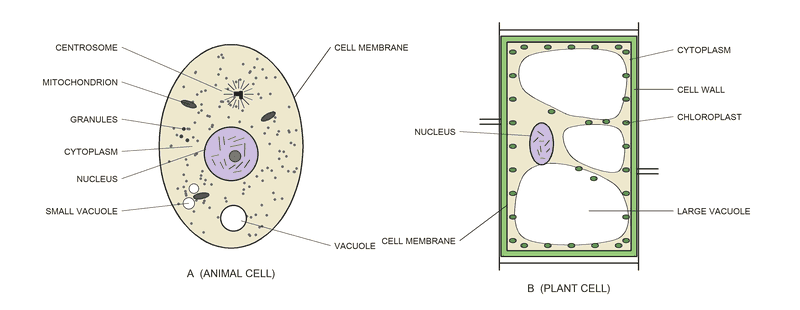
Watch out: Both cells have vacuoles; what marks the plant cell is that its vacuoles are large and permanent.
Therefore, (a) B is the plant cell (cell wall, large vacuoles, chloroplasts, no centrosome); (b) cell membrane, cytoplasm, nucleus and vacuoles are common; (c) cell wall, plastids and large vacuoles are plant-only, and the centrosome is animal-only.
What Class 9 Biology Ch 2 covers
The sections of the chapter, in the order the book takes them. Every question above comes from one of these.
- 01What Is a Cell
- 02The Invention of the Microscope and the Discovery of Cell
- 03Cell Theory
- 04Cells – How Many
- 05Cells – How Small
- 06Smallness of Cells: A Greater Efficiency
More ways to study this chapter
The same chapter asked three other ways. Practise it, revise it, and see what the board has set on Ch 2 before.
Class 9 Biology Ch 2 questions students ask
How many questions are there in Class 9 Biology Ch 2?
45 questions. Every one is solved step by step on this page.
Are these Class 9 Biology solutions free?
Yes. Every question and its full working is free to read, with no account needed.
Can I download the Class 9 Biology Ch 2 solutions as a PDF?
There is no PDF to download. Every solution is on this page instead, which means it is searchable, always the current syllabus, and readable on a phone. Use your browser's print option if you want it on paper.