Solution:
Concept: A thick, rigid cell wall, plastids and large vacuoles mark a plant cell; a centrosome and only a cell membrane mark an animal cell.
Step 1 — (a) Identify the plant cell.
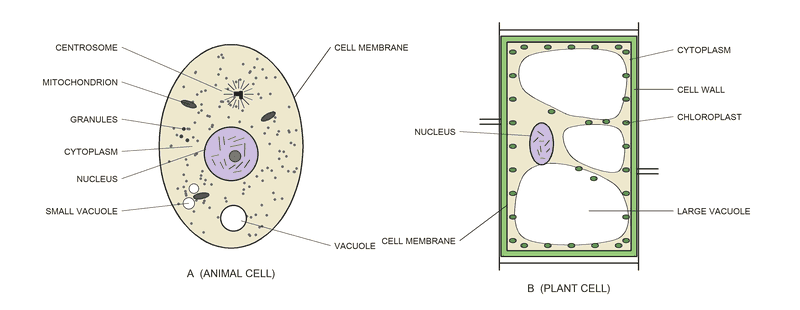
Cell B is the plant cell, because it has a thick cell wall (with the walls of neighbouring cells), large vacuoles, many chloroplasts in the cytoplasm and no centrosome. Cell A is oval, bounded only by a membrane and has a centrosome, so it is an animal cell.
Step 2 — (b) Structures common to both.
Both cells have a cell membrane, cytoplasm, a nucleus and vacuoles (with mitochondria and other organelles in the cytoplasm).
Step 3 — (c) Structures found in only one kind.
Only in plant cells: the cell wall, plastids (chloroplasts) and large vacuoles. Only in animal cells: the centrosome.
Step 4 — See the labelled cells.
The labelled sketches show these parts:
Watch out: Both cells have vacuoles; what marks the plant cell is that its vacuoles are large and permanent.
Therefore, (a) B is the plant cell (cell wall, large vacuoles, chloroplasts, no centrosome); (b) cell membrane, cytoplasm, nucleus and vacuoles are common; (c) cell wall, plastids and large vacuoles are plant-only, and the centrosome is animal-only.

