
Opening your dashboard
Class 9 Biology Chapter 2 Cell: The Unit of Life: Practice Questions
49 questions on Chapter 2, each worked through on its own page with the AI tutor. Class 9 Biology, ICSE 2026-27.
49 questions
1–5 marks · Mixed difficulty
- 11 mark
Question 1
Bloom's level: Remember
In Leeuwenhoek's simple microscope, the object to be seen was mounted on :
- 21 mark
Question 2
Bloom's level: Remember
The size of bacteria, the smallest cells, usually lies in the range :
- 31 mark
Question 3
Bloom's level: Remember
Most organisms, including human beings, start life as a single cell called the :
- 41 mark
Question 4
Bloom's level: Remember
The point "all cells arise from pre-existing cells" was added to the cell theory in 1858 by :
- 51 mark
Question 5
Bloom's level: Understand
Human red blood cells are circular and biconcave. This shape mainly helps them to :
- 61 mark
Question 6
Bloom's level: Understand
Which of the following is a quantitative difference (not a structural one) between plant and animal cells ?
- 71 mark
Question 7
Bloom's level: Apply
A newly found single-celled organism has ribosomes and DNA lying freely in its cytoplasm. It has no nuclear membrane and no mitochondria. It should be placed among the :
- 81 mark
Question 8
Bloom's level: Apply
The cells of a gland make large amounts of digestive enzymes and send them out of the cell. Which organelle would be especially well developed in these cells ?
- 91 mark
Question 9
Bloom's level: Apply
Which of these organisms will have the largest number of cells in its body ?
- 101 mark
Question 10
Bloom's level: Analyse
Assertion (A): A small cell can exchange materials with its surroundings more efficiently than a large cell.
Reason (R): A small cell has a larger surface area in proportion to its volume.
- 111 mark
Question 11
Bloom's level: Evaluate
Assertion (A): Cotton, jute and coconut fibres are the cell walls of dead cells.
Reason (R): The cell wall is a living part of the plant cell.
- 121 mark
Question 12
Bloom's level: Analyse
Assertion (A): The lion, the tiger and the house cat look quite different, although all three have 38 chromosomes in their body cells.
Reason (R): It is the genes, not the number of chromosomes, that determine the characteristics of a species.
- 132 marks
Question 13
Bloom's level: Understand
An adult human body has about 37.2 trillion cells, yet each of us began life as just one cell. Explain how so many cells came from one.
- 142 marks
Question 14
Bloom's level: Understand
A single muscle cell taken out of the body can be kept alive for some time in a nutrient liquid, but a single mitochondrion taken out of a cell cannot live on its own. Use the definition of a cell to explain this.
- 152 marks
Question 15
Bloom's level: Apply
A blood sample has about 5 million red blood cells and 7 thousand white blood cells in each cubic millimetre.
(a) How many red blood cells and how many white blood cells are there in cubic millimetres of this blood ?
(b) About how many red blood cells are there for every white blood cell ?
- 162 marks
Question 16
Bloom's level: Apply
A cube of side mm is cut into equal cubes of side mm.
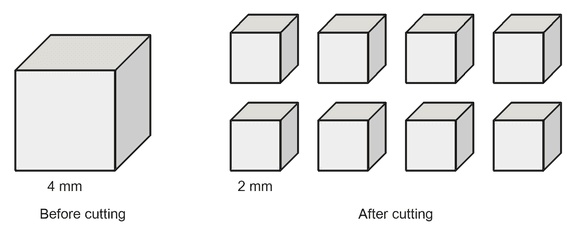
(a) Find the total surface area and the total volume before and after cutting.
(b) What happens to the surface area/volume ratio ? What does this tell us about cells ?
- 172 marks
Question 17
Bloom's level: Understand
Explain how the shape of each of these cells suits its function :
(a) guard cells of a stomatal pore
(b) muscle cells
- 182 marks
Question 18
Bloom's level: Evaluate
Some people describe chloroplasts as the "kitchen of the cell". Is this a good comparison ? Justify your answer.
- 192 marks
Question 19
Bloom's level: Apply
When a tadpole changes into a frog, its tail disappears because the tail cells are broken down from inside. Name the organelle mainly responsible and explain why it is called the "suicide bag".
- 202 marks
Question 20
Bloom's level: Analyse
Three cells X, Y and Z were examined. A tick (✓) shows that the part is present, and a cross (✗) that it is absent.
Part X Y Z Cell wall ✓ ✓ ✗ Nuclear membrane ✗ ✓ ✓ Mitochondria ✗ ✓ ✓ Chloroplasts ✗ ✓ ✗ Centrosome ✗ ✗ ✓ Identify each cell as a bacterial cell, a plant cell or an animal cell, giving one reason for each.
- 212 marks
Question 21
Bloom's level: Analyse
Link each observation to the point of the cell theory that it supports :
(a) A thin slice of any part of a mango tree shows cells under a microscope.
(b) A frog moves because its muscle cells contract.
(c) The lost tail of a lizard grows again by the division of cells.
- 221 mark
Question 22
Bloom's level: Understand
The cell membrane is selectively permeable, while the cell wall is freely permeable. What does this mean for a substance dissolved in water that reaches a plant cell from outside ?
- 234 marks
Question 23
Bloom's level: Apply
Case: In a class demonstration, a teacher cuts two sets of jelly blocks that contain a colourless chemical. Set 1 is a single cube of side cm. Set 2 is a cube of the same size cut into small cubes of side cm. Both sets are dropped into a coloured solution that slowly soaks in from the surface.
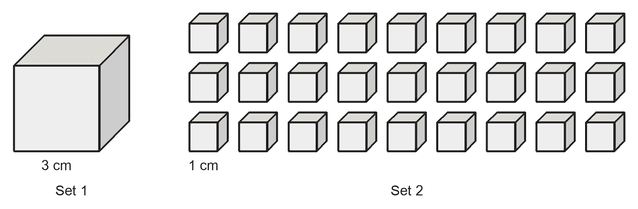
(a) Calculate the total surface area and the total volume of each set.
(b) Which set will become coloured all the way through first ? Give the reason.
(c) Use this result to explain why a large organism is made of many small cells rather than a few very big cells.
- 245 marks
Question 24
Bloom's level: Analyse
Case: A laboratory technician examines a drop of pond water under an electron microscope and draws one rod-shaped cell that she finds :
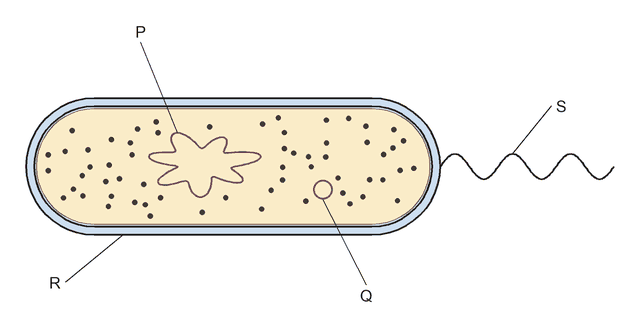
(a) Name the parts labelled P, Q, R and S.
(b) Is this cell prokaryotic or eukaryotic ? Give two reasons from the drawing.
(c) Why did she need an electron microscope, and not an ordinary compound microscope, to see these details ?
- 253 marks
Question 25
Bloom's level: Understand
The endoplasmic reticulum (ER) is sometimes described as both the "framework" and the "highway" of the cell.
(a) Explain each of these two descriptions.
(b) What is the difference between rough ER and smooth ER ?
- 264 marks
Question 26
Bloom's level: Apply
Ravi looked at two slides under a compound microscope: a peel from the fleshy leaf of an onion bulb, and cells scraped from the inside of his cheek.
(a) List two features that he would see only in the onion peel cells.
(b) List two features of the cheek cells that show they are animal cells.
(c) Ravi noticed that the onion peel cells had no chloroplasts and said, "So these cannot be plant cells." Is he right ? Explain.
- 273 marks
Question 27
Bloom's level: Apply
A bacterium is micrometre long ( micrometre mm). Find how long its image would appear :
(a) with one of Leeuwenhoek's best simple microscopes (magnifying times),
(b) with an ordinary compound microscope at its maximum of about times,
(c) with an electron microscope magnifying times.
Give each answer in millimetre.
- 284 marks
Question 28
Bloom's level: Evaluate
A student argues : "The ostrich egg is a single cell much bigger than a cricket ball. So the idea that cells remain small because of surface area/volume ratio must be wrong."
Evaluate this argument. Give three points in your answer.
- 295 marks
Question 29
Bloom's level: Create
Imagine the cell as a factory. Construct a table that matches six parts of a cell with suitable parts of a factory, giving a reason for each match. Then state one way in which the comparison does not hold good.
- 305 marks
Question 30
Bloom's level: Create
Plan an investigation to show that every part of a plant is made up of cells.
(a) Name the parts of a plant you will examine and the instrument you will use.
(b) Write the steps you will follow to prepare a slide of one part.
(c) Draw up a table to record your observations, and state the conclusion you expect.
- 311 mark
Question 31
Which one of the following statements about microscopes is correct ?
- 321 mark
Question 32
Which one of the following pairs consists of two few-celled organisms ?
- 331 mark
Question 33
Assertion (A): Nerve cells are circular and biconcave in shape.
Reason (R): Nerve cells conduct impulses from distant parts of the body to the brain and from the brain to those parts.
- 342 marks
Question 34
(i) Why could the existence of cells not be detected until microscopes were invented ?
(ii) Old and weak cells of the body continually die. How is this loss made up ? Give one example of a kind of cell of the human body, stating how long it lives.
- 352 marks
Question 35
According to the cell theory, the cell is the unit of function of all living things. Support this statement with
(i) one example from the body of a frog, and
(ii) one example from a mango tree.
- 362 marks
Question 36
A cube of side 6 mm is cut into 216 equal small cubes, each of side 1 mm.
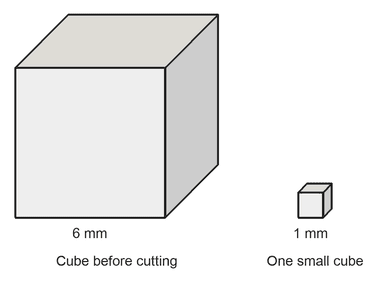
(i) Calculate the total surface area before cutting and the total surface area of all the small cubes after cutting.
(ii) What happens to the total volume on cutting ? State what this model shows about the advantage of the small size of cells.
- 372 marks
Question 37
(i) Name the smallest cells and state their size. What is the size of a human red blood cell ?
(ii) A bird's egg is called the largest cell. Which part of the egg is actually the cell ? What are the white of the egg and the egg-shell ?
- 384 marks
Question 38
The figure shows the structure of the nucleus of a cell that is not dividing.
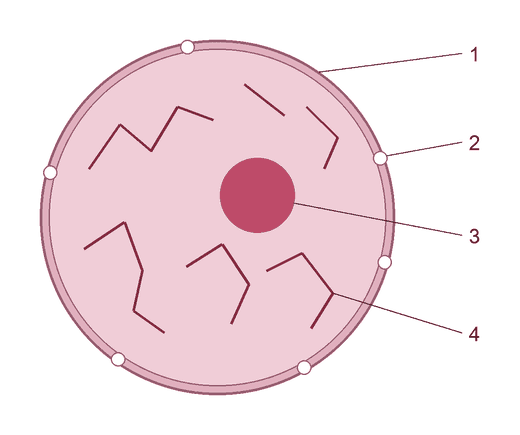
(i) Name the parts numbered 1 to 4.
(ii) What change takes place in part 4 during cell division ? What are these structures then called ?
(iii) State one function of part 3. Why is the nucleus said to be the most important part of the cell ? Give two reasons.
- 394 marks
Question 39
The figure shows a generalised plant cell as seen under a compound microscope.
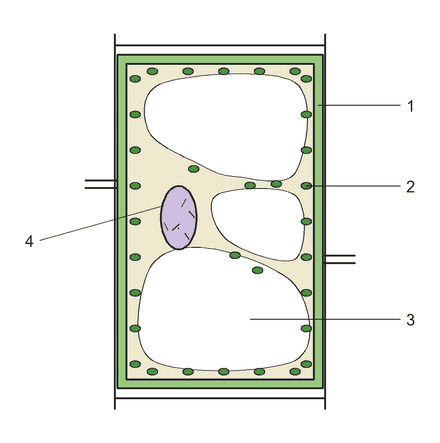
(i) Name the parts numbered 1 to 4.
(ii) State the substance of which part 1 is mainly made, and give two functions of this part.
(iii) Name the liquid that fills part 3. Name one organelle that is present in an animal cell but would not be found in this cell, and state its function.
- 403 marks
Question 40
Cells are of two kinds, prokaryotic and eukaryotic.
(i) What does the term prokaryotic mean ? What is the nuclear region of a prokaryotic cell called ?
(ii) State two differences, other than those of the nucleus, between a prokaryotic cell and a eukaryotic cell.
(iii) Classify the following as prokaryotes or eukaryotes : Amoeba, blue-green algae, Euglena, bacteria.
- 411 mark
Question 41
Class 9 Sample Paper 1 · Section A
Fill in the blank:
.......... is the building block of an organism.
- 421 mark
Question 42
Class 9 Sample Paper 1 · Section A
Write the function of the following:
(a) Centrosome
- 431 mark
Question 43
Class 9 Sample Paper 1 · Section A
Write the function of the following:
(c) Cell wall
- 442 marks
Question 44
Class 9 Sample Paper 1 · Section B
Differentiate between the nucleus and the nucleolus.
- 451 mark
Question 45
Class 9 Sample Paper 2 · Section A
What is the function of ribosomes?
- 461 mark
Question 46
Class 9 Sample Paper 2 · Section A
The cell is the building block of an organism. Justify.
- 472 marks
Question 47
Class 9 Sample Paper 2 · Section B
Differentiate between protoplasm and cytoplasm.
- 482 marks
Question 48
Class 9 Sample Paper 2 · Section B
Differentiate between a plant cell and an animal cell.
- 495 marks
Question 49
Class 9 Sample Paper 2 · Section E
From the given diagram, answer the following questions.
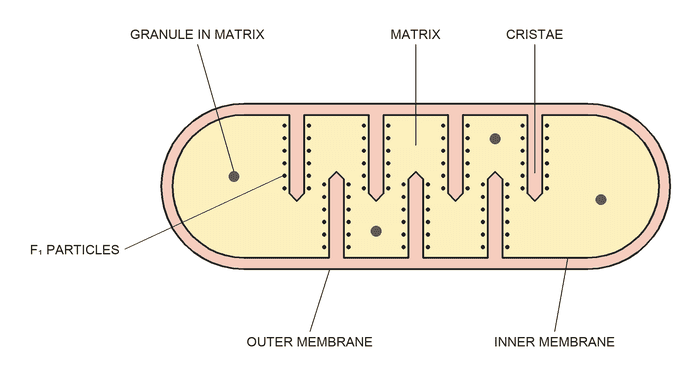
(a) Name the cell organelle.
(b) Describe its structure.
(c) What is the function of this structure?
(d) Why is it called the powerhouse of the cell?