
Opening your dashboard
Class 9 Biology Chapter 2 Cell: The Unit of Life: Competency-Based Questions (CBQ)
40 questions on Chapter 2, each worked through on its own page with the AI tutor. Class 9 Biology, ICSE 2026-27.
40 questions
1–5 marks · Mixed difficulty
- 11 mark
Question 1
Cognitive domain: Application
Aditi's school laboratory has a good compound microscope. She has read that the endoplasmic reticulum is a network of double membranes spread all over the cytoplasm. She mounts a thin onion peel and tries hard to see this network, but she cannot. What is the best explanation ?
- 21 mark
Question 2
Cognitive domain: Analysis
The figure shows four cells P, Q, R and S. They are not drawn to the same scale.
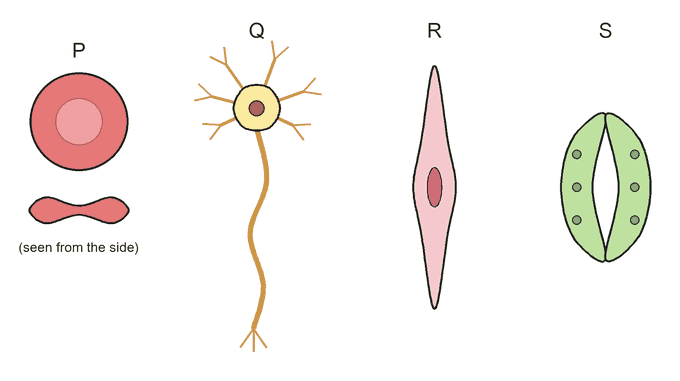
The shape of a cell is related to the function it performs. Which option matches both cells with their correct functions ?
- 31 mark
Question 3
Cognitive domain: Application
A pigeon can fly for hours without rest. Its flight muscles go on contracting all through the flight and need a steady supply of energy. Which cell organelle would you expect to be especially numerous in the cells of these muscles ?
- 41 mark
Question 4
Cognitive domain: Analysis
The number of chromosomes is definite in each species. The table gives the number of chromosomes in a body cell of some organisms.
Organism Chromosomes in a body cell Mouse 40 Wheat 42 Human 46 Potato 48 Chimpanzee 48 Dog 78 Sugarcane 80 Which conclusion is supported by this data ?
- 51 mark
Question 5
Cognitive domain: Understanding
Assertion (A): The number of red blood cells in a healthy person stays nearly the same, although each red blood cell dies after about 120 days.
Reason (R): Old cells which die are replaced by new cells, and new cells are formed from pre-existing cells.
- 61 mark
Question 6
Cognitive domain: Analysis
Assertion (A): A bacterial cell has no ribosomes, because it does not have a well defined nucleus.
Reason (R): In a bacterial cell, the nuclear material lies freely in a region of the cytoplasm called the nucleoid.
- 71 mark
Question 7
Cognitive domain: Application
For a class chart, Rohan uses two figures from his textbook. An average-sized adult human has about trillion cells in the whole body, and about billion nerve cells in the brain. ( trillion billion.)
Complete the sentence :
So, out of every ______ cells of the body, about one is a nerve cell of the brain.
- 81 mark
Question 8
Cognitive domain: Understanding
Robert Hooke looked at a thin slice of cork and described cells as empty "boxes". More than 350 years later, Riya looks at a fresh leaf of a water plant under her school microscope. She finds that each "box" is filled with material that is slowly moving.
Complete the sentence :
Hooke saw only the walls because the cells of cork were ______, whereas the cells Riya sees still contain their living substance, which is called ______.
- 91 mark
Question 9
Cognitive domain: Application
A human red blood cell is about micrometre across. Imagine red blood cells placed side by side in a single row to make a line mm long. ( mm micrometre.)
Complete the sentence :
About ______ red blood cells would be needed to make this line, which shows why a single cell can be seen only with a ______.
- 102 marks
Question 10
Cognitive domain: Evaluation
While revising, Sameer says, "A plant cell already has a strong cell wall around it. So the cell membrane lying inside the wall is of no real use to a plant cell."
Do you agree with Sameer ? Justify your answer by comparing what the two layers can do.
- 112 marks
Question 11
Cognitive domain: Evaluation
In her notebook, Farah has drawn a cell and written, "Everything that lies in the cytoplasm is a cell organelle. So mitochondria, ribosomes, fat droplets and starch granules are all organelles."
Judge Farah's statement. Which of the four parts has she placed correctly, and which wrongly ? Give the reason.
- 122 marks
Question 12
Cognitive domain: Understanding
Curd is set by bacteria, and bread dough is raised by yeast. Both are organisms made of just one cell. Yet a biologist says that a bacterial cell and a yeast cell belong to two different types of cells.
Name the two types of cells, and explain two differences that the biologist would expect to find between them.
- 134 marks
Question 13
Cognitive domain: Application
Case: A food-testing laboratory receives a jar labelled "100% vegetable paste". A complaint says that minced meat has been mixed into it. A technician spreads a little of the paste on a slide, stains it and examines it. She finds two kinds of cells.
- Kind 1 : larger cells with distinct outlines, a thick outer boundary, one big clear space in the middle and a thin lining of cytoplasm pushed to the sides.
- Kind 2 : smaller cells with less distinct boundaries, no thick outer boundary, and dense, granular cytoplasm filling almost the entire cell.
(a) Which kind of cells has come from a plant ? Give two observations from the case that support your answer.
(b) Name one organelle that the technician could expect only in cells of Kind 1, and one that she could expect only in cells of Kind 2.
(c) The thick outer boundary of Kind 1 cells is non-living. Name the substance it is made of, and state one function of this boundary.
(d) What should the technician report about the complaint ? Give the reason.
- 145 marks
Question 14
Cognitive domain: Analysis
Case: A research student took cells from four parts of a potato plant growing in a field. Under a microscope she counted the chloroplasts in 20 cells from each part and found the average.
Part of the plant Light received by the part Average number of chloroplasts per cell Leaf cells just below the upper surface Very bright 45 Leaf cells near the lower surface Moderate 20 Green outer cells of the stem, shaded by the leaves Dim 9 Cells of the potato tuber (under the soil) None 0 (a) In which of these cells would the most solar energy be trapped ? Give the reason.
(b) How many times as many chloroplasts does a leaf cell just below the upper surface have, compared with a green cell of the stem ?
(c) What relationship does the table show between the light a part receives and the number of chloroplasts in its cells ?
(d) Seeing the last row, a classmate says, "The cells of the potato tuber have no plastids at all." Is this conclusion correct ? Explain.
- 155 marks
Question 15
Cognitive domain: Creativity
Case: Meena has learnt that cells remain small because a small size gives a larger surface area for the same volume, so substances can pass in and out faster. She wants to show the idea of "more surface, faster exchange" to her class with a simple model. She has sugar cubes, a spoon, a clean plate, drinking water at room temperature, identical glass tumblers and a stop-watch.
(a) Design the experiment for Meena. Describe the set-up, the one thing that is different between the tumblers, and two things that must be kept the same.
(b) What should she measure ? Draw a table for her record, and state the result you expect.
(c) Explain how the expected result is linked to the small size of cells. State one way in which this model is not like a real cell.
- 161 mark
Question 16
Cognitive domain: Analysis
In a tissue-culture laboratory, a small piece taken from a carrot root is placed on a sterile jelly that contains water, nutrients and plant growth substances. After two weeks the piece has grown into a lump many times larger, made of small cells. A time-lapse film taken through a microscope shows that each new cell appeared when an existing cell split into two, and that no cell ever formed on its own in the jelly. Which conclusion does this observation support ?
- 171 mark
Question 17
Cognitive domain: Application
The picture shows, under high magnification, a human red blood cell and a rod-shaped bacterium. The scale bar below them is micrometre long and is divided into ten equal parts. The left end of each cell is level with the of the bar, and the dashed lines run from the bar up to the right-hand end of each cell.

Which option gives the sizes read from the picture ?
- 181 mark
Question 18
Cognitive domain: Understanding
Assertion (A): In a muscle cell, the mitochondria release the energy that the cell uses when it contracts.
Reason (R): Mitochondria contain chlorophyll, which traps the energy of sunlight for the cell.
- 191 mark
Question 19
Cognitive domain: Analysis
A student studied three cells, P, Q and R, from the tissues of a plant and an animal, and noted the parts that she could see. (Hypothetical data.)
Part Cell P Cell Q Cell R Cell wall Present Absent Present Large central vacuole Present Absent Present Chloroplasts Present Absent Absent Leucoplasts Absent Absent Present Centrosome Absent Present Absent Nucleus Present Present Present Which conclusion is correct ?
- 201 mark
Question 20
Cognitive domain: Understanding
Assertion (A): A potato tuber, which grows under the soil, can store a large amount of starch in its cells.
Reason (R): The cells of a potato tuber have many leucoplasts, which are colourless plastids that store starch.
- 211 mark
Question 21
Cognitive domain: Analysis
Four cells were examined with an electron microscope: W (a bacterium), X (yeast), Y (an onion peel cell) and Z (a cell from the inside of the cheek). A tick shows that a part is present. (Hypothetical data.)
Part W X Y Z Ribosomes ✓ ✓ ✓ ✓ Nuclear membrane ✗ ✓ ✓ ✓ Cell wall ✓ ✓ ✓ ✗ Mitochondria ✗ ✓ ✓ ✓ Which conclusion is supported by the table ?
- 221 mark
Question 22
Cognitive domain: Understanding
A museum wants to display four events in the history of the cell theory in the order in which they happened.
P : Virchow said that all cells arise from pre-existing cells.
Q : Schwann declared that animals, like plants, are made up of cells.
R : Hooke looked at a thin slice of cork and called its "boxes" cells.
S : Schleiden announced that every plant is made up of a large number of cells.
Which order is correct ?
- 231 mark
Question 23
Cognitive domain: Analysis
Sana crushes some leaves of red cabbage in a little water and sees that the water turns purple. Under the microscope she then looks at a thin piece of a leaf. The purple colour fills the large clear space in the middle of each cell, while the nucleus and the plastids lying near the cell wall are almost colourless. (Hypothetical observation.) Where is the purple pigment present ?
- 241 mark
Question 24
Cognitive domain: Understanding
Which row matches all three parts of the cell with their correct functions ?
- 251 mark
Question 25
Cognitive domain: Application
A structure inside a cell is micrometre wide. To see it clearly it must be magnified until it looks at least mm wide. ( mm micrometre.) Which instrument can show it ?
- 262 marks
Question 26
Cognitive domain: Application
Most organisms, including ourselves, start life as a single cell called the zygote. Imagine that a zygote divides into two cells, then all the cells divide again at the same time, and so on, with no cell dying. (This is only a model; real cells do not all divide together.)
(a) How many cells are there after rounds of division ?
(b) What is the least number of rounds after which there are more than trillion () cells ? (Use .)
- 272 marks
Question 27
Cognitive domain: Evaluation
Ishaan writes in his notes, "The nucleus is the only part of any cell that contains DNA. So a cell that has no nucleus cannot have any DNA at all."
Do you agree with Ishaan ? Give two points from this chapter to support your answer.
- 282 marks
Question 28
Cognitive domain: Analysis
A scientist finds a chemical that sticks to the ribosomes of a bacterium and stops them from working. When bacteria are placed in a liquid containing this chemical, they stop growing and multiplying.
(a) Which activity of the cell is stopped by this chemical ?
(b) Explain why this stops the bacterium from growing and multiplying.
- 292 marks
Question 29
Cognitive domain: Analysis
In an experiment, the nucleus of an Amoeba (a one-celled animal) is removed with a very fine needle. The rest of the cell, with its cytoplasm and cell membrane, is kept in pond water with plenty of food. It moves about for a few days, but it never divides and finally dies. (Hypothetical observation.)
Using the functions of the nucleus, give two reasons why this cell cannot go on living.
- 302 marks
Question 30
Cognitive domain: Understanding
Raw bananas have a green peel, but the peel of a ripe banana is yellow.
(a) Name the green pigment of the raw peel and the kind of plastid that holds it.
(b) Name the yellow pigment that gives the colour of the ripe peel, and say why the yellow colour could not be seen in the raw peel.
- 312 marks
Question 31
Cognitive domain: Creativity
One reason why cells remain small is that the different regions of a cell can communicate with each other rapidly, so that the cell can function effectively.
Make up your own everyday example (not a school class and not a factory) that shows why communication is quicker in a small space than in a very large one. Say what each part of your example stands for in a cell.
- 323 marks
Question 32
Cognitive domain: Application
The cell is called both the structural unit and the functional unit of all living beings. Meera writes down three observations.
(a) A very thin slice of an onion bulb, seen under a microscope, looks like a wall of tiny bricks, each brick being a separate compartment.
(b) The milk with which a mother feeds her baby is made and released by the cells of special glands in her body.
(c) When Meera eats sugar, it is broken down inside the cells of her body to release energy.
For each observation, say whether it shows the cell as a structural unit or as a functional unit. Give a reason each time.
- 333 marks
Question 33
Cognitive domain: Evaluation
A student wrote three statements for her notebook.
(i) A prokaryotic cell has its chromatin fibres lying freely in the central region of the cytoplasm, called the nucleoid.
(ii) All organisms other than bacteria are made of prokaryotic cells.
(iii) A cell is called eukaryotic when its nucleus is surrounded by a double nuclear membrane.
Say whether each statement is correct or wrong. Correct the wrong one.
- 343 marks
Question 34
Cognitive domain: Understanding
Spinach leaves left on a kitchen shelf become limp. When their stalks are kept in a bowl of water for an hour, the leaves become firm and crisp again.
(a) Which part of the plant cell stores the water that gives it firmness ?
(b) Explain how this makes the leaf firm.
(c) An animal cell does not become firm in this way even when it is full of water. Give one reason.
- 353 marks
Question 35
Cognitive domain: Application
The longest cells in the human body are the nerve cells. One nerve cell, running from the tip of a finger to the spinal cord, is about cm long and, along most of its length, only about micrometre thick. (Approximate values.) ( cm mm and mm micrometre.)
(a) Express the length of the cell in micrometre.
(b) How many times as long as it is thick is this cell ?
(c) What does your answer to (b) tell you about the shape of a nerve cell, and why is a nerve cell made in this way ?
- 363 marks
Question 36
Cognitive domain: Application
Under a microscope, Maya sees a cell that is dividing. Near each end of the cell lies a small body made of two short bundles lying at right angles to each other, with star-like rays around it, and spindle fibres run between the two ends.
(a) Is this a plant cell or an animal cell ? Give the reason.
(b) Name the cell organelle from which the spindle fibres develop.
(c) Name the small bundles inside it.
- 375 marks
Question 37
Cognitive domain: Analysis
Case: Cells of a gland make an enzyme and send it out of the cell. To find the path taken, a scientist gave the gland cells a labelled substance that is used to make the enzyme, and noted the part of the cell that held most of the label at different times. (Hypothetical data.)
Time after the label was supplied Part of the cell holding most of the label minutes Ribosomes on the rough endoplasmic reticulum minutes Golgi apparatus minutes Small vesicles near the cell membrane minutes Outside the cell (a) What is the enzyme made of, and which cell part makes it ?
(b) Describe the path of the enzyme from its making to the outside of the cell.
(c) Predict what would happen to the movement of the label if the mitochondria of the cell stopped working. Give a reason.
- 385 marks
Question 38
Cognitive domain: Analysis
Case: Rohit's blood report shows about million red blood cells and thousand white blood cells in each cubic millimetre of his blood. His mother, a laboratory worker, tells him that an adult has about litres of blood and that an average adult body has about trillion cells in all. (Approximate values.) ( litre cubic millimetre; billion ; trillion .)
(a) How many red blood cells are there in the litres of blood ? Give the answer in trillion.
(b) How many white blood cells are there in the litres of blood ? Give the answer in billion. During an infection the white blood cells rise to about thousand per cubic millimetre. How many more white blood cells are then present in the litres of blood ?
(c) What percentage of the cells of the whole body are the red blood cells of the blood ? Does the answer look reasonable ? Give a reason.
- 394 marks
Question 39
Cognitive domain: Evaluation
Case: A museum panel called "The Story of the Microscope" has four sentences. A visitor suspects that some of them are wrong.
Sentence 1 : Leeuwenhoek's microscopes were simple microscopes, each with a single biconvex lens, and some of them could magnify up to about times.
Sentence 2 : Hooke's microscope, like Leeuwenhoek's, had only one lens.
Sentence 3 : An ordinary compound microscope of today can magnify an object up to a maximum of about times.
Sentence 4 : The electron microscope uses beams of light bent by glass lenses and can magnify over times.
(a) Which sentences are wrong ?
(b) Rewrite each wrong sentence correctly.
(c) Explain why the cell theory could be put forward only after the microscope had been invented.
- 404 marks
Question 40
Cognitive domain: Analysis
Case: A teacher makes three jelly models, P, Q and R, to show how the shape of a cell affects its exchange of materials with its surroundings. The three models have the same volume. (Hypothetical data.)
Model Shape Length breadth height (mm) P Cube Q Flat slab R Long thin rod (a) Show that the volume of each model is cubic mm.
(b) Find the total surface area of each model and then its surface area for each cubic mm of volume.
(c) Which model would exchange materials fastest with its surroundings ? What does this show about the shape of a cell ?