
Opening your dashboard
Class 9 Biology Chapter 19: Waste Generation and Management Solutions
26 textbook questions with step-by-step answers, free to read, for ICSE 2026-27.
Get talked through Ch 19, not just shown the answer
Reading a finished solution is not the same as being able to do it. The AI tutor takes one question at a time and works it with you, in your own words, until you can.
- Ask it out loud, in your own words
- It gives you the next step, not the answer
- Stuck on part (ii)? Start there
26 questions with solutions
1–10 marks · Mixed difficulty
- 12 marks
Question 1
How will you categorise the following under domestic and industrial wastes ?
Rags, used containers, old newspapers, mine tailing (left overs), flyash, kitchen waste, broken bricks.
Solve with AIWritten solution
Solution:
Concept: Domestic waste is thrown out from homes; industrial waste comes from mines, factories, power stations and construction sites.
Step 1 — Sort the items from homes.
Rags, used containers, old newspapers and kitchen waste are all thrown out from our homes.
Domestic wastes: rags, used containers, old newspapers, kitchen waste.
Step 2 — Sort the items from industry.
Mine tailing is left over from processing ores in mines, fly ash comes from furnaces that burn coal (power stations and factories), and broken bricks come from construction sites.
Industrial wastes: mine tailing, fly ash, broken bricks.
Watch out: Broken bricks may look like household rubbish, but in the book they are the waste of construction units, so they are industrial.
Therefore, rags, used containers, old newspapers and kitchen waste are domestic wastes; mine tailing, fly ash and broken bricks are industrial wastes.
- 21 mark
Question 2
What is bagasse ?
Solve with AIWritten solution
Solution:
Concept: Bagasse is an agricultural waste of the sugar industry.
Step 1 — Say what it is.
Bagasse is the dry, fibrous plant residue left after the juice is crushed out of sugarcane.
Step 2 — Say how it is used.
Being a waste that still burns well, it is used as fuel in the sugar mills' own boilers and as a raw material in the paper and board industry.
Therefore, bagasse is the fibrous residue of sugarcane left after its juice has been extracted.
- 31 mark
Question 3
Name any two categories of chemicals which are washed off as wastes from agricultural fields.
Solve with AIWritten solution
Solution:
Concept: Chemicals sprayed or spread on fields are partly washed away by irrigation water and rain into ponds, rivers and ground water.
Step 1 — Chemicals that kill pests.
Pesticides (insecticides, weedicides and fungicides) are sprayed on crops, and the extra is washed off.
Step 2 — Chemicals that feed crops.
Fertilisers such as urea and phosphates are added to the soil, and the part not taken up by the plants is washed off.
Therefore, pesticides and fertilisers are washed off as wastes from agricultural fields.
- 41 mark
Question 4
What are the two portions into which the municipal sewage is separated ?
Solve with AIWritten solution
Solution:
Concept: Municipal sewage is separated according to whether microorganisms can break it down.
Step 1 — The degradable part.
The degradable part can be broken down by microorganisms into simple, non-toxic substances, for example in septic tanks and treatment plants.
Step 2 — The non-degradable part.
The non-degradable part cannot be broken down; it stays as it is and becomes a source of pollution unless it is safely dumped.
Therefore, municipal sewage is separated into a degradable part and a non-degradable part.
- 53 marks
Question 5
In which category of wastes will you include the non-functioning discarded
(i) Mobile phones,
(ii) Thermometers,
(iii) Photocopying machines.
Solve with AIWritten solution
Solution:
Concept: E-waste (electronic waste) is made up of discarded electrical and electronic appliances, including medical instruments. It often contains harmful metals such as lead, cadmium and mercury.
Step 1 — Part (i): mobile phones.
A mobile phone is an electronic appliance, so a discarded one is e-waste.
Step 2 — Part (ii): thermometers.
The textbook places discarded medical instruments such as thermometers in e-waste. A digital thermometer is electronic; an old mercury thermometer also holds poisonous mercury, so it must be handed in separately and never broken or thrown in the bin.
Step 3 — Part (iii): photocopying machines.
A photocopier is an electrical and electronic machine, so a discarded one is e-waste.
Therefore, all three, mobile phones, thermometers and photocopying machines, are e-waste.
- 61 mark
Question 6
Name the three categories of wastes under segregation.
Solve with AIWritten solution
Solution:
Concept: Segregation means sorting refuse into groups according to what can be done with each group.
Step 1 — Waste that can be used again.
Reusable waste (paper, glass, metal, some plastics) is sent for reuse or recycling.
Step 2 — Waste that rots.
Degradable waste (kitchen and garden waste) can be broken down by microorganisms, for example into compost.
Step 3 — Waste that does not rot.
Non-degradable waste (certain plastics, construction rubble) cannot be broken down and has to be dumped safely.
Therefore, the three categories are reusable, degradable and non-degradable wastes.
- 71 mark
Question 7
Which categories of wastes require dumping ?
Solve with AIWritten solution
Solution:
Concept: Waste that can be neither reused nor broken down by microorganisms has nowhere else to go, so it is dumped.
Step 1 — Identify the category.
Non-degradable wastes, such as certain plastics and construction waste, need dumping.
Step 2 — Say where they go.
They are put in specially dug pits or landfills away from human habitations.
Therefore, non-degradable wastes require dumping.
- 81 mark
Question 8
Is it true that composting is a useful method contributing in crop farming ?
Solve with AIWritten solution
Solution:
Concept: Composting is letting waste organic matter decay, by the action of microorganisms, into a dark, crumbly manure called compost.
Step 1 — Give the answer.
Yes, the statement is true.
Step 2 — Give the reason.
Compost adds plant nutrients and humus to the soil, so it is used for fertilising agricultural land and garden beds; it also turns waste into something useful.
Therefore, yes, composting is useful in crop farming because compost is a good manure for the fields.
- 91 mark
Question 9
What is sludge ?
Solve with AIWritten solution
Solution:
Concept: Waste water from towns and factories (effluent) is cleaned in Effluent Treatment Plants in stages; the secondary treatment uses microorganisms.
Step 1 — What happens in secondary treatment.
Microorganisms feed on the organic matter in the waste water and oxidise (break down) it.
Step 2 — Define sludge.
Sludge is the solid material that settles out (precipitates) during this secondary treatment; after treatment it can be used as manure.
Therefore, sludge is the solid precipitated material produced during the secondary treatment of effluents.
- 101 mark
Question 10
Can incineration lead to certain kind of pollution? Yes/No.
Solve with AIWritten solution
Solution:
Concept: Incineration is the disposal of waste by burning it at high temperature.
Step 1 — Give the answer.
Yes, incineration can cause pollution.
Step 2 — Give the reason.
Burning waste releases smoke, harmful gases and fine particles, which cause air pollution; that is why incinerators must be fitted with pollution-control devices.
Therefore, yes, incineration can lead to air pollution.
- 111 mark
Question 11
Name two types of devices used for removing particulate air pollutants.
Solve with AIWritten solution
Solution:
Concept: Particulate air pollutants (dust, soot, fly ash) are removed from waste gases before the gases leave the chimney.
Step 1 — The wet method.
A scrubber passes the dirty air through a wet packing and a water spray, which wash out the particles and dissolve some gases.
Step 2 — The electric method.
An electrostatic precipitator gives the particles an electric charge and collects them on oppositely charged plates.
Therefore, the two devices are scrubbers and electrostatic precipitators.
- 121 mark
Question 12
Choose the correct answer from the options given below :
The 'Municipal solid waste' is the term used to describe what kind of solid waste ?
Solve with AIAnswer
(A) Hazardous
(B) Toxic
- Correct
(C) Non-hazardous
(D) Non-toxic
Answer: (C) Non-hazardous
Concept: Municipal solid waste is the everyday refuse of homes, offices, shops and streets of a town. It is classed as non-hazardous waste.
Step 1 — Recall the class of waste.
Municipal solid waste is ordinary refuse such as food waste, paper, plastic and rags, so it is classed as non-hazardous.
Step 2 — Match with the options.
Non-hazardous is option (C).
Why the other options are wrong:
- (A) Hazardous: this is wrong because hazardous wastes (industrial chemicals, radioactive and hospital wastes) are handled separately from municipal solid waste.
- (B) Toxic: this is wrong because toxic wastes are a part of the hazardous wastes.
- (D) Non-toxic: this is wrong because 'non-toxic' is not the standard term; municipal solid waste is called non-hazardous waste.
Therefore, municipal solid waste is non-hazardous solid waste, option (C).
- 131 mark
Question 13
The most rapidly increasing and much harmful waste today is
Solve with AIAnswer
(A) plastics
(B) pesticides
(C) municipal sewage
- Correct
(D) electronic waste
Answer: (D) electronic waste
Concept: E-waste (discarded electrical and electronic goods) is the fastest-growing kind of waste, because people replace phones, computers and gadgets ever more often. It also contains harmful lead, cadmium and mercury.
Step 1 — Check 'most rapidly increasing'.
Cities and even small towns are flooded with discarded electronic gadgets, and the amount grows faster every year.
Step 2 — Check 'much harmful'.
These gadgets contain poisonous heavy metals, so the waste is also very harmful.
Step 3 — Match with the options.
Both points fit electronic waste, option (D).
Why the other options are wrong:
- (A) plastics: this is wrong because plastics are harmful, but e-waste is growing faster and also carries poisonous heavy metals.
- (B) pesticides: this is wrong because pesticides are harmful chemicals but are not the most rapidly increasing waste.
- (C) municipal sewage: this is wrong because municipal sewage is largely degradable and can be treated in treatment plants.
Therefore, the most rapidly increasing and harmful waste today is electronic waste, option (D).
- 141 mark
Question 14
Out of the following, which substance can be recycled many times ?
Solve with AIAnswer
(A) Plastic
(B) Wood
(C) Organic materials
- Correct
(D) Aluminium
Answer: (D) Aluminium
Concept: Recycling turns a used material back into raw material. Metals such as aluminium can be melted and recast again and again without losing quality.
Step 1 — Check each material.
Plastic, wood and organic matter all lose quality or are broken down when they are processed, but aluminium does not.
Step 2 — Match with the options.
So the substance that can be recycled many times is aluminium, option (D).
Why the other options are wrong:
- (A) Plastic: this is wrong because plastic weakens each time it is melted, so it can be recycled only a few times.
- (B) Wood: this is wrong because wood can only be reused or made into lower-grade products (like particle board) a limited number of times; it is not recycled again and again.
- (C) Organic materials: this is wrong because organic materials are decomposed (composted), not recycled many times.
Therefore, aluminium can be recycled many times, option (D).
- 151 mark
Question 15
Which of the following is not a waste from construction sites?
Solve with AIAnswer
(A) Pebbles
- Correct
(B) Bagasse
(C) Broken bricks
(D) Wood waste
Answer: (B) Bagasse
Concept: Bagasse is the residue of sugarcane after its juice is extracted, an agricultural waste, not a waste from construction sites.
Step 1 — Check each option.
Pebbles, broken bricks and wood waste are all left over at construction sites.
Step 2 — Find the odd one.
Bagasse comes from sugar mills, so it is not a construction waste. This is option (B).
Why the other options are wrong:
- (A) Pebbles: this is wrong because pebbles are a waste of construction units.
- (C) Broken bricks: this is wrong because broken bricks are a waste of construction units.
- (D) Wood waste: this is wrong because wood waste is a waste of construction units.
Therefore, the one that is not a construction waste is bagasse, option (B).
- 161 mark
Question 16
Which of the following is a kind of gaseous waste?
Solve with AIAnswer
(A) Sewage
(B) Garbage
- Correct
(C) Fly ash
(D) Effluents
Answer: (C) Fly ash
Concept: Wastes are grouped as solid, liquid and gaseous. The textbook lists fly ash, the fine ash carried out of a furnace by the draught, among the gaseous wastes because it leaves with the chimney gases.
Step 1 — Sort the other three.
Sewage and effluents are liquid wastes, and garbage is solid waste, so none of them is gaseous.
Step 2 — Pick the one that leaves with the gases.
Fly ash is carried out with the flue gases through the chimney, so it is the book's example of a gaseous waste, option (C).
Note: The textbook lists fly ash as a gaseous waste of the cement industry. Fly ash is really fine solid ash that is carried out with the hot flue gases, mostly from coal-burning thermal power stations; it is then used to make cement and bricks.
Watch out: Do not pick effluents just because they come out of factories; effluents are liquid wastes.
Why the other options are wrong:
- (A) Sewage: this is wrong because sewage is liquid waste from homes and towns.
- (B) Garbage: this is wrong because garbage is solid waste.
- (D) Effluents: this is wrong because effluents are liquid wastes flowing out of factories.
Therefore, the waste that goes out with the gases is fly ash, option (C).
- 175 marks
Question 17
Name the following :
(a) The solid precipitated material produced during secondary treatment of the effluent, carried out in the Effluent Treatment Plants.
(b) The two types of devices commonly used for removing the particulate air pollutants.
(c) The process of disposal of waste by burning.
(d) The solid waste residue left after burning.
(e) The category of wastes given out from homes.
Solve with AIWritten solution
Solution:
Concept: Each description is the definition of a term used in waste disposal.
Step 1 — Part (a).
The solid matter that settles out during the secondary treatment of effluents is sludge.
Step 2 — Part (b).
The two devices that remove particles from waste gases are scrubbers and electrostatic precipitators.
Step 3 — Part (c).
Disposing of waste by burning it is incineration.
Step 4 — Part (d).
The solid residue left after burning is ash.
Step 5 — Part (e).
Waste given out from homes is domestic waste.
Therefore, (a) sludge, (b) scrubbers and electrostatic precipitators, (c) incineration, (d) ash, (e) domestic waste.
- 185 marks
Question 18
Correct the following statements by changing the first/ last word only.
(a) Some of the electronic wastes may contain valuable metals such as potassium.
(b) Sludge is the gaseous waste of cement industry.
(c) Drains are used to remove gaseous and particulate air pollutants.
(d) Industrial liquid waste is termed as sewage.
(e) Rags are the plant residue left after extracting the sugarcane juice.
Solve with AIWritten solution
Solution:
Concept: Only one word may be changed, either the first or the last, and the corrected statement must be true.
Step 1 — Statement (a).
Potassium is far too reactive to be used as a metal in electronic goods; the valuable metals recovered from circuit boards are gold, silver and copper.
Corrected: Some of the electronic wastes may contain valuable metals such as gold (or silver, or copper).
Step 2 — Statement (b).
Sludge is a solid from effluent treatment; the waste that leaves a cement works with the gases is fly ash.
Corrected: Fly ash is the gaseous waste of cement industry.
Step 3 — Statement (c).
Drains carry liquid waste; the devices that clean dirty air are scrubbers.
Corrected: Scrubbers are used to remove gaseous and particulate air pollutants.
Step 4 — Statement (d).
Liquid waste from industries is called effluent; the liquid waste of a town is sewage.
Corrected: Municipal liquid waste is termed as sewage. (Changing the last word instead: Industrial liquid waste is termed as effluent.)
Step 5 — Statement (e).
Rags are old cloth; the plant residue left after extracting sugarcane juice is bagasse.
Corrected: Bagasse is the plant residue left after extracting the sugarcane juice.
Note: The textbook lists fly ash as a gaseous waste of the cement industry. Fly ash is really fine solid ash that is carried out with the hot flue gases, mostly from coal-burning thermal power stations; it is then used to make cement and bricks.
Therefore, (a) gold, (b) Fly ash, (c) Scrubbers, (d) Municipal (or effluent), (e) Bagasse.
- 194 marks
Question 19
Match the items in Column I with as many items as possible in Column II.
Column I Column II 1. Cow dung (i) Sugarcane 2. Bagasse (ii) Manure 3. Okhla khad (iii) Food wastes 4. Lead and cadmium (iv) e-wastes Solve with AIWritten solution
Solution:
Concept: Link each item in Column I to its source or its use in Column II; one item may match more than one.
Step 1 — Item 1: cow dung.
Cow dung rots into a rich fertiliser, so it matches (ii) manure.
Step 2 — Item 2: bagasse.
Bagasse is the residue of (i) sugarcane after its juice is extracted.
Step 3 — Item 3: Okhla khad.
Okhla khad is the compost made in Delhi from town refuse, mainly food waste, so it matches (ii) manure and (iii) food wastes.
Step 4 — Item 4: lead and cadmium.
Lead and cadmium are poisonous metals found in discarded electronic goods, so they match (iv) e-wastes.
Therefore, 1 – (ii), 2 – (i), 3 – (ii) and (iii), 4 – (iv).
- 2010 marks
Question 20
Define the terms :
(a) Waste
(b) Fly ash
(c) E-wastes
(d) Composting
(e) Mine tailing
Solve with AIWritten solution
Solution:
Concept: A good definition says what the thing is and where it comes from.
Step 1 — Part (a): Waste.
Waste is any substance that is discarded after its primary use, or is worthless, defective and of no use.
Step 2 — Part (b): Fly ash.
Fly ash is the fine solid particles of non-combustible ash carried out of a bed of burning solid fuel (mainly coal, in thermal power stations and factory furnaces) by the draught of gases. It is used to make bricks, cement, concrete and roofing sheets.
Step 3 — Part (c): E-wastes.
E-wastes are discarded appliances that use electricity, such as old computers, TVs, refrigerators, mobile phones, batteries and fluorescent tubes.
Step 4 — Part (d): Composting.
Composting is putting waste organic matter to decay by the action of microorganisms so that it can be used for fertilising agricultural land.
Step 5 — Part (e): Mine tailing.
Mine tailing is the left-over waste produced while processing ores in mining; mixed with other materials, it can be used to make tiles and masonry cement.
Therefore, waste is discarded or useless material; fly ash is fine unburnt ash carried out with flue gases; e-wastes are discarded electrical appliances; composting is decaying organic waste into manure; mine tailing is the left-over of ore processing.
- 216 marks
Question 21
Give reasons for the following :
(a) Broken glass utensils are a kind of non-degradable waste.
(b) Landfills are coming up fast near large cities.
(c) Why is municipal sewage first separated into degradable and non-degradable wastes ?
Solve with AIWritten solution
Solution:
Concept: How a waste is disposed of depends on whether microorganisms (decomposers) can break it down into simple, harmless substances.
Step 1 — Part (a).
Glass is not food for any decomposer, so microorganisms cannot break it down. Broken glass stays unchanged in the soil for a very long time, which is why it is non-degradable.
Step 2 — Part (b).
Large cities produce huge quantities of waste, especially construction waste (stones, broken bricks, wood) and non-degradable refuse that cannot be decomposed and must be dumped. As cities and their building work grow, more and more landfills are opened near them.
Step 3 — Part (c).
The two parts need different methods of disposal. The degradable part can be broken down by microorganisms (in septic tanks or treatment plants), while the non-degradable part must be dumped or buried at safe places. Separating them first makes disposal easier, safer and cheaper.
Therefore, (a) glass cannot be decomposed by microorganisms; (b) big cities produce huge amounts of undecomposable waste that must be dumped; (c) the two parts are disposed of by different methods.
- 223 marks
Question 22
Define electronic waste and list at least six items which come under this category.
Solve with AIWritten solution
Solution:
Concept: Electronic waste (e-waste) is made up of electrical and electronic equipment that has been thrown away because it no longer works or is no longer wanted.
Step 1 — Define it.
E-waste consists of discarded appliances that use electricity, which are non-functioning or no longer wanted.
Step 2 — List the items.
Any six of these are e-waste: old computers, TVs, refrigerators, radios, mobile phones, batteries, fluorescent tubes, electronic toys and medical instruments.
Therefore, e-waste is discarded electrical and electronic equipment, such as computers, TVs, refrigerators, radios, mobile phones and batteries.
- 233 marks
Question 23
List some of the common wastes produced in mining operation and mention how these can be reused.
Solve with AIWritten solution
Solution:
Concept: Mining digs out ores of metals and coal; separating the useful mineral from the ore leaves behind huge amounts of waste called mine tailing.
Step 1 — Name the wastes.
Mines extract copper, silver, gold, zinc, iron and coal. Processing their ores leaves mine tailing: waste rock, soil and powdered ore residue.
Step 2 — Say how they can be reused.
Mine tailing mixed with other materials can be used for making tiles and masonry cement; rocky waste can also be used to fill low land and in construction.
Therefore, the main mining waste is mine tailing, which can be reused to make tiles and masonry cement and to fill land.
- 243 marks
Question 24
Describe the procedure usually used to produce compost.
Solve with AIWritten solution
Solution:
Concept: Compost is made by letting organic refuse decay, by the action of microorganisms, first in a trench and then in heaps.
Step 1 — Dig the trench.
A trench about 5 m long, 1.5 m wide and 1.5 m deep is dug.
Step 2 — Lay the first layer.
A layer of well-mixed refuse and waste, about 30 cm thick, is spread in the trench.
Step 3 — Wet it.
This layer is fully wetted with a watery mixture of cow-dung and some mud, which brings in the decomposing microorganisms.
Step 4 — Fill the trench.
More layers of mixed refuse are spread over the first, until the heap rises about half a metre above ground level.
Step 5 — Leave it to decay.
The set-up is left for about 3 months. Then the trench is opened, the material is taken out, arranged in conical heaps and covered with earth.
Step 6 — Collect the compost.
About 50–60 days later the mass, now called compost, is ready for use in fields and gardens.
Therefore, compost is made by layering refuse wetted with cow-dung slurry in a trench for about 3 months, then heaping and covering it with earth for another 50–60 days.
- 253 marks
Question 25
Describe the usefulness of incineration of wastes, and also mention the precautions required in it.
Solve with AIWritten solution
Solution:
Concept: Incineration is the disposal of waste by burning it at a very high temperature.
Step 1 — Usefulness.
Incineration helps in these ways:
- It reduces the volume and weight of the waste.
- It makes toxic wastes less toxic or non-toxic.
- The left-over ash (about a quarter of the waste) needs much less landfill space, and some metals can be recovered from it.
- Electricity can be generated from the heat released.
Step 2 — Precautions.
Because burning can pollute the air, these precautions are needed:
- It should be carried out at very high temperatures, so that the waste burns completely.
- Incinerators should be fitted with pollution-control devices (such as scrubbers).
- Incinerators should be installed away from residential areas.
Therefore, incineration reduces the bulk and toxicity of waste and can give electricity, but it needs high temperatures, pollution-control devices and a site away from homes.
- 267 marks
Question 26
The figure given below represents a device. Study the same and answer the following questions :
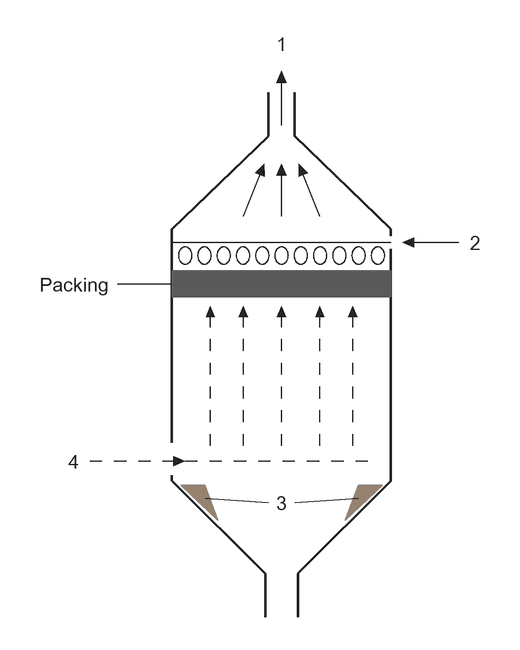
(a) Identify the device.
(b) Mention the specific purpose for which we can use this device.
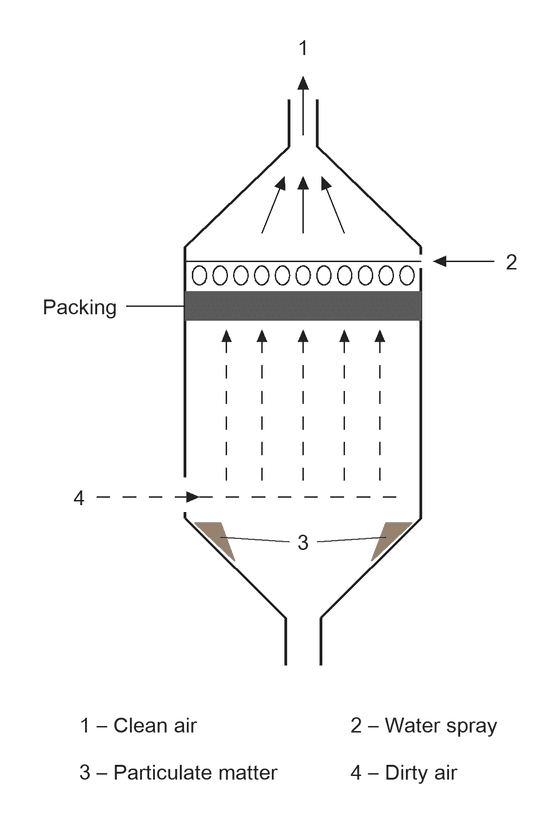
(c) Label the guidelines 1,2,3 and 4.
(d) Name another similar kind of device which can also be used for the same purpose.
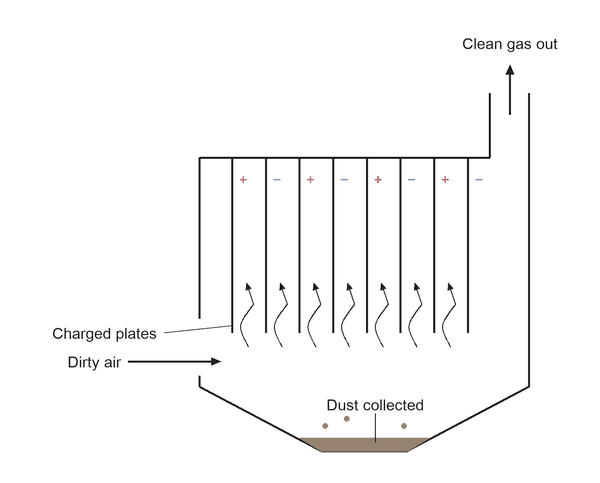
(e) Draw a neat and labelled diagram of the device mentioned by you in part (d) above.
Solve with AIWritten solution
Solution:
Concept: Dirty air rising through a wet packing under a water spray is washed clean: the device is a scrubber.
Step 1 — Part (a): identify the device.
Dirty air enters at the bottom, rises through the packing and the water spray, and clean air leaves at the top, so the device is a scrubber (wet scrubber).
Step 2 — Part (b): its purpose.
It is used to remove gaseous and particulate air pollutants (dust, soot, soluble gases) from the waste gases of factories, so that only clean air leaves the chimney.
Step 3 — Part (c): label the guidelines.
The arrow leaving at the top is the cleaned air; the arrow entering beside the nozzles brings the water; the deposits in the hopper are the trapped particles; the arrow entering at the bottom is the dirty air.
1 – Clean air; 2 – Water spray; 3 – Particulate matter; 4 – Dirty air.
Step 4 — Part (d): a similar device.
The electrostatic precipitator also removes particles from waste gases.
Step 5 — Part (e): diagram.
In a plate-type electrostatic precipitator, dirty air rises between charged plates; the particles pick up a charge, stick to the plates of opposite charge and drop as dust into the hopper, and clean gas leaves at the top.
Watch out: In the scrubber, water flows down while the dirty air flows up; do not label the water spray as the inlet for air.
Therefore, (a) scrubber; (b) to remove gaseous and particulate pollutants from dirty air; (c) 1 clean air, 2 water spray, 3 particulate matter, 4 dirty air; (d) electrostatic precipitator; (e) as drawn.
What Class 9 Biology Ch 19 covers
The sections of the chapter, in the order the book takes them. Every question above comes from one of these.
- 01What Is a Waste
- 02Categories of Wastes
- 03e-Waste
- 04Waste From Scientific Research Laboratories
- 05Methods of Safe Disposal of Wastes
- 06Segregation
More ways to study this chapter
The same chapter asked three other ways. Practise it, revise it, and see what the board has set on Ch 19 before.
Class 9 Biology Ch 19 questions students ask
How many questions are there in Class 9 Biology Ch 19?
26 questions. Every one is solved step by step on this page.
Are these Class 9 Biology solutions free?
Yes. Every question and its full working is free to read, with no account needed.
Can I download the Class 9 Biology Ch 19 solutions as a PDF?
There is no PDF to download. Every solution is on this page instead, which means it is searchable, always the current syllabus, and readable on a phone. Use your browser's print option if you want it on paper.