
Opening your dashboard
Class 9 Biology Chapter 19 Waste Generation and Management: Practice Questions
40 questions on Chapter 19, each worked through on its own page with the AI tutor. Class 9 Biology, ICSE 2026-27.
40 questions
1–5 marks · Mixed difficulty
- 11 mark
Question 1
Bloom's level: Remember
A substance is called a waste when it :
- 21 mark
Question 2
Bloom's level: Remember
In the secondary treatment of effluents, the organic matter in the oxidation ponds is oxidised by :
- 31 mark
Question 3
Bloom's level: Remember
Discarded mobile phones and batteries can release a poisonous metal into the soil. From the list in your book, that metal is :
- 41 mark
Question 4
Bloom's level: Remember
Electrostatic precipitators can remove up to what percentage of the particulate matter from thermal plants?
- 51 mark
Question 5
Bloom's level: Understand
Vegetable and fruit peelings are put in the degradable bin because they :
- 61 mark
Question 6
Bloom's level: Understand
The amount of waste produced by human society keeps increasing mainly because :
- 71 mark
Question 7
Bloom's level: Understand
Incinerators should be fitted with pollution control devices and set up away from residential areas because incineration :
- 81 mark
Question 8
Bloom's level: Apply
In a colony, waste water from kitchens and bathrooms collects in pits and puddles in the lanes, and mosquitoes are increasing. Which method of safe disposal is missing?
- 91 mark
Question 9
Bloom's level: Apply
A school biology laboratory has to get rid of old culture plates and preserved animal remains. The proper way is to :
- 101 mark
Question 10
Bloom's level: Analyse
Assertion (A): Incinerating waste reduces the landfill space needed for its disposal.
Reason (R): The residue left after incineration is only about 25% of the waste, as ash.
- 111 mark
Question 11
Bloom's level: Evaluate
Assertion (A): Burning old circuit boards in the open is a safe way of recycling e-waste.
Reason (R): e-Waste contains valuable metals such as gold, silver and copper.
- 121 mark
Question 12
Bloom's level: Analyse
Assertion (A): In the primary treatment of effluents, large debris is separated out.
Reason (R): In the secondary treatment, microorganisms oxidise the organic matter, releasing carbon dioxide.
- 131 mark
Question 13
Bloom's level: Understand
Why do methods of waste disposal need to be improved continuously?
- 142 marks
Question 14
Bloom's level: Understand
Explain why dumping is used for non-degradable waste, and why the dumping pits are dug away from human habitations.
- 152 marks
Question 15
Bloom's level: Understand
Both a scrubber and an electrostatic precipitator clean dirty air. Explain how each removes the pollutants.
- 162 marks
Question 16
Bloom's level: Understand
Explain why the disposal of radioactive material from laboratories needs special care, with reference to the cobalt-60 case reported in Delhi.
- 172 marks
Question 17
Bloom's level: Apply
Place each item in one of the five categories of waste (domestic, industrial, agricultural, municipal, e-waste) :
(i) A dead mobile phone charger
(ii) Cow dung from a dairy farm
(iii) Wash-offs from a cement factory
(iv) Used tea leaves from a kitchen
(v) Waste water from a hotel
(vi) An old fluorescent tube
- 182 marks
Question 18
Bloom's level: Apply
A compost trench is dug 5 m long, 1.5 m wide and 1.5 m deep, as described in your book.
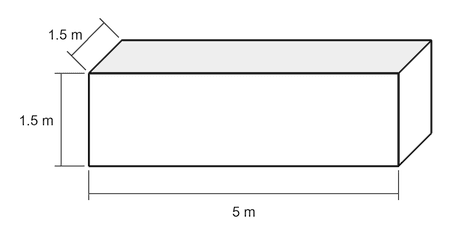
(i) Find the volume of the trench.
(ii) The trench is opened after 3 months, and the compost is ready 50–60 days after that. Taking 1 month = 30 days, after how many days in all will the compost be ready?
- 192 marks
Question 19
Bloom's level: Apply
A town burns 600 tonnes of waste a day in an incinerator. About 25% of the waste is left as ash.
(i) How much ash must be sent to the landfill each day?
(ii) By how many tonnes a day is the load on the landfill reduced, compared with dumping all the waste?
- 202 marks
Question 20
Bloom's level: Analyse
Two thermal plants, P and Q, each produce 800 kg of particulate matter a day, and each has an electrostatic precipitator. Plant P lets out 80 kg a day and plant Q lets out 300 kg a day.
Calculate the percentage of particulate matter removed in each plant, and state which precipitator is probably not working properly. Give a reason.
- 212 marks
Question 21
Bloom's level: Apply
Segregate these household wastes into reusable, degradable and non-degradable :
old exercise books, banana peels, a plastic wrapper, a broken steel spoon, used tea leaves, a broken glass bottle.
- 222 marks
Question 22
Bloom's level: Evaluate
Every autumn, Mr Rao burns the heap of dry leaves in his garden, saying it is "the cleanest and quickest" way to get rid of them. Evaluate his practice and suggest a better one.
- 233 marks
Question 23
Bloom's level: Apply
Case: Tara's family is getting rid of an old mobile phone, a broken radio and some used batteries. A kabadiwala offers to buy them; Tara has seen him burning wires and circuit boards behind his shop to get the metals out.
(a) What is this kind of waste called? Name two harmful substances and two valuable materials it may contain.
(b) Explain two health risks of the way the kabadiwala handles it.
(c) How should Tara's family dispose of these items safely?
- 244 marks
Question 24
Bloom's level: Analyse
Case: A town's Effluent Treatment Plant discharges its treated water into a river. On three different days, a student testing the river water just below the outlet found :
- Day 1 : bits of plastic and sand in the water.
- Day 2 : a foul smell and a lot of rotting organic matter.
- Day 3 : clear water, but tests showed dissolved metals such as lead.
(a) For each day, identify the stage of treatment that failed. Give a reason.
(b) What is sludge, and how is it useful?
(c) Why must effluents be treated before discharge into rivers?
- 254 marks
Question 25
Bloom's level: Evaluate
Case: A town's landfill is almost full. The town council proposes to build an incinerator on an empty plot next to a school in a crowded residential area, and to run it at a low temperature to save fuel.
(a) State three purposes that the incinerator would serve.
(b) Point out two faults in the council's plan, with reasons.
(c) Should the council go ahead? Give your verdict with the conditions you would add.
- 265 marks
Question 26
Bloom's level: Create
Design a waste management plan for your school.
(a) Construct a table with columns Type of waste, Where it comes from in the school, Method of disposal. Include at least five types of waste.
(b) Describe how the bins will be arranged so that students segregate waste correctly.
(c) Suggest two ways to reduce the amount of waste the school produces.
- 275 marks
Question 27
Bloom's level: Create
Your school garden has room for a small compost trench 2 m long, 1 m wide and 1 m deep. Plan how you will make compost in it, following the method in your book.
(a) List the materials you need and describe, step by step, how you will fill the trench.
(b) Prepare a time plan showing when each step happens and when the compost will be ready.
(c) State two kinds of school waste you will put in, and two you will keep out, with reasons.
- 284 marks
Question 28
Bloom's level: Analyse
A city produces 400 tonnes of solid waste a day. Its make-up is :
Kind of waste Share Kitchen and food waste 45% Paper 15% Plastics 10% Glass 5% Construction debris 15% e-Waste 2% Others 8% (a) How many tonnes a day are kitchen and food waste? Which method of disposal suits this part best?
(b) How many tonnes a day of paper can be sent for recycling, and how many tonnes of plastics and glass together need dumping?
(c) e-Waste is only 2% of the total. Why does it still need special attention?
- 293 marks
Question 29
Bloom's level: Apply
Choose the most suitable method of safe disposal for each waste, and give one reason :
(a) Kitchen waste and garden leaves from a housing society.
(b) Smoke full of fine ash from a factory chimney.
(c) Waste water from a factory, before it reaches a lake.
(d) Discarded culture plates from a research laboratory.
(e) Rain water and kitchen washings collecting in the lanes.
- 303 marks
Question 30
Bloom's level: Apply
Using the definition of waste, decide whether each of the following is a waste. Give the part of the definition that applies.
(a) A ball pen whose ink has run out.
(b) A television whose circuit has burnt out.
(c) A new, unopened notebook kept in a cupboard.
(d) Bagasse left after the juice is extracted from sugarcane.
Also explain, with one example from this list, why a waste need not be useless to everyone.
- 311 mark
Question 31
Which one of the following is a waste according to the definition of a waste ?
- 321 mark
Question 32
In the method of composting described in the chapter, each layer of mixed refuse spread in the trench is wetted fully with :
- 331 mark
Question 33
Assertion (A): Waste glass bottles are collected and sent for recycling instead of being dumped.
Reason (R): Glass is a degradable waste that microorganisms break down into harmless substances.
- 342 marks
Question 34
(i) Name two poisonous metals present in e-wastes.
(ii) Name two valuable metals that can be recovered from e-wastes.
- 352 marks
Question 35
(i) Name two kinds of waste produced in a school science laboratory.
(ii) State how the animal and plant wastes of a biology laboratory should be disposed of.
- 362 marks
Question 36
The flow chart shows the three stages through which the waste water of a town is treated in an Effluent Treatment Plant before it is discharged.

(i) Name the stages 1, 2 and 3.
(ii) In which stage do microorganisms oxidise the organic matter ? Name the solid material that is formed in this stage.
- 372 marks
Question 37
An incinerator in a town burns 480 tonnes of waste every day. About 25 per cent of the waste is left as ash.
(i) How many tonnes of ash are left each day ?
(ii) How many tonnes of ash will have to be dumped in 30 days ?
- 383 marks
Question 38
A colony sets up three bins for segregation : one for reusable waste, one for degradable waste and one for non-degradable waste. State the bin in which each of the following is to be put :
(i) metal tin cans
(ii) left-over rice and vegetable peelings
(iii) broken bricks from a building under repair
- 394 marks
Question 39
(i) Draw a neat, labelled diagram of a plate-type electrostatic precipitator. Label the charged plates, the dirty air going in, the clean gas coming out and the dust collected.
(ii) A thermal plant produces 1200 kg of particulate matter in a day. Its electrostatic precipitator removes 90 per cent of it. How many kilograms of the particulate matter escape into the air ?
(iii) Name the other device used to remove particulate air pollutants, and state what it sprays on the dirty air.
- 403 marks
Question 40
A compost trench is 5 m long, 1.5 m wide and 1.5 m deep. The first layer of well-mixed refuse spread over the floor of the trench is 30 cm thick.

(i) Find the volume of this first layer, in cubic metres.
(ii) Layers are added until the heap rises half a metre above the ground level. What is the height of the heap above the floor of the trench ?
(iii) The trench is opened after about 3 months, and the material is arranged in conical heaps and covered with earth. After how many days is the compost ready for use ?