Solution:
Concept: Dirty air rising through a wet packing under a water spray is washed clean: the device is a scrubber.
Step 1 — Part (a): identify the device.
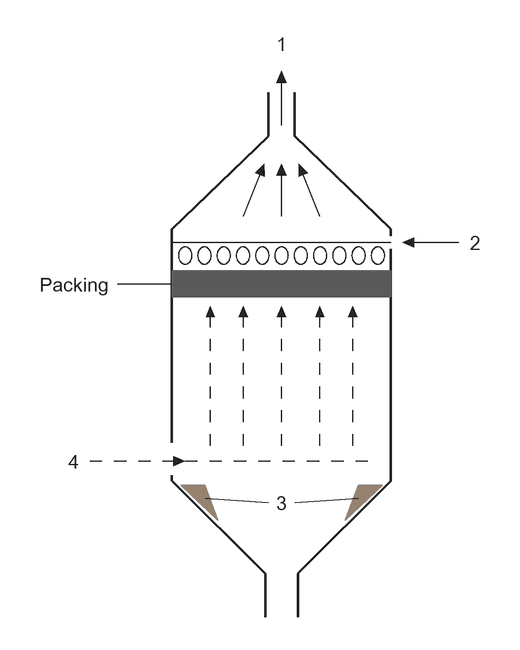
Dirty air enters at the bottom, rises through the packing and the water spray, and clean air leaves at the top, so the device is a scrubber (wet scrubber).
Step 2 — Part (b): its purpose.
It is used to remove gaseous and particulate air pollutants (dust, soot, soluble gases) from the waste gases of factories, so that only clean air leaves the chimney.
Step 3 — Part (c): label the guidelines.
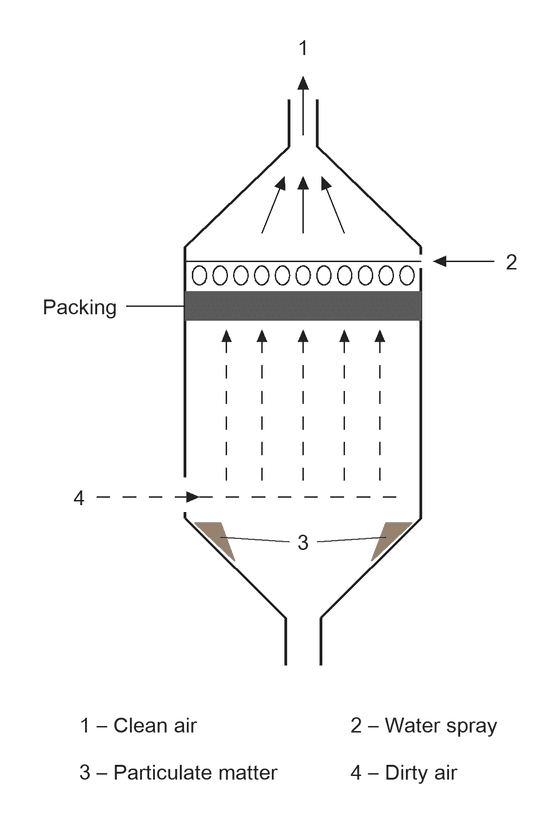
The arrow leaving at the top is the cleaned air; the arrow entering beside the nozzles brings the water; the deposits in the hopper are the trapped particles; the arrow entering at the bottom is the dirty air.
1 – Clean air; 2 – Water spray; 3 – Particulate matter; 4 – Dirty air.
Step 4 — Part (d): a similar device.
The electrostatic precipitator also removes particles from waste gases.
Step 5 — Part (e): diagram.
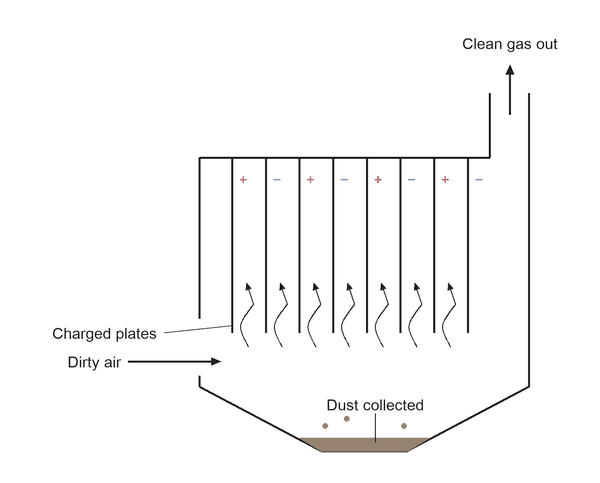
In a plate-type electrostatic precipitator, dirty air rises between charged plates; the particles pick up a charge, stick to the plates of opposite charge and drop as dust into the hopper, and clean gas leaves at the top.
Watch out: In the scrubber, water flows down while the dirty air flows up; do not label the water spray as the inlet for air.
Therefore, (a) scrubber; (b) to remove gaseous and particulate pollutants from dirty air; (c) 1 clean air, 2 water spray, 3 particulate matter, 4 dirty air; (d) electrostatic precipitator; (e) as drawn.