
Opening your dashboard
Class 9 Biology Chapter 19 Waste Generation and Management: Competency-Based Questions (CBQ)
40 questions on Chapter 19, each worked through on its own page with the AI tutor. Class 9 Biology, ICSE 2026-27.
40 questions
1–5 marks · Mixed difficulty
- 11 mark
Question 1
Cognitive domain: Application
During the crushing season, a sugar mill in western Uttar Pradesh is left every day with huge heaps of the fibrous plant residue that remains after the juice has been extracted from sugarcane. The manager does not want to dump it. Which plan puts this waste to the uses given for it in your chapter ?
- 21 mark
Question 2
Cognitive domain: Analysis
The figure shows the chamber of an electrostatic precipitator fitted to the chimney of a thermal plant. The four plates are numbered 1 to 4, and the sign above each plate shows its charge. X is a dust particle that carries a negative charge.
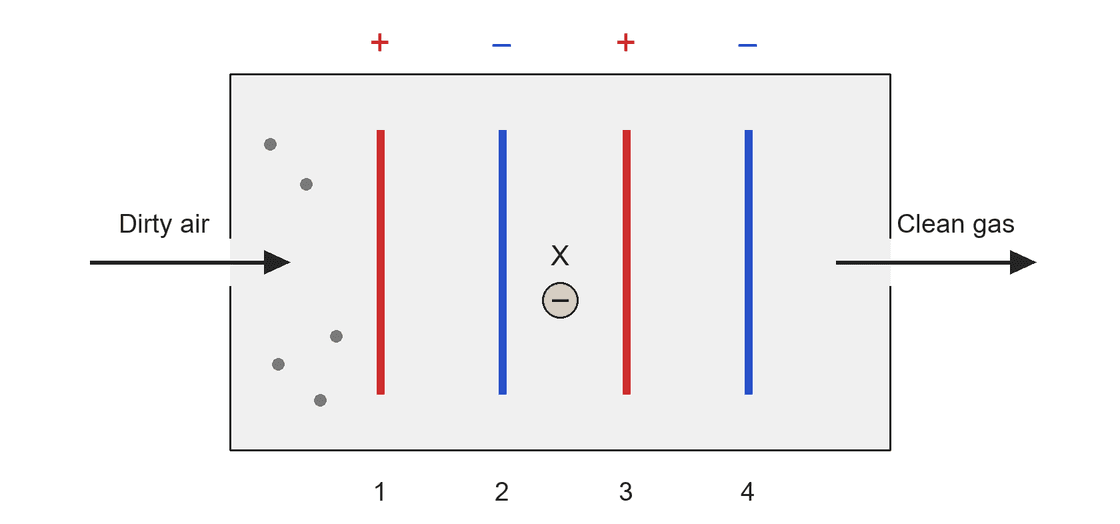
What will most likely happen to particle X ?
- 31 mark
Question 3
Cognitive domain: Application
The waste water of a milk dairy has no large debris in it, but it is very rich in organic matter. It is sent to an Effluent Treatment Plant. Which stage of the plant will mainly deal with this organic matter, and what useful by-product will it give ?
- 41 mark
Question 4
Cognitive domain: Analysis
A gardener filled two small pits with the same kind and amount of vegetable and fruit peelings and covered both with earth.
Pit How the waste was treated After five months 1 Fully wetted with a watery mixture of cow-dung and some mud A dark, crumbly mass with no peelings to be seen 2 Kept dry; nothing was added Dried-up peelings, most of them still recognisable Which statement best explains the difference ?
- 51 mark
Question 5
Cognitive domain: Understanding
Assertion (A): Discarded computers and mobile phones are worth recycling instead of being thrown away with the household garbage.
Reason (R): Most electronic devices contain a variety of materials, including metals, which can be recovered for future use.
- 61 mark
Question 6
Cognitive domain: Analysis
Assertion (A): The fly ash collected at a cement factory is a waste for which no further use can be found.
Reason (R): Fly ash consists of fine solid particles of non-combustible ash carried out of a bed of solid fuel by a draft.
- 71 mark
Question 7
Cognitive domain: Understanding
Every month, Farah's family ties up the newspapers they have finished reading and sells the bundle to the raddiwala. He passes the paper on, and in the end it reaches a paper mill, where it is recycled.
Complete the sentence :
For Farah's family the old newspapers are a waste because they are discarded after their ______ use, but when wastes are segregated, such paper is placed in the ______ category.
- 81 mark
Question 8
Cognitive domain: Application
The septic tank of a housing society has stopped working well. When it is opened, the workers find it choked with plastic wrappers and bits of broken glass that the residents had been flushing down their toilets and drains.
Complete the sentence :
A septic tank can deal only with the ______ part of the sewage, whereas the plastic wrappers and glass form the ______ part, which has to be dumped or buried at safe places.
- 91 mark
Question 9
Cognitive domain: Application
The gases leaving the chimney of a factory carry dust and also a harmful gas that dissolves in water. The engineer has to choose between a wet scrubber and an electrostatic precipitator. She chooses the wet scrubber.
Complete the sentence :
An electrostatic precipitator would have removed only the ______ matter, but in the wet scrubber the harmful gas also gets ______ in the wet packing.
- 102 marks
Question 10
Cognitive domain: Evaluation
Balbir grows paddy on a field that slopes down to the village pond. He says, "I always add much more fertilizer and pesticide than is needed. Whatever is extra stays in my own field, so it harms nobody."
Evaluate Balbir's claim. Give reasons for your answer.
- 112 marks
Question 11
Cognitive domain: Understanding
A municipality gives every house two bins and a cloth bag. Wet kitchen waste is to go into one bin, plastics and broken glass into the other, and old paper and metal items into the bag. Mrs D'Souza asks, "All of it goes into the same garbage truck in the end. Why should I take the trouble of keeping the three apart ?"
Explain to her why the three kinds of waste need to be kept apart.
- 122 marks
Question 12
Cognitive domain: Evaluation
At the end of the term, the laboratory assistant of a school has some cracked beakers and test tubes, a few bottles of left-over waste chemicals and some preserved plant and animal specimens that have gone bad. He says, "The amount is small. I shall just put it all in the dustbin of the corridor with the waste paper."
Is this a proper decision ? Justify your answer and state what should be done instead.
- 135 marks
Question 13
Cognitive domain: Analysis
Case: The waste water of a town passes through an Effluent Treatment Plant in three stages, one after the other. Students on a visit were given the test results of samples taken at four points : W, X, Y and Z.
Sample taken at Large debris Organic matter (mg per litre) Dissolved metals (mg per litre) W (entering the plant) Present 420 12 X Absent 400 12 Y Absent 40 11 Z (leaving the plant) Absent 36 1 (a) Name the stage of treatment that lies between W and X, between X and Y, and between Y and Z. Give the evidence from the table for each.
(b) Calculate the percentage of organic matter removed between X and Y. What happens to this organic matter ?
(c) To save money, the plant manager wants to shut down the last stage and send the water at Y to the vegetable fields for irrigation. Use the table to judge whether the water at Y is fit for this.
- 144 marks
Question 14
Cognitive domain: Application
Case: A new cement factory has come up near a small town. The people of the town are worried. They can see three things coming out of the factory : heaps of solid waste in the yard, dirty wash-off water flowing in a channel towards the river, and a grey haze of fine ash from the chimney. The owner invites them to a meeting and promises to deal with each of these properly.
(a) State how the solid waste and the liquid waste of the factory should each be dealt with.
(b) Name the fine ash coming out of the chimney. Suggest one device that the factory can fit to its chimney and explain how it will clean the air.
(c) The device will collect a large amount of this ash every day. Suggest how the factory can avoid simply dumping it.
- 155 marks
Question 15
Cognitive domain: Creativity
Case: A residents' association finds that every house in its colony has a drawer full of dead mobile phones, chargers, batteries, fluorescent tubes and broken electronic toys. Some residents sell them to a kabadi who breaks and burns them in an open plot nearby. The association asks the students of the colony to design an "e-waste drive".
(a) Design the label for the collection box of the drive. It should have a name for the box, a list of what may be put in it and a list of what must not be put in it.
(b) Plan the drive as a series of steps, from the houses up to the final disposal. Say who does each step.
(c) Write two messages for the colony notice board to persuade the residents not to sell their e-waste to the kabadi who burns it. Each message must carry a reason.
(d) Suggest one simple way of finding out whether the drive has worked.
- 161 mark
Question 16
Cognitive domain: Understanding
A student sorted some household items into the groups of domestic waste that are named in the chapter. Which row of her list is correct ?
- 171 mark
Question 17
Cognitive domain: Application
A city runs a waste-burning plant at a very high temperature, fitted with pollution control devices and built far from any residential area. The engineer tells visitors one benefit of the plant and one precaution that is being followed. Which pair of statements is correct ?
- 181 mark
Question 18
Cognitive domain: Application
A school in a hilly area has no sewer line. The principal wants a hygienic and cost-effective way of disposing of human waste on the campus. Which method does the chapter name as one of the latest ones for this purpose ?
- 191 mark
Question 19
Cognitive domain: Analysis
The figure shows a scrubber fitted to the chimney of a brick kiln. The smoke that enters at the bottom carries fine soot particles and also sulphur dioxide, a harmful gas that dissolves in water.
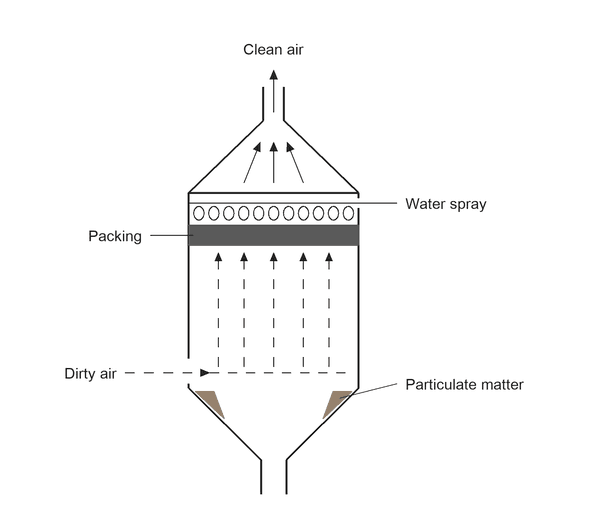
The pump that feeds the water spray fails, and the packing dries out, but the smoke keeps passing through it. According to the chapter, what is the most likely result ?
- 201 mark
Question 20
Cognitive domain: Analysis
A class buried four items in moist garden soil. After six months they dug the items out and noted what they saw. (Hypothetical data.)
Item buried What was seen after six months Banana peel Not found; only some dark soil-like crumbs Used tea leaves Not found; only some dark soil-like crumbs Plastic wrapper Looks just as it did when it was buried Broken glass bottle Looks just as it did when it was buried Which conclusion is best supported by the record ?
- 211 mark
Question 21
Cognitive domain: Analysis
A student wrote four rows in a table on the wastes of industries. Only one row is correct as per the chapter. Which one is it ?
- 221 mark
Question 22
Cognitive domain: Understanding
Assertion (A): Waste water that has passed through all the stages of an Effluent Treatment Plant may be used for irrigation.
Reason (R): In tertiary treatment, dissolved chemicals, metals and even pathogens are removed from the waste water.
- 231 mark
Question 23
Cognitive domain: Evaluation
Assertion (A): A housing society can safely collect all its waste mixed together and dump it in one pit, and leave nature to decompose it.
Reason (R): Degradable waste, such as vegetable and fruit peelings, is decomposed by the activity of microorganisms.
- 241 mark
Question 24
Cognitive domain: Understanding
A builder has pulled down an old house. The site is covered with waste stones, pebbles, broken bricks and pieces of wood. Where are such wastes mostly taken, and why ?
- 251 mark
Question 25
Cognitive domain: Application
After the groundnut harvest, a farmer is left with the plants from which the pods were picked. In his cattle shed there is also a heap of cow dung. Which row names the category of each waste and a use for it correctly ?
- 262 marks
Question 26
Cognitive domain: Analysis
An old lead-acid battery from a home inverter was thrown on the garbage heap at the edge of a vegetable field. Two years later, tests on spinach grown in that field showed traces of lead. A family in another town buys and eats this spinach. (Hypothetical data.)
(i) Name the category of waste to which the battery belongs.
(ii) Trace, step by step, how the lead could have reached the family.
- 272 marks
Question 27
Cognitive domain: Evaluation
At a town meeting, an official says: "Once we burn our wastes in an incinerator, nothing will be left, so we shall need no landfill, and there will be no harm to anyone."
Evaluate the official's statement using the chapter.
- 282 marks
Question 28
Cognitive domain: Analysis
Rohit wrote these notes on the Effluent Treatment Plant of his town.
- Primary treatment: large debris is separated by sedimentation in tanks.
- Secondary treatment: microorganisms oxidise the organic matter, releasing oxygen, and a solid sludge is formed.
- Tertiary treatment: dissolved chemicals, metals and even pathogens are removed.
One of the three lines has a mistake. Find it, correct it, and state one use of the sludge.
- 292 marks
Question 29
Cognitive domain: Application
Near a copper mine, huge heaps of left-over material remain after the ore has been processed. A builder from the town says he would like to use some of it.
(i) What is this waste called ?
(ii) Is the builder's plan possible ? Give one use to support your answer.
- 302 marks
Question 30
Cognitive domain: Application
A school wants compost, made by the method described in the chapter, to be ready for its flower beds on 1 October. The compost must surely be ready by then, so the school plans for the longer time given in the chapter for the heaps. Take 3 months as exactly 3 calendar months, and work backwards to find
(i) the latest date on which the trench must be opened, and
(ii) the latest date on which the trench must be filled and covered.
- 312 marks
Question 31
Cognitive domain: Analysis
A town engineer says: "We shall build a system of drains in every lane. They will carry away the water from kitchens and bathrooms, and the waste from toilets too, so we need no septic tanks."
(i) Point out the mistake in his plan.
(ii) State what will happen in the lanes if the drains are not built at all.
- 323 marks
Question 32
Cognitive domain: Application
The store room of an examination board holds 24 tonnes of old answer sheets that are no longer needed. One officer suggests burning them in the open ground behind the office to free the room.
(i) Into which of the three categories of segregation do these answer sheets fall ?
(ii) Suggest a better way of dealing with them than burning, and give a reason.
(iii) Assume that recycling 1 tonne of paper saves about 17 trees. (Hypothetical data.) About how many trees would be saved by recycling all the answer sheets ?
- 333 marks
Question 33
Cognitive domain: Analysis
The table gives the e-waste collected in a small town. (Hypothetical data.)
Year e-waste collected (tonnes) 2012 8 2016 20 2020 52 (i) How many times as large was the e-waste of 2020 as that of 2012 ?
(ii) The chapter says that even smaller cities and towns are flooded with electronic gadgets. Give the reason it gives.
(iii) The town plans to recover useful materials from this e-waste. Name two valuable materials it could recover, and say why the recovery must be done under skilled supervision.
- 343 marks
Question 34
Cognitive domain: Application
Under their teacher's supervision, in a well-ventilated room, students make a model scrubber. They pack a layer of dry cotton wool in the middle of a cut plastic bottle and use a small hand pump to draw the smoke of a lit incense stick in at the bottom, so that it passes up through the cotton and out at the top.
(i) Predict how the lower side of the cotton will look after 15 minutes, and say what this shows.
(ii) Describe a simple way of checking that the air leaving the top is cleaner than the smoke going in.
(iii) Give one way in which an electrostatic precipitator removes particles differently from this model.
- 353 marks
Question 35
Cognitive domain: Evaluation
Three students made these statements.
Asha: "An electrostatic precipitator is used to remove particulate matter from the smoke of thermal plants."
Bilal: "A scrubber removes only gaseous pollutants."
Chitra: "In an electrostatic precipitator the particles are collected on plates carrying the same charge as the particles."
Say whether each statement is right or wrong, and correct each wrong one.
- 363 marks
Question 36
Cognitive domain: Application
A company plans an oil refinery beside a lake. It says that the poisonous gaseous and liquid wastes of the refinery will be let out directly, since they will be "small in quantity".
(i) Name the category of waste to which these belong.
(ii) State what the chapter says should be done with the gaseous waste.
(iii) State what should be done with the liquid waste, and why the plan to let it out directly is not acceptable.
- 374 marks
Question 37
Cognitive domain: Analysis
Case: The graph shows the waste produced per day in a town in four different years. The town's population in those years is given in the table. (Hypothetical data.)

Year 2005 2010 2015 2020 Population (people) 100000 120000 150000 200000 (a) Read from the graph the waste produced per day in 2005 and in 2020. How many times as large was it in 2020 ?
(b) Find the waste produced per person per day, in kg, in 2005 and in 2020.
(c) The mayor says that the waste of the town increased only because the number of people increased. Use your answers to say whether he is fully right. Give one reason from the chapter for the extra waste.
- 385 marks
Question 38
Cognitive domain: Evaluation
Case: Two towns, P and Q, each produce tonnes of waste a day. Town P puts all of it in an open dump near a river. Town Q segregates its waste at the source and treats it as shown. (Hypothetical data.)
Kind of waste in town Q Tonnes a day What is done with it Reusable 60 Sent for recycling Degradable 150 Made into compost Non-degradable 90 30 tonnes are dumped in specially dug pits; 60 tonnes are burnt in an incinerator About per cent of the waste burnt in an incinerator is left as ash, and this ash is dumped.
(a) How many tonnes of ash does town Q get each day, and how many tonnes in all does it have to dump each day ?
(b) What per cent of its waste does town Q dump, compared with town P ?
(c) The mayor of town P says, "Segregation is too much trouble, so we shall continue to dump." Give two points from the chapter to evaluate her statement.
- 394 marks
Question 39
Cognitive domain: Creativity
Case: The eco-club of a school wants to find out what kinds of waste the families of the students throw out. It asks the students to keep a record of the waste of their home for one week.
(a) Design a record sheet with the columns Waste item, Weight in kg and Bin (reusable, degradable or non-degradable). Fill in five rows of your own.
(b) A family finds that the week's waste weighed kg in all, and that kg of it was degradable. Show how the club will find the per cent of degradable waste. (Hypothetical data.)
(c) Suggest two actions for the club that follow from such a record, each linked to a method of disposal from the chapter.
- 405 marks
Question 40
Cognitive domain: Analysis
Case: A new township has houses, a hospital and a hotel. The discharge of the houses and the hotel kitchen, and of the public toilets and the hospital, is carried away through sewers. The planners sent a sample of the solid matter in this discharge for analysis. (Hypothetical data.)
Kind of solid matter Mass in the kg sample (kg) Degradable part 150 Non-degradable part 50 (a) What is this combined waste called ? Into which two parts is it separated ?
(b) Find the per cent of each part in the sample. What is done with each part ?
(c) An engineer says, "The non-degradable part is only a quarter of the sample, so the township need not bother about it." Evaluate his statement.