
Opening your dashboard
Class 9 Biology Chapter 14: The Respiratory System Solutions
47 textbook questions with step-by-step answers, free to read, for ICSE 2026-27.
Get talked through Ch 14, not just shown the answer
Reading a finished solution is not the same as being able to do it. The AI tutor takes one question at a time and works it with you, in your own words, until you can.
- Ask it out loud, in your own words
- It gives you the next step, not the answer
- Stuck on part (ii)? Start there
47 questions with solutions
1–12 marks · Mixed difficulty
- 11 mark
Question 1
Given below is the definition of respiration with a few blanks to be filled in. Write suitable words in the blanks :
Respiration is a process of releasing .......... by breaking down .......... for carrying out .......... processes.
Solve with AIWritten solution
Solution:
Concept: Respiration is the biochemical process in which food (mainly glucose) is broken down inside the cells to release energy for the work of the body.
Step 1 — Find what is released.
The whole purpose of respiration is to free the energy locked in food, so the first blank is energy.
Step 2 — Find what is broken down.
The food that cells normally break down for this energy is the sugar glucose, so the second blank is glucose.
Step 3 — Find what the energy is used for.
The energy runs all the activities that keep an organism alive, such as growth, movement and repair. These are the life processes.
Watch out: Respiration is not the same as breathing; it happens inside every living cell.
Therefore, respiration is a process of releasing energy by breaking down glucose for carrying out life processes.
- 21 mark
Question 2
Write the overall chemical equation representing the above definition of respiration.
Solve with AIWritten solution
Solution:
Concept: In aerobic respiration glucose is oxidised by oxygen to carbon dioxide and water, and energy is released.
Step 1 — Write the reactants and products in words.
Glucose and oxygen are used up; carbon dioxide and water are formed, and energy is set free.
Glucose + oxygen → carbon dioxide + water + energy
Step 2 — Write the formulae and balance them.
One molecule of glucose needs six molecules of oxygen and gives six of carbon dioxide and six of water. Each side then has 6 carbon, 12 hydrogen and 18 oxygen atoms.
Watch out: The equation must be balanced: 6 O₂, 6 CO₂ and 6 H₂O for every one glucose.
Therefore, C₆H₁₂O₆ + 6O₂ → 6CO₂ + 6H₂O + energy (glucose + oxygen → carbon dioxide + water + energy).
- 31 mark
Question 3
In what form is the energy liberated in respiration?
Solve with AIWritten solution
Solution:
Concept: The energy freed in respiration does not all stay useful: part of it is trapped in a chemical store, and the rest escapes as heat.
Step 1 — The chemical (stored) form.
Part of the energy, roughly 40 %, is trapped as chemical energy in molecules of ATP (adenosine triphosphate). ATP is the cell's ready store of energy, so it is called the energy currency of the cell.
Step 2 — The heat form.
The rest of the energy, roughly 60 %, is released as heat. In birds and mammals this heat keeps the body warm.
Watch out: Say both forms; the energy is not released only as heat.
Therefore, the energy is liberated partly as chemical energy stored in ATP and partly as heat.
- 41 mark
Question 4
Give two examples of life activities which need energy.
Solve with AIWritten solution
Solution:
Concept: Every activity of a living cell, from moving to building new material, uses energy released by respiration.
Step 1 — Think of what the body does.
Any work done by the body's cells needs energy. Some examples are:
- contraction of muscles for movement and for the heartbeat;
- synthesis of proteins from amino acids, for growth and repair;
- conduction of nerve impulses;
- cell division to make new cells;
- keeping the body warm (in birds and mammals).
Step 2 — Choose two.
Any two of these are correct, for example muscle contraction and protein synthesis.
Therefore, two life activities that need energy are the contraction of muscles and the synthesis of proteins (any two from the list).
- 55 marks
Question 5
State whether the following statements are true (T) or false (F) :
(i) Strenuous physical exercise may cause fatigue due to accumulation of in the blood. (T/F)
(ii) No is produced in anaerobic respiration in the human body. (T/F)
(iii) Breathing and gaseous transport are one and the same thing. (T/F)
(iv) is transported to the lungs by the blood in two forms : as bicarbonates and as carbamino-haemoglobin. (T/F)
(v) Tissue respiration means chemical changes occurring inside the cell. (T/F)
Solve with AIWritten solution
Solution:
Concept: Respiration in humans has separate parts: breathing (air in and out of the lungs), gaseous transport (gases carried by the blood), tissue respiration (gas exchange between blood and cells) and cellular respiration (the chemical breakdown of glucose inside cells).
Step 1 — Statement (i).
Hard exercise causes fatigue because muscles respire anaerobically and form lactic acid, not because carbon dioxide piles up. The statement is False (F).
Note: scientists now link muscle fatigue mainly to the acid (H⁺ ions) and other changes that build up while lactic acid is formed, rather than to the lactate itself; either way, it is not carbon dioxide.
Step 2 — Statement (ii).
Anaerobic respiration in human muscle turns glucose into lactic acid only; no carbon dioxide is given off. The statement is True (T).
Step 3 — Statement (iii).
Breathing is moving air into and out of the lungs; gaseous transport is the carrying of oxygen and carbon dioxide by the blood. They are different. The statement is False (F).
Step 4 — Statement (iv).
The blood carries carbon dioxide to the lungs mostly as bicarbonate ions and partly bound to haemoglobin as carbamino-haemoglobin. The statement is True (T).
Note: a small part (about 7 %) also travels simply dissolved in the plasma.
Step 5 — Statement (v).
Tissue respiration is the exchange of gases between the blood capillaries and the tissue cells. The chemical changes inside the cell are cellular respiration. The statement is False (F).
Watch out: Lactic acid (not carbon dioxide) is linked with tired muscles, and it is formed without any carbon dioxide.
Therefore, (i) F, (ii) T, (iii) F, (iv) T, (v) F.
- 67 marks
Question 6
Match the items in Column I with those in Column II.
Column I Column II A. Nasal chamber (i) Production of voice B. Epiglottis (ii) C-shaped rings C. Air-sacs (iii) Warms air D. Lungs (iv) Drives mucus E. Larynx (v) Closes wind-pipe during swallowing F. Trachea (vi) Network of capillaries G. Cilia (vii) Spongy and elastic Solve with AIWritten solution
Solution:
Concept: Each part of the respiratory system is built for its own job in getting clean air to the alveoli.
Step 1 — Parts of the air passage.
The nasal chamber warms (and moistens) the air. The larynx (voice box) produces the voice. The trachea is kept open by C-shaped cartilage rings.
Step 2 — Guards and cleaners.
The epiglottis closes the windpipe during swallowing so food does not enter it. The cilia beat and drive the mucus, with trapped dust, up towards the throat.
Step 3 — The lungs themselves.
Each air-sac (alveolus) is covered by a network of blood capillaries for gas exchange. The lungs as a whole are spongy and elastic.
Step 4 — Write the pairs.
Putting these together:
Column I Column II A. Nasal chamber (iii) Warms air B. Epiglottis (v) Closes wind-pipe during swallowing C. Air-sacs (vi) Network of capillaries D. Lungs (vii) Spongy and elastic E. Larynx (i) Production of voice F. Trachea (ii) C-shaped rings G. Cilia (iv) Drives mucus Watch out: The epiglottis closes the windpipe; the larynx (not the epiglottis) makes the voice.
Therefore, A–(iii), B–(v), C–(vi), D–(vii), E–(i), F–(ii), G–(iv).
- 74 marks
Question 7
How do the following contribute in inspiration during breathing ?
(i) Ribs
(ii) Diaphragm
Solve with AIWritten solution
Solution:
Concept: Air flows into the lungs when the chest cavity becomes larger, because a larger volume means a lower pressure inside the lungs than outside.
Step 1 — (i) The ribs.
The external intercostal muscles between the ribs contract. This lifts the ribs upwards and outwards, so the chest cavity becomes wider from side to side and from front to back.
Step 2 — (ii) The diaphragm.
The dome-shaped diaphragm contracts and flattens (moves down). This makes the chest cavity longer from top to bottom.
Step 3 — The result.
With the cavity larger in every direction, the lungs expand, the pressure inside them falls below the outside air pressure, and air rushes in. This is inspiration.
Watch out: In inspiration the diaphragm contracts (flattens); it relaxes and domes up in expiration.
Therefore, in inspiration the ribs are raised upwards and outwards and the diaphragm contracts and flattens; both enlarge the chest cavity so that air enters the lungs.
- 84 marks
Question 8
Match the lung capacities in Column I with the quantities given in Column II.
Column I Column II A. Residual air 4500 mL B. Vital capacity 6000 mL C. Total lung capacity 1500 mL D. Dead air space 150 mL Solve with AIWritten solution
Solution:
Concept: The lung volumes of a normal adult are: residual air about 1500 mL, vital capacity about 4500 mL, total lung capacity about 6000 mL and dead air space about 150 mL.
Step 1 — Use the relation between the volumes.
The total lung capacity is the vital capacity plus the residual air that can never be breathed out.
Step 2 — Match each item.
The smallest volume, 150 mL, is the dead air space left in the air tubes. So:
Column I Column II A. Residual air 1500 mL B. Vital capacity 4500 mL C. Total lung capacity 6000 mL D. Dead air space 150 mL Watch out: Vital capacity (4500 mL) does not include the residual air; add 1500 mL to get the total capacity.
Therefore, A–1500 mL, B–4500 mL, C–6000 mL, D–150 mL.
- 91 mark
Question 9
Mention any two points of difference in the quality of inspired and expired air.
Solve with AIWritten solution
Solution:
Concept: In the alveoli the blood takes oxygen from the air and adds carbon dioxide and water vapour to it, and the air is warmed by the body.
Step 1 — Compare the gases.
Compared with inspired air, expired air has:
- less oxygen: about 16.4 % instead of 20.96 %;
- more carbon dioxide: about 4.0 % instead of 0.04 %;
- more water vapour (it is nearly saturated);
- a higher temperature: close to body temperature, 37 °C.
Step 2 — Choose two.
Any two of these differences answer the question.
Therefore, expired air contains less oxygen and more carbon dioxide than inspired air (it is also moister and warmer).
- 106 marks
Question 10
Give reasons for :
(i) People climbing to high altitudes may suffer from dizziness and unsteady vision.
(ii) Lime water is used in most experiments on respiration.
(iii) Respiration rate is higher in animals than in plants.
Solve with AIWritten solution
Solution:
Concept: Each case depends on oxygen supply, on a simple test for carbon dioxide, or on how much energy a living thing needs.
Step 1 — (i) Dizziness at high altitudes.
High up, the air pressure is low. The air is still about 21 % oxygen, but it is so thin that each breath brings in less oxygen. The brain and other tissues get too little oxygen, which causes dizziness, unsteady vision, headache and poor muscular coordination. This is called mountain (altitude) sickness.
Step 2 — (ii) Use of lime water.
Lime water is a solution of calcium hydroxide. It turns milky when carbon dioxide passes through it, because insoluble white calcium carbonate forms. So it is a simple test for carbon dioxide, the gas given out in respiration.
Step 3 — (iii) Faster respiration in animals.
Animals need more energy than plants: they move about to find food and escape enemies, and birds and mammals also make heat to keep the body warm. Plants stay in one place and make their own food, so they respire much more slowly.
Watch out: At high altitudes the percentage of oxygen does not drop; the pressure does, so less oxygen enters per breath.
Therefore, (i) thin air at high altitudes gives the tissues too little oxygen; (ii) lime water turns milky with carbon dioxide, so it detects it; (iii) animals need far more energy than plants.
- 112 marks
Question 11
Given alongside is an experiment intended to demonstrate the action of diaphragm, but some thing has gone wrong.
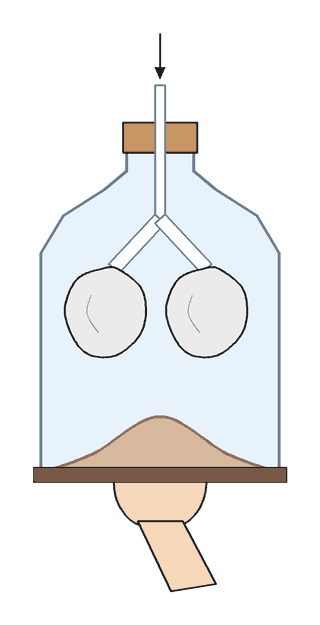
(i) What is the mistake in the diagram? Explain.
Solve with AIWritten solution
Solution:
Concept: The bell-jar model copies breathing: the jar is the chest cavity, the balloons are the lungs and the rubber sheet is the diaphragm. Pulling the sheet down enlarges the jar's space, so air flows into the balloons.
Step 1 — Read the diagram.
The hand is pushing the rubber sheet upward, but the balloons are drawn inflated and the arrow shows air going in. These two do not fit together.
Step 2 — Work out what really happens.
Pushing the sheet up reduces the space inside the jar, so the pressure rises. The air is pushed out of the balloons and they shrink (collapse). This copies expiration.
Step 3 — State the correction.
The balloons fill only when the sheet is pulled down: the space increases, the pressure falls and air rushes in, as in inspiration.
Watch out: Pushing the diaphragm up = expiration; pulling it down = inspiration.
Therefore, the mistake is that the balloons are shown inflated while the rubber sheet is pushed up; with the sheet pushed up they should be deflated, because air is forced out of them.
- 121 mark
Question 12
During inspiration, the diaphragm
Solve with AIAnswer
(A) relaxes
- Correct
(B) contracts
(C) expands
(D) gets folded
Answer: (B) contracts
Concept: In inspiration the diaphragm contracts and flattens from its dome shape, which makes the chest cavity longer.
Step 1 — Recall the diaphragm's action.
When a muscle shortens, it contracts. The diaphragm contracts at the start of each breath in and moves down.
Step 2 — Match with the options.
Contracts is option (B).
Watch out: The chest cavity expands, but the diaphragm itself contracts.
Why the other options are wrong:
- (A) relaxes: the diaphragm relaxes during expiration, when it returns to its dome shape.
- (C) expands: a muscle contracts or relaxes; it is the chest cavity, not the diaphragm, that expands.
- (D) gets folded: the diaphragm flattens; it does not fold.
Therefore, during inspiration the diaphragm contracts, option (B).
- 131 mark
Question 13
The ultimate end parts of the respiratory system in humans are known as
Solve with AIAnswer
- Correct
(A) alveoli
(B) bronchioles
(C) tracheoles
(D) bronchi
Answer: (A) alveoli
Concept: The air tubes of the lungs divide again and again into bronchioles, which end in clusters of tiny air sacs called alveoli, where gas exchange takes place.
Step 1 — Follow the air tubes to their end.
Trachea → bronchi → bronchioles → alveoli. The alveoli are the blind ends of the system.
Step 2 — Match with the options.
Alveoli is option (A).
Why the other options are wrong:
- (B) bronchioles: bronchioles are fine tubes that lead to the alveoli; they are not the end parts.
- (C) tracheoles: tracheoles are the fine air tubes of insects, not of humans.
- (D) bronchi: bronchi are the two large tubes into which the trachea divides.
Therefore, the ultimate end parts are the alveoli, option (A).
- 141 mark
Question 14
During respiration there is
Solve with AIAnswer
(A) gain in dry weight
- Correct
(B) loss in dry weight
(C) no change in dry weight
(D) increase in the overall weight
Answer: (B) loss in dry weight
Concept: Respiration breaks down stored food (glucose) into carbon dioxide and water, which leave the body, so the dry matter decreases.
Step 1 — Think about what happens to the food.
Food is the dry matter of a living thing. In respiration it is oxidised and its carbon leaves as carbon dioxide gas.
Step 2 — Decide the change in dry weight.
Since dry matter is used up, the dry weight goes down. That is option (B).
Watch out: Dry weight leaves out water; respiration always lowers it, as in germinating seeds kept in the dark.
Why the other options are wrong:
- (A) gain in dry weight: a gain in dry weight happens in photosynthesis, when food is made.
- (C) no change in dry weight: food is used up in respiration, so the dry weight does change.
- (D) increase in the overall weight: nothing is built up in respiration, so the overall weight cannot increase from it.
Therefore, respiration causes a loss in dry weight, option (B).
- 151 mark
Question 15
The product of anaerobic respiration in animals is :
Solve with AIAnswer
(A) Amino acids
(B) Uric acid
- Correct
(C) Lactic acid
(D) Ethanol
Answer: (C) Lactic acid
Concept: When animal muscles run short of oxygen they respire anaerobically and break glucose down to lactic acid only, with no carbon dioxide.
Step 1 — Recall anaerobic respiration in animals.
Glucose → lactic acid + a little energy (2 ATP).
Step 2 — Match with the options.
Lactic acid is option (C).
Watch out: Ethanol is the anaerobic product in yeast and plants, not in animals.
Why the other options are wrong:
- (A) Amino acids: amino acids are the products of protein digestion.
- (B) Uric acid: uric acid is a nitrogenous waste formed from proteins, mainly in birds and reptiles.
- (D) Ethanol: ethanol (with carbon dioxide) is formed in anaerobic respiration of yeast and plants.
Therefore, the product of anaerobic respiration in animals is lactic acid, option (C).
- 161 mark
Question 16
Anaerobic respiration in animals mostly occurs in :
Solve with AIAnswer
(A) Cardiac muscles
- Correct
(B) Skeletal muscles
(C) Both (A) and (B)
(D) Smooth muscles
Answer: (B) Skeletal muscles
Concept: Skeletal muscles working hard (sprinting, lifting) use oxygen faster than the blood can bring it, so they respire anaerobically for a short time and form lactic acid.
Step 1 — Find the muscle that runs short of oxygen.
Skeletal muscles can suddenly increase their work many times over, so they are the ones that run short of oxygen.
Step 2 — Match with the options.
Skeletal muscles is option (B).
Watch out: The heart works all the time, but it is built to stay aerobic.
Why the other options are wrong:
- (A) Cardiac muscles: cardiac muscle has a rich blood supply and many mitochondria; it respires aerobically and cannot rely on anaerobic respiration.
- (C) Both (A) and (B): cardiac muscle does not depend on anaerobic respiration, so 'both' is wrong.
- (D) Smooth muscles: smooth muscles work slowly and get enough oxygen.
Therefore, anaerobic respiration in animals mostly occurs in skeletal muscles, option (B).
- 171 mark
Question 17
Which of the following is popularly called as 'Adam's apple' ?
Solve with AIAnswer
- Correct
(A) Larynx
(B) Glottis
(C) Pharynx
(D) Epiglottis
Answer: (A) Larynx
Concept: The larynx (voice box) is a hollow box of cartilage at the top of the windpipe. In men it sticks out at the front of the neck as the Adam's apple.
Step 1 — Recall the name.
The bulge in the throat is the front cartilage of the larynx.
Step 2 — Match with the options.
Larynx is option (A).
Why the other options are wrong:
- (B) Glottis: the glottis is only the slit-like opening of the larynx.
- (C) Pharynx: the pharynx is the common passage for air and food at the back of the mouth and nose.
- (D) Epiglottis: the epiglottis is the flap that covers the glottis during swallowing.
Therefore, Adam's apple is the larynx, option (A).
- 181 mark
Question 18
The basic structural and functional unit of a lung is :
Solve with AIAnswer
(A) Capillaries
- Correct
(B) Alveolus
(C) Bronchioles
(D) Bronchi
Answer: (B) Alveolus
Concept: The lungs are made of millions of alveoli; each is a tiny air sac where oxygen and carbon dioxide are exchanged, so the alveolus is the unit of structure and function of the lung.
Step 1 — Find the unit that does the lung's job.
The job of a lung is gas exchange, and that happens in each alveolus.
Step 2 — Match with the options.
Alveolus is option (B).
Why the other options are wrong:
- (A) Capillaries: capillaries are blood vessels around the alveoli, not the unit of the lung.
- (C) Bronchioles: bronchioles only conduct air to the alveoli.
- (D) Bronchi: bronchi are large air tubes that conduct air.
Therefore, the basic structural and functional unit of a lung is the alveolus, option (B).
- 191 mark
Question 19
The protective membranous covering of lung is:
Solve with AIAnswer
(A) Capsule
(B) Pericardium
(C) Epithelium
- Correct
(D) Pleura
Answer: (D) Pleura
Concept: Each lung is covered by two thin pleural membranes (the pleura), with pleural fluid between them.
Step 1 — Recall the lung's covering.
The inner pleura sticks to the lung and the outer one lines the chest wall.
Step 2 — Match with the options.
Pleura is option (D).
Why the other options are wrong:
- (A) Capsule: a capsule covers organs such as the kidney, not the lung.
- (B) Pericardium: the pericardium is the covering of the heart.
- (C) Epithelium: epithelium lines surfaces in general; it is not the special covering of the lung.
Therefore, the protective covering of the lung is the pleura, option (D).
- 201 mark
Question 20
The muscular sheet which separates the thoracic and abdominal chamber of the human body is :
Solve with AIAnswer
(A) Peritoneum
- Correct
(B) Diaphragm
(C) Parietal pleura
(D) Visceral pleura
Answer: (B) Diaphragm
Concept: The diaphragm is a dome-shaped sheet of muscle that forms the floor of the thoracic (chest) cavity and separates it from the abdomen.
Step 1 — Look for a muscular sheet.
Only one of the options is made of muscle.
Step 2 — Match with the options.
Diaphragm is option (B).
Why the other options are wrong:
- (A) Peritoneum: the peritoneum is a thin membrane lining the abdominal cavity, not a muscle.
- (C) Parietal pleura: the parietal pleura is the outer membrane around a lung.
- (D) Visceral pleura: the visceral pleura is the inner membrane sticking to the lung.
Therefore, the muscular sheet is the diaphragm, option (B).
- 211 mark
Question 21
Which of the following produces mucus in the respiratory passage ?
Solve with AIAnswer
(A) Ciliated cells
(B) Air sacs
- Correct
(C) Goblet cells
(D) Tertiary bronchi
Answer: (C) Goblet cells
Concept: The lining of the trachea and bronchi has goblet cells, which secrete mucus, and ciliated cells, which sweep the mucus away.
Step 1 — Separate making from moving.
Goblet cells make the sticky mucus that traps dust and germs.
Step 2 — Match with the options.
Goblet cells is option (C).
Watch out: Ciliated cells move mucus; goblet cells make it.
Why the other options are wrong:
- (A) Ciliated cells: ciliated cells sweep the mucus towards the throat; they do not make it.
- (B) Air sacs: air sacs (alveoli) are thin-walled sacs for gas exchange and do not line the air passage with mucus.
- (D) Tertiary bronchi: tertiary bronchi are air tubes, not single secreting cells.
Therefore, mucus is produced by goblet cells, option (C).
- 225 marks
Question 22
Name the following :
(a) The energy currency of the cell.
(b) The compound formed by the combination of oxygen and haemoglobin.
(c) The common passage of Oesophagus and Trachea.
(d) The muscles found between the ribs which can change the size of the chest cavity lengthwise.
(e) The compound formed by the combination of haemoglobin and carbon dioxide gas.
Solve with AIWritten solution
Solution:
Concept: Each description points to one term from the chapter.
Step 1 — (a) Energy currency.
The cell stores and spends energy as ATP (adenosine triphosphate).
Step 2 — (b) Oxygen + haemoglobin.
Haemoglobin joined loosely with oxygen is oxyhaemoglobin.
Step 3 — (c) Common passage.
Both food and air pass through the pharynx before the oesophagus and the trachea separate.
Step 4 — (d) Muscles between the ribs.
The muscles between the ribs are the intercostal muscles (external and internal).
Note: the intercostal muscles change the chest's width (side to side and front to back); the lengthwise change is made by the diaphragm.
Step 5 — (e) Haemoglobin + carbon dioxide.
Haemoglobin joined with carbon dioxide is carbamino-haemoglobin.
Therefore, (a) ATP, (b) oxyhaemoglobin, (c) pharynx, (d) intercostal muscles, (e) carbamino-haemoglobin.
- 236 marks
Question 23
Name the body structure concerned with the given functional activity :
(a) Prevents food from entering the trachea during swallowing.
(b) Transports oxygen to the body cells.
(c) Helps to increase the volume of the chest cavity lengthwise.
(d) Combines with the oxygen in the lungs.
(e) Protects the lungs from mechanical injuries.
(f) Provides actual diffusion of respiratory gases in lungs.
Solve with AIWritten solution
Solution:
Concept: Match each job to the structure that does it.
Step 1 — (a) Keeping food out of the trachea.
The epiglottis covers the glottis during swallowing.
Step 2 — (b) Carrying oxygen to the cells.
The red blood cells (RBCs) carry oxygen, using their haemoglobin.
Step 3 — (c) Lengthening the chest cavity.
The diaphragm flattens and makes the chest cavity longer.
Step 4 — (d) Combining with oxygen in the lungs.
Haemoglobin in the red cells combines with oxygen to form oxyhaemoglobin.
Step 5 — (e) Protecting the lungs.
The bony rib cage (ribs with the sternum and backbone) guards the lungs from injury.
Step 6 — (f) Diffusion of gases.
The thin-walled alveoli (air sacs) are where the gases actually diffuse.
Therefore, (a) epiglottis, (b) red blood cells, (c) diaphragm, (d) haemoglobin, (e) rib cage, (f) alveoli.
- 245 marks
Question 24
Name :
(a) Two kinds of respiration
(b) Two steps of cellular respiration
(c) Two phases of breathing
(d) Two main raw materials for respiration
(e) Two parts of tidal volume
Solve with AIWritten solution
Solution:
Concept: Each answer is a pair of terms from the chapter.
Step 1 — (a) Kinds of respiration.
Respiration with oxygen is aerobic; without oxygen it is anaerobic.
Step 2 — (b) Steps of cellular respiration.
Glucose is first split to pyruvic acid in the cytoplasm (glycolysis); then, with oxygen, it is fully oxidised in the mitochondria (Krebs cycle).
Step 3 — (c) Phases of breathing.
Air is taken in (inspiration) and given out (expiration).
Step 4 — (d) Raw materials.
Respiration uses glucose and oxygen.
Step 5 — (e) Parts of the tidal volume.
Of the 500 mL tidal air, about 350 mL reaches the alveoli (alveolar air) and about 150 mL stays in the air tubes (dead space air).
Therefore, (a) aerobic and anaerobic; (b) glycolysis and Krebs cycle; (c) inspiration and expiration; (d) glucose and oxygen; (e) alveolar air and dead space air.
- 251 mark
Question 25
Arrange the organs of the human respiratory system in a proper logical sequence :
Bronchi, Lungs, Larynx, Nose, Trachea, Pharynx.
Solve with AIWritten solution
Solution:
Concept: The organs are arranged in the order in which inhaled air passes through them.
Step 1 — Start where air enters.
Air enters through the nose, then passes the pharynx at the back of the throat.
Step 2 — Follow the windpipe.
Next comes the larynx (voice box) at the top of the trachea, which divides into two bronchi.
Step 3 — End in the lungs.
The bronchi enter the lungs.
Watch out: The larynx comes before the trachea; the pharynx comes before both.
Therefore, nose → pharynx → larynx → trachea → bronchi → lungs.
- 261 mark
Question 26
What is the normal percentage composition of gases in inspired air and expired air respectively ?
Solve with AIWritten solution
Solution:
Concept: In the alveoli oxygen is taken up and carbon dioxide added; nitrogen is not used, so its share rises a little only because the other gases change.
Step 1 — Write the two columns.
The usual textbook values are:
Gas Inspired air Expired air Oxygen 20.96 % 16.4 % Carbon dioxide 0.04 % 4.0 % Nitrogen 79.00 % 79.6 % Step 2 — Check the totals.
Each column adds up to 100 %, so the figures are consistent: 20.96 + 0.04 + 79.00 and 16.4 + 4.0 + 79.6 both give 100.
Watch out: Expired air still has plenty of oxygen (about 16 %), which is why mouth-to-mouth rescue breathing works.
Therefore, inspired air has about 20.96 % oxygen, 0.04 % carbon dioxide and 79 % nitrogen; expired air has about 16.4 %, 4.0 % and 79.6 %.
- 274 marks
Question 27
Match the items in Column I with the ones most appropriate in Column II. Rewrite the matching pairs :
Column I Column II (a) Alveoli (i) where aerobic respiration takes place (b) Bronchioles (ii) lined with hair (c) Nasal chamber (iii) diffusion of gases (d) Bronchi (iv) small air tubes (v) An inverted Y-shaped tube (vi) A common passage for food and air Solve with AIWritten solution
Solution:
Concept: Column II has two extra items, so two of them are left unused.
Step 1 — (a) Alveoli.
The alveoli are where the diffusion of gases takes place: (iii).
Step 2 — (b) Bronchioles.
The bronchioles are the small air tubes: (iv).
Step 3 — (c) Nasal chamber.
The nasal chamber is lined with hair that filters dust: (ii).
Step 4 — (d) Bronchi.
The trachea and two bronchi form an inverted Y-shaped tube: (v).
Step 5 — Unused items.
(i) aerobic respiration takes place in the cells (mitochondria), and (vi) the common passage for food and air is the pharynx, so neither matches.
Watch out: Aerobic respiration happens in the cells, not in the alveoli.
Therefore, (a)–(iii), (b)–(iv), (c)–(ii), (d)–(v).
- 286 marks
Question 28
Given below is an example of a certain structure and its special functional activity:
"Kidney and excretion."
Fill in the blanks on a similar pattern.
(a) Alveoli and ..........
(b) Mitochondria and ..........
(c) Epiglottis and ..........
(d) Pleura and ..........
(e) Diaphragm and ..........
(f) 'C' shaped cartilage rings and ..........
Solve with AIWritten solution
Solution:
Concept: The pattern is 'structure and its main job', as in 'kidney and excretion'.
Step 1 — (a) Alveoli.
Alveoli are for the exchange (diffusion) of gases.
Step 2 — (b) Mitochondria.
Mitochondria carry out cellular (aerobic) respiration, releasing energy as ATP.
Step 3 — (c) Epiglottis.
The epiglottis closes the windpipe during swallowing.
Step 4 — (d) Pleura.
The pleura protects the lungs and, with its fluid, reduces friction.
Step 5 — (e) Diaphragm.
The diaphragm brings about breathing movements by changing the size of the chest.
Step 6 — (f) 'C'-shaped rings.
The cartilage rings keep the trachea open so it never collapses.
Therefore, (a) gas exchange, (b) cellular respiration, (c) closing the windpipe in swallowing, (d) protection of the lungs, (e) breathing movements, (f) keeping the trachea open.
- 296 marks
Question 29
Match the items in Column A with those in Column B.
Column A Column B Cartilaginous Epiglottis Large surface area Diaphragm Breathing movements Bronchi Voice Alveoli Complemental air Larynx Swallowing Extra inhalation Solve with AIWritten solution
Solution:
Concept: Match each feature in Column A to the one structure or term in Column B that it describes; settle the sure pairs first.
Step 1 — The sure pairs.
Voice → larynx; swallowing → epiglottis; breathing movements → diaphragm; large surface area → alveoli; complemental air → extra inhalation.
Step 2 — The pair left over.
The only item left for cartilaginous is the bronchi, whose walls are kept open by cartilage rings (the larynx and epiglottis are also cartilage, but they are already used).
Step 3 — Write the table.
The matched pairs are:
Column A Column B Cartilaginous Bronchi Large surface area Alveoli Breathing movements Diaphragm Voice Larynx Complemental air Extra inhalation Swallowing Epiglottis Therefore, cartilaginous–bronchi, large surface area–alveoli, breathing movements–diaphragm, voice–larynx, complemental air–extra inhalation, swallowing–epiglottis.
- 3010 marks
Question 30
State one function of each of the following :
(a) Ciliated epithelium lining the respiratory tract
(b) Mitochondria
(c) Diaphragm
(d) Intercostal muscles
(e) Pleural fluid
Solve with AIWritten solution
Solution:
Concept: Give one clear job for each part and say how it does it.
Step 1 — (a) Ciliated epithelium.
Its cilia beat all the time and drive the mucus, with trapped dust and germs, up towards the throat, keeping the air passages clean.
Step 2 — (b) Mitochondria.
They are the site of the aerobic stage (Krebs cycle) of cellular respiration, which releases most of the energy as ATP.
Step 3 — (c) Diaphragm.
It contracts and flattens in inspiration, lengthening the chest cavity so that air is drawn in.
Step 4 — (d) Intercostal muscles.
The external intercostals raise the ribs upwards and outwards, widening the chest in inspiration; the internal ones help in forced expiration.
Step 5 — (e) Pleural fluid.
It lubricates the two pleural membranes so the lungs expand and contract without friction.
Therefore, (a) cleans the air passage, (b) aerobic respiration releasing ATP, (c) enlarges the chest lengthwise, (d) raise the ribs to widen the chest, (e) lubrication for friction-free lung movement.
- 312 marks
Question 31
Under what conditions would the breathing rate increase ?
Solve with AIWritten solution
Solution:
Concept: The breathing centre in the brain speeds up breathing when the carbon dioxide in the blood rises or the body needs more oxygen.
Step 1 — When the body uses more oxygen.
Breathing becomes faster during strenuous exercise (running, swimming), during fever, and with strong emotions such as fear or excitement.
Step 2 — When the blood gets more carbon dioxide.
It also speeds up when the carbon dioxide in the blood increases, for example in a crowded, poorly ventilated room.
Step 3 — When the air has less oxygen.
At high altitudes each breath brings in less oxygen, so breathing becomes faster.
Therefore, the breathing rate increases during exercise, fever and excitement, when blood carbon dioxide rises, and at high altitudes.
- 322 marks
Question 32
How would you prove that the air you breathe out is warmer ?
Solve with AIWritten solution
Solution:
Concept: Breathed-out air has been warmed to near body temperature (37 °C) in the lungs, while room air is usually cooler.
Step 1 — Take a reference reading.
Note the reading of a laboratory thermometer in the room air.
Step 2 — Breathe on the bulb.
Now breathe out gently on its bulb through the mouth for about a minute and note the reading again.
Step 3 — Compare.
The reading rises, which shows that expired air is warmer than the room air.
A quick check without apparatus: breathe gently on the back of your hand with the mouth wide open; it feels warm.
Watch out: The test works only when the room is cooler than about 37 °C.
Therefore, a thermometer reading rises when you breathe on its bulb, proving that expired air is warmer.
- 332 marks
Question 33
How is the respiratory passage kept free of dust particles ?
Solve with AIWritten solution
Solution:
Concept: The air passage has three cleaners that work together: hairs, mucus and cilia.
Step 1 — In the nose.
The hairs in the nostrils stop larger dust particles, and the mucus of the nasal chambers traps finer dust and germs.
Step 2 — In the trachea and bronchi.
The goblet cells of the lining secrete mucus, which traps the dust that gets past the nose.
Step 3 — Removing the trapped dust.
The cilia keep beating and sweep the mucus upward to the throat, where it is swallowed or coughed out.
Watch out: The cilia do not trap dust; they move the mucus that has trapped it.
Therefore, nasal hairs and mucus trap dust, and the cilia sweep the dusty mucus out to the throat.
- 342 marks
Question 34
What is wrong in the statement "We breathe in oxygen and breathe out carbon dioxide"?
Solve with AIWritten solution
Solution:
Concept: Inspired and expired air are both mixtures of gases; only the amounts of oxygen and carbon dioxide change.
Step 1 — What we breathe in.
We breathe in air, which has about 21 % oxygen, 0.04 % carbon dioxide and mostly nitrogen, not pure oxygen.
Step 2 — What we breathe out.
We breathe out air that still has about 16 % oxygen, with about 4 % carbon dioxide, and nitrogen, not pure carbon dioxide.
Step 3 — Say what is wrong.
The statement wrongly suggests that we inhale only oxygen and exhale only carbon dioxide.
Therefore, the statement is wrong because we breathe in and out a mixture of gases: expired air has less oxygen and more carbon dioxide than inspired air, but is not pure carbon dioxide.
- 3510 marks
Question 35
Write the balanced chemical equations for the following :
(a) Aerobic respiration
(b) Anaerobic respiration in plants
(c) Anaerobic respiration in animals
(d) Photosynthesis
(e) Phosphorylation
Solve with AIWritten solution
Solution:
Concept: A balanced equation has the same number of each kind of atom on both sides.
Step 1 — (a) Aerobic respiration.
Glucose is completely oxidised by oxygen in the mitochondria.
Note: 38 ATP is the textbook (and ICSE) value. Careful measurements today give about 30–32 ATP per glucose, because some energy is used to move materials into the mitochondria.
Step 2 — (b) Anaerobic respiration in plants (and yeast).
Without oxygen, glucose gives ethanol and carbon dioxide.
Step 3 — (c) Anaerobic respiration in animals (muscles).
Without oxygen, glucose gives lactic acid only.
Step 4 — (d) Photosynthesis.
Green leaves use carbon dioxide and water in sunlight with chlorophyll; the oxygen released comes from the water.
Step 5 — (e) Phosphorylation.
Energy from respiration joins a phosphate to ADP to make ATP.
Watch out: Check (d): 12 H₂O on the left and 6 H₂O on the right keep the oxygen and hydrogen atoms balanced.
Therefore, the five balanced equations are as written in Steps 1–5.
- 3610 marks
Question 36
Define :
(a) Respiration
(b) Hypoxia
(c) Asphyxiation
(d) Breathing
(e) Vital capacity
Solve with AIWritten solution
Solution:
Concept: A definition says exactly what a term means, in one or two sentences.
Step 1 — (a) Respiration.
The biochemical process in which food (glucose) is broken down in the cells to release energy for life processes.
Step 2 — (b) Hypoxia.
A shortage of oxygen reaching the tissues, for example at high altitudes or in a crowded, poorly ventilated room.
Step 3 — (c) Asphyxiation.
A condition in which the oxygen supply to the body is cut off while carbon dioxide builds up in the blood, as in strangulation, drowning or a blocked windpipe.
Step 4 — (d) Breathing.
The physical (muscular) process of taking air into the lungs (inspiration) and forcing it out (expiration).
Step 5 — (e) Vital capacity.
The largest volume of air that can be breathed out after the deepest possible breath in, about 4500 mL in a normal adult.
Watch out: Breathing is physical; respiration is chemical and goes on in every cell.
Therefore, the five terms are defined as in Steps 1–5.
- 3710 marks
Question 37
Differentiate between the following pairs on the basis of the aspect given in the brackets.
(a) Aerobic and anaerobic respiration (end products of the process)
(b) Respiration and photosynthesis (Gas released)
(c) Photosynthesis and respiration (Reactants)
(d) Respiration and breathing (organs involved)
(e) Tidal volume and residual volume (quantity of air)
Solve with AIWritten solution
Solution:
Concept: Compare each pair only on the point given in the brackets.
Step 1 — (a) End products.
Aerobic and anaerobic respiration give different products.
Aerobic respiration Anaerobic respiration Carbon dioxide and water, with much energy. Ethanol and carbon dioxide in plants; lactic acid only in animals, with little energy. Step 2 — (b) Gas released.
The two processes release opposite gases.
Respiration Photosynthesis Carbon dioxide is released. Oxygen is released. Step 3 — (c) Reactants.
What one uses, the other makes.
Photosynthesis Respiration Carbon dioxide and water. Glucose and oxygen. Step 4 — (d) Organs involved.
Breathing needs special organs; respiration does not.
Respiration Breathing Takes place in every living cell (cytoplasm and mitochondria). Uses the respiratory organs: nose, pharynx, larynx, trachea, bronchi and lungs, worked by the diaphragm and intercostal muscles. Step 5 — (e) Quantity of air.
The two volumes differ greatly.
Tidal volume Residual volume Air breathed in or out in one normal, quiet breath: about 500 mL. Air left in the lungs even after the most forceful breath out: about 1500 mL. Therefore, the five pairs differ as shown in the tables.
- 388 marks
Question 38
Give suitable explanations for the following :
(a) Breathing through the nose is said to be healthier than through the mouth.
(b) Why does gaseous exchange continue in the lungs even during expiration ?
(c) Why does a person feel breathlessness at higher altitudes ?
(d) Why do you shiver and why do your teeth chatter when it is very cold in winter ?
Solve with AIWritten solution
Solution:
Concept: Each answer comes from how the respiratory system works.
Step 1 — (a) Nose breathing is healthier.
In the nose the hairs stop large particles and the mucus traps dust and germs; the lining also warms and moistens the air. Air entering by the mouth misses all this, so it reaches the lungs dusty, cold and dry.
Step 2 — (b) Gas exchange during expiration.
The lungs are never fully emptied: about 1500 mL of residual air always stays in the alveoli, and blood keeps flowing past them. So oxygen and carbon dioxide go on diffusing between the alveolar air and the blood even while we breathe out.
Step 3 — (c) Breathlessness at high altitudes.
The air pressure is low, so although the air is still about 21 % oxygen, each breath brings in less oxygen. The tissues get too little oxygen (hypoxia), so the person breathes faster and deeper and feels breathless.
Step 4 — (d) Shivering and chattering teeth.
These are involuntary contractions of the muscles. The extra muscle work speeds up respiration in the muscle cells, which releases extra heat and helps keep the body warm.
Therefore, (a) the nose filters, warms and moistens air; (b) residual air keeps gas exchange going; (c) less oxygen enters per breath at altitude; (d) shivering makes heat by extra respiration in the muscles.
- 3912 marks
Question 39
With regard to the respiratory system and the process of respiration in humans, answer the following questions:
(a) Name the two muscles that help in breathing.
(b) Briefly describe how the above mentioned muscles help in the inspiration of air.
(c) Give the overall chemical equation to represent the process of respiration in humans.
(d) What is meant by :
-
Residual air
-
Dead air space.
Solve with AIWritten solution
Solution:
Concept: Inspiration happens when the ribs and the diaphragm together enlarge the chest cavity, lowering the pressure inside the lungs.
Step 1 — (a) The two breathing muscles.
They are the diaphragm and the intercostal muscles (between the ribs).
Step 2 — (b) How they help inspiration.
The two muscles work together:
- the external intercostal muscles contract and lift the ribs upwards and outwards, widening the chest;
- the diaphragm contracts and flattens, making the chest cavity longer;
- the chest volume increases, the pressure in the lungs falls below the outside air pressure, and air rushes in.
Step 3 — (c) The overall equation.
Glucose is oxidised by oxygen to carbon dioxide and water.
About 2870 kJ (686 kcal) is released per mole of glucose. The 38 moles of ATP formed store 38 × 30.5 = 1159 kJ, which is about 40 %; the remaining 1711 kJ (about 409 kcal) is given off as heat.
Note: 38 ATP is the textbook (and ICSE) value. Careful measurements today give about 30–32 ATP per glucose, because some energy is used to move materials into the mitochondria.
Step 4 — (d) Residual air and dead air space.
Each is a volume of air that stays behind somewhere in the respiratory system:
- Residual air: about 1500 mL of air that is always left in the lungs, even after the most forceful expiration.
- Dead air space: about 150 mL of each breath that stays in the air tubes (trachea, bronchi), where no gas exchange can occur.
Watch out: Residual air is in the alveoli and does exchange gases; dead space air is in the tubes and does not.
Therefore, (a) diaphragm and intercostal muscles; (b) they enlarge the chest so air rushes in; (c) the equation in Step 3; (d) residual air ≈ 1500 mL left in the lungs, dead space ≈ 150 mL left in the air tubes.
-
- 403 marks
Question 40
Starting from the nostrils, trace the path in sequence which the inspired air takes until it reaches the air sacs.
Solve with AIWritten solution
Solution:
Concept: The inspired air passes through tubes that become narrower and more branched until they end in the alveoli.
Step 1 — The upper passage.
Air enters the nostrils, passes through the nasal chambers and the pharynx, and then the larynx.
Step 2 — The windpipe and its branches.
It goes down the trachea, which divides into two bronchi; these branch into secondary and tertiary bronchi and then fine bronchioles.
Step 3 — The end.
The bronchioles open into alveolar ducts and finally the air sacs (alveoli).
Therefore, nostrils → nasal chambers → pharynx → larynx → trachea → bronchi → bronchioles → alveolar ducts → air sacs (alveoli).
- 419 marks
Question 41
What are the functions of the following in breathing?
(a) Ribs,
(b) Diaphragm,
(c) Abdominal muscles
Solve with AIWritten solution
Solution:
Concept: Breathing works by changing the volume of the chest cavity; the ribs, diaphragm and abdominal muscles each play a part.
Step 1 — (a) Ribs.
Their movements change the chest's width:
- in inspiration the external intercostals lift the ribs upwards and outwards, enlarging the chest;
- in expiration the ribs return downwards and inwards, making the chest smaller and pushing air out;
- the rib cage also protects the lungs from injury.
Step 2 — (b) Diaphragm.
Its movements change the chest's length:
- in inspiration it contracts and flattens, lengthening the chest so air is drawn in;
- in expiration it relaxes and domes upward, shortening the chest so air is pushed out.
Step 3 — (c) Abdominal muscles.
They work with the diaphragm:
- in inspiration they relax, so the abdominal wall moves outward as the flattening diaphragm presses on the abdominal organs;
- in forced expiration they contract, pushing the abdominal organs and the diaphragm upward to drive out more air.
Therefore, the ribs change the width of the chest, the diaphragm changes its length, and the abdominal muscles relax in inspiration and contract in forced expiration.
- 422 marks
Question 42
Given alongside is a diagrammatic sketch of a part in human lungs
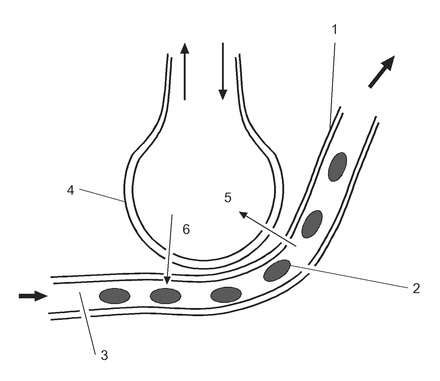
(i) Name the parts numbered 1– 4
(ii) What do the arrows 5 and 6 indicate ?
Solve with AIWritten solution
Solution:
Concept: The figure shows an alveolus with a blood capillary pressed against it; gases cross the thin walls by diffusion.
Step 1 — (i) Parts 1 and 4: the two walls.
Leader 1 ends on the wall of the tube carrying blood cells, so 1 is the wall of the blood capillary. Leader 4 ends on the wall of the bulb-shaped air sac, so 4 is the wall of the alveolus.
Step 2 — (i) Parts 2 and 3: inside the capillary.
The dark oval bodies are 2, red blood cells, and the liquid around them is 3, plasma.
Step 3 — (ii) Arrows 5 and 6.
Arrow 5 points from the blood into the alveolus: carbon dioxide diffuses out of the blood. Arrow 6 points from the alveolus into the blood: oxygen diffuses in and is taken up by the red blood cells.
Watch out: Oxygen moves from the alveolus to the blood and carbon dioxide the other way, each from high to low concentration.
Therefore, (i) 1 capillary wall, 2 red blood cell, 3 plasma, 4 alveolar wall; (ii) arrow 5 is carbon dioxide diffusing out of the blood and arrow 6 is oxygen diffusing into it.
- 433 marks
Question 43
Given below is an overall chemical reaction of a certain process :
(a) Name the process.
(b) Is this reaction applicable to animals or to plants or to both animals and plants ?
(c) Name one tissue in which this reaction may occur.
Solve with AIWritten solution
Solution:
Concept: Glucose broken down to lactic acid without oxygen, giving only 2 ATP, is anaerobic respiration in animals.
Step 1 — (a) Name the process.
No oxygen is used and lactic acid is formed, so this is anaerobic respiration (lactic acid fermentation).
Step 2 — (b) Who carries it out.
It applies to animals (and some bacteria). Plants and yeast respire anaerobically to ethanol and carbon dioxide instead.
Step 3 — (c) One tissue.
It occurs in skeletal muscle during fast, strenuous work, when oxygen runs short. (Red blood cells, which have no mitochondria, also get their energy this way.)
Watch out: Lactic acid comes from animals; ethanol and carbon dioxide come from plants and yeast.
Therefore, (a) anaerobic respiration, (b) animals only, (c) skeletal muscle.
- 4410 marks
Question 44
Given below are chemical reactions (1 to 5) involving glucose and five other chemical products (A–E).
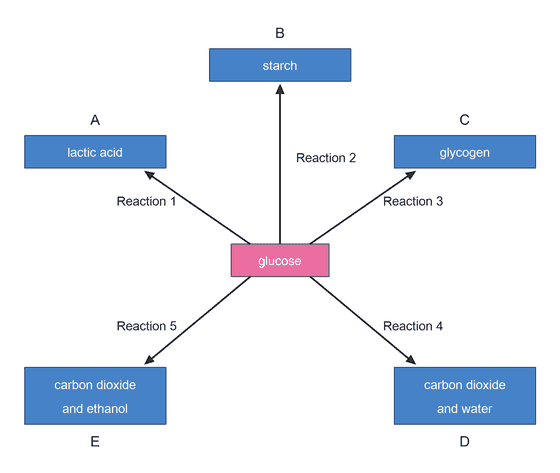
(a) Write the reaction number of the following :
(i) Anaerobic respiration in plants ..........
(ii) End-products in aerobic respiration ..........
(iii) Reaction occurring in liver ..........
(iv) Anaerobic respiration in animals ..........
(v) Storage in the liver ..........
(b) Which reactions (1–5) in the above correspond to the following (write the corresponding number of reaction next to them).
(i) Aerobic respiration
(ii) Change taking place in the liver
(iii) Anerobic respiration in yeast.
(iv) Change taking place in a plant storage organ, e.g., potato.
(v) Anaerobic respiration in animals
Solve with AIWritten solution
Solution:
Concept: Read the chart: reaction 1 gives lactic acid (A), 2 gives starch (B), 3 gives glycogen (C), 4 gives carbon dioxide and water (D), and 5 gives carbon dioxide and ethanol (E).
Step 1 — Name each reaction.
Lactic acid is from anaerobic respiration in animals; starch is the storage form in plants; glycogen is the storage form in the liver; carbon dioxide and water are the end-products of aerobic respiration; ethanol and carbon dioxide come from anaerobic respiration in plants and yeast.
Step 2 — (a) Fill the blanks.
Using these meanings:
- (i) anaerobic respiration in plants — 5;
- (ii) end-products in aerobic respiration — 4;
- (iii) reaction occurring in liver — 3;
- (iv) anaerobic respiration in animals — 1;
- (v) storage in the liver — 3.
Step 3 — (b) Match the reactions.
Again from the chart:
- (i) aerobic respiration — 4;
- (ii) change taking place in the liver — 3;
- (iii) anaerobic respiration in yeast — 5;
- (iv) change in a plant storage organ, e.g. potato — 2;
- (v) anaerobic respiration in animals — 1.
Watch out: Starch is stored in plants and glycogen in the liver; do not swap 2 and 3.
Therefore, (a) 5, 4, 3, 1, 3 and (b) 4, 3, 5, 2, 1.
- 4510 marks
Question 45
The volume of air in the lungs and the rate at which it is exchanged during inspiration and expiration was measured.
The following diagram shows a group of the lung volumes and capacities :

Study the diagram carefully and explain briefly the following :
(a) Tidal volume
(b) Inspiratory reserve volume
(c) Expiratory reserve volume
(d) Vital capacity
(e) Residual volume
Solve with AIWritten solution
Solution:
Concept: Each lung volume is the difference between two levels on the graph.
Step 1 — (a) Tidal volume.
The air breathed in and out in normal, quiet breathing: the small waves between 2500 and 3000 mL, so about 500 mL (350 mL alveolar air + 150 mL dead space air).
Step 2 — (b) Inspiratory reserve volume.
The extra air that can be breathed in by force after a normal breath in (complemental air): from 3000 up to 6000 mL.
Step 3 — (c) Expiratory reserve volume.
The extra air that can be breathed out by force after a normal breath out (supplemental air): from 2500 down to 1500 mL.
Step 4 — (d) Vital capacity.
The largest volume that can be breathed out after the deepest breath in; it is the sum of the three volumes above.
Step 5 — (e) Residual volume.
The air that always stays in the lungs even after the most forceful breath out: the part below 1500 mL, about 1500 mL. It keeps the alveoli from collapsing.
Watch out: Vital capacity leaves out the residual volume; total lung capacity (6000 mL) includes it.
Therefore, tidal volume ≈ 500 mL, inspiratory reserve volume ≈ 3000 mL, expiratory reserve volume ≈ 1000 mL, vital capacity ≈ 4500 mL and residual volume ≈ 1500 mL, each as explained above.
- 466 marks
Question 46
The figure given below represents a certain organ of the human chest cavity. Study the same and answer the following questions.

(a) Identify the organ and the organ system.
(b) Label the guidelines 1 to 6.
(c) What are the two advantages of C-shaped cartilaginous rings found in structure 1 ?
(d) Name the fluid filled between the two protective layers of the organ shown as part 2.
(e) Name the basic structural and functional unit of part 2.
Solve with AIWritten solution
Solution:
Concept: The figure is a front view of the chest: the windpipe and its branches, the lungs in their pleura, the ribs at the sides and the diaphragm below.
Step 1 — (a) Organ and system.
The organ is the lungs, part of the respiratory system.
Step 2 — (b) The guidelines.
Reading the figure:
- 1 — trachea (windpipe), with its cartilage rings;
- 2 — lung;
- 3 — bronchus, the branch of the trachea entering the lung;
- 4 — rib;
- 5 — pleura (the pleural membranes around the lung);
- 6 — diaphragm.
Step 3 — (c) The C-shaped rings of the trachea.
They help in two ways:
- they keep the trachea always open, so it never collapses and air passes freely;
- being incomplete at the back, they let the oesophagus behind it bulge forward when food is swallowed.
Step 4 — (d) Fluid between the pleural layers.
The space between the two pleural membranes holds pleural fluid, which reduces friction as the lung moves.
Step 5 — (e) Unit of the lung.
The structural and functional unit of the lung is the alveolus (air sac).
Therefore, (a) lungs, respiratory system; (b) 1 trachea, 2 lung, 3 bronchus, 4 rib, 5 pleura, 6 diaphragm; (c) keep the trachea open and let the oesophagus expand; (d) pleural fluid; (e) alveolus.
- 476 marks
Question 47
The figure given alongside shows an experimental set up to demonstrate a process. Answer the following questions.
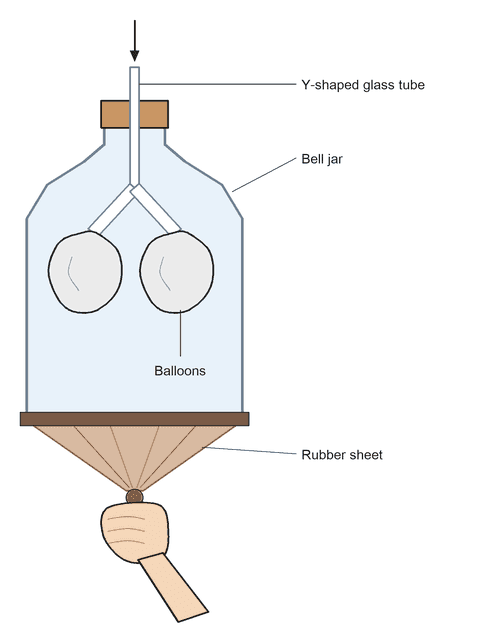
(a) Name the process depicted.
(b) What are the two steps of the above mentioned process ?
(c) What do the following parts in the diagram represent ?
(1) Balloons
(2) Rubber sheet
(3) Bell jar
(d) Write the exact location of the organ represented by the balloons in the human body.
Solve with AIWritten solution
Solution:
Concept: The bell-jar model shows how the diaphragm brings about breathing: changing the space inside the jar changes the pressure, so air moves into or out of the balloons.
Step 1 — (a) The process.
The model shows breathing (the mechanism of breathing by the diaphragm). With the rubber sheet pulled down, air enters the balloons, as in inspiration.
Step 2 — (b) Its two steps.
Breathing has two steps: inspiration (inhalation) and expiration (exhalation).
Step 3 — (c) What each part represents.
Each part of the model stands for a part of the body:
- (1) balloons — the lungs;
- (2) rubber sheet — the diaphragm;
- (3) bell jar — the thoracic (chest) cavity with its walls.
Step 4 — (d) Where the lungs are.
The lungs lie in the thoracic (chest) cavity, one on each side of the heart, enclosed by the rib cage, with their bases resting on the diaphragm.
Watch out: Pulling the sheet down copies inspiration; pushing it up copies expiration.
Therefore, (a) breathing, (b) inspiration and expiration, (c) lungs, diaphragm, chest cavity, (d) in the thoracic cavity on either side of the heart, inside the rib cage and above the diaphragm.
What Class 9 Biology Ch 14 covers
The sections of the chapter, in the order the book takes them. Every question above comes from one of these.
- 01The Need for Respiration
- 02Animals Need More Energy
- 03Glucose Has No Alternative for Respiration
- 04Two Kinds of Respiration – Aerobic and Anaerobic
- 05Parts of Respiration
- 06Respiratory Organs (Breathing)
More ways to study this chapter
The same chapter asked three other ways. Practise it, revise it, and see what the board has set on Ch 14 before.
Class 9 Biology Ch 14 questions students ask
How many questions are there in Class 9 Biology Ch 14?
47 questions. Every one is solved step by step on this page.
Are these Class 9 Biology solutions free?
Yes. Every question and its full working is free to read, with no account needed.
Can I download the Class 9 Biology Ch 14 solutions as a PDF?
There is no PDF to download. Every solution is on this page instead, which means it is searchable, always the current syllabus, and readable on a phone. Use your browser's print option if you want it on paper.