Solution:
Concept: The bell-jar model shows how the diaphragm brings about breathing: changing the space inside the jar changes the pressure, so air moves into or out of the balloons.
Step 1 — (a) The process.
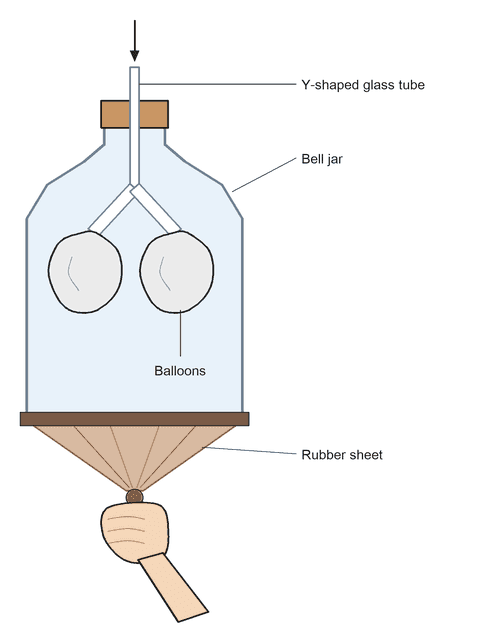
The model shows breathing (the mechanism of breathing by the diaphragm). With the rubber sheet pulled down, air enters the balloons, as in inspiration.
Step 2 — (b) Its two steps.
Breathing has two steps: inspiration (inhalation) and expiration (exhalation).
Step 3 — (c) What each part represents.
Each part of the model stands for a part of the body:
- (1) balloons — the lungs;
- (2) rubber sheet — the diaphragm;
- (3) bell jar — the thoracic (chest) cavity with its walls.
Step 4 — (d) Where the lungs are.
The lungs lie in the thoracic (chest) cavity, one on each side of the heart, enclosed by the rib cage, with their bases resting on the diaphragm.
Watch out: Pulling the sheet down copies inspiration; pushing it up copies expiration.
Therefore, (a) breathing, (b) inspiration and expiration, (c) lungs, diaphragm, chest cavity, (d) in the thoracic cavity on either side of the heart, inside the rib cage and above the diaphragm.