
Opening your dashboard
Class 9 Biology Chapter 14 The Respiratory System: Competency-Based Questions (CBQ)
40 questions on Chapter 14, each worked through on its own page with the AI tutor. Class 9 Biology, ICSE 2026-27.
40 questions
1–5 marks · Mixed difficulty
- 11 mark
Question 1
Cognitive domain: Application
During the lunch break, Rohan bursts out laughing just as he is swallowing a mouthful of puffed rice. At once he starts coughing hard. Which is the most likely cause of the cough ?
- 21 mark
Question 2
Cognitive domain: Analysis
The figure is a simple sketch of two tubes of the neck, X and Y, cut across. The person is not swallowing anything at this moment.

Which option identifies the two tubes correctly and explains their shapes ?
- 31 mark
Question 3
Cognitive domain: Analysis
Two students set up the experiment shown in their textbook. They placed a live cockroach in conical flask A and a dead cockroach (soaked in formalin) in a similar flask B. Both flasks were made air-tight and left for three hours. Then a small burning candle was lowered into each flask and the flask was closed again at once.
Flask Contents Time for which the candle burned A Live cockroach 6 seconds B Dead cockroach 15 seconds A classmate objects : "The flame may have gone out sooner in flask A only because a cockroach's body takes up some space in the flask, not because it was respiring." Which feature of the experiment answers this objection ?
- 41 mark
Question 4
Cognitive domain: Application
On a cold December morning in Shimla, Tashi waits for the school bus without a sweater. Soon he begins to shiver and his teeth start chattering. What is the best explanation for these movements ?
- 51 mark
Question 5
Cognitive domain: Understanding
Assertion (A): When glucose is oxidised in a living cell, all its energy is not given out as heat, as it is when sugar burns in a flame.
Reason (R): In respiration, a large part of the energy liberated is converted into chemical energy in the form of ATP.
- 61 mark
Question 6
Cognitive domain: Analysis
Assertion (A): If you hold your breath, a stage soon comes when you cannot hold it any longer.
Reason (R): The respiratory centre in the medulla oblongata is stimulated by a rise in the oxygen content of the blood.
- 71 mark
Question 7
Cognitive domain: Understanding
Nikhil cheered loudly all through a kabaddi match. Next morning he can only whisper. The doctor tells him that the two ligamentous folds in his voice-box are swollen and need rest.
Complete the sentence :
Nikhil cannot speak aloud because his ______ cannot vibrate properly when air is expelled through them, and these folds lie inside the ______.
- 81 mark
Question 8
Cognitive domain: Application
A singer wants to hold a single note for as long as she can. Take the respiratory volumes of a normal adult. If she starts the note just after a normal, quiet breath in, the most air she can breathe out is the tidal air and the expiratory reserve volume together, that is 500 mL + 1000 mL = 1500 mL.
Complete the sentence :
If she first breathes in as deeply as she can, the most air she can then breathe out is ______ mL, and this volume is called her ______ capacity.
- 91 mark
Question 9
Cognitive domain: Application
A long-distance runner drinks a solution containing 90 g of glucose. Assume that all of it is completely oxidised in her cells by aerobic respiration. One mole of glucose (180 g) releases 686 kcal of energy.
Complete the sentence :
The energy released from this glucose is ______ kcal, and the part of it that is not stored in ATP is given out as ______ energy.
- 102 marks
Question 10
Cognitive domain: Evaluation
Forty students are writing a three-hour examination in a small room on a cold January morning. All the doors and windows are shut. Towards the end, the invigilator opens the windows. Karan protests, "Sir, it will get cold. The room is full of air, and air always has enough oxygen."
Is Karan's objection sound ? Justify your answer, using the way expired air differs from inspired air.
- 112 marks
Question 11
Cognitive domain: Application
During a demonstration, a teacher drops a small piece of a goat's lung and a small piece of its liver into a beaker of water. The piece of lung floats, but the piece of liver sinks.
Explain why the piece of lung floats. Use the structure of the lungs and one respiratory volume in your answer.
- 122 marks
Question 12
Cognitive domain: Understanding
After a heavy lunch, Arjun pulls his belt very tight around his abdomen. He finds that he cannot take a really deep breath until he loosens the belt.
Explain why, using the movement of the diaphragm during inspiration.
- 135 marks
Question 13
Cognitive domain: Analysis
Case: In a biology practical, Ishaan passed a measuring tape round his partner's chest, just below the armpits, and noted the reading at four stages of breathing.
Stage of breathing Chest measurement End of a normal expiration 80 cm End of a normal inspiration 82 cm End of the deepest possible inspiration 86 cm End of a forced expiration 78 cm (a) By how much did the chest measurement increase during a normal inspiration ? Name the muscles that contracted and state how the ribs moved.
(b) The tape shows the chest growing bigger all around. In which other direction does the chest cavity enlarge during inspiration ? Name the structure responsible and state what it does.
(c) Explain how this enlargement of the chest cavity makes air enter the lungs.
(d) At the end of a forced expiration the reading is lower than at the end of a normal expiration. Which muscles bring about this extra change, and how does it help the body ? Also find the difference between the highest and the lowest readings.
- 144 marks
Question 14
Cognitive domain: Evaluation
Case: Rahul, a school sprinter, sat at rest for two minutes, ran as fast as he could for the next two minutes and then sat down again. The amount of lactic acid in his blood was measured during the whole period. The results are shown in the graph.

(a) During which period did the lactic acid in his blood rise ? What does this tell you about the respiration going on in his leg muscles during that period ?
(b) Rahul says, "I stopped running at 4 minutes, so from that moment my body needed no extra oxygen." Use the graph to judge his statement.
(c) His friend says, "Anaerobic respiration needs no oxygen, so it is the better way for muscles to get energy." Do you agree ? Give two reasons.
- 155 marks
Question 15
Cognitive domain: Creativity
Case: The science club has the apparatus described in the chapter for measuring the volume of expired air : a large bottle full of water, fitted with a short tube to blow through and a long tube through which water is pushed out into a basin. Aditi wants to use it to find out whether taller students can breathe out more air in one breath than shorter students. She also has a measuring cylinder, a measuring tape and a packet of clean drinking straws.
(a) Plan her investigation. State what she changes, what she measures and two things she must keep the same. How will she keep the test hygienic ?
(b) Draw a table in which she can record her results.
(c) How should she use the results to reach a conclusion ? State one reason why the volume measured is less than the total amount of air the lungs can hold.
- 161 mark
Question 16
Cognitive domain: Analysis
The trace shows the volume of air in the lungs of Mr Gupta, an adult who is recovering from a chest infection. It records quiet breathing, then the deepest possible breath in, then the deepest possible breath out, and then quiet breathing again. Dashed levels A, B, C and D are marked. (Hypothetical data.)

The vital capacity of a normal adult is . By how much is the vital capacity of Mr Gupta lower than this normal value ?
- 171 mark
Question 17
Cognitive domain: Analysis
The figure is a simple scheme (not to scale) of the air passages inside the lungs. The trachea divides into two main tubes, P and R. The small circles are clusters of air sacs, numbered 1 to 5.

A thick plug of mucus completely blocks tube P, but the trachea and tube R stay open. How many clusters of air sacs still receive fresh air, and why ?
- 181 mark
Question 18
Cognitive domain: Application
A doctor compares two samples of blood taken from the two kinds of blood vessels that join the lungs to the heart of a patient. (Hypothetical data.)
Sample Haemoglobin combined with oxygen Carbon dioxide in of blood X Y Which option names the vessel from which sample Y was taken and says where that vessel carries the blood ?
- 191 mark
Question 19
Cognitive domain: Analysis
During a lesson on breathing, Meera's teacher records what she sees in Meera at one moment of a breathing cycle. (Hypothetical observations.)
Part observed State at this moment Diaphragm Relaxed and moving up to its dome-like shape External intercostal muscles Relaxed Internal intercostal muscles Contracting Rib cage Moving downwards and inwards Which moment of breathing is this, and what is happening to the air in the lungs ?
- 201 mark
Question 20
Cognitive domain: Analysis
Assertion (A): On a cool morning, the air we breathe out is warmer than the air we breathe in.
Reason (R): The air we breathe out contains more carbon dioxide than the air we breathe in.
- 211 mark
Question 21
Cognitive domain: Understanding
Assertion (A): The right lung has two lobes and the left lung has three lobes.
Reason (R): The left lung is slightly smaller than the right lung, to make room for the heart.
- 221 mark
Question 22
Cognitive domain: Application
A toddler puts a small bead in his mouth and it slips into his windpipe and blocks it. (Hypothetical case.) Very little fresh air reaches his lungs, the carbon dioxide in his blood rises and the oxygen supply falls, so his blood becomes more venous.
Which statement describes his condition correctly ?
- 231 mark
Question 23
Cognitive domain: Application
A coach explains how muscle cells get energy from glucose, using the values given in the textbook: aerobic respiration forms ATP for each glucose broken down, and anaerobic respiration in animal muscles forms ATP. A muscle sample uses up moles of glucose. (Hypothetical data.)
How many more moles of ATP are formed if all of it is respired aerobically than if all of it is respired anaerobically ?
- 241 mark
Question 24
Cognitive domain: Application
Ria's teacher times her quiet breathing. (Hypothetical data.) Ria breathes times in one minute. Each inspiration takes and each expiration takes . The respiratory cycle is made of an inspiration, an expiration and a very short respiratory pause.
How long is the pause in each cycle ?
- 251 mark
Question 25
Cognitive domain: Application
After a road accident, Mr Rao's lips, cheeks, tongue and jaws became so weak that he cannot shape his voice into words. (Hypothetical case.) When he hums, however, a clear and steady sound comes from his throat.
Which statement explains his condition correctly ?
- 262 marks
Question 26
Cognitive domain: Analysis
Three friends noted the average food they ate in a day for a week. (Hypothetical data.)
Person Carbohydrate (g) Protein (g) Amit 450 60 Bhavna 300 55 Chirag 150 220 (a) Whose liver has to break down the largest amount of excess amino acids ? Give a reason.
(b) Name the two things that are formed from the excess amino acids in the liver and state what happens to each.
- 272 marks
Question 27
Cognitive domain: Analysis
Three situations in animals are described. (Hypothetical situations.)
P: A tapeworm lives in the intestine of a person, where there is hardly any oxygen.
Q: The leg muscles of a boy are working while he walks slowly to school.
R: The leg muscles of the same boy are working while he runs as fast as he can to catch a bus.
(a) In which of P, Q and R do the cells respire anaerobically ?
(b) Name the product formed from glucose in the muscles in R, and state two ways in which the respiration in R differs from the respiration in Q.
- 282 marks
Question 28
Cognitive domain: Evaluation
Neha counts the breaths of her baby cousin, who is only three days old, while the baby sleeps. She counts breaths in one minute and becomes worried. Her aunt says it is normal. (Hypothetical data.)
(a) Who is right ? Support your answer with the breathing rates given in the chapter.
(b) How many more breaths does the baby take in one hour than a healthy adult who breathes times a minute ?
- 292 marks
Question 29
Cognitive domain: Evaluation
On a hot afternoon Seema breathes gently on a glass slide that has been lying in the sun. No droplets appear on it. She says, "This shows that the air we breathe out has no water vapour in it."
Is Seema's conclusion correct ? Give a reason and say how she should repeat the experiment.
- 302 marks
Question 30
Cognitive domain: Understanding
Anil is sitting in a room where a flower vase gives out a very faint smell. While he breathes normally he cannot notice any smell, but the moment he gives a little sniff he can.
Use the structure of the nose to explain why.
- 312 marks
Question 31
Cognitive domain: Evaluation
Sunil says, "A banyan tree stays fixed in one place and does not move, so it needs no energy and does not respire."
(a) Is Sunil right ? Name two activities in the cells of the tree that need energy.
(b) Give one reason why animals need more energy than plants.
- 323 marks
Question 32
Cognitive domain: Application
Sanjay eats glucose biscuits that give him of glucose. All of it is oxidised completely by aerobic respiration in his cells. (Hypothetical data.)
Use the overall reaction . One mole of glucose is . One mole of oxygen is , one mole of carbon dioxide is and one mole of water is .
(a) Find the mass of oxygen that is needed.
(b) Find the mass of carbon dioxide that is formed.
(c) Find the mass of water that is formed, and show that the mass of glucose and oxygen used equals the mass of carbon dioxide and water formed.
- 333 marks
Question 33
Cognitive domain: Analysis
Two persons, X and Y, are breathing quietly. In both of them the dead air space is . (Hypothetical data.)
Person Breaths per minute Tidal volume (mL) X (slow, deep breaths) 12 600 Y (fast, shallow breaths) 30 250 (a) Find the volume of fresh air that reaches the air sacs of X in one minute.
(b) Y wants the same volume of fresh air to reach his air sacs each minute while he still breathes times a minute. What tidal volume would he need ?
(c) With his actual tidal volume of , Y breathes in more air in a minute than X. Show this, and explain why his air sacs still get less fresh air than those of X.
- 343 marks
Question 34
Cognitive domain: Analysis
Two patients, M and N, are studied by a doctor. (Hypothetical cases.) In M the diaphragm cannot contract, but the muscles between the ribs work normally. In N the external intercostal muscles cannot contract, but the diaphragm works normally.
(a) In which direction can the chest cavity of M no longer be enlarged, and which structure still enlarges it ?
(b) In which direction can the chest cavity of N no longer be enlarged, and what does his working diaphragm do ?
(c) Both patients can still draw in a small amount of air. Explain this, stating what happens to the pressure inside their lungs.
- 353 marks
Question 35
Cognitive domain: Application
Ravi's grandfather has smoked for forty years. His doctor says that the smoke has damaged the cilia that line his trachea and bronchi. (Hypothetical case.) He coughs up a lot of mucus every morning.
(a) Name the two kinds of cells that line the trachea and state what each does.
(b) What happens to the dust and germs that are trapped in the mucus when the cilia no longer sweep ?
(c) What does his morning cough do for him ?
- 363 marks
Question 36
Cognitive domain: Understanding
Rani runs up the school stairs. Four events in her body are listed. (Hypothetical situation.)
Event 1: Air is drawn in through her nostrils and moves down into her lungs.
Event 2: Red blood cells carry oxygen as oxyhaemoglobin through arteries to her leg muscles.
Event 3: Oxygen passes through the thin wall of a capillary into a muscle cell.
Event 4: Inside a muscle cell, glucose is broken down to release energy.
(a) Name the part of respiration to which each event belongs.
(b) Her friend says, "Breathing and respiration are the same thing." Correct this statement.
- 374 marks
Question 37
Cognitive domain: Analysis
Case: The graphs show how the volume of air in the lungs of a healthy student, and the pressure inside her lungs, change during two quiet breaths. In the lower graph, means the same pressure as the atmosphere outside. (Hypothetical data.)
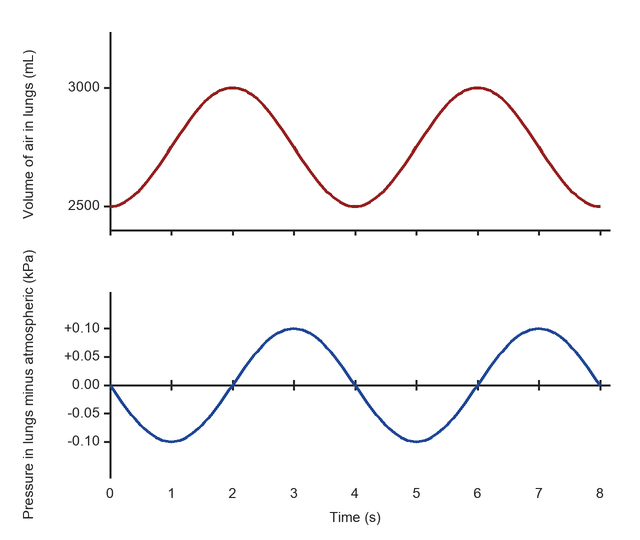
(a) Find the volume of air that enters her lungs during one inspiration. What is this volume called ?
(b) Between and s the pressure in the lungs is below the atmospheric pressure. Name the muscles that contract in this period and explain how their action makes air flow in.
(c) At s the lungs hold the most air and the pressure inside them is the same as outside. Why does air neither enter nor leave at that moment, and what begins to happen just after it ?
- 384 marks
Question 38
Cognitive domain: Creativity
Case: Workers at a stone-crushing yard breathe in a lot of dust. A school science club wants to design a two-layer dust mask in which each layer copies one natural defence of the nose against dust. The club has a coarse net cloth and a damp, soft cloth.
(a) Name the part of the nose that the coarse net copies and the secretion that the damp cloth copies, and say what each one traps.
(b) The air passages need no changing, but a mask has to be washed or changed often. Name the structures that clear the trapped dust in the air passages and say how they do it.
(c) Plan a fair test to find out which of two masks traps more dust. State what you will change, what you will measure and two things that you will keep the same.
- 394 marks
Question 39
Cognitive domain: Application
Case: The two lungs of a healthy adult have about million air sacs (alveoli). Their total surface area is about . In a person with a lung disease many air sacs have been destroyed and only of surface is left. (Hypothetical patient.) Use .
(a) Find the average surface area of one air sac of a healthy adult in .
(b) If the air sacs that are left are of the same average size, how many are left ?
(c) The patient becomes breathless on climbing a few stairs. Explain why, and name two features of the wall of a healthy air sac that make gas exchange easy.
- 405 marks
Question 40
Cognitive domain: Evaluation
Case: Two organisms, P and Q, were studied in a laboratory. Their features are noted below. (Hypothetical data.)
Feature P Q Special breathing (ventilation) movements None Present How oxygen reaches the cells Direct diffusion from the air spaces Carried by the blood Detectable heat produced Very little Considerable Rate of respiration Low High Product of the breakdown of glucose when oxygen is short Ethanol and carbon dioxide Lactic acid only (a) Identify P and Q as a plant or an animal, giving two reasons from the table.
(b) P is a green plant kept in sunlight. Name the extra source of oxygen that P has and Q does not.
(c) A student says, "P gives out very little heat, so it is not respiring." Evaluate this statement.
(d) Write the word equation for the anaerobic respiration of the muscle cells of Q, and state one way in which its energy release differs from aerobic respiration.