
Opening your dashboard
Class 9 Biology Chapter 14 The Respiratory System: Practice Questions
42 questions on Chapter 14, each worked through on its own page with the AI tutor. Class 9 Biology, ICSE 2026-27.
42 questions
1–5 marks · Mixed difficulty
- 11 mark
Question 1
Bloom's level: Remember
The simple carbohydrate that body cells break down in respiration to release energy is :
- 21 mark
Question 2
Bloom's level: Remember
Carbon dioxide is carried from the tissues to the lungs partly in combination with haemoglobin and partly as :
- 31 mark
Question 3
Bloom's level: Remember
The total surface area of all the alveoli in the two lungs of an adult is about :
- 41 mark
Question 4
Bloom's level: Remember
The volume of air that can be forcibly breathed out after a normal expiration (supplemental air) is about :
- 51 mark
Question 5
Bloom's level: Understand
After a fast 400 m race, an athlete's leg muscles feel tired and ache. This is mainly because :
- 61 mark
Question 6
Bloom's level: Understand
Birds and mammals need more energy than a frog of the same size mainly because they :
- 71 mark
Question 7
Bloom's level: Understand
During inspiration, air flows into the lungs because :
- 81 mark
Question 8
Bloom's level: Apply
A tiger eats almost nothing but meat, which has very little carbohydrate. Its body cells still get glucose for respiration because :
- 91 mark
Question 9
Bloom's level: Apply
A sample of air is analysed: oxygen , carbon dioxide , nearly saturated with water vapour and at about . The sample is most likely :
- 101 mark
Question 10
Bloom's level: Analyse
Assertion (A): The trachea does not collapse when the air pressure inside it falls during inspiration.
Reason (R): The walls of the trachea are supported by C-shaped rings of cartilage.
- 111 mark
Question 11
Bloom's level: Evaluate
Assertion (A): Anaerobic respiration in the leg muscles during a sprint gives out carbon dioxide.
Reason (R): In human muscle cells, anaerobic respiration turns glucose into lactic acid only.
- 121 mark
Question 12
Bloom's level: Analyse
Assertion (A): Liver cells produce a large amount of the heat that keeps our body warm.
Reason (R): The liver breaks down excess amino acids into glucose and urea.
- 132 marks
Question 13
Bloom's level: Understand
Why is the energy-releasing part of respiration called cellular or tissue respiration ? Name the two places in a cell where its two main phases take place.
- 142 marks
Question 14
Bloom's level: Understand
During tissue respiration, oxygen moves from the blood capillaries into the body cells, while carbon dioxide moves in the opposite direction. Explain why.
- 152 marks
Question 15
Bloom's level: Understand
Explain three features of the alveoli that make them suitable for exchange of gases.
- 162 marks
Question 16
Bloom's level: Apply
One mole of glucose releases 686 kcal on complete oxidation. Of this, 38 ATP are formed, and each ATP stores 7 kcal; the rest is given off as heat. How much energy is stored as ATP, and how much is released as heat, when 2 moles of glucose are completely oxidised ?
- 172 marks
Question 17
Bloom's level: Apply
A trained swimmer's lung volumes are : tidal volume , inspiratory reserve volume , expiratory reserve volume and residual volume . Calculate her inspiratory capacity, vital capacity and total lung capacity.
- 182 marks
Question 18
Bloom's level: Apply
A resting adult takes 16 breaths per minute with a tidal volume of . The dead air space is . How much air does he breathe in per minute, and how much of it actually reaches the alveoli ?
- 192 marks
Question 19
Bloom's level: Apply
After a 100 m sprint, Kunal stops running but keeps panting heavily for several minutes. Explain why he continues to breathe fast even though he is no longer running.
- 202 marks
Question 20
Bloom's level: Analyse
Inspired air contains oxygen and carbon dioxide; expired air contains oxygen and carbon dioxide. Taking one breath as , work out how much oxygen is taken up and how much carbon dioxide is added in the lungs per breath. What do your two answers tell you ?
- 212 marks
Question 21
Bloom's level: Evaluate
Ravi says, "Respiration takes place only in the lungs." Do you agree ? Justify your answer.
- 222 marks
Question 22
Bloom's level: Understand
ATP is often described as the cell's "energy currency". Explain this description, using the change of ATP to ADP and back.
- 234 marks
Question 23
Bloom's level: Apply
Case: A group of students went on a trek to a pass about 5000 metres above sea level. Near the top, two of them felt dizzy, had unsteady vision and found it hard to keep their balance. They felt better after coming down to a lower camp.
(a) What change in the air at that height caused their trouble ?
(b) Name the condition in which too little oxygen reaches the tissues. Give one other everyday situation, not related to height, in which it can occur.
(c) Explain why coming down to the lower camp helped them recover.
- 244 marks
Question 24
Bloom's level: Apply
Case: In the evening Tara's grandmother mixes yeast into dosa batter; by morning the batter has risen and smells slightly of alcohol. The same evening Tara's brother plays a hard football match, and by the end of the match his leg muscles feel tired and heavy.
(a) Name the type of respiration in the yeast and in the brother's leg muscles.
(b) Write the products of this respiration in each case.
(c) Explain why the batter rises but the muscles do not swell up with gas.
- 254 marks
Question 25
Bloom's level: Apply
Aman fills his chest with air to the maximum and then blows out as much as he can through the short tube of a bottle full of water. The water pushed out through the other tube measures .
(a) Which lung capacity has he measured ?
(b) Why is this volume less than his total lung capacity ?
(c) If his residual volume is , tidal volume and expiratory reserve volume , find his total lung capacity and his inspiratory reserve volume.
- 264 marks
Question 26
Bloom's level: Analyse
Case: In the lime-water experiment, two flasks A and B hold equal volumes of clear lime water and are joined to a common mouth-tube. Priya breathes in through the tube with clip C open and clip D closed, so the air enters through flask A; then she breathes out with clip C closed and clip D open, so the air goes through flask B. She repeats this many times. Flask B turns milky after about 5 breaths, but flask A shows only a faint milkiness even after 50 breaths.
(a) What kind of air bubbles through each flask ?
(b) Why does flask A also turn slightly milky in the end ?
(c) A classmate says the result is only because flask B had stronger lime water. How should the experiment be set up so that this objection does not hold ? What conclusion can then be drawn ?
- 273 marks
Question 27
Bloom's level: Analyse
In the bell-jar model of breathing, two balloons hang from a Y-tube inside a bell jar whose open bottom is covered with a rubber sheet.
(a) Predict what happens to the balloons when the rubber sheet is pulled down, and give the reason.
(b) What happens when the sheet is pushed up ?
(c) Point out two ways in which this model does not fully show how our chest works during breathing.
- 283 marks
Question 28
Bloom's level: Evaluate
Ankit plans to eat only eggs and meat, with almost no carbohydrate, for a month. His friend warns, "Without carbohydrates your body will have no glucose, so your cells will stop respiring."
(a) Is the friend's warning correct ? Justify.
(b) Explain how the body will still meet its need for glucose.
(c) State one extra load that such a diet puts on the body.
- 295 marks
Question 29
Bloom's level: Create
Plan an investigation to find out how exercise changes the breathing rate of a classmate.
(a) Describe your method, including how you will make the readings reliable.
(b) Draw up a table for your readings and fill it with the kind of results you expect.
(c) Explain the expected result, naming the part of the brain that controls the breathing rate and what stimulates it.
- 305 marks
Question 30
Bloom's level: Create
Construct a table to compare the trachea, bronchi, bronchioles and alveoli under these headings :
(a) Cartilage rings present or absent
(b) One special feature of structure
(c) Main function
- 311 mark
Question 31
Which one of the following statements about the human lungs is correct ?
- 321 mark
Question 32
The respiratory centre of the brain makes us breathe faster when there is a slight increase, in the blood, of :
- 331 mark
Question 33
Assertion (A): The air we breathe out contains very few dust particles, if any.
Reason (R): The dust particles of the air we breathe in are caught in the mucus of the respiratory passages.
- 342 marks
Question 34
Birds and mammals have to produce a lot of heat to keep their bodies warm.
(i) Name the two kinds of body cells that produce most of this heat, and the process in these cells from which the heat comes.
(ii) On a very cold morning a boy begins to shiver and his teeth start clattering. How does this help him ?
- 352 marks
Question 35
Respiration without oxygen can take place in plant cells and also in the skeletal muscles of a person who is running very fast.
(i) Name the products formed from glucose in this kind of respiration in plants and in the muscles.
(ii) Why can this kind of respiration not go on for a long time in the muscles ? What happens to the product when the person rests ?
- 362 marks
Question 36
Gaseous transport is one of the four major parts of respiration in humans.
(i) In what form is oxygen carried by the blood, and through which kind of blood vessels is it carried throughout the body ?
(ii) State the two ways in which the carbon dioxide from the tissues is transported by the blood to the lungs.
- 372 marks
Question 37
The larynx is popularly called the voice-box.
(i) What are the vocal cords, and where exactly is the larynx located ?
(ii) How is the voice produced ? How are we able to produce a range of sounds ?
- 383 marks
Question 38
An athlete breathes out forcibly again and again just after finishing a race.
(i) Name the muscles of the rib cage that contract only during such a forced expiration, and state the effect of their contraction.
(ii) Describe the diaphragm at the end of an expiration. What happens to the volume of the thoracic cavity and to the air pressure inside the lungs during expiration ?
(iii) State the normal breathing rate of an adult and of a new-born baby. How far is breathing under the control of our will ?
- 394 marks
Question 39
The column in the figure shows how much air there is in the lungs of a healthy young man at four moments of his breathing. The column is divided into four blocks P, Q, R and S.
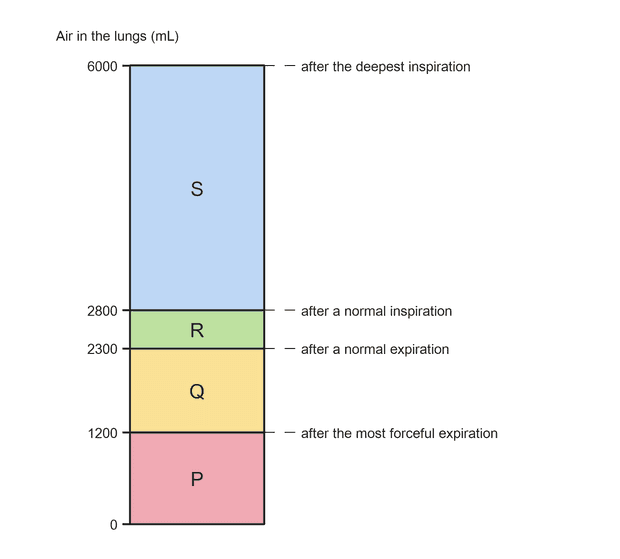
(i) Name the lung volume represented by each of the blocks P, Q, R and S.
(ii) From the figure, calculate his tidal volume and his vital capacity.
(iii) Only a part of the air of block R reaches his air sacs. Name the rest of this air and state why it takes no part in the exchange of gases.
- 403 marks
Question 40
A live cockroach was placed in conical flask A, and a dead cockroach that had been soaked in formalin was placed in conical flask B. Both flasks were closed with rubber corks and left for a few hours. A small burning candle was then introduced into each flask, as shown in the figure, and the flasks were at once closed tightly again.

(i) In which flask does the candle flame go out first ? Give a reason.
(ii) What is the purpose of flask B ? Why was the dead cockroach soaked in formalin ?
(iii) What does this experiment prove ? Why must the two flasks be air-tight ?
- 411 mark
Question 41
Class 9 Sample Paper 2 · Section A
What are the products of anaerobic respiration?
- 422 marks
Question 42
Class 9 Sample Paper 2 · Section B
Why should we breathe through the nose?