
Opening your dashboard
Class 9 Biology Chapter 11: Digestive System Solutions
46 textbook questions with step-by-step answers, free to read, for ICSE 2026-27.
Get talked through Ch 11, not just shown the answer
Reading a finished solution is not the same as being able to do it. The AI tutor takes one question at a time and works it with you, in your own words, until you can.
- Ask it out loud, in your own words
- It gives you the next step, not the answer
- Stuck on part (ii)? Start there
46 questions with solutions
1–12 marks · Mixed difficulty
- 11 mark
Question 1
Given below is a jumbled sequence of the different parts of the human alimentary canal. Rewrite them in correct sequence.
Stomach, Oesophagus, Large intestine, Small intestine, Pharynx.
Solve with AIWritten solution
Solution:
Concept: The alimentary canal is one continuous tube from the mouth to the anus. Food always passes through its parts in the same order.
Step 1 — Start after the mouth.
The mouth cavity opens behind into the pharynx (throat), the common passage for food and air.
Step 2 — Follow the food down.
From the pharynx the food enters the oesophagus (food pipe), which carries it through the chest into the stomach.
Step 3 — Finish with the intestines.
The stomach passes the food into the small intestine, where digestion is completed and the food is absorbed. The remains then go into the large intestine.
Watch out: The small intestine comes first. It is called 'small' because it is narrower, not because it is shorter.
Therefore, the correct sequence is Pharynx → Oesophagus → Stomach → Small intestine → Large intestine.
- 24 marks
Question 2
Give the technical names for the following types of teeth in humans (on each side, in each jaw)
(i) The three last grinders.
(ii) The pointed tooth for holding and tearing.
(iii) The broad sharp cutting teeth.
(iv) The two temporary (deciduous) grinding teeth.
Solve with AIWritten solution
Solution:
Concept: Human teeth are of four kinds: incisors (cutting), canines (tearing), premolars and molars (grinding). In each half of each jaw an adult has 2 incisors, 1 canine, 2 premolars and 3 molars.
Step 1 — (i) The three last grinders.
The last three broad grinding teeth on each side of each jaw are the molars.
Step 2 — (ii) The pointed tooth.
The single pointed tooth on each side of each jaw, used for holding and tearing, is the canine.
Step 3 — (iii) The broad sharp cutting teeth.
The flat, chisel-shaped front teeth used for biting and cutting are the incisors.
Step 4 — (iv) The two temporary grinders.
The book calls the two grinders on each side that are shed and replaced the premolars, so that is the answer expected here.
Watch out: Molars come only once, in the permanent set; the temporary grinders are the ones that fall out.
Note: In today's dental terms, a child's two temporary grinders on each side of each jaw are called milk (deciduous) molars. When they fall out, the permanent premolars grow in their place.
Therefore, (i) molars, (ii) canine, (iii) incisors, (iv) premolars.
- 35 marks
Question 3
Name the following parts of a tooth :
(i) Part exposed above the gum.
(ii) The hard substance making the covering of the tooth.
(iii) The soft connective tissue contained in the central space of the tooth.
(iv) Bone-like structure fixing the root in position.
(v) Slight constriction between the root and the crown.
Solve with AIWritten solution
Solution:
Concept: A tooth has three regions: the crown above the gum, the neck at the gum line and the root in the jaw. It is built of enamel, dentine, pulp and cement.
Step 1 — (i) Part above the gum.
The part of the tooth that we can see above the gum is the crown.
Step 2 — (ii) The hard covering.
The crown is covered by enamel, the hardest substance in the body.
Step 3 — (iii) The soft central tissue.
The central space (pulp cavity) holds the pulp, a soft connective tissue with blood vessels and nerves.
Step 4 — (iv) What fixes the root.
The root is fixed in its socket by cement (cementum), a bone-like substance.
Step 5 — (v) The slight constriction.
The narrow part between the crown and the root is the neck.
Watch out: Enamel covers only the crown; the root is covered by cement.
Therefore, (i) crown, (ii) enamel, (iii) pulp, (iv) cement (cementum), (v) neck.
- 47 marks
Question 4
Mention if the following statements are true (T) or false (F) :
(i) Saliva moistens and lubricates food.
(ii) Saliva contains a protein-digesting enzyme.
(iii) Saliva tends to destroy germs in the mouth.
(iv) Peristalsis occurs through all regions of the gut.
(v) The food in stomach stays for about 10 hours.
(vi) Gastric juice is alkaline.
(vii) Gastric juice contains pepsinogen.
Solve with AIWritten solution
Solution:
Concept: Saliva moistens food and starts the digestion of starch. Gastric juice is acidic and contains the protein-digesting enzyme pepsin, secreted in an inactive form. Peristalsis moves food along the whole gut.
Step 1 — (i) Saliva and food.
Saliva wets the food and makes it slippery, so it is easy to swallow. The statement is True (T).
Step 2 — (ii) Enzyme in saliva.
The enzyme of saliva is ptyalin (salivary amylase), which digests starch, not protein. The statement is False (F).
Step 3 — (iii) Saliva and germs.
Saliva washes the mouth and contains substances (such as lysozyme) that kill some germs. The statement is True (T).
Step 4 — (iv) Peristalsis.
Waves of muscle contraction push food along the oesophagus, the stomach and the intestines, that is, through the whole gut. The statement is True (T).
Step 5 — (v) Time in the stomach.
Food stays in the stomach for about 3 hours, not 10 hours. The statement is False (F).
Step 6 — (vi) Nature of gastric juice.
Gastric juice contains hydrochloric acid, so it is strongly acidic, not alkaline. The statement is False (F).
Step 7 — (vii) Pepsinogen.
Pepsin is secreted as inactive pepsinogen, which the hydrochloric acid changes into active pepsin. The statement is True (T).
Watch out: Pepsin is made in the inactive form so that it does not digest the stomach's own cells.
Therefore, (i) T, (ii) F, (iii) T, (iv) T, (v) F, (vi) F, (vii) T.
- 51 mark
Question 5
Name the three salivary glands.
Solve with AIWritten solution
Solution:
Concept: There are three pairs of salivary glands, named after where they lie.
Step 1 — Glands below the ears.
The largest pair, just in front of and below the ears, are the parotid glands.
Step 2 — Glands of the lower jaw.
A pair on the inner side of the lower jaw are the submandibular glands.
Step 3 — Glands under the tongue.
The smallest pair, below the tongue, are the sublingual glands.
Therefore, the three salivary glands are the parotid, submandibular and sublingual glands.
- 66 marks
Question 6
Mention if the following statements are true (T) or false (F)
(i) Intestinal villi have a lymph vessel called lacteal.
(ii) Intestine is narrow for fast movement of food.
(iii) Large intestine secretes no enzymes.
(iv) Bile neutralizes the acid content of the food received from the stomach.
(v) Pancreatic juice has enzymes to digest all the major components of food.
(vi) The anus is surrounded by circular muscles.
Solve with AIWritten solution
Solution:
Concept: The small intestine digests and absorbs food through its villi. Bile neutralises the acid from the stomach, and pancreatic juice has enzymes for all three major foods.
Step 1 — (i) Lacteal.
Each villus contains a lymph vessel called the lacteal. The statement is True (T).
Step 2 — (ii) Why the intestine is narrow.
The intestine is long and narrow so that food moves slowly, giving time for digestion and absorption. The statement is False (F).
Step 3 — (iii) Large intestine.
The large intestine secretes only mucus and no enzyme; it mainly absorbs water. The statement is True (T).
Step 4 — (iv) Bile.
The sodium bicarbonate in bile neutralises the acid of the food coming from the stomach and makes it alkaline. The statement is True (T).
Step 5 — (v) Pancreatic juice.
It contains amylopsin (for starch), trypsin (for proteins) and steapsin (for fats). The statement is True (T).
Step 6 — (vi) Anus.
The anus is guarded by circular muscles (sphincters) that keep it closed except while passing faeces. The statement is True (T).
Watch out: The narrow gut slows food down; it is not made narrow to speed it up.
Therefore, (i) T, (ii) F, (iii) T, (iv) T, (v) T, (vi) T.
- 72 marks
Question 7
Name the following :
(i) The three subdivisions of the small intestine.
(ii) The three subdivisions of the large intestine.
Solve with AIWritten solution
Solution:
Concept: The small intestine and the large intestine each have three regions, given in the order in which food passes through them.
Step 1 — (i) Small intestine.
Food passes from the stomach into the duodenum, then the jejunum and then the ileum.
Step 2 — (ii) Large intestine.
The large intestine begins with the caecum, continues as the colon and ends in the rectum.
Therefore, (i) duodenum, jejunum and ileum; (ii) caecum, colon and rectum.
- 84 marks
Question 8
Name the enzyme which digests :
(i) starch in the mouth
(ii) fats in the ileum
(iii) protein in duodenum
(iv) sucrose in the ileum
Solve with AIWritten solution
Solution:
Concept: Each digestive enzyme acts on one kind of food in a particular part of the gut.
Step 1 — (i) Starch in the mouth.
Saliva contains ptyalin (salivary amylase), which begins changing starch into maltose.
Step 2 — (ii) Fats in the ileum.
The intestinal juice in the ileum contains lipase (intestinal lipase), which breaks fats into fatty acids and glycerol.
Step 3 — (iii) Protein in the duodenum.
Pancreatic juice poured into the duodenum contains trypsin, which breaks proteins and peptides into smaller peptides.
Step 4 — (iv) Sucrose in the ileum.
The intestinal juice contains sucrase (invertase), which splits sucrose into glucose and fructose.
Therefore, (i) ptyalin, (ii) lipase, (iii) trypsin, (iv) sucrase (invertase).
- 94 marks
Question 9
What are the end-products of digestion of :
(i) Proteins
(ii) Fats
(iii) Starch
(iv) Sucrose
Solve with AIWritten solution
Solution:
Concept: Digestion breaks large food molecules down to the smallest units that can be absorbed.
Step 1 — (i) Proteins.
Pepsin, trypsin and erepsin break proteins down step by step into amino acids.
Step 2 — (ii) Fats.
Lipases split fats into fatty acids and glycerol.
Step 3 — (iii) Starch.
Amylases change starch into maltose, and maltase then changes maltose into glucose.
Step 4 — (iv) Sucrose.
Sucrase splits each sucrose molecule into one glucose and one fructose.
Watch out: Sucrose gives two different sugars, glucose and fructose, not glucose alone.
Therefore, (i) amino acids, (ii) fatty acids and glycerol, (iii) glucose, (iv) glucose and fructose.
- 104 marks
Question 10
Fill in the blanks.
(i) Liver stores glucose as .......... .
(ii) Liver produces .......... only in embryo.
(iii) Urea is produced in .......... by the deamination of extra .......... .
(iv) For testing the action of saliva on starch, the material has to be kept at a temperature of about .......... °C.
Solve with AIWritten solution
Solution:
Concept: The liver stores extra glucose, makes red blood cells before birth and breaks down extra amino acids. Digestive enzymes work best near body temperature.
Step 1 — (i) Storage of glucose.
The liver changes extra glucose into glycogen and stores it.
Step 2 — (ii) Work done only in the embryo.
Before birth the liver makes red blood cells; after birth the bone marrow does this.
Step 3 — (iii) Making urea.
Urea is made in the liver by the deamination (removal of the nitrogen part) of extra amino acids.
Step 4 — (iv) Temperature for the saliva test.
Ptyalin works best near body temperature, so the tube is kept at about 38 °C (the book's value; body temperature is about 37 °C).
Therefore, (i) glycogen, (ii) red blood cells, (iii) liver, amino acids, (iv) 38.
- 114 marks
Question 11
Mention the constituent of food if the end result of the test shows :
(i) White to yellow and yellow to orange colour.
(ii) Turning blue-black after adding iodine solution.
(iii) Blue green to deep red with appearance of precipitate.
(iv) Ash that does not burn after continued heating.
Solve with AIWritten solution
Solution:
Concept: Each food test gives its own colour change or result: nitric acid test for protein, iodine test for starch, Fehling's test for glucose and burning to ash for minerals.
Step 1 — (i) White to yellow, then yellow to orange.
Concentrated nitric acid gives a white precipitate that turns yellow on heating and orange with ammonium hydroxide. This shows protein.
Step 2 — (ii) Blue-black with iodine.
Iodine solution turns blue-black only with starch.
Step 3 — (iii) Blue-green to deep red with a precipitate.
Heating with Fehling's solution gives a brick-red precipitate with glucose (a reducing sugar).
Step 4 — (iv) Ash that does not burn.
On strong heating, the carbohydrates, fats and proteins burn away. The ash left behind is the minerals.
Watch out: Sucrose does not give the Fehling's test until it has been boiled with dilute acid.
Therefore, (i) protein, (ii) starch, (iii) glucose (sugar), (iv) minerals.
- 121 mark
Question 12
Choose the correct answer from the options given below :
Pylorus is an opening from
Solve with AIAnswer
(A) oesophagus into stomach
(B) mouth cavity into oesophagus
- Correct
(C) stomach into intestine
(D) intestine into rectum
Answer: (C) stomach into intestine
Concept: The pylorus is the lower opening of the stomach into the duodenum (the first part of the small intestine). It is guarded by the pyloric sphincter.
Step 1 — Locate the pylorus.
The pylorus lies at the lower end of the stomach. It opens from time to time to let the pulpy chyme pass little by little into the intestine.
Step 2 — Match with the options.
An opening from the stomach into the intestine is option (C).
Watch out: The opening at the top of the stomach (from the oesophagus) is the cardiac opening, not the pylorus.
Why the other options are wrong:
- (A) oesophagus into stomach: the oesophagus opens into the stomach through the cardiac opening, which has its own cardiac sphincter.
- (B) mouth cavity into oesophagus: the mouth cavity leads into the pharynx and then the oesophagus; there is no pylorus there.
- (D) intestine into rectum: the small intestine opens into the caecum of the large intestine, and the rectum is the last part of the large intestine; the pylorus belongs to the stomach.
Therefore, the pylorus is the opening from the stomach into the intestine, option (C).
- 131 mark
Question 13
Choose the correct answer from the options given below :
Gastric juice contains
Solve with AIAnswer
- Correct
(A) HCl and pepsin
(B) pepsin and trypsin
(C) trypsin and HCl
(D) amylopsin and pepsin
Answer: (A) HCl and pepsin
Concept: Gastric juice, made by the glands of the stomach wall, contains water, mucus, hydrochloric acid and the protein-digesting enzyme pepsin (secreted as pepsinogen).
Step 1 — List what gastric juice contains.
Its acid is hydrochloric acid (HCl) and its main enzyme is pepsin.
Step 2 — Match with the options.
HCl and pepsin together is option (A).
Watch out: Trypsin and amylopsin are pancreatic enzymes; they act in the duodenum, not in the stomach.
Why the other options are wrong:
- (B) pepsin and trypsin: pepsin is in gastric juice, but trypsin is an enzyme of pancreatic juice.
- (C) trypsin and HCl: HCl is in gastric juice, but trypsin comes from the pancreas.
- (D) amylopsin and pepsin: pepsin is in gastric juice, but amylopsin (pancreatic amylase) comes from the pancreas.
Therefore, gastric juice contains HCl and pepsin, option (A).
- 141 mark
Question 14
Choose the correct answer from the options given below :
The water from the digested food is mainly absorbed by
Solve with AIAnswer
(A) stomach
(B) duodenum
- Correct
(C) colon
(D) rectum
Answer: (C) colon
Concept: After digestion and absorption, the leftover material reaching the large intestine is still watery. The colon absorbs much of this water, so the faeces become semi-solid.
Step 1 — Recall the job of the large intestine.
The large intestine secretes no enzyme. It absorbs much water but very little digested food.
Step 2 — Compare the options.
Among the four parts given, the colon is the main water-absorbing part, which is option (C). The small intestine as a whole absorbs even more water, but it is not offered here, and the duodenum alone absorbs little.
Watch out: The rectum stores faeces; it is the colon that removes most of their water.
Why the other options are wrong:
- (A) stomach: the stomach churns and digests food; it absorbs very little water.
- (B) duodenum: the duodenum is the short first part of the small intestine, where bile and pancreatic juice act; it is mainly a site of digestion.
- (D) rectum: the rectum only stores the faeces for a short time before they are passed out.
Therefore, water from the digested food is mainly absorbed by the colon, option (C).
- 151 mark
Question 15
Choose the correct answer from the options given below :
Which one of the following pairs of types of teeth perform one common function as stated against it?
Solve with AIAnswer
(A) Incisors, canines — Holding
(B) Canines, premolars — Tearing
- Correct
(C) Premolars, molars — Grinding
(D) Molars, incisors — Tearing
Answer: (C) Premolars, molars — Grinding
Concept: The four kinds of teeth have different jobs: incisors cut, canines hold and tear, and premolars and molars grind and crush food.
Step 1 — Find a pair with the same job.
Premolars and molars both have broad crowns with cusps, and both grind the food.
Step 2 — Match with the options.
Premolars, molars — grinding is option (C).
Watch out: Check that the function fits BOTH teeth of the pair, not just one of them.
Why the other options are wrong:
- (A) Incisors, canines — Holding: only canines hold and tear; incisors cut and bite.
- (B) Canines, premolars — Tearing: canines tear, but premolars grind, so the pair does not share one function.
- (D) Molars, incisors — Tearing: molars grind and incisors cut; neither of them tears.
Therefore, premolars and molars share the common function of grinding, option (C).
- 161 mark
Question 16
Choose the correct answer from the options given below :
The hardest substance in the human body is :
Solve with AIAnswer
(A) Bone
- Correct
(B) Enamel
(C) Cement
(D) Dentine
Answer: (B) Enamel
Concept: Enamel covers the crown of a tooth. It is mostly calcium phosphate crystals and is the hardest substance in the human body.
Step 1 — Compare the hard tissues.
In order of hardness: enamel is harder than dentine, and dentine is harder than bone and cement.
Step 2 — Match with the options.
The hardest one, enamel, is option (B).
Watch out: Dentine is hard too, but it is softer than enamel.
Why the other options are wrong:
- (A) Bone: bone is softer than both enamel and dentine.
- (C) Cement: cement (cementum) is a bone-like substance that fixes the root; it is softer than enamel.
- (D) Dentine: dentine is harder than bone but softer than enamel.
Therefore, the hardest substance in the human body is enamel, option (B).
- 171 mark
Question 17
Choose the correct answer from the options given below :
Which of the following teeth is bicuspid ?
Solve with AIAnswer
(A) Molars
(B) Incisors
- Correct
(C) Premolars
(D) Canines
Answer: (C) Premolars
Concept: A cusp is a raised point on the grinding surface of a tooth. A bicuspid tooth has two cusps.
Step 1 — Count the cusps of each kind.
Premolars have two cusps each, while molars have several cusps.
Step 2 — Match with the options.
The bicuspid teeth are the premolars, option (C).
Why the other options are wrong:
- (A) Molars: molars have more than two cusps (usually four or five).
- (B) Incisors: incisors have a straight chisel-like cutting edge, not cusps.
- (D) Canines: canines have a single pointed cusp.
Therefore, the premolars are bicuspid, option (C).
- 181 mark
Question 18
Choose the correct answer from the options given below :
The temperature range within which enzymes can act best is :
Solve with AIAnswer
(A) 20° to 30°C
- Correct
(B) 35° to 40°C
(C) 40° to 45°C
(D) 35° to 50°C
Answer: (B) 35° to 40°C
Concept: Enzymes are proteins. The enzymes of the human body work best near body temperature (about 37 °C), so the book gives their best range as 35 °C to 40 °C.
Step 1 — Think about low and high temperatures.
Below this range enzymes work slowly. Above it they start to lose their shape (are denatured), and above about 50 °C most are destroyed.
Step 2 — Match with the options.
The range that contains body temperature, 35 °C to 40 °C, is option (B).
Watch out: A wide range like 35 °C to 50 °C includes temperatures at which human enzymes are destroyed.
Why the other options are wrong:
- (A) 20° to 30°C: at 20 °C to 30 °C the enzymes are not destroyed, but they act slowly.
- (C) 40° to 45°C: 40 °C to 45 °C is above the best range; enzyme activity falls as the protein starts to be denatured.
- (D) 35° to 50°C: the range is too wide; near 50 °C most human enzymes are destroyed.
Therefore, enzymes act best between 35 °C and 40 °C, option (B).
- 191 mark
Question 19
Choose the correct answer from the options given below :
Heterodont dentition is found in :
Solve with AIAnswer
- Correct
(A) Humans
(B) Snake
(C) Frog
(D) Lizards
Answer: (A) Humans
Concept: Heterodont dentition means teeth of different shapes for different jobs (incisors, canines, premolars and molars), as in humans and other mammals. Homodont dentition means all teeth are alike.
Step 1 — Check the human teeth.
Humans have four kinds of teeth with different shapes, so human dentition is heterodont.
Step 2 — Match with the options.
Humans is option (A).
Why the other options are wrong:
- (B) Snake: the teeth of a snake are all alike, pointed and curved backwards (homodont).
- (C) Frog: a frog has small, similar teeth on the upper jaw only (homodont).
- (D) Lizards: most lizards have teeth that are all much alike (homodont), as the book says.
Therefore, heterodont dentition is found in humans, option (A).
- 201 mark
Question 20
Choose the correct answer from the options given below :
Which of the following enzymes is not found in pancreatic juice ?
Solve with AIAnswer
- Correct
(A) Sucrase
(B) Trypsinogen
(C) Amylopsin
(D) Steapsin
Answer: (A) Sucrase
Concept: Pancreatic juice contains amylopsin (for starch), trypsin (for proteins, secreted as inactive trypsinogen) and steapsin (for fats). Sucrase comes in the intestinal juice made by the wall of the small intestine.
Step 1 — Sort the enzymes by source.
Trypsinogen, amylopsin and steapsin all come from the pancreas. Sucrase (invertase) comes from the intestinal glands.
Step 2 — Pick the one not in pancreatic juice.
The odd one is sucrase, option (A).
Watch out: Trypsinogen is simply the inactive form of trypsin; it is a normal part of pancreatic juice.
Why the other options are wrong:
- (B) Trypsinogen: trypsinogen is in pancreatic juice; it is changed into active trypsin in the duodenum.
- (C) Amylopsin: amylopsin (pancreatic amylase) is a pancreatic enzyme that digests starch.
- (D) Steapsin: steapsin (pancreatic lipase) is a pancreatic enzyme that digests fats.
Therefore, sucrase is not found in pancreatic juice, option (A).
- 211 mark
Question 21
Choose the correct answer from the options given below :
The process of conversion of excess glucose into glycogen is termed as :
Solve with AIAnswer
(A) Glycolysis
- Correct
(B) Glycogenesis
(C) Glycogenolysis
(D) Defaecation
Answer: (B) Glycogenesis
Concept: The liver stores extra glucose by joining glucose units into glycogen. Making glycogen is called glycogenesis (genesis = making).
Step 1 — Name the process from its parts.
Glycogen + genesis (formation) gives glycogenesis, the formation of glycogen from glucose.
Step 2 — Match with the options.
Glycogenesis is option (B).
Watch out: -genesis means making and -lysis means breaking down.
Why the other options are wrong:
- (A) Glycolysis: glycolysis is the breakdown of glucose (into pyruvic acid) during respiration.
- (C) Glycogenolysis: glycogenolysis is the reverse process, changing glycogen back into glucose.
- (D) Defaecation: defaecation is passing out the faeces through the anus.
Therefore, converting excess glucose into glycogen is glycogenesis, option (B).
- 221 mark
Question 22
What is the dental formula of a normal human adult?
Solve with AIWritten solution
Solution:
Concept: A dental formula gives the number of incisors (i), canines (c), premolars (pm) and molars (m) in one half of the upper jaw (above the line) and of the lower jaw (below the line).
Step 1 — Write the formula for one half of each jaw.
An adult has 2 incisors, 1 canine, 2 premolars and 3 molars in each half of each jaw.
Step 2 — Count the teeth in one half of a jaw.
We add the four kinds of teeth.
Step 3 — Count the whole set.
Each jaw has two halves, and there are two jaws, so we double the total of the upper and lower halves.
Watch out: The formula is for HALF a jaw, so always multiply by 2 at the end.
Therefore, the dental formula of a normal adult is i 2/2, c 1/1, pm 2/2, m 3/3, which gives 32 teeth.
- 231 mark
Question 23
Mention two reflexes which occur when a person chews and swallows food.
Solve with AIWritten solution
Solution:
Concept: A reflex is an automatic action that happens without our thinking about it.
Step 1 — Reflex while chewing.
Secretion of saliva is a reflex: saliva flows as soon as food is in the mouth, and even at its sight or smell.
Step 2 — Reflex while swallowing.
Closing of the windpipe is a reflex: during swallowing the epiglottis covers the glottis so that food does not enter the windpipe (the soft palate also closes the nasal passage).
Therefore, the two reflexes are the flow of saliva and the closing of the glottis by the epiglottis during swallowing.
- 241 mark
Question 24
Consider the following two statements A & B and select the statements from (A)-(D) that hold true.
A. Small intestine is shorter than large intestine.
B. Small intestine is wider than large intestine.
Options :
Solve with AIAnswer
(A) Both the statements are correct.
- Correct
(B) Both the statements are wrong.
(C) Statement A is correct, B is wrong.
(D) Statement B is correct, A is wrong.
Answer: (B) Both the statements are wrong.
Concept: The small intestine is long and narrow (several metres long; about 2.5 cm wide). The large intestine is short and wide (about 1.5 m long, and broader than the ileum).
Step 1 — Check statement A (length).
The small intestine is much longer than the large intestine, so statement A is wrong.
Step 2 — Check statement B (width).
The small intestine is narrower than the large intestine, so statement B is also wrong.
Step 3 — Match with the options.
Both statements wrong is option (B).
Watch out: The words 'small' and 'large' describe the width of the intestines, not their length.
Why the other options are wrong:
- (A) Both the statements are correct: neither statement is correct, so they cannot both be correct.
- (C) Statement A is correct, B is wrong: statement A is wrong: the small intestine is the longer one.
- (D) Statement B is correct, A is wrong: statement B is wrong: the small intestine is the narrower one.
Therefore, both statements are wrong, option (B).
- 255 marks
Question 25
Match the terms given in column A with those of column B.
Column A Column B (a) Ptyalin (i) Proteins and peptides (b) Rennin (ii) Emulsified fat (c) Erepsin (iii) Protein (d) Steapsin (iv) Starch (e) Pepsin (v) Casein Solve with AIWritten solution
Solution:
Concept: Each enzyme acts on one kind of food (its substrate). Match each enzyme with the food it acts on.
Step 1 — (a) Ptyalin.
Ptyalin, the salivary amylase, digests starch. So (a) matches (iv).
Step 2 — (b) Rennin.
Rennin curdles milk by acting on casein, the milk protein. So (b) matches (v).
Step 3 — (c) Erepsin.
Erepsin in the intestinal juice finishes protein digestion by breaking peptides into amino acids. So (c) matches (i), proteins and peptides.
Step 4 — (d) Steapsin.
Steapsin, the pancreatic lipase, digests emulsified fat. So (d) matches (ii).
Step 5 — (e) Pepsin.
Pepsin in the stomach starts the digestion of whole protein. So (e) matches (iii).
Watch out: Pepsin starts on whole proteins in the stomach, and erepsin finishes on the peptides in the intestine.
Note: The book lists rennin (secreted as prorennin) for babies; it curdles milk by changing casein into paracasein. Rennin is made in large amounts by young calves, but human babies are now thought to make little or none: in humans, pepsin curdles milk.
Therefore, (a)–(iv), (b)–(v), (c)–(i), (d)–(ii), (e)–(iii).
- 265 marks
Question 26
Name these :
(a) Two main divisions of the digestive system.
(b) Three digestive glands
(c) Three pairs of salivary glands
(d) Three parts of small intestine
(e) Three parts of large intestine
Solve with AIWritten solution
Solution:
Concept: The digestive system is made of the alimentary canal and the digestive glands that pour juices into it.
Step 1 — (a) Two main divisions.
The system is divided into the alimentary canal (the food tube) and the digestive glands.
Step 2 — (b) Three digestive glands.
Three large glands outside the canal are the salivary glands, the liver and the pancreas.
Step 3 — (c) Three pairs of salivary glands.
These are the parotid, submandibular and sublingual glands.
Step 4 — (d) Three parts of the small intestine.
In order, these are the duodenum, jejunum and ileum.
Step 5 — (e) Three parts of the large intestine.
In order, these are the caecum, colon and rectum.
Therefore, (a) alimentary canal and digestive glands; (b) salivary glands, liver, pancreas; (c) parotid, submandibular, sublingual; (d) duodenum, jejunum, ileum; (e) caecum, colon, rectum.
- 275 marks
Question 27
Choose the odd one out and write the category of the remaining terms :
(a) Pepsin, Trypsin, Steapsin, Erepsin
(b) Lactase, Peptidase, Invertase, Maltase
(c) Glucose, Fructose, Galactose, Starch
(d) Ileum, Colon, Duodenum, Jejunum
(e) Palate, Crown, Root, Neck
Solve with AIWritten solution
Solution:
Concept: In each group, find the feature that three of the terms share; the fourth term, which lacks it, is the odd one out.
Step 1 — (a) Pepsin, Trypsin, Steapsin, Erepsin.
Pepsin, trypsin and erepsin all digest proteins, but steapsin digests fats. Odd one: Steapsin; the rest are protein-digesting enzymes.
Step 2 — (b) Lactase, Peptidase, Invertase, Maltase.
Lactase, invertase (sucrase) and maltase all digest sugars, but peptidase digests peptides. Odd one: Peptidase; the rest are carbohydrate (sugar)-digesting enzymes.
Step 3 — (c) Glucose, Fructose, Galactose, Starch.
Glucose, fructose and galactose are simple sugars, but starch is a large complex carbohydrate. Odd one: Starch; the rest are monosaccharides (simple sugars).
Step 4 — (d) Ileum, Colon, Duodenum, Jejunum.
The ileum, duodenum and jejunum make up the small intestine, but the colon is part of the large intestine. Odd one: Colon; the rest are parts of the small intestine.
Step 5 — (e) Palate, Crown, Root, Neck.
The crown, root and neck are parts of a tooth, but the palate is the roof of the mouth. Odd one: Palate; the rest are parts of a tooth.
Watch out: Always write the category of the three remaining terms as well as the odd one.
Therefore, the odd ones are (a) steapsin, (b) peptidase, (c) starch, (d) colon and (e) palate.
- 2812 marks
Question 28
Define the terms :
(a) Digestion
(b) Enzymes
(c) Peristalsis
(d) Dentition
(e) Defaecation
(f) Assimilation
Solve with AIWritten solution
Solution:
Concept: A definition says exactly what a process or substance is, in one or two clear sentences.
Step 1 — (a) Digestion.
Digestion is the breaking down of complex, insoluble food into simple, soluble forms that can be absorbed, by the action of enzymes.
Step 2 — (b) Enzymes.
Enzymes are proteins that act as biological catalysts: they speed up chemical reactions in the body, such as digestion, without being used up.
Step 3 — (c) Peristalsis.
Peristalsis is the wave of contraction of the muscles of the gut wall that pushes the food along the alimentary canal.
Step 4 — (d) Dentition.
Dentition is the kind, number and arrangement of teeth in an animal.
Step 5 — (e) Defaecation.
Defaecation is the passing out of the undigested remains of food (faeces) from the alimentary canal through the anus.
Step 6 — (f) Assimilation.
Assimilation is the use of the absorbed food by the body cells to build new protoplasm and to release energy.
Watch out: Digestion makes food absorbable; assimilation is what the cells do with it after absorption.
Therefore, the six terms are defined as above.
- 293 marks
Question 29
What are the end-products of the digestion of: starch, proteins and fats respectively ?
Solve with AIWritten solution
Solution:
Concept: Digestion breaks each food down to its simplest absorbable units.
Step 1 — Starch.
Starch is broken down to maltose and then to glucose.
Step 2 — Proteins.
Proteins are broken down to peptides and then to amino acids.
Step 3 — Fats.
Fats are broken down to fatty acids and glycerol.
Therefore, the end-products are glucose (from starch), amino acids (from proteins) and fatty acids with glycerol (from fats).
- 305 marks
Question 30
Write the exact locations of the following :
(a) Liver
(b) Submandibular gland
(c) Pylorus
(d) Pancreas
(e) Caecum
Solve with AIWritten solution
Solution:
Concept: Give the exact place of each organ in the body, with a landmark where possible.
Step 1 — (a) Liver.
The liver lies in the upper right part of the abdomen, just below the diaphragm.
Step 2 — (b) Submandibular gland.
One submandibular gland lies on the inner side of the lower jaw, on each side.
Step 3 — (c) Pylorus.
The pylorus is at the lower end of the stomach, where the stomach opens into the duodenum.
Step 4 — (d) Pancreas.
The pancreas lies behind and below the stomach, in the loop of the duodenum.
Step 5 — (e) Caecum.
The caecum is at the junction of the small and large intestines, in the lower right part of the abdomen.
Therefore, the five locations are as given above.
- 3110 marks
Question 31
Write the important roles of the following :
(a) Rectum
(b) Gastric juice
(c) Epiglottis
(d) Small intestine
(e) Tongue
Solve with AIWritten solution
Solution:
Concept: Each part of the digestive system has a particular job in digestion, swallowing or getting rid of waste.
Step 1 — (a) Rectum.
The rectum stores the faeces for a short time until they are passed out through the anus.
Step 2 — (b) Gastric juice.
Its hydrochloric acid kills germs and changes pepsinogen into active pepsin. Its pepsin then digests proteins into peptides in the acid medium.
Step 3 — (c) Epiglottis.
This flap closes the glottis (the opening of the windpipe) during swallowing, so food goes only into the oesophagus.
Step 4 — (d) Small intestine.
Here bile, pancreatic juice and intestinal juice complete the digestion of carbohydrates, proteins and fats, and the villi absorb the digested food.
Step 5 — (e) Tongue.
The tongue mixes food with saliva and turns it while chewing, pushes it back for swallowing, gives the sense of taste and helps in speech.
Watch out: The large intestine absorbs water, but the rectum only stores the faeces.
Note: The book lists rennin (secreted as prorennin) for babies; it curdles milk by changing casein into paracasein. Rennin is made in large amounts by young calves, but human babies are now thought to make little or none: in humans, pepsin curdles milk.
Therefore, the roles of the rectum, gastric juice, epiglottis, small intestine and tongue are as given above.
- 3210 marks
Question 32
Give reasons/explain :
(a) Only animals require a digestive system and not plants.
(b) There are no enzymes to digest vitamins.
(c) Thorough chewing of food in mouth is helpful in digestion.
(d) Bile juice does not contain any enzyme but is still important in digestion.
(e) The inner layer of small intestine has a large number of finger-like projections called villi.
Solve with AIWritten solution
Solution:
Concept: Food must be made simple and soluble before it can be absorbed. Each reason below links a fact to this need.
Step 1 — (a) Only animals need a digestive system.
Plants are autotrophs: they make their own food from simple substances (carbon dioxide, water and minerals) that they absorb directly. Animals take in complex food that must be broken down before it can be absorbed, so only they need a digestive system.
Step 2 — (b) No enzymes for vitamins.
Vitamins are small molecules that are absorbed through the gut wall as they are. They need no breaking down, so no enzymes are needed for them.
Step 3 — (c) Thorough chewing.
Chewing breaks food into small pieces with a large surface for enzymes to act on. It also mixes the food with saliva, whose ptyalin starts digesting starch, and the moist bolus is easy to swallow.
Step 4 — (d) Bile without enzymes.
Bile salts emulsify fats into tiny droplets, which gives lipases a much larger surface to work on. The sodium bicarbonate in bile also neutralises the acid from the stomach, so the intestinal enzymes can work in an alkaline medium.
Step 5 — (e) Villi.
The villi greatly increase the inner surface area of the small intestine, to many times the area of the skin. Each villus has a thin lining, blood capillaries and a lacteal, so digested food is absorbed quickly and carried away.
Watch out: Bile is not an enzyme; it helps fat digestion only physically, by breaking fat into droplets.
Therefore, each statement is explained by the need to make food simple and soluble and to absorb it.
- 332 marks
Question 33
What is roughage ? Give two examples.
Solve with AIWritten solution
Solution:
Concept: Roughage (dietary fibre) is the part of plant food that our enzymes cannot digest, mainly the cellulose of plant cell walls.
Step 1 — Say what roughage is.
Roughage is the indigestible fibrous part of food. It adds bulk to the food, helps the gut muscles move it along and prevents constipation.
Step 2 — Give two examples.
Good sources are green leafy vegetables and whole-grain cereals (bran); fruits and salads also provide it.
Therefore, roughage is the indigestible fibre of food, found for example in green leafy vegetables and whole-grain cereals.
- 342 marks
Question 34
Mention two ways in which the ileum of a mammal is adapted for the absorption of digested food.
Solve with AIWritten solution
Solution:
Concept: Absorption is faster when there is a large surface, a thin barrier and a good blood supply.
Step 1 — First adaptation.
The ileum is very long and its inner lining bears a large number of villi, which together give a huge surface for absorption.
Step 2 — Second adaptation.
Each villus has a single layer of thin cells and is richly supplied with blood capillaries and a lacteal, so absorbed food quickly passes into blood and lymph.
Therefore, the ileum is adapted by its great length with many villi, and by thin-walled villi rich in capillaries and lacteals.
- 352 marks
Question 35
The stomach secretes gastric juice, which contains hydrochloric acid. What is its function ?
Solve with AIWritten solution
Solution:
Concept: The stomach wall secretes hydrochloric acid (HCl) in gastric juice, which makes the contents strongly acidic.
Step 1 — It protects.
HCl kills many germs that enter with the food.
Step 2 — It activates.
HCl changes inactive pepsinogen into active pepsin.
Step 3 — It provides the right medium.
Pepsin works only in an acid medium, which HCl provides for the digestion of proteins.
Watch out: HCl itself does not digest proteins; it is the pepsin that digests them.
Therefore, the hydrochloric acid kills germs, activates pepsinogen into pepsin and gives the acid medium in which pepsin works.
- 363 marks
Question 36
What are the main characteristics of an enzyme ?
Solve with AIWritten solution
Solution:
Concept: Enzymes are proteins that act as biological catalysts. All of them share some general properties.
Step 1 — Nature.
An enzyme is a protein, so it is destroyed by heating.
Step 2 — Specificity.
Each enzyme is specific: it acts on one kind of substance only and always forms the same products.
Step 3 — Catalyst.
An enzyme speeds up a reaction and is not used up, so it can act again and again.
Step 4 — Conditions.
Each enzyme works best at a particular pH (acidity or alkalinity) and within a narrow range of temperature, about 35 °C to 40 °C for human enzymes.
Watch out: Boiling destroys an enzyme permanently; cold only slows it down.
Therefore, an enzyme is a heat-sensitive protein that is specific, is not used up, speeds up reactions and needs a suitable pH and temperature.
- 373 marks
Question 37
Why is the small intestine the most important organ of the digestive system ?
Solve with AIWritten solution
Solution:
Concept: Most digestion and almost all absorption of digested food happen in the small intestine.
Step 1 — It receives three juices.
The small intestine receives bile and pancreatic juice in the duodenum, and its own walls secrete intestinal juice.
Step 2 — It completes digestion.
These juices complete the digestion of carbohydrates into simple sugars, of proteins into amino acids and of fats into fatty acids and glycerol.
Step 3 — It absorbs the food.
It is very long (several metres) and has numerous villi with thin walls, capillaries and lacteals, so it gives a huge surface for absorption.
Step 4 — It gives time.
Its narrow tube makes food move slowly, which allows time for digestion and absorption.
Therefore, the small intestine is the most important organ of digestion because it completes digestion and absorbs nearly all the digested food.
- 383 marks
Question 38
How is the liver an important organ in our body ?
Solve with AIWritten solution
Solution:
Concept: The liver is the largest gland in the body. Besides making bile, it does many jobs in the use and storage of food.
Step 1 — Makes bile.
It produces bile, which emulsifies fats and neutralises the acid from the stomach.
Step 2 — Controls sugar.
It changes extra glucose into glycogen for storage (glycogenesis) and releases glucose when needed.
Step 3 — Deals with extra amino acids.
By deamination it removes the nitrogen part of extra amino acids, forming urea.
Step 4 — Stores and cleans.
It stores iron, copper and vitamins such as A and D, and detoxifies harmful substances such as drugs and alcohol.
Step 5 — Blood work.
It makes fibrinogen and prothrombin for blood clotting, makes red blood cells in the embryo, and helps to destroy worn-out red blood cells.
Watch out: The liver does not digest food itself; its bile contains no enzymes.
Therefore, the liver is important because it makes bile, controls blood sugar, forms urea, stores and detoxifies substances and does important work for the blood.
- 393 marks
Question 39
List the enzymes and their action on food in the stomach and intestine.
Solve with AIWritten solution
Solution:
Concept: Gastric juice acts in the stomach; pancreatic juice (in the duodenum) and intestinal juice (in the ileum) act in the small intestine. The large intestine secretes no enzyme.
Step 1 — List the enzymes with their actions.
The table below lists each enzyme, where it acts and what it does.
Region Enzyme Action Stomach Pepsin Proteins → peptides Stomach (see the note) Rennin Casein (milk protein) → paracasein (curdles milk) Duodenum (pancreatic juice) Amylopsin Starch → maltose Duodenum (pancreatic juice) Trypsin Proteins and peptides → smaller peptides Duodenum (pancreatic juice) Steapsin Emulsified fats → fatty acids + glycerol Ileum (intestinal juice) Erepsin (peptidases) Peptides → amino acids Ileum (intestinal juice) Maltase Maltose → glucose Ileum (intestinal juice) Sucrase Sucrose → glucose + fructose Ileum (intestinal juice) Lactase Lactose → glucose + galactose Ileum (intestinal juice) Lipase Fats → fatty acids + glycerol Step 2 — Note the large intestine.
No enzyme is secreted beyond the ileum; the large intestine mainly absorbs water.
Watch out: Trypsin and steapsin act in the duodenum, but they come from the pancreas, not from the intestinal wall.
Note: The book lists rennin (secreted as prorennin) for babies; it curdles milk by changing casein into paracasein. Rennin is made in large amounts by young calves, but human babies are now thought to make little or none: in humans, pepsin curdles milk.
Therefore, the enzymes of the stomach and the intestine and their actions are as listed in the table.
- 403 marks
Question 40
You have been supplied with a sample of food. How will you perform tests for the presence of starch and proteins in it ?
Solve with AIWritten solution
Solution:
Concept: Starch is detected with iodine solution. Protein is detected with concentrated nitric acid followed by ammonium hydroxide (the xanthoproteic test).
Step 1 — Test for starch.
Follow these steps and look for the colour.
- Shake a little of the food with water in a test tube, boil it and let it cool.
- Add a few drops of dilute iodine solution.
- A blue-black colour shows that starch is present.
Step 2 — Test for protein.
Follow these steps carefully, as the acid is corrosive.
- Put a little of the food (for example, boiled egg-white) in a test tube and add a few drops of concentrated nitric acid: a white precipitate forms.
- Heat gently: the precipitate turns yellow.
- Cool the tube under the tap and add ammonium hydroxide: the colour changes from yellow to orange.
- This colour change shows that protein is present.
Watch out: Cool the starch solution before adding iodine; the blue-black colour disappears when it is hot.
Therefore, a blue-black colour with iodine shows starch, and white → yellow → orange with nitric acid and ammonium hydroxide shows protein.
- 412 marks
Question 41
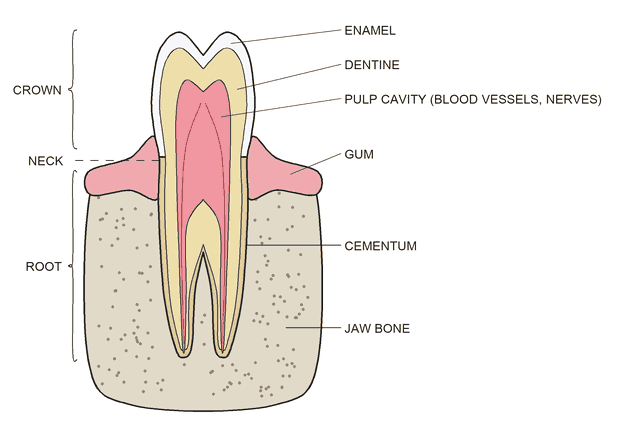
Draw a labelled diagram to show the internal structure of a mammalian tooth with two roots.
Solve with AIWritten solution
Solution:
Concept: A premolar (or a molar) has two roots. Its vertical section shows the crown, neck and roots, and the enamel, dentine, pulp cavity and cement.
Step 1 — Draw the outline.
Draw the tooth set in the jaw bone, with the crown above the gum and two roots inside the bone.
Step 2 — Draw the inside and label it.
Show the enamel over the crown, the dentine below it, the pulp cavity reaching into both roots, and the cement on the roots. Label all the parts:
Step 3 — Check the labels.
The labels are crown, neck, root, enamel, dentine, pulp cavity (with blood vessels and nerves), gum, cementum and jaw bone.
Watch out: The pulp cavity must continue down into BOTH roots.
Therefore, the labelled diagram of a two-rooted tooth is as shown.
- 428 marks
Question 42
Complete the following table by filling in the blanks 1 to 8.
Organ Enzyme Food acted upon Final product 1 Pepsin 2 3 Mouth 4 5 Disaccharide 6 7 Maltose 8 Solve with AIWritten solution
Solution:
Concept: Pepsin acts in the stomach, ptyalin in the mouth and maltase (from the intestinal juice) in the small intestine.
Step 1 — Row 1: pepsin.
Pepsin is made in the stomach (1). It acts on proteins (2) and forms peptides (3).
Step 2 — Row 2: the mouth.
The mouth's enzyme is ptyalin (4). It acts on starch (5) and forms the disaccharide maltose.
Step 3 — Row 3: maltose.
Maltose is digested in the small intestine (6) by maltase (7), forming glucose (8).
Therefore, 1 stomach, 2 proteins, 3 peptides, 4 ptyalin, 5 starch, 6 small intestine (ileum), 7 maltase, 8 glucose.
- 4311 marks
Question 43
Study the diagram given below and then answer the questions that follow :
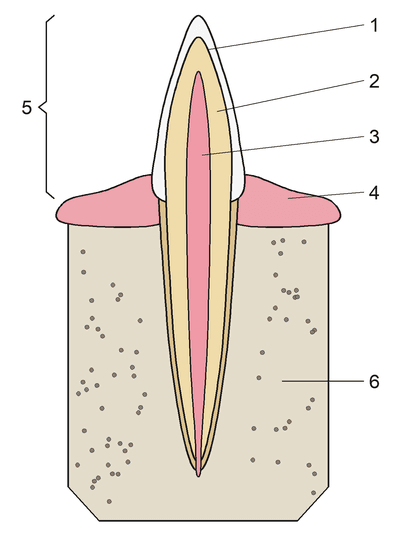
(a) Name the parts labelled 1, 2, 3, 4, 5 and 6.
(b) Identify the tooth and give a reason to support your answer.
(c) Describe the structure of the part labelled '3'.
(d) Give the total number of the type of tooth mentioned in 'b' above, in the mouth of an adult and state its function.
Solve with AIWritten solution
Solution:
Concept: The tooth shown has a conical, sharply pointed crown and a single long root fixed in the jaw bone.
Step 1 — (a) Name the parts.
Reading the labels from the figure: 1 enamel, 2 dentine, 3 pulp cavity, 4 gum, 5 crown and 6 jaw bone.

Step 2 — (b) Identify the tooth.
It is a canine, because its crown is conical and sharply pointed and it has a single long root.
Step 3 — (c) Structure of part 3.
Part 3 is the pulp cavity, the central space of the tooth. It is filled with pulp, a soft connective tissue with blood capillaries, lymph vessels and nerve fibres. These enter through an opening at the tip of the root; the pulp nourishes the tooth and makes it sensitive.
Step 4 — (d) Number and function.
An adult has 4 canines, one on each side of each jaw. They hold and tear the food.
Therefore, (a) 1 enamel, 2 dentine, 3 pulp cavity, 4 gum, 5 crown, 6 jaw bone; (b) canine; (c) pulp with vessels and nerves; (d) 4 canines, for holding and tearing.
- 444 marks
Question 44
Study the following dental formula and then answer the questions that follow :
(a) What is the total number of teeth in the (i) upper jaw and (ii) lower jaw ?
(b) State the total number of teeth present in the dentition.
(c) Give the dental formula of an adult human being.
Solve with AIWritten solution
Solution:
Concept: A dental formula gives the teeth in one half of the upper jaw (above the line) and lower jaw (below the line), so each total is doubled.
Step 1 — (a)(i) Upper jaw.
We add the numbers above the line and double them for the two halves.
Step 2 — (a)(ii) Lower jaw.
We add the numbers below the line and double them.
Step 3 — (b) Total number of teeth.
We add the two jaws.
Step 4 — (c) The adult human formula.
An adult human has 2 incisors, 1 canine, 2 premolars and 3 molars in each half of each jaw, which is 32 teeth in all.
Watch out: Add the numbers in the formula first, then multiply by 2 for the two halves.
Therefore, (a) upper jaw 8 and lower jaw 12; (b) 20 teeth; (c) i 2/2, c 1/1, pm 2/2, m 3/3, that is 32 teeth.
- 457 marks
Question 45
The figures (A, B, C and D) shown below represent different kinds of teeth in humans. Study the figures and answer the following questions :
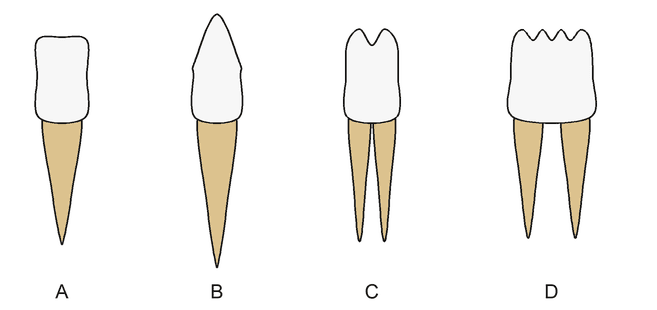
(a) What kind of teeth do A, B, C and D represent ?
(b) Write one structural feature/shape of each.
(c) Mention the number of teeth of each kind in one jaw with their specific position.
(d) Name two minerals present in teeth.
(e) What do you mean by 'Wisdom tooth' ?
Solve with AIWritten solution
Solution:
Concept: The four kinds of human teeth differ in the shape of the crown and the number of roots.
Step 1 — (a) Name the teeth.
Comparing the crowns: A incisor, B canine, C premolar, D molar.
Step 2 — (b) One feature of each.
Each kind has a crown suited to its job.
- A (incisor): a broad, chisel-like crown with a sharp straight cutting edge; one root.
- B (canine): a conical, sharply pointed crown; one long root.
- C (premolar): two cusps on the crown (bicuspid); one or two roots.
- D (molar): a broad crown with several cusps; two or three roots.
Step 3 — (c) Number in one jaw and position.
One jaw has two halves, so each number in the formula is doubled.
- Incisors: 4, the front teeth in the middle of the jaw.
- Canines: 2, one on each side of the incisors.
- Premolars: 4, two on each side behind the canines.
- Molars: 6, the last three on each side at the back.
Step 4 — (d) Minerals in teeth.
Teeth are hardened mainly by calcium and phosphorus, present as calcium phosphate.
Step 5 — (e) Wisdom tooth.
The wisdom tooth is the last molar on each side of each jaw. It appears last, usually after the age of about 17, when the body is reaching maturity, hence the name.
Watch out: One jaw has 16 teeth: count both halves when the question says 'in one jaw'.
Therefore, A incisor, B canine, C premolar, D molar; one jaw has 4 incisors, 2 canines, 4 premolars and 6 molars; teeth contain calcium and phosphorus; the wisdom tooth is the last molar.
- 4611 marks
Question 46
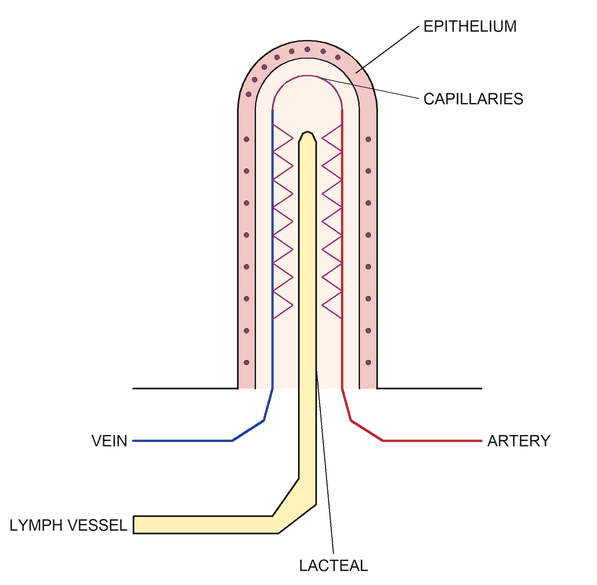
Draw a neat diagram of the "Microscopic structure of an intestinal villus" and label the parts given below :
(i) Epithelium
(ii) Capillaries
(iii) Lacteals
Answer the following questions :
(a) What is the advantage of having a large number of villi on the inner surface of small intestine ?
(b) Write the important role of lacteals.
(c) Name the juice secreted from the glandular cells of small intestine.
(d) Name the specific secretions of :
(1) Salivary gland
(2) Stomach
(3) Liver
(4) Pancreas
Solve with AIWritten solution
Solution:
Concept: A villus is a finger-like projection of the lining of the small intestine. It has a one-cell-thick epithelium, a network of blood capillaries and a central lymph vessel, the lacteal.
Step 1 — Draw and label the villus.
Draw the villus with its epithelium, the capillaries joining a small artery and vein, and the central lacteal:
Step 2 — (a) Advantage of many villi.
The villi greatly increase the inner surface area of the small intestine, so digested food is absorbed quickly and completely.
Step 3 — (b) Role of the lacteals.
Digested fats (fatty acids and glycerol) are taken into the villus cells, rebuilt into tiny fat droplets and passed into the lacteals. The lymph carries them through the lymphatic system, which finally empties into the blood.
Step 4 — (c) Juice of the intestinal glands.
The glandular cells of the small intestine secrete intestinal juice (succus entericus).
Step 5 — (d) Specific secretions.
Each gland pours out its own juice.
- (1) Salivary gland: saliva.
- (2) Stomach: gastric juice.
- (3) Liver: bile.
- (4) Pancreas: pancreatic juice.
Watch out: Sugars and amino acids go into the blood capillaries; fats go into the lacteals.
Therefore, the villi increase the absorbing surface, the lacteals carry away digested fats, the intestinal glands secrete intestinal juice, and the four secretions are saliva, gastric juice, bile and pancreatic juice.
What Class 9 Biology Ch 11 covers
The sections of the chapter, in the order the book takes them. Every question above comes from one of these.
- 01Need for a Digestive System
- 02The Mouth and the Teeth
- 03The Salivary Glands
- 04Swallowing and Peristalsis
- 05Oesophagus
- 06Stomach
More ways to study this chapter
The same chapter asked three other ways. Practise it, revise it, and see what the board has set on Ch 11 before.
Class 9 Biology Ch 11 questions students ask
How many questions are there in Class 9 Biology Ch 11?
46 questions. Every one is solved step by step on this page.
Are these Class 9 Biology solutions free?
Yes. Every question and its full working is free to read, with no account needed.
Can I download the Class 9 Biology Ch 11 solutions as a PDF?
There is no PDF to download. Every solution is on this page instead, which means it is searchable, always the current syllabus, and readable on a phone. Use your browser's print option if you want it on paper.