
Opening your dashboard
Class 9 Biology Chapter 11 Digestive System: Practice Questions
45 questions on Chapter 11, each worked through on its own page with the AI tutor. Class 9 Biology, ICSE 2026-27.
45 questions
1–5 marks · Mixed difficulty
- 11 mark
Question 1
Bloom's level: Remember
The last molar on each side of each jaw, which appears at about 17–20 years of age, is called the :
- 21 mark
Question 2
Bloom's level: Remember
The salivary glands located just in front of and beneath each ear are the :
- 31 mark
Question 3
Bloom's level: Remember
Which statement about the oesophagus is correct ?
- 41 mark
Question 4
Bloom's level: Remember
The narrow, worm-shaped vermiform appendix projects from the :
- 51 mark
Question 5
Bloom's level: Understand
After digestion, fatty acids and glycerol enter the body mainly through the :
- 61 mark
Question 6
Bloom's level: Understand
The pyloric sphincter keeps the opening of the stomach into the intestine closed for some time after a meal. This is so that :
- 71 mark
Question 7
Bloom's level: Understand
Sucrose dissolves easily in water, yet it still has to be digested before it can be absorbed. This is because :
- 81 mark
Question 8
Bloom's level: Apply
Rahul laughed while swallowing, and a bit of food went into his windpipe, making him cough. The structure that failed to close the opening of the windpipe in time was the :
- 91 mark
Question 9
Bloom's level: Apply
A student heats a sucrose (cane-sugar) solution with Fehling's solution, but the colour stays blue-green. To detect the sugar, she should first :
- 101 mark
Question 10
Bloom's level: Analyse
Assertion (A): A mouthful of plain boiled rice begins to taste sweet if it is chewed for a long time.
Reason (R): Ptyalin (salivary amylase) in saliva converts starch into maltose.
- 111 mark
Question 11
Bloom's level: Evaluate
Assertion (A): Excess amino acids absorbed after a protein-rich meal are stored in the liver for later use.
Reason (R): Amino acids serve as the building blocks of proteins.
- 121 mark
Question 12
Bloom's level: Analyse
Assertion (A): If food accidentally enters the windpipe, we start coughing at once.
Reason (R): During swallowing, the tongue presses upward and back against the palate, pushing the bolus into the pharynx.
- 132 marks
Question 13
Bloom's level: Understand
Human teeth are described as heterodont, while the teeth of a frog are homodont. Explain the difference, and say why heterodont teeth are useful to humans.
- 142 marks
Question 14
Bloom's level: Understand
An astronaut in space, where there is no gravity, can still swallow food and it reaches his stomach. Explain how.
- 152 marks
Question 15
Bloom's level: Understand
Trypsin is secreted by the pancreas as inactive trypsinogen. Explain how it becomes active, and what it then does.
- 162 marks
Question 16
Bloom's level: Understand
A bite of chapati contains starch. Using this starch, explain in one line each what is meant by digestion, absorption and assimilation.
- 172 marks
Question 17
Bloom's level: Apply
The dental formula of a human adult is . A 30-year-old man's four wisdom teeth never came out, and one premolar was removed by a dentist. How many teeth does he have now? Which tooth type is completely absent from a 2-year-old child's milk teeth ?
- 182 marks
Question 18
Bloom's level: Apply
A person produces about 1000–1500 mL of saliva a day. How many 250 mL glasses is this? Since we do not spit it out, suggest what happens to all this water.
- 192 marks
Question 19
Bloom's level: Apply
After overeating at a wedding, a boy vomits. Explain what happens at the cardiac sphincter and in the muscles of the gut during vomiting.
- 202 marks
Question 20
Bloom's level: Apply
Predict the result in each case and name the nutrient detected :
(a) A few drops of dilute iodine solution are put on a cut potato.
(b) A crushed groundnut is rubbed on a piece of plain paper, which is then held against light.
- 212 marks
Question 21
Bloom's level: Analyse
Three test tubes are set up at to copy conditions in different parts of the gut :
- Tube X : starch + an enzyme, slightly acidic (pH 6.8)
- Tube Y : protein + an enzyme + hydrochloric acid
- Tube Z : emulsified fat + an enzyme, alkaline medium
Identify the part of the gut each tube copies, name the enzyme, and give the end product.
- 222 marks
Question 22
Bloom's level: Evaluate
Sameer says, "Each molecule of ptyalin is used up after it digests one starch molecule, so the salivary glands must make fresh enzyme for every bit of starch." Evaluate his statement.
- 235 marks
Question 23
Bloom's level: Apply
A glass of milk contains the protein casein, milk fat and the sugar lactose. Trace what happens to it in an adult :
(a) Name the enzymes that digest the milk protein, where they act, and the end product.
(b) Explain how the milk fat is digested, naming the juices and enzymes involved.
(c) Name the enzyme that digests lactose and its products. By which route does each end product of milk enter the circulation ?
- 244 marks
Question 24
Bloom's level: Apply
Case: Mr Sharma has a stone blocking his common bile duct. He has pale stools and feels uneasy after oily food.
(a) Which juice cannot reach his duodenum? Where is it produced and where is it normally stored ?
(b) Explain why the digestion of fats is affected most.
(c) Bile also contains sodium bicarbonate. Explain how the lack of bile can affect the working of the pancreatic and intestinal enzymes.
- 253 marks
Question 25
Bloom's level: Apply
Priya ate a large plate of sweets and a big bowl of paneer for lunch. Two hours later she ran a long race.
(a) What does her liver do with the extra glucose soon after lunch? Name the process.
(b) What does the liver do with this stored food during the race? Name the process.
(c) What happens in her liver to the amino acids that her body does not need ?
- 264 marks
Question 26
Bloom's level: Analyse
Case: Normal faeces contain about 75% water. A child with an infection of the colon passes very watery stools containing about 90% water.
(a) Which function of the large intestine has been disturbed? Explain.
(b) Calculate the mass of water in 200 g of normal faeces and in 200 g of the watery stool. How much extra water is lost with every 200 g ?
(c) Using your answers, analyse why such a child must be given plenty of fluids.
- 274 marks
Question 27
Bloom's level: Analyse
Tooth decay usually starts on the crown and spreads inwards.
(a) Name, in order from the outside, the three layers that the decay passes through to reach the centre of the tooth.
(b) Analyse why the tooth does not hurt while the decay is only in the outer layer, but becomes very painful once it reaches the centre.
(c) Which tissue fixes the root in its socket, and why is a tooth with healthy cementum and gums still able to stay in place even when the crown is badly decayed ?
- 285 marks
Question 28
Bloom's level: Evaluate
Case: Mr Rao gets "acidity" now and then. He decides that hydrochloric acid in his stomach is useless and harmful, and starts taking strong antacid tablets after every meal, every day, for months.
(a) State two useful functions of hydrochloric acid in the stomach.
(b) Evaluate how his habit could affect his digestion of proteins.
(c) Evaluate one other risk of keeping his stomach contents neutral all the time, and give him a sensible suggestion.
- 295 marks
Question 29
Bloom's level: Create
Plan an experiment to show that saliva digests starch and that it works best at body temperature.
(a) List the materials and describe how you will prepare the starch suspension and saliva.
(b) Set up three test tubes — one at body temperature, one in ice, and a control with boiled saliva. State what you will do with each.
(c) Make a table of the expected results of the iodine test and the sugar test after 15 minutes, and state your conclusion.
- 305 marks
Question 30
Bloom's level: Create
Construct a flow chart of the human alimentary canal from the mouth to the anus. Beside each part, show any gland or juice that pours into it and the main enzyme(s) in that juice. Mark the parts where no digestive enzyme is produced.
- 311 mark
Question 31
Which one of the following changes is brought about by the hydrochloric acid of the gastric juice ?
- 321 mark
Question 32
Which one of the following statements about the large intestine of humans is correct ?
- 331 mark
Question 33
Assertion (A): The oesophagus does not secrete any digestive enzyme.
Reason (R): Food is pushed along the oesophagus by peristalsis.
- 342 marks
Question 34
Meera is 14 years old. All her permanent teeth have appeared except the wisdom teeth.
(i) Write her dental formula and state the total number of teeth in her mouth.
(ii) How many molars does she have at present ? State one function of the molars.
- 352 marks
Question 35
(i) How does saliva help in preventing tooth decay ?
(ii) A dry mouth makes us feel thirsty. Explain how saliva, in this way, helps to maintain the water balance of the body.
- 362 marks
Question 36
The figure shows a short length of the oesophagus, drawn lying on its side, at one moment while a mass of food (2) is passing through it. X and Y are the two cut ends of this length.
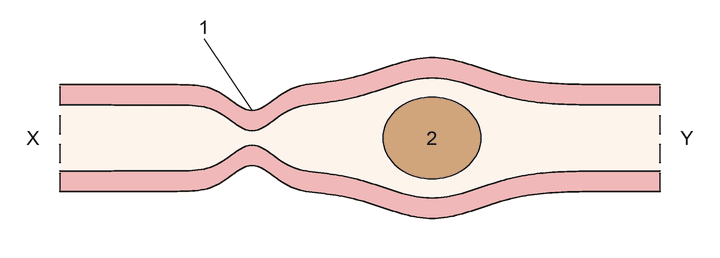
(i) Name the movement of the gut wall that is taking place, and the muscles that produce the narrowing at 1.
(ii) Will the food mass move towards X or towards Y ? Give a reason from the figure.
- 372 marks
Question 37
State what happens in the body to the excess of each of the following absorbed food materials :
(i) amino acids
(ii) fatty acids and glycerol (fats)
- 384 marks
Question 38
The figure shows the C-shaped first part of the small intestine (4), which receives the food from the stomach, together with the organs and ducts that pour their juices into it.
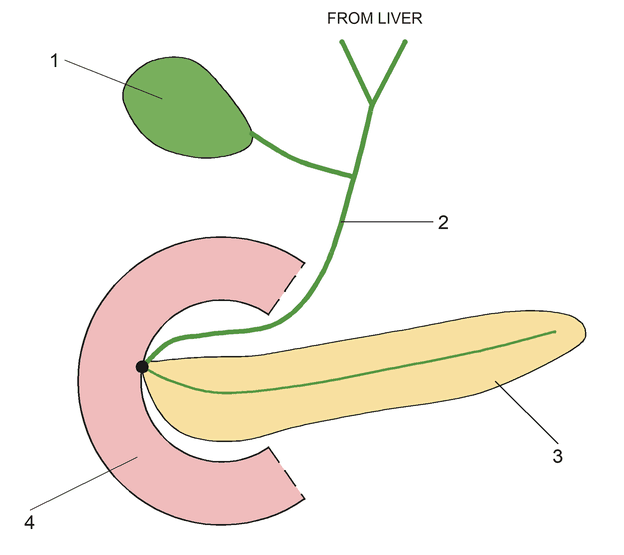
(i) Identify the organs and the duct numbered 1 to 4 in the figure.
(ii) Name the fluid stored in part 1 and the two pigments that give this fluid its colour. From what are these pigments produced ?
(iii) The food that enters part 4 from the stomach is acidic. Name the substance present in the fluid of part 1 that changes this, and state why the change is necessary.
- 394 marks
Question 39
The figure shows the microscopic structure of one of the tiny finger-like projections found in very large numbers on the inner lining of the ileum.

(i) Name this projection and the parts numbered 1, 2 and 3.
(ii) Name the end products of digestion that are absorbed into part 2 and into part 3.
(iii) By what route do the food materials absorbed into part 2 reach the liver ? State one way in which part 1 is suited to the absorption of food.
- 403 marks
Question 40
A student stirred the white of an egg in water, then boiled and filtered the mixture to get a cloudy suspension of protein. She took about 3 mL of this suspension in each of four test tubes, added a few drops of the liquids shown in the table below, and kept all four tubes in a beaker of water at about 35 °C for 10 minutes.
Test tube Added to the egg-white suspension A pepsin only B dilute hydrochloric acid only C pepsin + dilute hydrochloric acid D boiled pepsin + dilute hydrochloric acid (i) In which test tube does the cloudy suspension change to a clear solution ? What does this change show ?
(ii) What do the results of test tubes A and B, taken together, tell us about the working of pepsin ?
(iii) Explain the result of test tube D. Why were the test tubes kept at about 35 °C ?
- 411 mark
Question 41
Class 9 Sample Paper 2 · Section A
Write the function of:
Enzymes
- 421 mark
Question 42
Class 9 Sample Paper 2 · Section A
Write the function of:
Peristalsis
- 431 mark
Question 43
Class 9 Sample Paper 2 · Section A
Define the following:
Digestion
- 443 marks
Question 44
Class 9 Sample Paper 2 · Section C
Write a test for protein.
- 455 marks
Question 45
Class 9 Sample Paper 2 · Section E
Draw the internal structure of a mammalian tooth.
(a) Label the different parts.
(b) Which part of the tooth is the hardest part in the human body?
(c) Which part of it is living?