
Opening your dashboard
Class 9 Biology Chapter 11 Digestive System: Competency-Based Questions (CBQ)
40 questions on Chapter 11, each worked through on its own page with the AI tutor. Class 9 Biology, ICSE 2026-27.
40 questions
1–5 marks · Mixed difficulty
- 11 mark
Question 1
Cognitive domain: Application
Mr Verma lost all the incisors and canines of both his jaws in a road accident. His premolars and molars are unharmed. Until he gets artificial teeth, which of these will he find the most difficult to do ?
- 21 mark
Question 2
Cognitive domain: Analysis
Some students mixed equal amounts of starch suspension and saliva in eight test tubes. They kept each tube at a different temperature for 10 minutes and then found out how much starch had been digested. The graph shows their results.
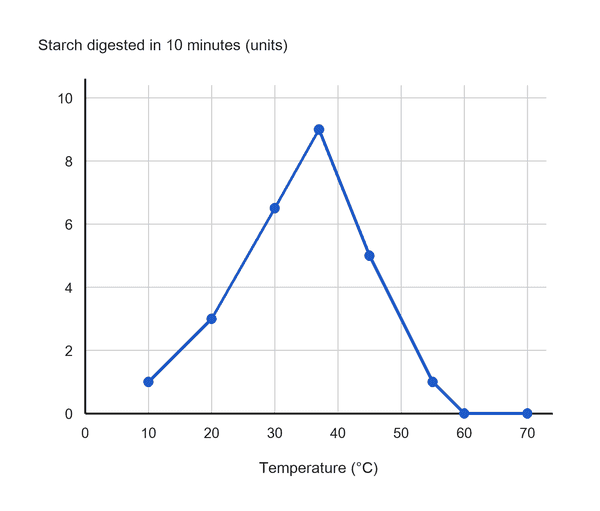
The tube that had been kept at is now cooled to and left for another 10 minutes. What is most likely to be found in this tube ?
- 31 mark
Question 3
Cognitive domain: Analysis
A doctor wants to know where a patient's breakfast will be at different times of the day. She uses the following information about a normal adult.
Region of the alimentary canal Time for which the food stays in it Stomach About 3 hours Small intestine About 4 hours The patient finishes his breakfast at 8 a.m. Where will most of this meal be at 1 p.m., and what will be happening to it there ?
- 41 mark
Question 4
Cognitive domain: Application
Just before her turn in a debate, Naina is very nervous and her mouth goes dry. She finds it hard to speak clearly, and she cannot swallow the dry biscuit a friend gives her. Which fact best explains both her difficulties ?
- 51 mark
Question 5
Cognitive domain: Understanding
Assertion (A): The proteins in a meal are not digested in the stomach unless hydrochloric acid is present in the gastric juice.
Reason (R): The enzyme of the stomach is first secreted as inactive pepsinogen, which is changed into active pepsin by hydrochloric acid.
- 61 mark
Question 6
Cognitive domain: Understanding
Assertion (A): The large intestine secretes enzymes that digest the remaining proteins and fats before the faeces are formed.
Reason (R): The large intestine absorbs much water from its contents, which then become semi-solid.
- 71 mark
Question 7
Cognitive domain: Application
Zainab keeps a fast from sunrise to sunset and takes no food for about 13 hours. Yet her body tissues keep getting glucose from the blood throughout the day for their energy needs.
Complete the sentence :
During the fast, her liver reconverts its stored ______ into glucose and puts it back into the blood circulation, and this process is known as ______.
- 81 mark
Question 8
Cognitive domain: Understanding
In a certain disease the villi of the ileum become short and flat. A patient with this disease eats proper meals, and the food is digested normally, yet he keeps losing weight.
Complete the sentence :
The patient loses weight because the inner ______ of his intestine is greatly reduced, and so much less of the digested food can be ______ into the blood and lymph.
- 91 mark
Question 9
Cognitive domain: Application
A human skull is dug out at an old burial site. All its teeth are in place and none has been lost. A scientist counts 7 teeth in each half of the upper jaw and 7 teeth in each half of the lower jaw.
Complete the sentence :
The skull has ______ teeth in all, so the person was most probably an adolescent in whom the ______ teeth had not yet appeared.
- 102 marks
Question 10
Cognitive domain: Evaluation
The label on a bottle of "Digesto" syrup makes two claims :
- Claim 1 : "Contains one single super-enzyme that digests starch, proteins and fats alike."
- Claim 2 : "The enzyme syrup is boiled for one hour before bottling, for your safety."
Using what you know about the characteristics of enzymes, judge whether each claim can be trusted.
- 112 marks
Question 11
Cognitive domain: Analysis
Kabir was drinking water when his friend cracked a joke. Kabir burst out laughing in the middle of a swallow, and some of the water came out through his nose.
Which structure normally stops swallowed food or water from going into the nasal passage, and why did it fail this time ? Name the structure that keeps food and water out of the windpipe during a normal swallow.
- 122 marks
Question 12
Cognitive domain: Application
A two-month-old baby is fed on fresh milk. A little later the baby brings up a small amount of it, and the mother notices that the milk has turned into soft white curds. She is worried that the milk she gave had gone bad.
Explain why the milk curdled in the baby's stomach although it was fresh. Would the same change be brought about in the stomach of the baby's father when he drinks milk ? Give a reason.
- 135 marks
Question 13
Cognitive domain: Analysis
Case: In the laboratory, a teacher gave the class three foods, labelled P, Q and R, without saying what they were. One was a grape, one was a groundnut and one was a piece of boiled potato. Four tests were done on each food. The test with nitric acid was done by the teacher herself.
Test Food P Food Q Food R Dilute iodine solution added Turns blue-black No change No change Heated with Fehling's solution Stays blue-green Deep brick-red precipitate Stays blue-green Rubbed on plain paper No spot No spot Translucent spot Heated with conc. nitric acid, cooled, ammonium hydroxide added No colour change No colour change Turns yellow, then orange (a) Name the nutrient or nutrients shown to be present in each food.
(b) Which food is the grape, which is the groundnut and which is the boiled potato ?
(c) Trace the digestion of the nutrient found in food P as it passes along the alimentary canal. Name the enzymes, the regions where they act and the products formed.
(d) One of the nutrients in food R cannot be digested well unless bile is present. Name this nutrient and explain what bile does to it. What are its end-products of digestion ?
- 145 marks
Question 14
Cognitive domain: Evaluation
Case: Ravi wanted to find out whether the enzyme pepsin can work in an alkaline medium. He prepared a cloudy suspension of egg-white in water and set up two test tubes.
Test tube Contents Where it was kept After 10 minutes A Egg-white suspension + pepsin + dilute hydrochloric acid In a beaker of water at Cloudy liquid became clear B Egg-white suspension + pepsin + sodium bicarbonate solution In a beaker of ice-cold water Liquid stayed cloudy Ravi wrote in his notebook, "Tube B stayed cloudy. This proves that pepsin does not act in an alkaline medium."
(a) What does the change seen in tube A show ?
(b) Is Ravi's conclusion justified by his experiment ? Give a reason for your answer.
(c) State the one change Ravi must make in his set-up so that his conclusion can be trusted. What result should he expect then ?
(d) Ravi's friend adds a tube C containing egg-white suspension, dilute hydrochloric acid and a pepsin solution that has been boiled, and keeps it at . Predict the result and explain it.
- 155 marks
Question 15
Cognitive domain: Creativity
Case: For the school science exhibition, Tanvi and Joy want to make a simple working model that shows visitors how food is pushed along the oesophagus. Their teacher tells them that the model must make it clear that the food does not simply fall down into the stomach. They can use only things that are easily found at home, such as an old cycle tube or a long stocking, a ball and some cooking oil.
(a) Describe the model you would make. State what each part of the model stands for in the body.
(b) Explain how you would work the model in front of the visitors to show how the food moves. How would you use the same model to show that food does not need to fall down under its own weight ?
(c) Write two ways in which your model differs from the real oesophagus, and suggest one improvement.
- 161 mark
Question 16
Cognitive domain: Analysis
Ritesh's oesophagus was badly narrowed by a chemical burn. For some weeks the doctors feed him a liquid diet of rice, dal and milk, blended into a thin paste, through a narrow tube that carries it straight into his stomach. His mouth is not used for these meals. His stomach, liver, pancreas and intestines are healthy. Which statement about his digestion during this time is correct ?
- 171 mark
Question 17
Cognitive domain: Application
After a very heavy dinner, Mr Das lies down flat on his back to rest. Soon he feels a burning pain behind his breastbone, because some of the acidic contents of his stomach have come back up into his food pipe. Which structure, which should have stayed closed, allowed this to happen ?
- 181 mark
Question 18
Cognitive domain: Analysis
The graph shows how the activity of three digestive enzymes, X, Y and Z, changes with the pH of their surroundings. A low pH means an acidic medium, pH 7 is neutral and a higher pH means an alkaline medium. The three enzymes are pepsin of the stomach, salivary amylase (ptyalin) of the mouth, and trypsin of the pancreatic juice, which acts in the duodenum after the bile has made the food alkaline. (Schematic graph.)
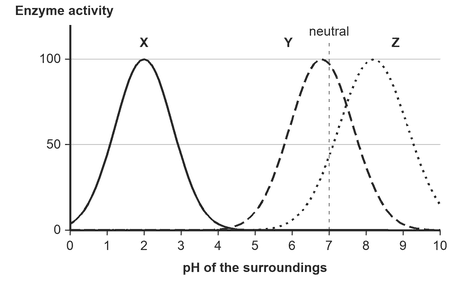
Which option correctly names the three enzymes ?
- 191 mark
Question 19
Cognitive domain: Understanding
Assertion (A): Most of the digested food is absorbed in the small intestine, and very little of it in the large intestine.
Reason (R): The inner lining of the ileum is made into a great number of tiny finger-like villi, which enormously increase its surface area.
- 201 mark
Question 20
Cognitive domain: Application
In a health survey, a healthy adult passed g of faeces in one day. The textbook says that faeces are normally about water and about solid matter, and that of the solid matter is roughage, the undigested plant fibre. (Hypothetical data for the survey; the composition of faeces varies from person to person.) How many grams of roughage were present in this sample ?
- 211 mark
Question 21
Cognitive domain: Application
To trace the path of absorbed food, scientists feed a rat a meal in which the glucose and the fatty acids are marked so that they can be found later. After some time they collect two fluids : fluid P from the hepatic portal vein, which carries blood from the intestine to the liver, and fluid Q from the lacteals of the villi, the lymph vessels that join the lymphatic system. Where will the marked glucose and the marked fatty acids be found first, mainly ?
- 221 mark
Question 22
Cognitive domain: Understanding
Assertion (A): Peristalsis takes place only in the oesophagus.
Reason (R): Peristalsis is the wave of constrictions caused by the circular muscles of the gut, which pushes the food along.
- 231 mark
Question 23
Cognitive domain: Analysis
Seema dries the upper surface of her tongue with a clean tissue and places a dry sugar crystal on it. At first she tastes very little, and the sweet taste becomes clear only after some seconds, as the crystal slowly disappears. Which statement best explains the delay ?
- 241 mark
Question 24
Cognitive domain: Application
For a science exhibition, Hamid shows the whole alimentary canal as a straight paper strip cm long, so that cm on the strip stands for cm of the real canal. He takes the textbook values: the whole canal is about m long, the small intestine is about m and the large intestine is about m. The rest of the canal is the part from the mouth to the stomach. What lengths should he mark on the strip for the small intestine and for the part from the mouth to the stomach ?
- 251 mark
Question 25
Cognitive domain: Analysis
Anita eats a piece of paneer, which is rich in protein. The events below take place as its protein is digested and absorbed in her alimentary canal.
P : Pepsin changes some of the protein into peptides in the stomach.
Q : Trypsin of the pancreatic juice acts on the remaining proteins and polypeptides in the duodenum.
R : Amino acids pass into the blood capillaries of the villi.
S : Erepsin of the intestinal juice changes the remaining peptides into amino acids in the ileum.
In which order do these events take place ?
- 262 marks
Question 26
Cognitive domain: Application
Sunil, a young athlete, eats a very protein-rich diet of eggs, dal and paneer, far more than his body needs for building new proteins. His doctor tells him that the body cannot store the extra amino acids.
Name the organ in which the extra amino acids are broken down and the process that takes place. Say what happens to the nitrogen-containing part and to the remaining part of each amino acid.
- 272 marks
Question 27
Cognitive domain: Understanding
Suresh smells the chapatis being roasted in the kitchen, and his mouth begins to water, although he has put nothing into it.
(a) Name the three pairs of glands that make the saliva.
(b) Give two ways in which the saliva already in his mouth will help when he chews and swallows his first bite of the chapati.
- 282 marks
Question 28
Cognitive domain: Analysis
(Hypothetical case.) Rohan, aged , gets stomach cramps and loose motions every time he drinks milk, but he digests chapati, rice, dal and sugar without any trouble. His doctor finds that his intestinal juice is short of the enzyme lactase, though it contains normal amounts of maltase and sucrase.
(a) Name the sugar of milk that stays undigested and the end-products that lactase would normally make from it.
(b) Which characteristic of enzymes explains why the maltase and sucrase cannot do the work of the missing lactase ?
- 292 marks
Question 29
Cognitive domain: Evaluation
Before a school race, Pooja drinks a glass of water with glucose dissolved in it, while her friend Neha eats a piece of chapati. Pooja says, "The glucose will reach my blood sooner than the chapati will reach Neha's, because the glucose needs no digestion, while the chapati has to be digested first."
Evaluate her statement. Name the nutrient of the chapati that has to be digested and say what it is digested into.
- 302 marks
Question 30
Cognitive domain: Analysis
The textbook says that in the stomach, pepsin digests only about of the proteins of a meal, and only into peptides. Moin eats a boiled egg, which is rich in protein.
What happens to the rest of the protein of the egg after it leaves the stomach ? Name the two enzymes that act on it and the end-product that is finally formed.
- 312 marks
Question 31
Cognitive domain: Application
Neeta has her gall bladder removed by an operation, because of stones in it. She can still digest fat.
(a) Where is the bile normally stored before it is used ?
(b) How does the bile of Neeta's liver now reach her food, and what does it do to the food there ?
- 323 marks
Question 32
Cognitive domain: Analysis
The teeth cut and break the food into smaller bits, which have a relatively larger surface area for the enzymes to act on. To see this, a student cuts a cube of boiled potato of edge cm into eight equal small cubes of edge cm.
(a) Find the total surface area of the large cube and the total surface area of the eight small cubes together.
(b) How many times larger has the surface for the enzymes become ?
(c) Which kinds of teeth do this cutting and breaking, and how does it help digestion ?
- 333 marks
Question 33
Cognitive domain: Application
A doctor examines the large intestine of a patient with a thin flexible tube that carries a tiny camera. The tube is passed in through the anus and is pushed up along the large intestine until it reaches the small intestine. Use the names of the parts given in your textbook.
(a) Write, in the order in which the camera meets them, the three parts of the large intestine, and the three divisions of the colon.
(b) On which side of the abdomen does the camera travel upwards in the first long stretch of the colon, and on which side does it travel last ?
(c) At the end of its journey, the camera reaches a small blind pouch. In its wall it sees the small opening of a narrow worm-shaped tube that projects from the pouch. Name the pouch and the tube.
- 343 marks
Question 34
Cognitive domain: Evaluation
After the oily lunch of a festival, Manoj says, "The bile that enters my duodenum digests the fat, because bile is an enzyme. That is why the fat disappears from the food there."
(a) Is Manoj right in saying that bile is an enzyme ? Give a reason.
(b) State two ways in which bile helps in the digestion of fat.
(c) Name the enzyme that actually digests fat in the duodenum, and its end-products.
- 353 marks
Question 35
Cognitive domain: Analysis
A teacher gives Priya three unlabelled test tubes. One holds a glucose solution, one a starch suspension and one an egg-white suspension. All three look cloudy or colourless. She can use dilute iodine solution, Fehling's solution, and concentrated nitric acid followed by ammonium hydroxide.
(a) Which one test will pick out the starch tube from the other two ? What colour will it give ?
(b) Which test should she use next, to separate the other two ? What colour will it give with each ?
(c) Name the nutrient that each of the three tubes holds, with the colour it gives in the test that detects it.
- 363 marks
Question 36
Cognitive domain: Creativity
A company wants to make a capsule for people whose pancreas does not make enough steapsin, the fat-digesting enzyme of the pancreatic juice. The capsule will hold the enzyme as a powder.
(a) Which nutrient will the enzyme digest, and what are the end-products ?
(b) The enzyme must not be set free in the stomach. Give two reasons.
(c) Suggest where in the gut the capsule should release its powder, and a property of the surroundings that its coating can use as the signal to open.
- 374 marks
Question 37
Cognitive domain: Analysis
Case: On a school health day, a dentist examined four members of one family. She counted the teeth of each person in one half of the upper jaw. The lower jaw and the other half are alike, so the same numbers apply to every half-jaw. She wrote the counts in the table below. Baby Ira has only her temporary milk teeth. Ishaan's wisdom teeth have not yet appeared. His mother has all her wisdom teeth. The grandfather has lost several teeth with age. (Hypothetical data.)
Member Age Incisors Canines Premolars Molars Baby Ira 3 years 2 1 0 2 Ishaan 15 years 2 1 2 2 Mother 38 years 2 1 2 3 Grandfather 70 years 2 1 1 1 (a) Write the dental formula of baby Ira in the form used in the textbook, and find her total number of teeth.
(b) Ishaan has more teeth than Ira. By how many more, and which kind of tooth is in his formula but not in hers ?
(c) Compare the grandfather with the mother. How many teeth has he lost, and which kinds of teeth have all been kept ?
- 384 marks
Question 38
Cognitive domain: Evaluation
Case: Arjun and Bilal, both aged , ate the same sugary lunch of rice, sweets and a cold drink. Arjun's liver is healthy. Bilal's liver is damaged and can store only a very little glycogen. Before lunch both were at rest and had the same blood glucose level. Their blood was tested for glucose then, and several times in the next five hours, while they ate nothing more. The graph shows the results. (Hypothetical data.)
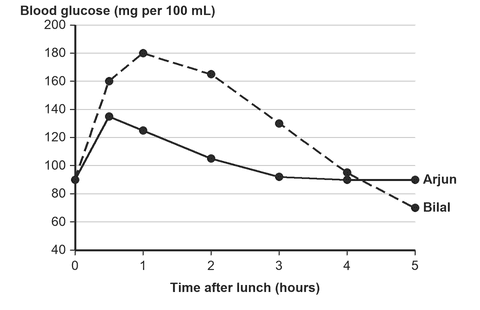
(a) Read from the graph the highest glucose level of each man and the time at which it was reached.
(b) Which two processes of the liver keep Arjun's glucose steady, first by lowering it after lunch and then by holding it up during the fast ? Name them and explain.
(c) The doctor advises Bilal to eat small meals at regular times instead of one big meal. Use the graph to explain why this advice makes sense.
- 395 marks
Question 39
Cognitive domain: Evaluation
Case: A school health team looked for tooth decay in the children of four groups. The children of groups A, B and C differ only in how often they brush their teeth and eat sweets. The children of group D brush twice a day and eat few sweets like group A, but a medicine they take makes their salivary glands produce much less saliva. The results are given below. (Hypothetical data.)
Group Habits Children examined Children with tooth decay A Brush twice a day, few sweets 200 20 B Brush once a day, sweets daily 200 70 C Seldom brush, sweets many times a day 200 140 D Brush twice a day, few sweets, little saliva 50 30 (a) Find the percentage of children with tooth decay in each group.
(b) Groups A and D have the same habits. What does the difference between them show about saliva ? Name two ways in which saliva protects the teeth.
(c) The principal says, "Only sweets cause tooth decay, so brushing and saliva do not matter." Use the table to evaluate her statement.
- 405 marks
Question 40
Cognitive domain: Creativity
Case: The teacher asks Rhea and Imran to build a simple model that shows why the small intestine, which is only a narrow tube, can still absorb so much digested food. They are given two pieces of cloth of the same size, cm cm: one is a smooth cotton handkerchief and the other a piece of a rough towel with many tiny loops. They also have two identical shallow trays, a measuring cylinder, a jug of water coloured with a little ink, and a stop-watch.
(a) State what each material stands for in the model.
(b) Describe how they should use the materials for a fair test, what must be kept the same and what must be measured.
(c) Predict the result and explain how it supports the need for villi. State one important part of a real villus that the model does not show.