Solution:
Concept: The four kinds of human teeth differ in the shape of the crown and the number of roots.
Step 1 — (a) Name the teeth.
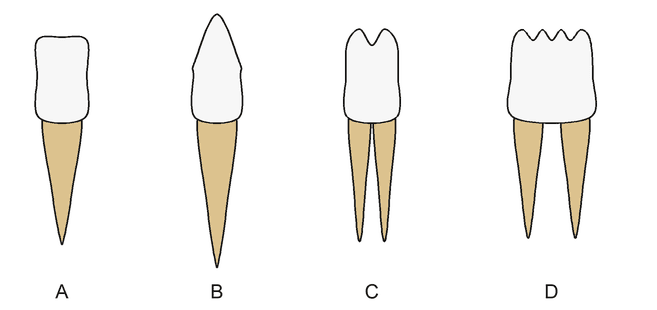
Comparing the crowns: A incisor, B canine, C premolar, D molar.
Step 2 — (b) One feature of each.
Each kind has a crown suited to its job.
- A (incisor): a broad, chisel-like crown with a sharp straight cutting edge; one root.
- B (canine): a conical, sharply pointed crown; one long root.
- C (premolar): two cusps on the crown (bicuspid); one or two roots.
- D (molar): a broad crown with several cusps; two or three roots.
Step 3 — (c) Number in one jaw and position.
One jaw has two halves, so each number in the formula is doubled.
- Incisors: 4, the front teeth in the middle of the jaw.
- Canines: 2, one on each side of the incisors.
- Premolars: 4, two on each side behind the canines.
- Molars: 6, the last three on each side at the back.
Step 4 — (d) Minerals in teeth.
Teeth are hardened mainly by calcium and phosphorus, present as calcium phosphate.
Step 5 — (e) Wisdom tooth.
The wisdom tooth is the last molar on each side of each jaw. It appears last, usually after the age of about 17, when the body is reaching maturity, hence the name.
Watch out: One jaw has 16 teeth: count both halves when the question says 'in one jaw'.
Therefore, A incisor, B canine, C premolar, D molar; one jaw has 4 incisors, 2 canines, 4 premolars and 6 molars; teeth contain calcium and phosphorus; the wisdom tooth is the last molar.