
Opening your dashboard
Class 8 Physics Chapter 3: Force and Pressure Solutions
100 textbook questions with step-by-step answers, free to read, for ICSE 2026-27.
Get talked through Ch 3, not just shown the answer
Reading a finished solution is not the same as being able to do it. The AI tutor takes one question at a time and works it with you, in your own words, until you can.
- Ask it out loud, in your own words
- It gives you the next step, not the answer
- Stuck on part (ii)? Start there
100 questions with solutions
1–4 marks · Mixed difficulty
- 11 mark
Question 1
S.I. unit of moment of force is :
Solve with AIAnswer
(A) N
(B) N cm
(C) kgf m
- Correct
(D) N m
Answer: (D) N m
Concept: The turning effect of a force is called the moment of force (or torque). It is the force multiplied by the perpendicular distance of the line of action of the force from the pivot (axis of rotation). Its S.I. unit is the newton metre (N m).
Step 1 — Write what the moment of force is.
The moment of force is a force multiplied by a distance (the perpendicular distance of the force from the pivot).
Step 2 — Put in the S.I. units.
In S.I. units the force is in newtons (N) and the distance in metres (m), so the unit of the moment is newton × metre, written N m.
Watch out: N m is the unit of a moment, while N m (newton per square metre) is the unit of pressure; the sign of the power of m makes all the difference.
Why the other options are wrong:
- (A) N: The newton is the unit of force alone; a moment also involves a distance.
- (B) N cm: N cm is a unit of moment, but the distance is in centimetres, so it is not the S.I. unit.
- (C) kgf m: kgf m is the gravitational unit of moment of force, not the S.I. unit.
Therefore, the S.I. unit of moment of force is N m, option (D).
- 21 mark
Question 2
To obtain a given moment of force for turning a body, the force needed can be decreased by :
Solve with AIAnswer
(A) applying the force at the pivoted point
(B) applying the force very close to the pivoted point
- Correct
(C) applying the force farthest from the pivoted point
(D) none of the above.
Answer: (C) applying the force farthest from the pivoted point
Concept: The turning effect of a force is called the moment of force (or torque). It is the force multiplied by the perpendicular distance of the line of action of the force from the pivot (axis of rotation). Its S.I. unit is the newton metre (N m). For a given turning effect, the farther from the pivot the force acts, the smaller the force needed.
Step 1 — Write the rule.
The moment of force is force × perpendicular distance from the pivot. Here the moment needed is fixed.
Step 2 — See how the force can be made smaller.
If the product is fixed, a larger distance means a smaller force. So the force needed is least when it is applied farthest from the pivot. This is why a door handle is at the edge far from the hinges.
Watch out: Applying the force at the pivot does not make turning easy; it makes turning impossible, because the distance is zero.
Why the other options are wrong:
- (A) applying the force at the pivoted point: At the pivot the perpendicular distance is zero, so the force has no turning effect at all, however large it is.
- (B) applying the force very close to the pivoted point: Close to the pivot the distance is small, so a larger force is needed for the same moment.
- (D) none of the above: Option (C) does decrease the force needed, so "none of the above" is not correct.
Therefore, the force needed is decreased by applying it farthest from the pivoted point, option (C).
- 31 mark
Question 3
The unit of thrust is :
Solve with AIAnswer
- Correct
(A) kgf
(B) kg
(C) g
(D) m s
Answer: (A) kgf
Concept: Thrust is the force acting on a surface normally (at right angles to it). It is a force, so its S.I. unit is the newton (N); it is also measured in kgf. A body resting on a horizontal surface exerts a thrust equal to its own weight.
Step 1 — Decide what kind of quantity thrust is.
Thrust is the force acting normally on a surface, so it is a force and is measured in units of force.
Step 2 — Pick the unit of force.
Among the options only the kilogram-force (kgf) is a unit of force (1 kgf is about 9.8 N). The others measure mass or speed.
Watch out: Kg (a unit of mass) and kgf (a unit of force) look alike; a mass of 1 kg weighs 1 kgf.
Why the other options are wrong:
- (B) kg: The kilogram is the unit of mass, not of force.
- (C) g: The gram is also a unit of mass, not of force.
- (D) m s: m s is the unit of speed (or velocity), not of force.
Therefore, the unit of thrust among the options is kgf, option (A).
- 41 mark
Question 4
The unit of pressure is :
Solve with AIAnswer
(A) N × m
(B) kgf
- Correct
(C) N m
(D) kgf m
Answer: (C) N m
Concept: Pressure is the thrust acting on unit area of a surface: pressure is thrust ÷ area. Its S.I. unit is N m, called the pascal (Pa).
Step 1 — Write the definition.
Pressure is thrust divided by area.
Step 2 — Put in the units.
The thrust is in newtons and the area in square metres, so the unit of pressure is newton per square metre, written N m (the pascal).
Why the other options are wrong:
- (A) N × m: N × m (that is, N m) is the unit of moment of force, not of pressure.
- (B) kgf: kgf is a unit of force (thrust), not of pressure; it has not been divided by an area.
- (D) kgf m: kgf m multiplies the force by an area, but pressure divides the force by the area.
Therefore, the unit of pressure is N m, option (C).
- 51 mark
Question 5
The pressure and thrust are related as :
Solve with AIAnswer
(A) Pressure = Thrust
(B) Pressure = Thrust × Area
- Correct
(C) Pressure = Thrust / Area.
(D) Pressure = Area / Thrust
Answer: (C) pressure is thrust divided by area
Concept: Pressure is the thrust acting on unit area of a surface: pressure is thrust ÷ area. Its S.I. unit is N m, called the pascal (Pa).
Step 1 — Recall what pressure means.
Pressure is the thrust acting on unit area, that is, the thrust shared out over each square metre of the surface.
Step 2 — Write it as a relation.
Sharing the thrust over the area means dividing by the area:
Watch out: The same thrust on a larger area gives a smaller pressure, so area must be in the denominator.
Why the other options are wrong:
- (A) pressure equals thrust: Pressure equals the thrust only in the special case when the area is exactly one unit; in general they differ.
- (B) pressure is thrust times area: Multiplying by the area would make the pressure larger on a larger area, which is the opposite of what we observe (broad feet sink less).
- (D) pressure is area divided by thrust: This turns the correct relation upside down.
Therefore, pressure = thrust / area, option (C).
- 61 mark
Question 6
A body weighing 5 kgf, placed on a surface of area 0.1 m, exerts a thrust on the surface equal to :
Solve with AIAnswer
(A) 50 kgf
- Correct
(B) 5 kgf
(C) 50 kgf m
(D) 5 kgf m
Answer: (B) 5 kgf
Concept: Thrust is the force acting on a surface normally (at right angles to it). It is a force, so its S.I. unit is the newton (N); it is also measured in kgf. A body resting on a horizontal surface exerts a thrust equal to its own weight.
Step 1 — Find the thrust.
The body rests on the surface, so it presses on it normally with a force equal to its weight. Its weight is 5 kgf, so the thrust is 5 kgf. The area does not change the thrust.
Step 2 — See where the area would be used.
The area is needed only to find the pressure:
This is not what is asked.
Watch out: Thrust is a force (unit kgf or N); pressure is force per area (unit kgf m or Pa). Read which one the stem asks for.
Why the other options are wrong:
- (A) 50 kgf: 50 is the pressure value; a thrust does not depend on the area, so it is not 50 kgf.
- (C) 50 kgf m: 50 kgf m is the pressure on the surface, not the thrust.
- (D) 5 kgf m: kgf m is a unit of pressure, not of thrust, and the pressure is 50, not 5, kgf m.
Therefore, the thrust on the surface is 5 kgf, option (B).
- 71 mark
Question 7
The feet of lizards act like :
Solve with AIAnswer
(A) moving pads
(B) drilling pads
- Correct
(C) suction pads
(D) none of the above
Answer: (C) suction pads
Concept: Air has weight, so the air column above any surface presses on it. The thrust of this air on unit area of the earth's surface is the atmospheric pressure. At sea level it is about Pa (1 atm), nearly Pa, and it decreases with height because the air column above becomes shorter and the air thinner.
Step 1 — Recall the chapter's example.
This chapter gives a lizard's feet as an example of atmospheric pressure at work. It treats each foot as a suction pad.
Step 2 — Explain the suction-pad idea.
When a suction pad is pressed on a smooth wall, air is pushed out from under it, so the pressure under it becomes less than the atmospheric pressure outside. The larger atmospheric pressure outside then presses the pad on to the wall and holds it there.
Note: Scientists have since found that house lizards (geckos) cling mainly through millions of very fine hairs on their toe pads, which are attracted to the wall by weak forces between molecules; gecko feet stick even where there is no air. The suction-pad answer is the model this chapter uses.
Why the other options are wrong:
- (A) moving pads: "Moving pads" does not describe how the feet hold on to a wall or a ceiling.
- (B) drilling pads: Lizard feet do not drill into the wall, so "drilling pads" is wrong.
- (D) none of the above: The chapter's expected answer is the suction-pad model in (C), so "none of the above" is not the answer here (see the note for the fuller picture).
Therefore, in this chapter the feet of lizards act like suction pads, option (C).
- 81 mark
Question 8
Pressure exerted by a liquid is due to its :
Solve with AIAnswer
- Correct
(A) weight
(B) mass
(C) volume
(D) area
Answer: (A) weight
Concept: A liquid has weight, so it exerts pressure on the bottom and the walls of its container and on anything placed in it. At a point in a liquid the pressure acts equally in all directions, it increases with depth (the height of the liquid column above the point) and, at the same depth, it is greater in a denser liquid.
Step 1 — Ask what makes a liquid press.
A liquid presses on the bottom of its container because the earth pulls it down; this pull is the liquid's weight.
Step 2 — Connect weight with depth.
At a deeper point there is a taller column of liquid above it, so more weight presses on each unit area, and the pressure is greater. So liquid pressure is due to the weight of the liquid.
Watch out: Mass is not the same as weight: the pressure comes from the pull of gravity on the mass.
Note: The printed key gives "volume"; that is a misprint, because the chapter itself explains liquid pressure by the weight of the liquid, so the answer is weight.
Why the other options are wrong:
- (B) mass: Mass on its own presses on nothing; it is the earth's pull on the mass (the weight) that makes the thrust.
- (C) volume: Volume only tells how much space the liquid fills; equal volumes of different liquids exert different pressures.
- (D) area: Area is not a property of the liquid that produces pressure.
Therefore, pressure exerted by a liquid is due to its weight, option (A).
- 91 mark
Question 9
Pressure inside a liquid increases with:
Solve with AIAnswer
- Correct
(A) increase in depth
(B) decrease in depth
(C) decrease in density
(D) none of the above
Answer: (A) increase in depth
Concept: A liquid has weight, so it exerts pressure on the bottom and the walls of its container and on anything placed in it. At a point in a liquid the pressure acts equally in all directions, it increases with depth (the height of the liquid column above the point) and, at the same depth, it is greater in a denser liquid.
Step 1 — Look at the column above a point.
The pressure at a point in a liquid comes from the weight of the liquid column above it.
Step 2 — Go deeper.
A deeper point has a taller column above it, so the pressure there is greater. The pressure increases with increase in depth.
Why the other options are wrong:
- (B) decrease in depth: When the depth decreases, the column above is shorter, so the pressure decreases.
- (C) decrease in density: A less dense liquid exerts less pressure at the same depth, not more.
- (D) none of the above: Option (A) is correct, so "none of the above" is wrong.
Therefore, pressure inside a liquid increases with increase in depth, option (A).
- 101 mark
Question 10
The atmospheric pressure at sea level is nearly :
Solve with AIAnswer
(A) 10 Pa
- Correct
(B) 100,000 Pa
(C) 100 Pa
(D) 10,000 Pa
Answer: (B) 100,000 Pa
Concept: Air has weight, so the air column above any surface presses on it. The thrust of this air on unit area of the earth's surface is the atmospheric pressure. At sea level it is about Pa (1 atm), nearly Pa, and it decreases with height because the air column above becomes shorter and the air thinner.
Step 1 — Recall the value.
At sea level the atmospheric pressure is 1 atmosphere:
Step 2 — Round it.
Rounding to the nearest option:
Watch out: Count the zeros: is 100,000 (five zeros).
Note: The printed key gives 10 Pa; that is a misprint, because the chapter itself gives the atmospheric pressure as Pa, so the answer is 100,000 Pa.
Why the other options are wrong:
- (A) 10 Pa: 10 Pa is about ten-thousand times too small.
- (C) 100 Pa: 100 Pa is about a thousand times too small.
- (D) 10,000 Pa: 10,000 Pa is only one-tenth of the real value.
Therefore, the atmospheric pressure at sea level is nearly 100,000 Pa, option (B).
- 111 mark
Question 11
Nose bleeding may occur at a high altitude because :
Solve with AIAnswer
- Correct
(A) the atmospheric pressure decreases
(B) the oxygen content of atmosphere decreases
(C) the atmospheric pressure increases
(D) there are strong air currents at the high altitude
Answer: (A) the atmospheric pressure decreases
Concept: Air has weight, so the air column above any surface presses on it. The thrust of this air on unit area of the earth's surface is the atmospheric pressure. At sea level it is about Pa (1 atm), nearly Pa, and it decreases with height because the air column above becomes shorter and the air thinner.
Step 1 — See what changes with height.
As we go up, the column of air above us becomes shorter and the air thinner, so the atmospheric pressure decreases.
Step 2 — Apply it to the body.
Blood in our body is at a pressure a little above the atmospheric pressure at the ground. High up, the outside air pressure is much less, so the pressure difference across the thin walls of the tiny blood vessels in the nose becomes larger, and they may burst.
Watch out: Atmospheric pressure decreases, not increases, as we go higher.
Note: This pressure-difference reason is the one the syllabus uses. Doctors today put most high-altitude nosebleeds down mainly to the very dry, cold mountain air drying and cracking the lining of the nose.
Why the other options are wrong:
- (B) the oxygen content of atmosphere decreases: There is less oxygen in each breath at a height, but this causes breathlessness, not nose bleeding.
- (C) the atmospheric pressure increases: The atmospheric pressure decreases with height; it does not increase.
- (D) there are strong air currents at the high altitude: Strong winds are not the reason this chapter gives; its reason is the fall in air pressure with height.
Therefore, nose bleeding may occur at a high altitude because the atmospheric pressure decreases, option (A).
- 121 mark
Question 12
Assertion (A) : A force when applied on a body changes its mass.
Reason (R) : Force is the cause which changes the size or shape of the body.
Solve with AIAnswer
(A) Both A and R are true and R is the correct explanation of A
(B) Both A and R are true and R is not the correct explanation of A
(C) Assertion is true but reason is false
- Correct
(D) Assertion is false but reason is true
Answer: (D) A false, R true
Concept: In an assertion-reason item, judge the Assertion (A) and the Reason (R) separately as true or false, and only if both are true decide whether R explains A. A force is a push or a pull. It can change the state of rest or of motion of a body (start it, stop it, change its speed or its direction) and it can change the size or shape of a body. Its S.I. unit is the newton (N); the gravitational unit is the kilogram-force (kgf), and 1 kgf is about 9.8 N (nearly 10 N).
Step 1 — Judge the Assertion.
A force can move a body, stop it, turn it, or change its size or shape, but it cannot change the amount of matter in the body. The mass stays the same, so the Assertion is false.
Step 2 — Judge the Reason.
A force can change the size or shape of a body; for example, pressing a rubber ball flattens it and pulling a spring stretches it. So the Reason is true.
Step 3 — Choose the option.
The Assertion is false and the Reason is true. That is option (D).
Watch out: A force changing the shape or size of a body does not change its mass.
Why the other options are wrong:
- (A) both true, R explains A: Both statements would have to be true, but the Assertion is false.
- (B) both true, R does not explain A: Both statements would have to be true, but the Assertion is false.
- (C) A true, R false: This is the wrong way round: the Assertion is false and the Reason is true.
Therefore, the Assertion is false but the Reason is true, option (D).
- 131 mark
Question 13
Assertion (A) : In heavy container trucks, more number of tyres are used to reduce then pressure on the ground.
Reason (R) : Larger the surface area, less is the pressure for the same thrust.
Solve with AIAnswer
- Correct
(A) Both A and R are true and R is the correct explanation of A
(B) Both A and R are true and R is not the correct explanation of A
(C) Assertion is true but reason is false
(D) Assertion is false but reason is true
Answer: (A) both true, R explains A
Concept: In an assertion-reason item, judge the Assertion (A) and the Reason (R) separately as true or false, and only if both are true decide whether R explains A. Pressure is thrust ÷ area. So for the same area a larger thrust gives a larger pressure, and for the same thrust a larger area gives a smaller pressure while a smaller area gives a larger pressure.
Step 1 — Judge the Assertion.
Heavy container trucks have six or eight (or more) tyres. More tyres touch the road over a larger total area, so the truck's weight is spread out and the pressure on the road is less. The Assertion is true.
Step 2 — Judge the Reason.
Pressure is thrust ÷ area, so for the same thrust a larger area gives a smaller pressure. The Reason is true.
Step 3 — Decide whether R explains A.
The tyres reduce the pressure exactly because they increase the area for the same thrust (the weight of the truck). So R correctly explains A.
Why the other options are wrong:
- (B) both true, R does not explain A: R does explain A: the larger area is the very reason the pressure is less.
- (C) A true, R false: The Reason is a true statement of how pressure depends on area.
- (D) A false, R true: The Assertion is true: more tyres do reduce the pressure on the road.
Therefore, both A and R are true and R is the correct explanation of A, option (A).
- 141 mark
Question 14
Assertion (A) : Camels can walk easily in deserts without their feet sinking in sand.
Reason (R) : Camels have large broad feet with a wide base, thus increasing the pressure exerted on sand.
Solve with AIAnswer
(A) Both A and R are true and R is the correct explanation of A
(B) Both A and R are true and R is not the correct explanation of A
- Correct
(C) Assertion is true but reason is false
(D) Assertion is false but reason is true
Answer: (C) A true, R false
Concept: In an assertion-reason item, judge the Assertion (A) and the Reason (R) separately as true or false, and only if both are true decide whether R explains A. Pressure is thrust ÷ area. So for the same area a larger thrust gives a larger pressure, and for the same thrust a larger area gives a smaller pressure while a smaller area gives a larger pressure.
Step 1 — Judge the Assertion.
Camels walk easily on soft desert sand without their feet sinking in. The Assertion is true.
Step 2 — Judge the Reason.
Broad feet with a wide base spread the camel's weight over a larger area, which decreases the pressure on the sand. The Reason says the broad feet increase the pressure, so the Reason is false as printed.
Step 3 — Choose the option.
The Assertion is true and the Reason is false. That is option (C).
Watch out: Read the last words of the Reason carefully: "increasing the pressure" makes it false, though broad feet are the right idea.
Why the other options are wrong:
- (A) both true, R explains A: The Reason is false, so it cannot be a correct explanation.
- (B) both true, R does not explain A: This needs both statements to be true, but the Reason is false.
- (D) A false, R true: The Assertion is true, not false.
Therefore, the Assertion is true but the Reason is false, option (C).
- 151 mark
Question 15
Fill in the blank :
1kgf = ................ N (nearly)
Solve with AIWritten solution
Solution:
Concept: A force is a push or a pull. It can change the state of rest or of motion of a body (start it, stop it, change its speed or its direction) and it can change the size or shape of a body. Its S.I. unit is the newton (N); the gravitational unit is the kilogram-force (kgf), and 1 kgf is about 9.8 N (nearly 10 N).
Step 1 — Recall what 1 kgf means.
One kilogram-force is the force with which the earth pulls a mass of 1 kg. This pull is about 9.8 N.
Step 2 — Round it.
The value 9.8 N is nearly 10 N, so the blank is filled with 10.
Therefore, 1 kgf = 10 N (nearly).
- 161 mark
Question 16
Fill in the blank :
Moment of force = ................ × distance of force from the point of turning
Solve with AIWritten solution
Solution:
Concept: The turning effect of a force is called the moment of force (or torque). It is the force multiplied by the perpendicular distance of the line of action of the force from the pivot (axis of rotation). Its S.I. unit is the newton metre (N m).
Step 1 — Recall the definition.
The moment of force measures the turning effect of a force about a point.
Step 2 — Fill the blank.
It is the product of the force and the (perpendicular) distance of the force from the point of turning.
Therefore, moment of force = force × distance of force from the point of turning.
- 171 mark
Question 17
Fill in the blank :
In a door, handle is provided ................ from the hinges.
Solve with AIWritten solution
Solution:
Concept: The turning effect of a force is called the moment of force (or torque). It is the force multiplied by the perpendicular distance of the line of action of the force from the pivot (axis of rotation). Its S.I. unit is the newton metre (N m). For a given turning effect, the farther from the pivot the force acts, the smaller the force needed.
Step 1 — Think about turning the door.
A door turns about its hinges. For the same force, the turning effect is larger when the force acts farther from the hinges.
Step 2 — Fill the blank.
So the handle is fixed farthest from the hinges (at the free edge), where a small force opens the door easily.
Therefore, in a door, the handle is provided farthest from the hinges.
- 181 mark
Question 18
Fill in the blank :
The unit of thrust is ................
Solve with AIWritten solution
Solution:
Concept: Thrust is the force acting on a surface normally (at right angles to it). It is a force, so its S.I. unit is the newton (N); it is also measured in kgf. A body resting on a horizontal surface exerts a thrust equal to its own weight.
Step 1 — Decide what thrust is.
Thrust is the force acting normally on a surface, so it is measured in units of force.
Step 2 — Fill the blank.
The S.I. unit of force, and so of thrust, is the newton (N).
Therefore, the unit of thrust is newton (N).
- 191 mark
Question 19
Fill in the blank :
Thrust is the .......... force acting on a surface.
Solve with AIWritten solution
Solution:
Concept: Thrust is the force acting on a surface normally (at right angles to it). It is a force, so its S.I. unit is the newton (N); it is also measured in kgf. A body resting on a horizontal surface exerts a thrust equal to its own weight.
Step 1 — Recall the definition.
Thrust is the force acting on a surface at right angles to it.
Step 2 — Fill the blank.
"At right angles to the surface" is called normal, so thrust is the normal force acting on a surface.
Therefore, thrust is the normal force acting on a surface.
- 201 mark
Question 20
Fill in the blank :
Pressure is the thrust acting on a surface of ................ area.
Solve with AIWritten solution
Solution:
Concept: Pressure is the thrust acting on unit area of a surface: pressure is thrust ÷ area. Its S.I. unit is N m, called the pascal (Pa).
Step 1 — Recall the definition.
Pressure is thrust ÷ area, which is the thrust shared out over each unit of area.
Step 2 — Fill the blank.
So pressure is the thrust acting on a surface of unit area.
Therefore, pressure is the thrust acting on a surface of unit area.
- 211 mark
Question 21
Fill in the blank :
The unit of pressure is ................
Solve with AIWritten solution
Solution:
Concept: Pressure is the thrust acting on unit area of a surface: pressure is thrust ÷ area. Its S.I. unit is N m, called the pascal (Pa).
Step 1 — Build the unit.
Pressure is thrust (N) ÷ area (m), so its S.I. unit is N m.
Step 2 — Give its name.
The unit N m is called the pascal (Pa).
Therefore, the unit of pressure is pascal (Pa).
- 221 mark
Question 22
Fill in the blank :
Pressure is reduced if ................ increases.
Solve with AIWritten solution
Solution:
Concept: Pressure is thrust ÷ area. So for the same area a larger thrust gives a larger pressure, and for the same thrust a larger area gives a smaller pressure while a smaller area gives a larger pressure.
Step 1 — Use the definition.
Pressure is thrust ÷ area, so the area is in the denominator.
Step 2 — Fill the blank.
For the same thrust, a larger area gives a smaller pressure, so the pressure is reduced if the area of the surface increases.
Therefore, pressure is reduced if the area of surface increases.
- 231 mark
Question 23
Fill in the blank :
Pressure in a liquid ............... with the depth.
Solve with AIWritten solution
Solution:
Concept: A liquid has weight, so it exerts pressure on the bottom and the walls of its container and on anything placed in it. At a point in a liquid the pressure acts equally in all directions, it increases with depth (the height of the liquid column above the point) and, at the same depth, it is greater in a denser liquid.
Step 1 — Look at the column above a point.
A deeper point in a liquid has a taller column of liquid above it, so more weight presses on each unit area.
Step 2 — Fill the blank.
So pressure in a liquid increases with the depth.
Therefore, pressure in a liquid increases with the depth.
- 241 mark
Question 24
Fill in the blank :
The atmospheric pressure on earth surface is nearly ................
Solve with AIWritten solution
Solution:
Concept: Air has weight, so the air column above any surface presses on it. The thrust of this air on unit area of the earth's surface is the atmospheric pressure. At sea level it is about Pa (1 atm), nearly Pa, and it decreases with height because the air column above becomes shorter and the air thinner.
Step 1 — Recall the value.
The atmospheric pressure at sea level is Pa.
Step 2 — Round it.
Rounded, this is nearly Pa (100,000 Pa).
Therefore, the atmospheric pressure on the earth's surface is nearly Pa.
- 251 mark
Question 25
Write true or false :
The S.I. unit of force is kgf.
Solve with AIWritten solution
Solution:
Concept: A force is a push or a pull. It can change the state of rest or of motion of a body (start it, stop it, change its speed or its direction) and it can change the size or shape of a body. Its S.I. unit is the newton (N); the gravitational unit is the kilogram-force (kgf), and 1 kgf is about 9.8 N (nearly 10 N).
Step 1 — Recall the S.I. unit of force.
The S.I. unit of force is the newton (N).
Step 2 — Place the kgf.
The kgf is the gravitational unit of force (1 kgf is about 9.8 N), not the S.I. unit. So the statement is false.
Therefore, the statement is false: the S.I. unit of force is the newton, not kgf.
- 261 mark
Question 26
Write true or false :
A force always produces both the linear and turning motions.
Solve with AIWritten solution
Solution:
Concept: A force on a free body moves it along a straight line (linear motion). A force on a body pivoted (fixed) at a point cannot move the body as a whole, but it can turn it about the pivot (turning or rotational motion).
Step 1 — Look at a free body.
A force on a free body, such as a ball pushed through its centre, moves it in a straight line and need not turn it.
Step 2 — Look at a pivoted body.
A force on a body fixed at a pivot, such as a door, only turns it; the door does not move along a straight line.
Step 3 — Decide.
A force does not always produce both motions, so the statement is false.
Therefore, the statement is false: a force produces linear motion in a free body and turning motion in a pivoted body, not always both.
- 271 mark
Question 27
Write true or false :
Moment of force = force × perpendicular distance of force from the pivoted point.
Solve with AIWritten solution
Solution:
Concept: The turning effect of a force is called the moment of force (or torque). It is the force multiplied by the perpendicular distance of the line of action of the force from the pivot (axis of rotation). Its S.I. unit is the newton metre (N m).
Step 1 — Compare with the definition.
The moment of force about a pivot is defined as the force multiplied by the perpendicular distance of its line of action from the pivot.
Step 2 — Decide.
The statement says exactly this, so it is true.
Therefore, the statement is true.
- 281 mark
Question 28
Write true or false :
Less force is needed when applied at a farther distance from the pivoted point.
Solve with AIWritten solution
Solution:
Concept: The turning effect of a force is called the moment of force (or torque). It is the force multiplied by the perpendicular distance of the line of action of the force from the pivot (axis of rotation). Its S.I. unit is the newton metre (N m). For a given turning effect, the farther from the pivot the force acts, the smaller the force needed.
Step 1 — Keep the turning effect fixed.
To turn a body we need a certain moment, which is force × distance.
Step 2 — Decide.
If the distance from the pivot is larger, a smaller force gives the same product. So less force is needed when it is applied farther from the pivot, and the statement is true.
Therefore, the statement is true.
- 291 mark
Question 29
Write true or false :
For a given thrust, pressure is more on a surface of large area.
Solve with AIWritten solution
Solution:
Concept: Pressure is thrust ÷ area. So for the same area a larger thrust gives a larger pressure, and for the same thrust a larger area gives a smaller pressure while a smaller area gives a larger pressure.
Step 1 — Use the definition.
Pressure is thrust ÷ area, so for a given thrust a larger area gives a smaller pressure.
Step 2 — Decide.
The statement says the pressure is more on a large area, which is the opposite, so it is false.
Therefore, the statement is false: for a given thrust, pressure is less on a surface of large area.
- 301 mark
Question 30
Write true or false :
The pressure on a surface increases with an increase in the thrust on the surface.
Solve with AIWritten solution
Solution:
Concept: Pressure is thrust ÷ area. So for the same area a larger thrust gives a larger pressure, and for the same thrust a larger area gives a smaller pressure while a smaller area gives a larger pressure.
Step 1 — Use the definition.
Pressure is thrust ÷ area. If the area stays the same, a larger thrust gives a larger pressure.
Step 2 — Decide.
So the pressure on a surface increases when the thrust on it increases, and the statement is true (for the same area).
Therefore, the statement is true.
- 311 mark
Question 31
Write true or false :
A man exerts same pressure on the ground whether he is standing or he is lying.
Solve with AIWritten solution
Solution:
Concept: Pressure is thrust ÷ area. So for the same area a larger thrust gives a larger pressure, and for the same thrust a larger area gives a smaller pressure while a smaller area gives a larger pressure.
Step 1 — Find the thrust.
Whether he stands or lies down, the man presses on the ground with his weight, so the thrust is the same.
Step 2 — Compare the areas.
Standing, only his feet touch the ground (a small area); lying, most of his body touches it (a large area).
Step 3 — Decide.
The same thrust on a smaller area gives a larger pressure, so he exerts more pressure while standing. The statement is false.
Therefore, the statement is false: a man exerts more pressure standing than lying.
- 321 mark
Question 32
Write true or false :
It is easier to hammer a blunt nail into a piece of wood than a sharply pointed nail.
Solve with AIWritten solution
Solution:
Concept: Pressure is thrust ÷ area. So for the same area a larger thrust gives a larger pressure, and for the same thrust a larger area gives a smaller pressure while a smaller area gives a larger pressure.
Step 1 — Compare the areas.
A sharply pointed nail touches the wood over a tiny area; a blunt nail touches it over a larger area.
Step 2 — Compare the pressures.
For the same blow of the hammer, the smaller area gives a much larger pressure, so the sharp nail goes in more easily.
Step 3 — Decide.
The statement says the blunt nail is easier, so it is false.
Therefore, the statement is false: it is easier to hammer a sharply pointed nail.
- 331 mark
Question 33
Write true or false :
The S.I. unit of pressure is pascal.
Solve with AIWritten solution
Solution:
Concept: Pressure is the thrust acting on unit area of a surface: pressure is thrust ÷ area. Its S.I. unit is N m, called the pascal (Pa).
Step 1 — Recall the S.I. unit.
Pressure is thrust (N) ÷ area (m), so its S.I. unit is N m.
Step 2 — Decide.
The unit N m is named the pascal (Pa), so the statement is true.
Therefore, the statement is true.
- 341 mark
Question 34
Write true or false :
Water in a lake exerts pressure only at its bottom.
Solve with AIWritten solution
Solution:
Concept: A liquid has weight, so it exerts pressure on the bottom and the walls of its container and on anything placed in it. At a point in a liquid the pressure acts equally in all directions, it increases with depth (the height of the liquid column above the point) and, at the same depth, it is greater in a denser liquid.
Step 1 — Think of the walls.
Water in a lake presses on its bottom, but it also presses sideways on the banks (that is why dams need thick walls) and upwards on anything immersed in it.
Step 2 — Decide.
So the water does not press only at the bottom; the statement is false.
Therefore, the statement is false: water in a lake exerts pressure in all directions.
- 351 mark
Question 35
Write true or false :
A liquid exerts pressure in all directions.
Solve with AIWritten solution
Solution:
Concept: A liquid has weight, so it exerts pressure on the bottom and the walls of its container and on anything placed in it. At a point in a liquid the pressure acts equally in all directions, it increases with depth (the height of the liquid column above the point) and, at the same depth, it is greater in a denser liquid.
Step 1 — Recall the property.
A liquid presses downwards on the bottom of its container, sideways on its walls and upwards on bodies placed in it; at a point the pressure is the same in all directions.
Step 2 — Decide.
So the statement is true.
Therefore, the statement is true.
- 361 mark
Question 36
Write true or false :
Gases exert pressure in all directions.
Solve with AIWritten solution
Solution:
Concept: A gas, like a liquid, is a fluid: its molecules move about in all directions, so it presses on every surface it touches.
Step 1 — Give an example.
When air is blown into a balloon, the balloon swells out on all sides, so the air inside presses outwards in every direction.
Step 2 — Decide.
So gases exert pressure in all directions, and the statement is true.
Therefore, the statement is true.
- 371 mark
Question 37
Write true or false :
The atmospheric pressure is nearly Pa.
Solve with AIWritten solution
Solution:
Concept: Air has weight, so the air column above any surface presses on it. The thrust of this air on unit area of the earth's surface is the atmospheric pressure. At sea level it is about Pa (1 atm), nearly Pa, and it decreases with height because the air column above becomes shorter and the air thinner.
Step 1 — Recall the value.
At sea level the atmospheric pressure is Pa.
Step 2 — Decide.
This is nearly Pa, so the statement is true.
Therefore, the statement is true.
- 381 mark
Question 38
Write true or false :
Higher we go, greater is the air pressure.
Solve with AIWritten solution
Solution:
Concept: Air has weight, so the air column above any surface presses on it. The thrust of this air on unit area of the earth's surface is the atmospheric pressure. At sea level it is about Pa (1 atm), nearly Pa, and it decreases with height because the air column above becomes shorter and the air thinner.
Step 1 — Look at the air column.
As we go higher, the column of air above us becomes shorter and the air becomes thinner (less dense), so it presses less.
Step 2 — Decide.
So the higher we go, the less the air pressure, and the statement is false.
Therefore, the statement is false: the higher we go, the less is the air pressure.
- 391 mark
Question 39
Match with the correct option from Column B :
Column A : Camel
Column B :
- (i) broad and deep foundation
- (ii) broad feet
- (iii) six or eight tyres
- (iv) sharp cutting edge
- (v) atm
- (vi) N
- (vii) N m
Solve with AIWritten solution
Solution:
Concept: Pressure is thrust ÷ area. So for the same area a larger thrust gives a larger pressure, and for the same thrust a larger area gives a smaller pressure while a smaller area gives a larger pressure.
Step 1 — Ask what a camel needs.
A camel is heavy and walks on soft sand, so it needs a small pressure on the sand to keep its feet from sinking.
Step 2 — Match.
Its broad feet, item (ii), increase the area in contact with the sand, which makes the pressure small.
Therefore, camel matches (ii) broad feet.
- 401 mark
Question 40
Match with the correct option from Column B :
Column A : Truck
Column B :
- (i) broad and deep foundation
- (ii) broad feet
- (iii) six or eight tyres
- (iv) sharp cutting edge
- (v) atm
- (vi) N
- (vii) N m
Solve with AIWritten solution
Solution:
Concept: Pressure is thrust ÷ area. So for the same area a larger thrust gives a larger pressure, and for the same thrust a larger area gives a smaller pressure while a smaller area gives a larger pressure.
Step 1 — Ask what a truck needs.
A loaded truck is very heavy, and too large a pressure would damage the road.
Step 2 — Match.
Its six or eight tyres, item (iii), spread the weight over a larger area of road, which makes the pressure less.
Therefore, truck matches (iii) six or eight tyres.
- 411 mark
Question 41
Match with the correct option from Column B :
Column A : Knife
Column B :
- (i) broad and deep foundation
- (ii) broad feet
- (iii) six or eight tyres
- (iv) sharp cutting edge
- (v) atm
- (vi) N
- (vii) N m
Solve with AIWritten solution
Solution:
Concept: Pressure is thrust ÷ area. So for the same area a larger thrust gives a larger pressure, and for the same thrust a larger area gives a smaller pressure while a smaller area gives a larger pressure.
Step 1 — Ask what a knife needs.
A knife must cut, so it needs a large pressure from a small force.
Step 2 — Match.
Its sharp cutting edge, item (iv), has a very small area, so even a small force gives a large pressure.
Therefore, knife matches (iv) sharp cutting edge.
- 421 mark
Question 42
Match with the correct option from Column B :
Column A : High building
Column B :
- (i) broad and deep foundation
- (ii) broad feet
- (iii) six or eight tyres
- (iv) sharp cutting edge
- (v) atm
- (vi) N
- (vii) N m
Solve with AIWritten solution
Solution:
Concept: Pressure is thrust ÷ area. So for the same area a larger thrust gives a larger pressure, and for the same thrust a larger area gives a smaller pressure while a smaller area gives a larger pressure.
Step 1 — Ask what a high building needs.
A tall building has a huge weight, and the soil can bear only a limited pressure.
Step 2 — Match.
Its broad and deep foundation, item (i), spreads the weight over a large area, so the pressure on the ground is small and the building does not sink.
Therefore, high building matches (i) broad and deep foundation.
- 431 mark
Question 43
Match with the correct option from Column B :
Column A : Thrust
Column B :
- (i) broad and deep foundation
- (ii) broad feet
- (iii) six or eight tyres
- (iv) sharp cutting edge
- (v) atm
- (vi) N
- (vii) N m
Solve with AIWritten solution
Solution:
Concept: Thrust is the force acting on a surface normally (at right angles to it). It is a force, so its S.I. unit is the newton (N); it is also measured in kgf. A body resting on a horizontal surface exerts a thrust equal to its own weight.
Step 1 — Decide what thrust is.
Thrust is a force (the normal force on a surface).
Step 2 — Match.
A force is measured in newtons, so thrust matches item (vi), N.
Therefore, thrust matches (vi) N.
- 441 mark
Question 44
Match with the correct option from Column B :
Column A : Moment of force
Column B :
- (i) broad and deep foundation
- (ii) broad feet
- (iii) six or eight tyres
- (iv) sharp cutting edge
- (v) atm
- (vi) N
- (vii) N m
Solve with AIWritten solution
Solution:
Concept: The turning effect of a force is called the moment of force (or torque). It is the force multiplied by the perpendicular distance of the line of action of the force from the pivot (axis of rotation). Its S.I. unit is the newton metre (N m).
Step 1 — Build the unit.
The moment of force is force (N) × distance (m).
Step 2 — Match.
So its unit is N m, item (vii).
Therefore, moment of force matches (vii) N m.
- 451 mark
Question 45
Match with the correct option from Column B :
Column A : Atmospheric pressure
Column B :
- (i) broad and deep foundation
- (ii) broad feet
- (iii) six or eight tyres
- (iv) sharp cutting edge
- (v) atm
- (vi) N
- (vii) N m
Solve with AIWritten solution
Solution:
Concept: Air has weight, so the air column above any surface presses on it. The thrust of this air on unit area of the earth's surface is the atmospheric pressure. At sea level it is about Pa (1 atm), nearly Pa, and it decreases with height because the air column above becomes shorter and the air thinner.
Step 1 — Recall how air pressure is stated.
Atmospheric pressure is often expressed in atmospheres (atm); 1 atm is the pressure at sea level, Pa.
Step 2 — Match.
So atmospheric pressure matches item (v), atm.
Therefore, atmospheric pressure matches (v) atm.
- 462 marks
Question 46
Define force. State its S.I. unit.
Solve with AIWritten solution
Solution:
Concept: A force is a push or a pull. It can change the state of rest or of motion of a body (start it, stop it, change its speed or its direction) and it can change the size or shape of a body. Its S.I. unit is the newton (N); the gravitational unit is the kilogram-force (kgf), and 1 kgf is about 9.8 N (nearly 10 N).
Step 1 — Define force.
Force is that push or pull which changes, or tends to change, the state of rest or of uniform motion of a body, or changes its size or shape.
Step 2 — State its S.I. unit.
The S.I. unit of force is the newton (N). The gravitational unit is the kilogram-force (kgf), and 1 kgf is about 9.8 N (nearly 10 N).
Watch out: The kgf is not the S.I. unit; it is the gravitational unit.
Therefore, force is a push or pull that changes the state of rest or motion, or the size or shape, of a body, and its S.I. unit is the newton (N).
- 472 marks
Question 47
State two effects of a force when applied on a body.
Solve with AIWritten solution
Solution:
Concept: A force is a push or a pull. It can change the state of rest or of motion of a body (start it, stop it, change its speed or its direction) and it can change the size or shape of a body. Its S.I. unit is the newton (N); the gravitational unit is the kilogram-force (kgf), and 1 kgf is about 9.8 N (nearly 10 N).
Step 1 — First effect — change of state of rest or motion.
A force can start a body at rest moving (kicking a football), stop a moving body (catching a ball), or change its speed or direction of motion (hitting a moving ball with a bat).
Step 2 — Second effect — change of size or shape.
A force can change the size or shape of a body: pressing a rubber ball flattens it, and pulling a rubber band stretches it.
Step 3 — Add the turning effect.
A force can also turn a body fixed at a pivot, for example when we push a door to open it. Any two of these answer the question.
Therefore, two effects of a force are: it can change the state of rest or of motion of a body, and it can change the size or shape of a body.
- 483 marks
Question 48
How does the effect of a force differ when it is applied on (a) a rigid body, (b) a non-rigid body ?
Solve with AIWritten solution
Solution:
Concept: A force is a push or a pull. It can change the state of rest or of motion of a body (start it, stop it, change its speed or its direction) and it can change the size or shape of a body. Its S.I. unit is the newton (N); the gravitational unit is the kilogram-force (kgf), and 1 kgf is about 9.8 N (nearly 10 N).
Step 1 — Understand the two kinds of body.
A rigid body is one whose particles keep the same spacing when a force acts, so its size and shape do not change (a stone or a wooden block is very nearly rigid). A non-rigid body is one whose size or shape changes under a force (a rubber ball, a spring, a lump of clay).
Step 2 — (a) Effect on a rigid body.
A force on a rigid body can only move it: start or stop its motion, change its speed or direction, or turn it about a pivot. It does not change its shape or size.
Step 3 — (b) Effect on a non-rigid body.
A force on a non-rigid body changes its shape or size: the body gets pressed, stretched or bent. The force may also move the body as a whole.
Watch out: No real body is perfectly rigid; we call a body rigid when the change in its shape is too small to notice.
Therefore, a force can only move (or turn) a rigid body, but it changes the shape or size of a non-rigid body and may move it as well.
- 493 marks
Question 49
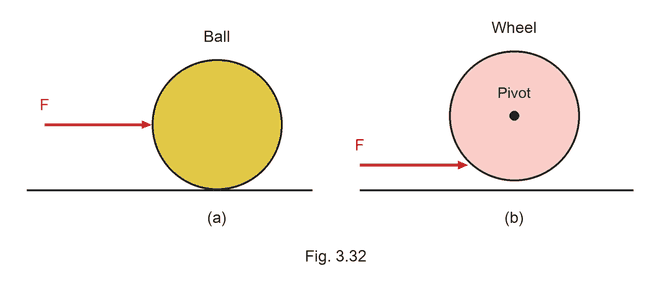
State the effect of force F in each of the following diagrams (a) and (b).
 Solve with AI
Written solution
Solution:
Concept: A force on a free body moves it along a straight line (linear motion). A force on a body pivoted (fixed) at a point cannot move the body as a whole, but it can turn it about the pivot (turning or rotational motion).
Step 1 — Look at diagram (a).
In diagram (a) the ball is free (not fixed at any point), and the force F acts along a line through its centre.
Step 2 — State the effect in (a).
A force through the centre of a free body moves it along a straight line, so the ball moves forward in the direction of F. The effect is linear (straight-line) motion.
Step 3 — Look at diagram (b).
In diagram (b) the wheel is fixed at a pivot at its centre, and F acts at a point of the rim below the pivot, so its line of action does not pass through the pivot.
Step 4 — State the effect in (b).
The pivot stops the wheel from moving forward, so the force can only turn it: the effect is turning (rotational) motion about the pivot. F pushes the lower part of the wheel to the right, so the top moves to the left and the wheel turns anticlockwise.
Watch out: The wheel in (b) cannot roll forward, because its centre is held by the pivot.
Therefore, in (a) the force produces linear motion of the ball in the direction of F, and in (b) it produces turning (anticlockwise) motion of the wheel about the pivot.
- 502 marks
Question 50
Define the term moment of force.
Solve with AIWritten solution
Solution:
Concept: A force on a free body moves it along a straight line (linear motion). A force on a body pivoted (fixed) at a point cannot move the body as a whole, but it can turn it about the pivot (turning or rotational motion).
Step 1 — Say what it measures.
When a force acts on a body pivoted at a point, it turns the body. The turning effect of the force about the pivot is called the moment of force (or torque).
Step 2 — Say how it is measured.
It is measured by the product of the force and the perpendicular distance of the line of action of the force from the pivot:
Therefore, the moment of force is the turning effect of a force about a pivot, measured by force × perpendicular distance of its line of action from the pivot.
- 512 marks
Question 51
State the S.I. unit of moment of force.
Solve with AIWritten solution
Solution:
Concept: The turning effect of a force is called the moment of force (or torque). It is the force multiplied by the perpendicular distance of the line of action of the force from the pivot (axis of rotation). Its S.I. unit is the newton metre (N m).
Step 1 — Build the unit.
The moment of force is force × perpendicular distance. In S.I. units the force is in newtons and the distance in metres.
Step 2 — Name the unit.
So the S.I. unit is the newton metre (N m). A moment of 1 N m is produced when a force of 1 N acts at a perpendicular distance of 1 m from the pivot. (The C.G.S. unit is dyne cm and the gravitational unit is kgf m.)
Therefore, the S.I. unit of moment of force is the newton metre (N m).
- 522 marks
Question 52
State two factors which affect moment of force.
Solve with AIWritten solution
Solution:
Concept: The turning effect of a force is called the moment of force (or torque). It is the force multiplied by the perpendicular distance of the line of action of the force from the pivot (axis of rotation). Its S.I. unit is the newton metre (N m).
Step 1 — Look at the formula.
The moment of force is force × perpendicular distance from the axis, so it depends on each of these two quantities.
Step 2 — First factor — the force.
The larger the magnitude of the force, the larger the moment.
Step 3 — Second factor — the distance.
The larger the perpendicular distance of the line of action of the force from the axis of rotation, the larger the moment.
Watch out: It is the perpendicular distance of the line of action that counts, not just any distance to the point where the force is applied.
Therefore, the moment of force depends on the magnitude of the force and on the perpendicular distance of its line of action from the axis of rotation.
- 532 marks
Question 53
Write the expression for the moment of force about a given axis of rotation.
Solve with AIWritten solution
Solution:
Concept: The turning effect of a force is called the moment of force (or torque). It is the force multiplied by the perpendicular distance of the line of action of the force from the pivot (axis of rotation). Its S.I. unit is the newton metre (N m).
Step 1 — Name the quantities.
Let a force act on a body, and let be the perpendicular distance of its line of action from the axis of rotation.
Step 2 — Write the expression.
The moment of force is the product of these two:
Therefore, moment of force = F × r, where r is the perpendicular distance of the force from the axis.
- 542 marks
Question 54
State one way to decrease the moment of a given force about a given axis of rotation.
Solve with AIWritten solution
Solution:
Concept: The turning effect of a force is called the moment of force (or torque). It is the force multiplied by the perpendicular distance of the line of action of the force from the pivot (axis of rotation). Its S.I. unit is the newton metre (N m).
Step 1 — Keep the force fixed.
The force is given, so its moment can change only through the perpendicular distance from the axis.
Step 2 — Make the distance smaller.
Applying the force closer to the axis (or so that its line of action passes nearer the axis) decreases the perpendicular distance, and so decreases the moment. For example, pushing a door near its hinges hardly turns it.
Therefore, the moment of a given force is decreased by applying it closer to the axis of rotation, so that the perpendicular distance becomes smaller.
- 552 marks
Question 55
State one way to obtain greater moment of a given force about a given axis of rotation.
Solve with AIWritten solution
Solution:
Concept: The turning effect of a force is called the moment of force (or torque). It is the force multiplied by the perpendicular distance of the line of action of the force from the pivot (axis of rotation). Its S.I. unit is the newton metre (N m).
Step 1 — Keep the force fixed.
The force is given, so a greater moment needs a greater perpendicular distance.
Step 2 — Make the distance larger.
Apply the force farther from the axis of rotation (and at right angles to the line joining it to the axis). For example, a spanner with a long handle, or pushing a door at its free edge, gives a large moment.
Therefore, a greater moment of a given force is obtained by applying it farther from the axis of rotation.
- 562 marks
Question 56
What do you mean by the clockwise and anti-clockwise moment of force ?
Solve with AIWritten solution
Solution:
Concept: The turning effect of a force is called the moment of force (or torque). It is the force multiplied by the perpendicular distance of the line of action of the force from the pivot (axis of rotation). Its S.I. unit is the newton metre (N m).
Step 1 — Clockwise moment.
If a force turns a body in the same direction as the hands of a clock, its moment is called a clockwise moment. By convention it is taken as negative.
Step 2 — Anticlockwise moment.
If a force turns a body in the direction opposite to that of the hands of a clock, its moment is called an anticlockwise moment. By convention it is taken as positive.
Step 3 — Give an example.
Seen from the head of an ordinary screw, tightening it (turning it to the right) needs a clockwise moment, and loosening it needs an anticlockwise moment.
Watch out: Whether a moment is clockwise depends on the side from which we look, so always say from where you are viewing.
Therefore, a moment that turns a body the way clock hands move is clockwise (taken negative), and one that turns it the opposite way is anticlockwise (taken positive).
- 572 marks
Question 57
What is thrust ?
Solve with AIWritten solution
Solution:
Concept: Thrust is the force acting on a surface normally (at right angles to it). It is a force, so its S.I. unit is the newton (N); it is also measured in kgf. A body resting on a horizontal surface exerts a thrust equal to its own weight.
Step 1 — Define thrust.
Thrust is the force acting on a surface in a direction normal (perpendicular) to the surface.
Step 2 — Give an example.
A book lying on a table presses straight down on it with its weight. This force is at right angles to the table top, so it is the thrust of the book on the table.
Therefore, thrust is the force acting normally on a surface.
- 582 marks
Question 58
State the unit of thrust.
Solve with AIWritten solution
Solution:
Concept: Thrust is the force acting on a surface normally (at right angles to it). It is a force, so its S.I. unit is the newton (N); it is also measured in kgf. A body resting on a horizontal surface exerts a thrust equal to its own weight.
Step 1 — Decide what thrust is.
Thrust is a force, so it is measured in units of force.
Step 2 — Give the units.
Its S.I. unit is the newton (N). It is also measured in the gravitational unit kilogram-force (kgf), where 1 kgf is about 9.8 N (nearly 10 N).
Therefore, the unit of thrust is the newton (N); it is also expressed in kgf.
- 592 marks
Question 59
On what factors does the effect of thrust on a surface depend ?
Solve with AIWritten solution
Solution:
Concept: Pressure is thrust ÷ area. So for the same area a larger thrust gives a larger pressure, and for the same thrust a larger area gives a smaller pressure while a smaller area gives a larger pressure.
Step 1 — Measure the effect.
The effect of a thrust on a surface (how deep it presses in, how easily it cuts) is measured by the pressure it produces, which is thrust ÷ area.
Step 2 — First factor — the magnitude of the thrust.
On the same area, a larger thrust produces a greater effect (a larger pressure).
Step 3 — Second factor — the area of the surface.
The same thrust produces a greater effect on a smaller area and a smaller effect on a larger area. For example, a sharp knife cuts easily while a blunt one does not, though the same force is applied.
Therefore, the effect of thrust on a surface depends on the magnitude of the thrust and on the area of the surface on which it acts.
- 602 marks
Question 60
Define the term 'pressure' and state its unit.
Solve with AIWritten solution
Solution:
Concept: Pressure is the thrust acting on unit area of a surface: pressure is thrust ÷ area. Its S.I. unit is N m, called the pascal (Pa).
Step 1 — Define pressure.
The thrust acting on unit area of a surface is called pressure:
Step 2 — State its unit.
With the thrust in newtons and the area in square metres, the S.I. unit is N m, called the pascal (Pa). One pascal is the pressure when a thrust of 1 N acts normally on an area of 1 m. Other units used are kgf m and kgf cm.
Therefore, pressure is the thrust acting on unit area of a surface, and its S.I. unit is the pascal (N m).
- 612 marks
Question 61
How is thrust related to pressure ?
Solve with AIWritten solution
Solution:
Concept: Pressure is the thrust acting on unit area of a surface: pressure is thrust ÷ area. Its S.I. unit is N m, called the pascal (Pa).
Step 1 — Write the relation.
Pressure is the thrust acting per unit area:
Step 2 — Turn it round.
Multiplying both sides by the area gives the thrust:
Step 3 — Read off the link.
So, for the same area, the pressure is directly proportional to the thrust: doubling the thrust doubles the pressure.
Therefore, pressure = thrust ÷ area, or thrust = pressure × area.
- 622 marks
Question 62
Name two factors on which the pressure on a surface depends.
Solve with AIWritten solution
Solution:
Concept: Pressure is thrust ÷ area. So for the same area a larger thrust gives a larger pressure, and for the same thrust a larger area gives a smaller pressure while a smaller area gives a larger pressure.
Step 1 — Look at the definition.
Pressure is thrust ÷ area, so it depends on these two quantities.
Step 2 — First factor — the thrust.
For the same area, the pressure increases as the thrust increases.
Step 3 — Second factor — the area.
For the same thrust, the pressure decreases as the area increases.
Therefore, the pressure on a surface depends on the thrust acting on it and on the area of the surface.
- 632 marks
Question 63
Why is the bottom part of the foundation of a building made wider ?
Solve with AIWritten solution
Solution:
Concept: Pressure is thrust ÷ area. So for the same area a larger thrust gives a larger pressure, and for the same thrust a larger area gives a smaller pressure while a smaller area gives a larger pressure.
Step 1 — Find the thrust.
A building is very heavy, so it presses on the ground with a very large thrust (its weight).
Step 2 — Spread it over a large area.
The bottom of the foundation is made wider so that this thrust acts on a large area of ground.
Step 3 — See the effect on pressure.
Since pressure is thrust ÷ area, the larger area makes the pressure on the ground small, small enough for the soil to bear. So the building does not sink into the ground.
Therefore, the foundation is made wider at the bottom to spread the large weight of the building over a large area, so that the pressure on the ground is small.
- 642 marks
Question 64
It is easier to cut with a sharp knife than with a blunt one. Explain.
Solve with AIWritten solution
Solution:
Concept: Pressure is thrust ÷ area. So for the same area a larger thrust gives a larger pressure, and for the same thrust a larger area gives a smaller pressure while a smaller area gives a larger pressure.
Step 1 — Compare the edges.
A sharp knife has a very thin cutting edge, so its area of contact with the object is very small. A blunt knife has a thicker edge, so its area of contact is larger.
Step 2 — Compare the pressures.
When the same force is applied, it acts on a smaller area with the sharp knife, so it produces a larger pressure, which cuts the object easily. With the blunt knife the same force is spread over a larger area, giving a smaller pressure that does not cut easily.
Therefore, it is easier to cut with a sharp knife, because its small edge area gives a much larger pressure for the same force.
- 653 marks
Question 65
A gum bottle rests on its base. If it is placed upside down, how does the (i) thrust, (ii) pressure change ?
Solve with AIWritten solution
Solution:
Concept: Pressure is thrust ÷ area. So for the same area a larger thrust gives a larger pressure, and for the same thrust a larger area gives a smaller pressure while a smaller area gives a larger pressure.
Step 1 — (i) Find the thrust.
The thrust on the table is the weight of the bottle. Turning the bottle upside down does not change its weight, so the thrust remains the same.
Step 2 — (ii) Compare the areas.
A gum bottle has a broad base and a narrow neck with a small cap. Upside down, it rests on its cap, so the area in contact with the table decreases.
Step 3 — (ii) Find the change in pressure.
The same thrust now acts on a smaller area, and pressure is thrust ÷ area, so the pressure increases.
Watch out: This assumes, as for an ordinary gum bottle, that the cap is narrower than the base.
Therefore, (i) the thrust remains the same and (ii) the pressure increases.
- 662 marks
Question 66
State two factors on which the pressure at a point in a liquid depends.
Solve with AIWritten solution
Solution:
Concept: A liquid has weight, so it exerts pressure on the bottom and the walls of its container and on anything placed in it. At a point in a liquid the pressure acts equally in all directions, it increases with depth (the height of the liquid column above the point) and, at the same depth, it is greater in a denser liquid.
Step 1 — See where the pressure comes from.
The pressure at a point in a liquid is due to the weight of the liquid column above it.
Step 2 — First factor — the depth.
The deeper the point below the free surface, the taller the column above it, so the pressure increases with depth.
Step 3 — Second factor — the density.
At the same depth, a denser liquid has a heavier column, so it exerts more pressure. For example, the pressure at a given depth is more in sea water than in fresh water.
Therefore, the pressure at a point in a liquid depends on its depth below the free surface and on the density of the liquid.
- 672 marks
Question 67
What do you mean by atmospheric pressure ?
Solve with AIWritten solution
Solution:
Concept: Air has weight, so the air column above any surface presses on it. The thrust of this air on unit area of the earth's surface is the atmospheric pressure. At sea level it is about Pa (1 atm), nearly Pa, and it decreases with height because the air column above becomes shorter and the air thinner.
Step 1 — See why air presses.
The earth is surrounded by a layer of air called the atmosphere. Air has weight, so the air above us presses on the earth's surface and on everything on it.
Step 2 — Define atmospheric pressure.
The thrust exerted on unit area of the earth's surface by the column of air above it is called atmospheric pressure. At sea level it is about Pa (1 atm).
Therefore, atmospheric pressure is the thrust of the air column above on unit area of the earth's surface.
- 682 marks
Question 68
We do not feel uneasy even under the enormous atmospheric pressure. Give a reason.
Solve with AIWritten solution
Solution:
Concept: Air has weight, so the air column above any surface presses on it. The thrust of this air on unit area of the earth's surface is the atmospheric pressure. At sea level it is about Pa (1 atm), nearly Pa, and it decreases with height because the air column above becomes shorter and the air thinner.
Step 1 — Notice the size of the push.
The atmospheric pressure on our body is very large: about 1 kgf on every square centimetre of skin.
Step 2 — Look inside the body.
The blood and other fluids in our body, and the air in our lungs, are at a pressure equal to or a little more than the atmospheric pressure. This inside pressure pushes outwards.
Step 3 — See the balance.
The outward push from inside balances the inward push of the atmosphere, so there is no unbalanced force on our body and we do not feel uneasy.
Therefore, we do not feel uneasy because the pressure inside our body balances the atmospheric pressure outside.
- 692 marks
Question 69
Write the numerical value of the atmospheric pressure on the earth surface in pascal.
Solve with AIWritten solution
Solution:
Concept: Air has weight, so the air column above any surface presses on it. The thrust of this air on unit area of the earth's surface is the atmospheric pressure. At sea level it is about Pa (1 atm), nearly Pa, and it decreases with height because the air column above becomes shorter and the air thinner.
Step 1 — Recall the value.
At sea level the atmospheric pressure is one atmosphere.
Step 2 — Write it in pascal.
One atmosphere is about Pa, which is nearly Pa (100,000 Pa).
Therefore, the atmospheric pressure on the earth's surface is about Pa (nearly Pa).
- 704 marks
Question 70
Explain the following :
(a) The spanner (or wrench) has a long handle.
(b) The steering wheel of a vehicle is of large diameter.
(c) The hand flour grinder is provided with a handle near the rim.
(d) It is easier to open the door by pushing it at its free end.
(e) A potter turns his wheel by applying a force through the stick near the rim of wheel.
Solve with AIWritten solution
Solution:
Concept: The turning effect of a force is called the moment of force (or torque). It is the force multiplied by the perpendicular distance of the line of action of the force from the pivot (axis of rotation). Its S.I. unit is the newton metre (N m). For a given turning effect, the farther from the pivot the force acts, the smaller the force needed.
Step 1 — See the common idea.
Each of the five objects has to be turned about an axis, which needs a certain moment of force. Since the moment is force × perpendicular distance, placing the force far from the axis lets a small force give the moment needed.
Step 2 — (a) Spanner with a long handle.
The nut is the axis of turning. The long handle lets us apply the force far from the nut, so a small force at the end of the handle gives the large moment needed to tighten or loosen the nut.
Step 3 — (b) Steering wheel of large diameter.
The driver pushes on the rim, and the axis is the steering column at the centre. A large diameter puts the rim far from the axis, so the wheel turns with a small force.
Step 4 — (c) Handle near the rim of a hand flour grinder.
The upper stone turns about its central axle. A handle near the rim is at nearly the largest distance from the axle, so a small force on it turns the heavy stone.
Step 5 — (d) Pushing a door at its free end.
The door turns about its hinges. The free end is farthest from the hinges, so a push there gives the largest moment for a given force; pushing near the hinges needs a much larger force.
Step 6 — (e) Potter's stick near the rim.
The potter's wheel turns about the axle at its centre. Putting the stick near the rim gives a large perpendicular distance, so a small force sets the heavy wheel spinning.
Therefore, in each case the force is applied as far as possible from the axis of rotation, so that a small force produces the large moment needed to turn the body.
- 714 marks
Question 71
Explain the following:
(a) Wooden sleepers are used below the rails.
(b) A tall building has wide foundations.
Solve with AIWritten solution
Solution:
Concept: Pressure is thrust ÷ area. So for the same area a larger thrust gives a larger pressure, and for the same thrust a larger area gives a smaller pressure while a smaller area gives a larger pressure.
Step 1 — (a) Find the thrust of a train.
A train is very heavy. If the narrow rails rested straight on the ground, its weight would act on a small area, so the pressure on the ground would be very large and the rails would sink.
Step 2 — (a) Use sleepers.
Wide sleepers placed below the rails spread the same thrust over a much larger area. Since pressure is thrust ÷ area, the pressure on the ground becomes small, and the rails do not sink. (Sleepers were once mostly wooden; today concrete sleepers are common, and they work the same way.)
Step 3 — (b) Find the thrust of a tall building.
A tall building has a huge weight, which is the thrust on the ground below it.
Step 4 — (b) Use wide foundations.
Wide foundations spread this thrust over a large area of ground, so the pressure on the ground is small enough for the soil to bear, and the building does not sink.
Therefore, sleepers and wide foundations both increase the area on which a large thrust acts, so the pressure on the ground is reduced.
- 723 marks
Question 72
Describe an experiment to show that a liquid exerts pressure at the bottom of the container in which it is kept.
Solve with AIWritten solution
Solution:
Concept: A liquid has weight, so it exerts pressure on the bottom and the walls of its container and on anything placed in it. At a point in a liquid the pressure acts equally in all directions, it increases with depth (the height of the liquid column above the point) and, at the same depth, it is greater in a denser liquid.
Step 1 — Collect the apparatus.
Take a glass tube open at both ends, a balloon (or a thin rubber sheet), thread and some water.
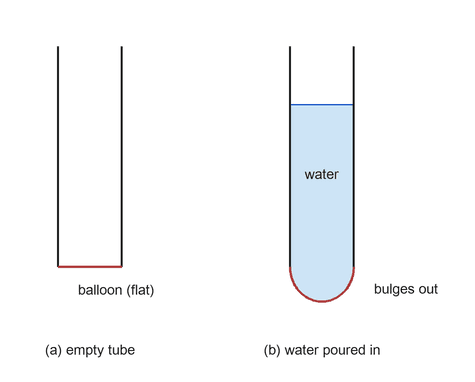
Step 2 — Set it up.
Tie the balloon tightly over the lower end of the tube so that it closes the bottom. Hold the tube vertical. The balloon is flat.
Step 3 — Pour in water and observe.
Pour some water into the tube. The balloon at the bottom bulges out downwards.
Step 4 — Explain and conclude.
The water column in the tube presses down on the rubber at the bottom. The thrust on the rubber is the weight of the water, and this thrust per unit area is the pressure that stretches the rubber. Pouring in more water makes the balloon bulge more.
Therefore, the bulging balloon shows that a liquid exerts pressure at the bottom of the container in which it is kept.
- 733 marks
Question 73
Describe a suitable experiment to demonstrate that a liquid exerts pressure sideways also.
Solve with AIWritten solution
Solution:
Concept: A liquid has weight, so it exerts pressure on the bottom and the walls of its container and on anything placed in it. At a point in a liquid the pressure acts equally in all directions, it increases with depth (the height of the liquid column above the point) and, at the same depth, it is greater in a denser liquid.
Step 1 — Collect the apparatus.
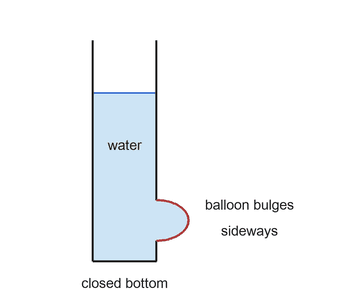
Take a glass tube closed at its lower end, with a small opening in its side near the bottom, a balloon (or a thin rubber sheet) and water.
Step 2 — Set it up.
Tie the balloon over the side opening and hold the tube vertical. The balloon is flat.
Step 3 — Pour in water and observe.
Pour water into the tube. The balloon tied at the side opening bulges out sideways.
Step 4 — Explain and conclude.
The water presses on the side walls of the tube; at the opening this sideways pressure pushes the rubber outwards. Another simple way: make a hole in the side of a can full of water, and water spurts out of it sideways.
Therefore, the sideways bulge shows that a liquid exerts pressure sideways on the walls of its container.
- 743 marks
Question 74
Describe an experiment to show that the liquid pressure at a point increases with the increase in height of the liquid column above that point.
Solve with AIWritten solution
Solution:
Concept: A liquid has weight, so it exerts pressure on the bottom and the walls of its container and on anything placed in it. At a point in a liquid the pressure acts equally in all directions, it increases with depth (the height of the liquid column above the point) and, at the same depth, it is greater in a denser liquid.
Step 1 — Collect the apparatus.
Take a tall empty tin, adhesive tape, a wooden block, a table and water.
Step 2 — Set it up.
Make two holes of the same size in the side of the tin, one (A) near the top and one (B) near the bottom, both on the same side. Close them with adhesive tape. Stand the tin on the block on the table and fill it with water.
Step 3 — Open the holes and observe.
Remove the tape from both holes together. Water spurts out of both. The jet from the lower hole B comes out faster (with more force) and, with the tin raised on the block, lands farther from the tin; the jet from the upper hole A comes out slowly and falls close to the tin.
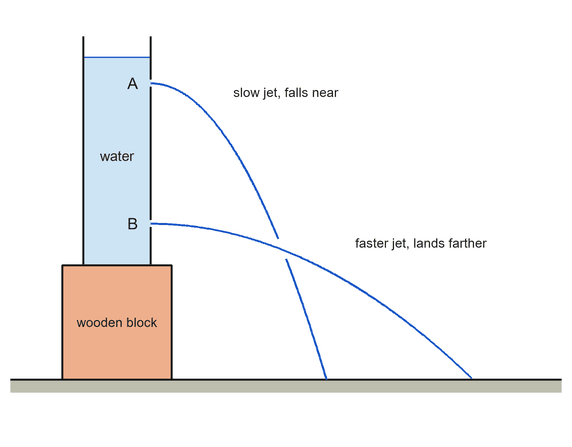
Step 4 — Explain and conclude.
The water column above hole B is taller than that above hole A, so the pressure at B is greater and pushes the water out faster. So the liquid pressure at a point increases with the height of the liquid column above it. A second way: tie a balloon over the bottom of a glass tube and pour in water; the more water we pour in, the more the balloon bulges.
Watch out: Judge by how fast the water comes out, not only by where it lands: how far a jet lands also depends on how high its hole is above the ground. The deeper (lower) hole always gives the faster jet; it lands farther here because the vessel stands high enough on a block.
Therefore, the faster jet from the lower hole shows that the liquid pressure at a point increases with the height of the liquid column above it.
- 753 marks
Question 75
Describe a simple experiment to show that at a given depth, a liquid exerts same pressure in all directions.
Solve with AIWritten solution
Solution:
Concept: A liquid has weight, so it exerts pressure on the bottom and the walls of its container and on anything placed in it. At a point in a liquid the pressure acts equally in all directions, it increases with depth (the height of the liquid column above the point) and, at the same depth, it is greater in a denser liquid.
Step 1 — Collect the apparatus.
Take a plastic bottle (or a tin can), a hot pin or nail, a stool and water.
Step 2 — Set it up.
Make four or five small holes of the same size all round the bottle, all at the same height above its bottom, so that they are at the same depth below the water surface. Close them with tape and fill the bottle with water up to a mark.
Step 3 — Open the holes and observe.
Place the bottle on the stool and open all the holes together, keeping the water level at the mark by pouring in more water. Water spurts out of every hole, in different directions, and all the jets travel the same distance before they fall.
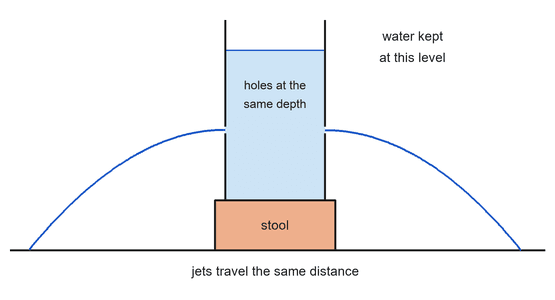
Step 4 — Explain and conclude.
The holes face different directions but are at the same depth, and the jets are equally strong. So the water presses equally in all these directions at that depth.
Watch out: The holes must be of the same size and at the same depth, or the jets cannot be compared.
Therefore, the equal jets show that at a given depth a liquid exerts the same pressure in all directions.
- 763 marks
Question 76
Describe an experiment to show that liquid pressure depends on the density of liquid.
Solve with AIWritten solution
Solution:
Concept: A liquid has weight, so it exerts pressure on the bottom and the walls of its container and on anything placed in it. At a point in a liquid the pressure acts equally in all directions, it increases with depth (the height of the liquid column above the point) and, at the same depth, it is greater in a denser liquid.
Step 1 — Collect the apparatus.
Take two identical glass tubes A and B open at both ends, two identical balloons, water and a concentrated sugar solution (which is denser than water).
Step 2 — Set it up.
Tie a balloon over the lower end of each tube and hold both tubes vertical.
Step 3 — Fill to the same height and observe.
Pour water into tube A and sugar solution into tube B up to the same height. The balloon under tube B (sugar solution) bulges more than the balloon under tube A (water).

Step 4 — Explain and conclude.
The two columns have the same height, so the only difference is the density of the liquid. The denser sugar solution presses more on the balloon at the same depth.
Watch out: The two heights must be the same; otherwise the difference could come from the depth instead of the density.
Therefore, the larger bulge under the sugar solution shows that liquid pressure increases with the density of the liquid.
- 773 marks
Question 77
Describe a simple experiment to illustrate that air exerts pressure.
Solve with AIWritten solution
Solution:
Concept: Air has weight, so the air column above any surface presses on it. The thrust of this air on unit area of the earth's surface is the atmospheric pressure. At sea level it is about Pa (1 atm), nearly Pa, and it decreases with height because the air column above becomes shorter and the air thinner.
Step 1 — Collect the apparatus.
Take a glass, water and a post card.
Step 2 — Fill and cover.
Fill the glass with water right up to the brim and place the post card on top of it.
Step 3 — Invert it.
Press the card on the glass with the palm of one hand and turn the glass upside down. Then gently take your hand away from the card.
Step 4 — Observe.
The card does not fall, and the water stays in the glass, although the water is pressing down on the card.
Step 5 — Explain and conclude.
The air outside pushes up on the card with the atmospheric pressure. This upward thrust is much greater than the weight of the water in the glass, so it holds the card and the water in place.
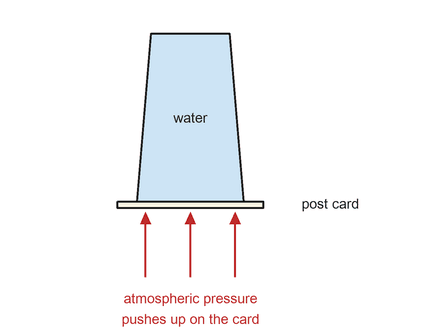
Watch out: The glass must be filled to the brim; a large air gap inside makes the trick fail more easily.
Therefore, the card held up against the water shows that air exerts pressure.
- 784 marks
Question 78
Describe the crushing tin can experiment. What do you conclude from this experiment ?
Solve with AIWritten solution
Solution:
Concept: Air has weight, so the air column above any surface presses on it. The thrust of this air on unit area of the earth's surface is the atmospheric pressure. At sea level it is about Pa (1 atm), nearly Pa, and it decreases with height because the air column above becomes shorter and the air thinner.
Step 1 — Collect the apparatus.
Take a thin-walled tin can with an airtight stopper, water, a burner, a tripod stand with wire gauze, and a tub of cold water.
Step 2 — Heat the water.
Remove the stopper, pour a little water into the can and heat it until the water boils. Steam drives most of the air out through the opening. Until now the pressure inside and outside the can is the same.
Step 3 — Close and cool.
When steam comes out freely, put the stopper back tightly, take the can off the burner, place it in the tub and pour cold water over it.
Step 4 — Observe.
The can collapses (gets crushed inwards).
Step 5 — Explain.
The cold water makes the steam inside condense into a few drops of water, leaving a partial vacuum in the can. The pressure inside becomes much less than the atmospheric pressure outside, and the unbalanced outside pressure pushes the walls inwards.
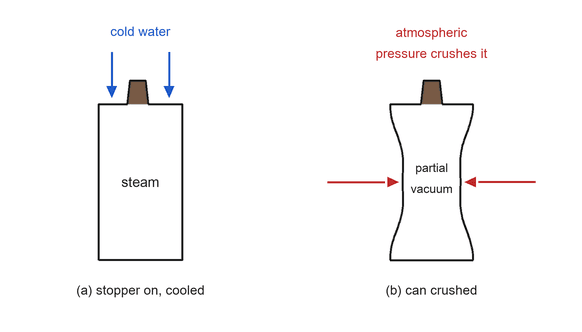
Watch out: Never heat a can with its stopper on; the steam pressure could burst it. The stopper goes on only after heating stops.
Therefore, the crushing tin can experiment shows that air exerts pressure, and that the atmospheric pressure is very large.
- 794 marks
Question 79
Give reasons for the following :
(a) A balloon collapses when air is removed from it.
(b) Water does not run out of a dropper unless its rubber bulb is pressed.
(c) Two holes are made in a sealed oil tin to take out oil from it.
Solve with AIWritten solution
Solution:
Concept: Air has weight, so the air column above any surface presses on it. The thrust of this air on unit area of the earth's surface is the atmospheric pressure. At sea level it is about Pa (1 atm), nearly Pa, and it decreases with height because the air column above becomes shorter and the air thinner.
Step 1 — See the common idea.
In each case, what happens depends on whether the air pressure inside balances the atmospheric pressure outside.
Step 2 — (a) The balloon collapses.
A blown-up balloon keeps its shape because the air inside presses outwards on its walls and balances the atmospheric pressure outside. When the air is removed, nothing pushes outwards, so the atmospheric pressure outside presses the walls in and the balloon collapses.
Step 3 — (b) Water stays in a dropper.
The open end of the dropper is at the bottom. The atmospheric pressure pushing up at this opening is greater than the pressure of the small column of water inside, so the water is held in. Pressing the rubber bulb squeezes the air above the water and raises its pressure above the atmospheric pressure, which pushes the water out.
Step 4 — (c) Two holes in an oil tin.
With only one hole, as oil flows out, the air pressure inside the tin falls and the atmospheric pressure outside pushes back at the hole, so the oil comes out with difficulty, in gulps. With a second hole, air enters the tin through it, so the atmospheric pressure acts on the oil from inside too, and the oil flows out smoothly through the other hole.
Therefore, all three are explained by the atmospheric pressure: it crushes the empty balloon, holds water in the dropper, and lets oil flow smoothly only when air can enter the tin.
- 803 marks
Question 80
How does the atmospheric pressure change with altitude ?
Solve with AIWritten solution
Solution:
Concept: Air has weight, so the air column above any surface presses on it. The thrust of this air on unit area of the earth's surface is the atmospheric pressure. At sea level it is about Pa (1 atm), nearly Pa, and it decreases with height because the air column above becomes shorter and the air thinner.
Step 1 — State the change.
The atmospheric pressure decreases as the altitude (height above sea level) increases.
Step 2 — Give the first reason.
The atmospheric pressure at a place is due to the weight of the air column above it. As we go higher, this column becomes shorter, so it weighs less.
Step 3 — Give the second reason.
The air also becomes thinner (less dense) higher up, so each metre of the column weighs less.
Step 4 — Give an example.
At sea level the pressure is about 76 cm of mercury ( Pa); on top of a high mountain it is much less. That is why aeroplane cabins are pressurised and astronauts wear pressurised suits.
Therefore, the atmospheric pressure decreases with increase in altitude.
- 812 marks
Question 81
In Fig. 3.33 a force F is applied in a direction passing through the pivoted point O of the body. Will the body rotate ? Give reason to support your answer.
 Solve with AI
Written solution
Solution:
Concept: The turning effect of a force is called the moment of force (or torque). It is the force multiplied by the perpendicular distance of the line of action of the force from the pivot (axis of rotation). Its S.I. unit is the newton metre (N m).
Step 1 — Look at the figure.
The force F acts along a line that passes through the pivot O of the body.
Step 2 — Find the perpendicular distance.
The line of action of F passes through O, so the perpendicular distance of the force from O is zero.
Step 3 — Find the moment.
The moment of force is force × perpendicular distance:
So the moment of the force about O is zero.
Step 4 — Decide.
A body turns only when a force has a moment about the pivot. Here the moment is zero, so the force has no turning effect. The body cannot move along a straight line either, because it is held at O.
Watch out: A force that acts on a pivoted body does not always turn it; its line of action must miss the pivot.
Therefore, the body will not rotate, because the line of action of F passes through O and its moment about O is zero.
- 822 marks
Question 82
When does a man exert more pressure on the floor : while standing or while walking ?
Solve with AIWritten solution
Solution:
Concept: Pressure is thrust ÷ area. So for the same area a larger thrust gives a larger pressure, and for the same thrust a larger area gives a smaller pressure while a smaller area gives a larger pressure.
Step 1 — Find the thrust.
In both cases the man presses on the floor with his weight, so the thrust is the same.
Step 2 — Compare the areas.
While standing, his weight is spread over the area of both feet. While walking, at each step his weight rests on one foot only (often only its heel or toes), so the area of contact is smaller.
Step 3 — Compare the pressures.
Pressure is thrust ÷ area, so the smaller area while walking gives the larger pressure.
Therefore, a man exerts more pressure on the floor while walking than while standing.
- 832 marks
Question 83
Why do camels or elephants have broad feet ?
Solve with AIWritten solution
Solution:
Concept: Pressure is thrust ÷ area. So for the same area a larger thrust gives a larger pressure, and for the same thrust a larger area gives a smaller pressure while a smaller area gives a larger pressure.
Step 1 — Find the thrust.
Camels and elephants are heavy animals, so they press on the ground with a large thrust (their weight).
Step 2 — See what broad feet do.
Broad feet increase the area in contact with the ground, so this thrust acts on a large area and the pressure on the ground is small.
Step 3 — Apply it.
So a camel can walk on soft desert sand, and an elephant on soft muddy forest ground, without its feet sinking in.
Therefore, camels and elephants have broad feet so that their weight is spread over a large area and the pressure on soft ground is small.
- 842 marks
Question 84
A sharp pin works better than a blunt pin. Explain the reason.
Solve with AIWritten solution
Solution:
Concept: Pressure is thrust ÷ area. So for the same area a larger thrust gives a larger pressure, and for the same thrust a larger area gives a smaller pressure while a smaller area gives a larger pressure.
Step 1 — Compare the tips.
The tip of a sharp pin has a very small area; the tip of a blunt pin has a larger area.
Step 2 — Compare the pressures.
When we press with the same force, the force on the tiny tip of the sharp pin gives a very large pressure, so it goes into cloth, paper or wood easily. On the blunt pin the same force is spread over a larger area, giving less pressure, so it does not go in easily.
Therefore, a sharp pin works better, because its small tip area gives a much larger pressure for the same force.
- 852 marks
Question 85
Which fact about liquid pressure does the diagram in Fig. 3.34 illustrate ?
 Solve with AI
Written solution
Solution:
Concept: A liquid has weight, so it exerts pressure on the bottom and the walls of its container and on anything placed in it. At a point in a liquid the pressure acts equally in all directions, it increases with depth (the height of the liquid column above the point) and, at the same depth, it is greater in a denser liquid.
Step 1 — Look at the figure.
Water spurts out of two holes in the side of a vessel standing on a block: one hole near the top and one lower down.
Step 2 — Compare the depths.
The lower hole is deeper below the water surface, so the column of water above it is taller than above the upper hole.
Step 3 — Compare the jets.
The water at the lower hole is under greater pressure, so it comes out faster and, in the figure, lands farther from the vessel. The jet from the upper hole, where the pressure is less, comes out slowly and falls close to the vessel.
Watch out: How far a jet lands also depends on how high its hole is above the ground. The deeper (lower) hole always gives the faster jet; it lands farther here because the vessel stands high enough on a block.
Therefore, the diagram illustrates that the liquid pressure at a point increases with the depth (the height of the liquid column above it).
- 862 marks
Question 86
A dam has broader walls at the bottom than at the top. Give a reason.
Solve with AIWritten solution
Solution:
Concept: A liquid has weight, so it exerts pressure on the bottom and the walls of its container and on anything placed in it. At a point in a liquid the pressure acts equally in all directions, it increases with depth (the height of the liquid column above the point) and, at the same depth, it is greater in a denser liquid.
Step 1 — See how the pressure changes with depth.
The water pressure on the wall of a dam increases with depth, because the height of the water column above a point increases as we go down.
Step 2 — Compare the top and the bottom.
So the bottom of the wall must withstand a much greater pressure than the top.
Step 3 — Shape the wall to match.
The wall is therefore made broad (thick and strong) at the bottom, where the pressure is greatest, and thinner at the top, where the pressure is small.
Therefore, a dam has broader walls at the bottom to withstand the larger water pressure there, since water pressure increases with depth.
- 872 marks
Question 87
Sea-divers wear specially designed swim-suit. Why ?
Solve with AIWritten solution
Solution:
Concept: A liquid has weight, so it exerts pressure on the bottom and the walls of its container and on anything placed in it. At a point in a liquid the pressure acts equally in all directions, it increases with depth (the height of the liquid column above the point) and, at the same depth, it is greater in a denser liquid.
Step 1 — See how the pressure changes with depth.
The pressure in the sea increases with depth. About every 10 m of sea water adds roughly one more atmosphere of pressure, so deep down it is many times the atmospheric pressure at the surface.
Step 2 — Protect the body.
So divers who go deep wear specially designed suits that help to protect the body from this high pressure.
Note: This is the reason the chapter gives. In practice, ordinary divers' wetsuits mainly keep them warm, and they breathe air supplied at the surrounding water pressure; for some very deep work, divers use rigid suits that keep the body at about atmospheric pressure.
Therefore, sea-divers wear specially designed suits to protect their bodies from the very large water pressure at great depths.
- 883 marks
Question 88
Find the moment of force of 20 N about an axis of rotation at a distance of 0.5 m from the force.
Solve with AIWritten solution
Solution:
Concept: The turning effect of a force is called the moment of force (or torque). It is the force multiplied by the perpendicular distance of the line of action of the force from the pivot (axis of rotation). Its S.I. unit is the newton metre (N m).
Given: Force is 20 N; distance from the axis is 0.5 m.
Step 1 — Write the formula.
The moment of a force is the force multiplied by its perpendicular distance from the axis of rotation:
Step 2 — Substitute and calculate.
Put in the force and the distance:
Therefore, the moment of force is 10 N m.
- 893 marks
Question 89
The moment of a force of 25 N about a point is 2.5 N m. Find the perpendicular distance of force from that point.
Solve with AIWritten solution
Solution:
Concept: The turning effect of a force is called the moment of force (or torque). It is the force multiplied by the perpendicular distance of the line of action of the force from the pivot (axis of rotation). Its S.I. unit is the newton metre (N m).
Given: Moment of force is 2.5 N m; force is 25 N.
Step 1 — Rearrange the formula.
Moment of force is , so dividing by the force gives the distance:
Step 2 — Substitute and calculate.
Put in the moment and the force:
Step 3 — Change to centimetres.
Since 1 m is 100 cm:
Therefore, the perpendicular distance of the force from the point is 0.1 m (10 cm).
- 903 marks
Question 90
A spanner of length 10 cm is used to unscrew a nut by applying a minimum force of 5.0 N. Calculate the moment of force required.
Solve with AIWritten solution
Solution:
Concept: The turning effect of a force is called the moment of force (or torque). It is the force multiplied by the perpendicular distance of the line of action of the force from the pivot (axis of rotation). Its S.I. unit is the newton metre (N m).
Given: Length of spanner is 10 cm; minimum force is 5.0 N.
Step 1 — Find the perpendicular distance.
The force is applied at the end of the spanner, at right angles to it, so the perpendicular distance from the nut is the length of the spanner. Change it to metres:
Step 2 — Find the moment.
Multiply the force by the distance:
Watch out: Change 10 cm to 0.1 m first; using 10 would give 50, which is in N cm, not N m.
Therefore, the moment of force required is 0.5 N m.
- 913 marks
Question 91
A wheel of diameter 2 m can be rotated about an axis passing through its centre by a moment of force equal to 2.0 N m.
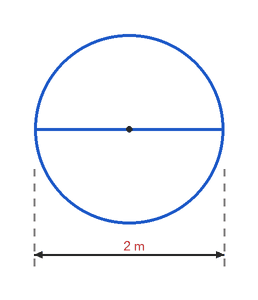
What minimum force must be applied on its rim ?
Solve with AIWritten solution
Solution:
Concept: The turning effect of a force is called the moment of force (or torque). It is the force multiplied by the perpendicular distance of the line of action of the force from the pivot (axis of rotation). Its S.I. unit is the newton metre (N m).
Given: Diameter of wheel is 2 m; moment of force needed is 2.0 N m.
Step 1 — Find the radius.
The force acts on the rim, which is one radius from the axis through the centre:
Step 2 — Decide the direction of the minimum force.
The force is least when it acts along the rim (at right angles to the radius), because then its perpendicular distance from the axis is the whole radius.

Step 3 — Find the force.
Moment of force is , so the force is the moment divided by the radius:
Watch out: Use the radius, not the diameter, as the distance from the axis.
Therefore, the minimum force that must be applied on the rim is 2 N.
- 923 marks
Question 92
A normal force of 200 N acts on an area of 0.02 m. Find the pressure in pascal.
Solve with AIWritten solution
Solution:
Concept: Pressure is the thrust acting on unit area of a surface: pressure is thrust ÷ area. Its S.I. unit is N m, called the pascal (Pa).
Given: Thrust is 200 N; area is 0.02 m.
Step 1 — Write the formula.
A normal force is a thrust, so the pressure is the force divided by the area:
Step 2 — Substitute and calculate.
Put in the force and the area:
Therefore, the pressure is 10,000 Pa ( Pa).
- 933 marks
Question 93
Find the thrust required to exert a pressure of 50,000 pascal on an area of 0.05 m.
Solve with AIWritten solution
Solution:
Concept: Pressure is the thrust acting on unit area of a surface: pressure is thrust ÷ area. Its S.I. unit is N m, called the pascal (Pa).
Given: Pressure is 50,000 Pa; area is 0.05 m.
Step 1 — Rearrange the formula.
Pressure is thrust ÷ area, so the thrust is the pressure multiplied by the area:
Step 2 — Substitute and calculate.
Put in the pressure and the area:
Therefore, the thrust required is 2500 N.
- 943 marks
Question 94
Find the area of a body which experiences a pressure of 50,000 Pa by a thrust of 100 N.
Solve with AIWritten solution
Solution:
Concept: Pressure is the thrust acting on unit area of a surface: pressure is thrust ÷ area. Its S.I. unit is N m, called the pascal (Pa).
Given: Thrust is 100 N; pressure is 50,000 Pa.
Step 1 — Rearrange the formula.
Pressure is thrust ÷ area, so the area is the thrust divided by the pressure:
Step 2 — Substitute and calculate.
Put in the thrust and the pressure:
Therefore, the area of the body is 0.002 m ( m).
- 953 marks
Question 95
Calculate the pressure in pascal exerted by a force of 300 N acting normally on an area of 30 cm.
Solve with AIWritten solution
Solution:
Concept: Pressure is the thrust acting on unit area of a surface: pressure is thrust ÷ area. Its S.I. unit is N m, called the pascal (Pa). To get pascal, the area must be in m: 1 cm is m.
Given: Force is 300 N acting normally; area is 30 cm.
Step 1 — Change the area to m.
Since 1 cm is m, 1 cm is m:
Step 2 — Find the pressure.
Divide the force by the area:
Watch out: 1 cm is m, not m, because the conversion is squared.
Therefore, the pressure exerted is Pa.
- 963 marks
Question 96
How much thrust will be required to exert a pressure of 20,000 Pa on an area of 1 cm ?
Solve with AIWritten solution
Solution:
Concept: Pressure is the thrust acting on unit area of a surface: pressure is thrust ÷ area. Its S.I. unit is N m, called the pascal (Pa). To use pascal, the area must be in m: 1 cm is m.
Given: Pressure is 20,000 Pa; area is 1 cm.
Step 1 — Change the area to m.
The pressure is in pascal (N m), so the area must be in m:
Step 2 — Find the thrust.
Thrust is pressure × area:
Watch out: 1 cm is m, because the conversion is squared.
Therefore, the thrust required is 2 N.
- 973 marks
Question 97
The base of a container measures 15 cm × 20 cm. It is placed on a table top. If the weight of the container is 60 N, what is the pressure exerted by the container on the table top ?
Solve with AIWritten solution
Solution:
Concept: Pressure is the thrust acting on unit area of a surface: pressure is thrust ÷ area. Its S.I. unit is N m, called the pascal (Pa). The thrust on the table is the weight of the container.
Given: Base 15 cm × 20 cm; weight of container (thrust) is 60 N.
Step 1 — Find the area of the base.
The base is a rectangle, so its area is length × breadth:
Step 2 — Change the area to m.
Since 1 cm is m:
Step 3 — Find the pressure.
The thrust is the weight, 60 N, so divide it by the area:
Therefore, the pressure exerted by the container on the table top is 2000 Pa.
- 983 marks
Question 98
Calculate the pressure exerted on a surface of 0.5 m by a thrust of 100 kgf.
Solve with AIWritten solution
Solution:
Concept: Pressure is the thrust acting on unit area of a surface: pressure is thrust ÷ area. Its S.I. unit is N m, called the pascal (Pa). With the thrust in kgf and the area in m, the pressure comes out in kgf m.
Given: Thrust is 100 kgf; area is 0.5 m.
Step 1 — Write the formula.
Pressure is thrust divided by area:
Step 2 — Substitute and calculate.
Put in the thrust and the area:
Therefore, the pressure exerted is 200 kgf m (about 1960 Pa, taking 1 kgf as 9.8 N).
- 994 marks
Question 99
A boy weighing 60 kgf stands on a platform of dimensions 2.5 cm × 0.5 cm. What pressure in pascal does he exert ?
Solve with AIWritten solution
Solution:
Concept: Pressure is the thrust acting on unit area of a surface: pressure is thrust ÷ area. Its S.I. unit is N m, called the pascal (Pa). For pressure in pascal, the thrust must be in newtons and the area in m.
Given: Weight of the boy is 60 kgf; platform 2.5 cm × 0.5 cm.
Step 1 — Change the thrust to newtons.
The boy's weight is the thrust. Taking 1 kgf as 10 N:
Step 2 — Find the area of the platform.
The platform is a rectangle, so multiply its sides:
Step 3 — Change the area to m.
Since 1 cm is m:
Step 4 — Find the pressure.
Divide the thrust by the area:
Watch out: Change both the kgf to N and the cm to m before dividing, or the answer will not be in pascal.
Note: With the more exact value 1 kgf = 9.8 N, the pressure is Pa; the answer above uses 1 kgf = 10 N, as the chapter does.
Therefore, the boy exerts a pressure of Pa.
- 1004 marks
Question 100
Fig 3.35 shows a brick of weight 2 kgf and dimensions 20 cm × 10 cm × 5 cm placed in three different positions on the ground. Find the pressure exerted by the brick in each case.
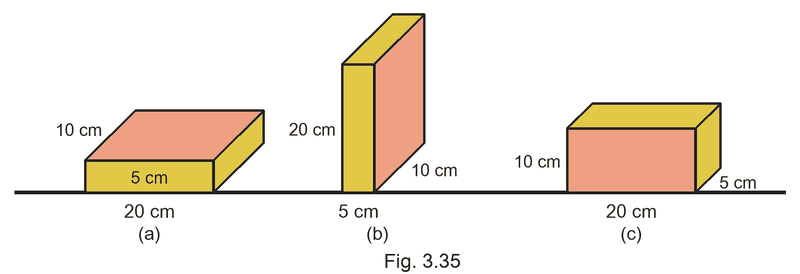 Solve with AI
Written solution
Solution:
Concept: Pressure is the thrust acting on unit area of a surface: pressure is thrust ÷ area. Its S.I. unit is N m, called the pascal (Pa). A body resting on the ground presses on it with its weight, whichever face it rests on; only the area of the face in contact changes.
Given: Weight of brick (thrust) is 2 kgf; dimensions 20 cm × 10 cm × 5 cm.
Step 1 — Find the thrust.
In every position the thrust is the weight of the brick, 2 kgf.
Step 2 — (a) Brick lying flat.
In position (a) the 20 cm × 10 cm face rests on the ground. Find its area, then the pressure:
Step 3 — (b) Brick standing on its end.
In position (b) the 5 cm × 10 cm face rests on the ground:
Step 4 — (c) Brick on its long side.
In position (c) the 20 cm × 5 cm face rests on the ground:
Step 5 — Compare.
The pressure is greatest in (b), where the area in contact is smallest, and least in (a), where it is largest.
Watch out: The thrust stays 2 kgf in all three positions; only the area changes.
Therefore, the pressure is (a) 0.01 kgf cm, (b) 0.04 kgf cm and (c) 0.02 kgf cm.
What Class 8 Physics Ch 3 covers
The sections of the chapter, in the order the book takes them. Every question above comes from one of these.
- 01Force
- 02Turning Effect of a Force
- 03Moment of Force
- 04Thrust
- 05Pressure
- 06Factors Affecting Pressure
More ways to study this chapter
The same chapter asked three other ways. Practise it, revise it, and see what the board has set on Ch 3 before.
Class 8 Physics Ch 3 questions students ask
How many questions are there in Class 8 Physics Ch 3?
100 questions. Every one is solved step by step on this page.
Are these Class 8 Physics solutions free?
Yes. Every question and its full working is free to read, with no account needed.
Can I download the Class 8 Physics Ch 3 solutions as a PDF?
There is no PDF to download. Every solution is on this page instead, which means it is searchable, always the current syllabus, and readable on a phone. Use your browser's print option if you want it on paper.