
Question 784 marksEasy
Describe the crushing tin can experiment. What do you conclude from this experiment ?
Confirming your payment
Sign up now and get 250 free tokens.
Force and Pressure · Question 78 of 100
Describe the crushing tin can experiment. What do you conclude from this experiment ?
Solution:
Concept: Air has weight, so the air column above any surface presses on it. The thrust of this air on unit area of the earth's surface is the atmospheric pressure. At sea level it is about Pa (1 atm), nearly Pa, and it decreases with height because the air column above becomes shorter and the air thinner.
Step 1 — Collect the apparatus.
Take a thin-walled tin can with an airtight stopper, water, a burner, a tripod stand with wire gauze, and a tub of cold water.
Step 2 — Heat the water.
Remove the stopper, pour a little water into the can and heat it until the water boils. Steam drives most of the air out through the opening. Until now the pressure inside and outside the can is the same.
Step 3 — Close and cool.
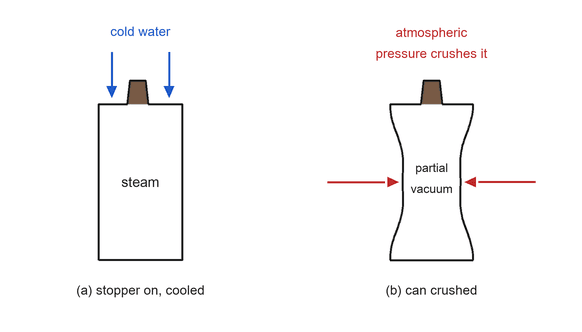
When steam comes out freely, put the stopper back tightly, take the can off the burner, place it in the tub and pour cold water over it.
Step 4 — Observe.
The can collapses (gets crushed inwards).
Step 5 — Explain.
The cold water makes the steam inside condense into a few drops of water, leaving a partial vacuum in the can. The pressure inside becomes much less than the atmospheric pressure outside, and the unbalanced outside pressure pushes the walls inwards.
Watch out: Never heat a can with its stopper on; the steam pressure could burst it. The stopper goes on only after heating stops.
Therefore, the crushing tin can experiment shows that air exerts pressure, and that the atmospheric pressure is very large.