
Opening your dashboard
Class 8 Physics Chapter 3 Force and Pressure: Competency-Based Questions (CBQ)
40 questions on Chapter 3, each worked through on its own page with the AI tutor. Class 8 Physics, ICSE 2026-27.
40 questions
1–5 marks · Mixed difficulty
- 11 mark
Question 1
Competency: Understanding
A goalkeeper punches a football that is flying towards the goal. The ball is squashed for a moment where the fist meets it, and then flies away towards the side-line faster than it came.
Which option lists all the effects of the force of the fist that are seen here ?
- 21 mark
Question 2
Competency: Application & Analysis
The crank of a bicycle pedal is 18 cm long. The figure shows it in three positions P, Q and R. In each position the rider pushes the pedal vertically downwards with a force of 200 N. The dashed line is the line along which the force acts.
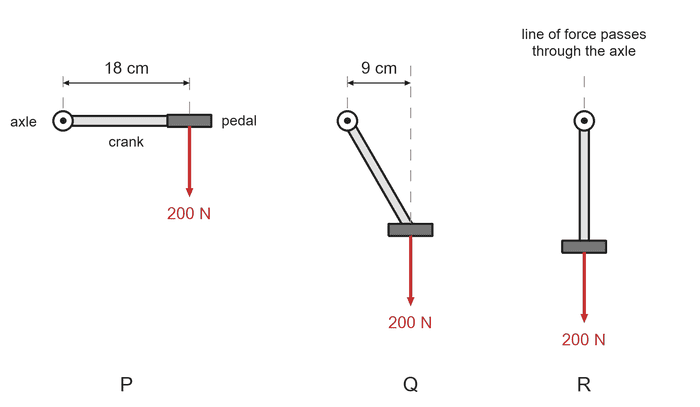
Which statement about the moment of the force about the axle is correct ?
- 31 mark
Question 3
Competency: Analysis
Four boxes are placed flat on the same patch of soft, wet mud. Their weights and base areas are given below.
Box Weight (N) Area of base (m) P 60 0.030 Q 90 0.060 R 40 0.016 S 120 0.050 Which box sinks the deepest into the mud ?
- 41 mark
Question 4
Competency: Application
A rubber sucker hook is pressed hard against a smooth glazed tile, so that the air under it is squeezed out. It stays on the tile for days and holds a towel. The same sucker, pressed just as hard against a rough plastered wall, drops off within seconds.
Which is the best explanation ?
- 51 mark
Question 5
Competency: Understanding
Assertion (A): When a porter puts a ring of rolled cloth between a heavy sack and his head, the thrust of the sack on his head becomes less.
Reason (R): The ring of cloth increases the area of contact between the load and the head.
- 61 mark
Question 6
Competency: Understanding & Analysis
Assertion (A): A diver feels a greater water pressure 5 m below the surface of the sea than 5 m below the surface of a fresh-water lake.
Reason (R): Sea water is denser than fresh water, and at the same depth a liquid of greater density exerts a greater pressure.
- 72 marks
Question 7
Competency: Application
In a hospital, the small round knobs of the wash-basin taps are replaced by taps with a long lever handle, so that patients with weak hands can open them.
(a) Explain why a tap with a long lever handle can be opened with a smaller force.
(b) At which point of the lever, and in which direction, should a patient push to open the tap with the least force ?
- 82 marks
Question 8
Competency: Application
A wooden bench weighs 240 N and stands on four legs. The bottom of each leg measures 4 cm × 5 cm. Two children weighing 300 N and 260 N sit on the bench with their feet off the floor.
(a) Find the pressure exerted on the floor, in pascal.
(b) A rubber cap of base area 25 cm is then fitted under each leg. Find the new pressure on the floor. (Ignore the weight of the caps.)
- 92 marks
Question 9
Competency: Understanding & Evaluation
Ravi says, "The water in an aquarium presses on a fish only from above, just as a pile of books presses only downwards on a table."
To test this idea, Kavya fills a balloon with water, ties its mouth and pricks it with a pin at many points all around. Water squirts out of every hole - from the sides and from the upper part of the balloon as well as from the bottom.
(a) What does Kavya's observation show about the pressure exerted by a liquid ?
(b) Is Ravi's statement correct ? Give a reason for your answer.
- 102 marks
Question 10
Competency: Application & Analysis
Meena pushes a drawing pin into a soft board with her thumb, using a force of 15 N. The flat head of the pin has an area of 1.5 cm and its sharp tip has an area of 0.01 cm. The pin passes the same force on to the board.
(a) Calculate the pressure of the head on her thumb and the pressure of the tip on the board, in pascal.
(b) Use your answers to explain why the pin goes into the board but does not hurt her thumb.
- 114 marks
Question 11
Competency: Application & Analysis
Case study: A playground merry-go-round has a radius of 1.5 m and turns about an axle at its centre. Because of friction at the axle, it starts to turn only when the moment of force about the centre is at least 84 N m. Children push it at right angles to the line joining them to the centre.
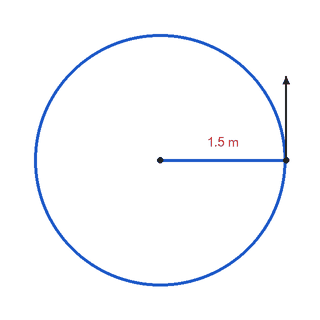
The largest push each child can give is shown below.
Child Largest push (N) Anu 40 Bala 50 Chitra 70 (a) Find the least force that must be applied at the rim to start the merry-go-round. Which of the three children can start it alone by pushing at the rim ?
(b) Chitra pushes with her largest force on a handrail that is 1.0 m from the centre. Does the merry-go-round start to turn ? Show your working.
(c) Find the least distance from the centre at which Chitra's largest push can start it. Explain why Bala cannot start it alone, wherever he pushes.
- 124 marks
Question 12
Competency: Application & Analysis
Case study: Workers cleaned the inside of an empty steel milk tanker with steam. While the tank was still full of hot steam, they closed every valve and lid tightly and went home. The night was cool. In the morning the walls of the tank were found crushed inwards.
(a) What was inside the tank when it was closed, and what happened to it as the tank cooled ?
(b) Suppose the pressure inside the tank fell to Pa while the atmospheric pressure outside was Pa. Find the resultant thrust on a flat part of the wall of area 2 m, and state its direction.
(c) Explain why the tank was crushed, and suggest one simple step that would have prevented it.
- 133 marks
Question 13
Competency: Analysis
Case study: For a science exhibition, two tall jars of the same size are filled to the same level, one with water and the other with concentrated sugar solution. A small pressure sensor is lowered slowly into each jar. The graph shows the pressure due to the liquid at different depths for the two liquids, marked X and Y.
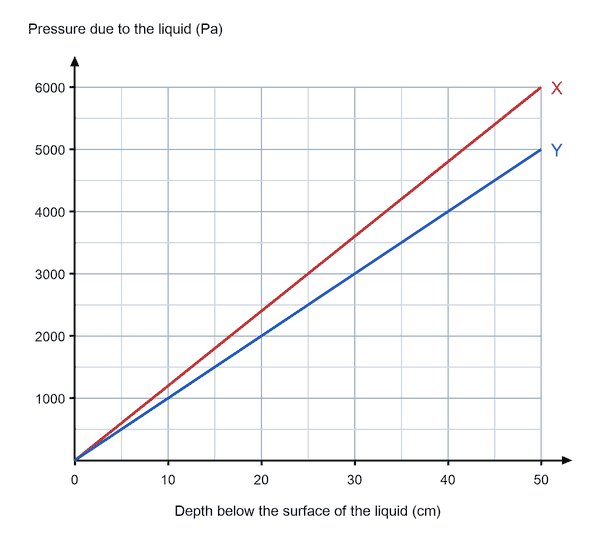
(a) Read from the graph the pressure at a depth of 50 cm in X and in Y. How does the pressure in each liquid change with depth ?
(b) Which liquid, X or Y, is the concentrated sugar solution ? Give a reason.
(c) At what depth in Y is the pressure the same as at a depth of 25 cm in X ? What does this comparison tell you about the two liquids ?
- 144 marks
Question 14
Competency: Application & Evaluation
Case study: A school gardening club wants to keep a full water drum, of total weight 1200 N, on soft garden soil. The soil gives way if the pressure on it is more than 20 000 Pa. Three stands are available. (The stands are light; ignore their weight.)
Stand How it rests on the soil P three legs, each with a base of 10 cm Q four legs, each with a base of 100 cm R a flat wooden board 50 cm × 60 cm (a) Calculate the pressure on the soil with each stand.
(b) Which stand or stands can be used safely ?
(c) Rahul says, "Stand Q has more legs than stand P, so it must be safe. More legs always solve the problem." Judge his statement, and work out the least base area each of the four legs of stand Q would need to be safe.
- 154 marks
Question 15
Competency: Creation
A classroom door is kept shut by a spring door-closer, so a force is needed to open it. You are given a spring balance (0 - 50 N), a strong rubber sucker hook that can be pressed on to the door at any point, a measuring tape and a piece of chalk.
Design an investigation to find out how the force needed to just open the door depends on the distance from the hinges at which the force is applied. Write :
(a) the steps you will follow,
(b) two things you will keep the same so that the test is fair,
(c) a table for your readings, the result you expect and the reason for it.
- 161 mark
Question 16
Competency: Application
A force is shown on paper by an arrow. In a poster, Neha draws a push of 40 N on a trolley, towards the east, as an arrow 2 cm long. On the same scale, she now has to show a pull of 90 N on the trolley, towards the west.
Which arrow should she draw?
- 171 mark
Question 17
Competency: Analysis
Rani wants to know how the force needed to work a village hand pump depends on where she pushes on its handle. Each time, she pushes down at right angles to the handle and notes the least force that just starts to lift the water. The distance is measured from the pivot of the handle to the point where she pushes. (Hypothetical data.)
Distance from the pivot (m) Least force (N) 0.3 120 0.4 90 0.6 60 0.9 40 Which conclusion do the readings support?
- 181 mark
Question 18
Competency: Application
Four students measure the pressure that four different loaded trolleys exert on the playground. They write the readings in different units. Take 1 kgf = 10 N.
Which trolley exerts the greatest pressure?
- 191 mark
Question 19
Competency: Analysis
Three vessels P, Q and R have different shapes. P is a wide cylinder, Q is a narrow tube and R is a flask that is wide at the bottom and narrow at the top. All of them are filled with water to the same height of 30 cm above their flat bases.
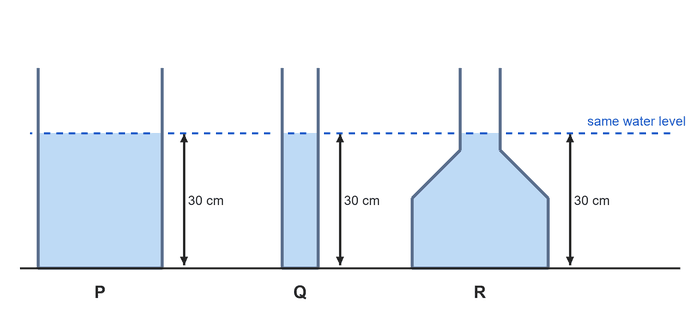
Which statement about the pressure of the water on the base of each vessel is correct?
- 201 mark
Question 20
Competency: Application
At sea level, the atmospheric pressure is equal to the pressure of a column of mercury 76 cm high, which is about Pa. At a hill station, the atmospheric pressure is found to be equal to the pressure of a mercury column 57 cm high. (Hypothetical data.)
What is the atmospheric pressure at the hill station?
- 211 mark
Question 21
Competency: Analysis
Assertion (A): A potter turns his heavy wheel by pushing a stick fixed near the rim of the wheel, and not one fixed near its centre.
Reason (R): A force applied closer to the pivot has a larger moment about the pivot.
- 221 mark
Question 22
Competency: Understanding
Assertion (A): The force of gravity on a body of mass 1 kg is 1 N.
Reason (R): The force of gravity on a body of mass 1 kg is 1 kgf, which is nearly 10 N.
- 231 mark
Question 23
Competency: Understanding
Thrust is the force acting normally (at right angles) on a surface.
In which case is the force described a thrust on the surface named ?
- 241 mark
Question 24
Competency: Application
Before driving over loose desert sand, a jeep driver lets some air out of the tyres, so that the tyres become a little flat at the bottom. The jeep then sinks much less in the sand than it does with fully inflated tyres.
Which is the best explanation?
- 251 mark
Question 25
Competency: Analysis
A flat disc can turn about its centre O in a horizontal plane. The figure shows the disc as seen from above. A force of 6 N is applied at the point A on the rim, at right angles to OA, and the disc turns anticlockwise. B is the point of the rim opposite to A, and C is the mid-point of OA.
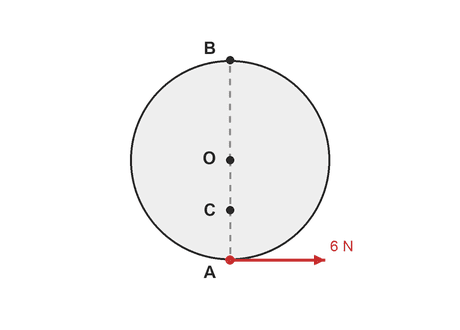
Which single change makes the disc turn clockwise ?
- 262 marks
Question 26
Competency: Evaluation
Tarun stretches a rubber band by 2 cm and says, "I can see the force in the rubber band. It is 2 cm long."
(a) What can we actually see or feel when a force acts on a body?
(b) Is Tarun right to call the 2 cm stretch the force ? Give a reason, and state how a force is expressed.
- 272 marks
Question 27
Competency: Application
To close a main water valve at a pumping station, a worker turns a hand-wheel of radius 0.25 m. He applies a force of 5 kgf at the rim of the wheel, at right angles to the spoke.
(a) Find the moment of the force in kgf m.
(b) Express it in N m, taking 1 kgf m = 9.8 N m.
- 282 marks
Question 28
Competency: Application
A tall plastic bottle, open at the top, is filled with water up to a height of 25 cm. It stands on a table. Three small holes of the same size, A, B and C, are made in a vertical line on its side, at heights of 20 cm, 12 cm and 4 cm above the table, and water spurts out of them. After some time, the water level in the bottle has fallen to a height of 8 cm above the table.
(a) From which of the holes is water still flowing out at this time?
(b) Is the jet from hole C longer or shorter than it was at the start ? Give a reason.
- 292 marks
Question 29
Competency: Application
A doctor dips the nozzle of a syringe into an open bottle of liquid medicine and pulls the plunger back. The medicine rises into the syringe.
(a) Explain why the medicine rises into the syringe.
(b) The doctor now closes the nozzle tightly with her thumb, pulls the plunger back a little, and lets go. What does the plunger do ? Give a reason.
- 302 marks
Question 30
Competency: Evaluation
The bolt that clamps the seat of a bicycle must be tightened with a moment of force of 12 N m. Meena says, "The unit newton metre is the same as the joule, so I may write this moment as 12 J." Her brother tightens the bolt by pushing at right angles to the spanner with a force of 80 N, at a distance of 15 cm from the bolt. He writes the moment as 1200 N cm.
(a) Is Meena right to write the moment of force as 12 J ? Give a reason.
(b) Is her brother's value correct ? Express it in N m, and say whether he has given the bolt the moment it needs.
- 312 marks
Question 31
Competency: Application
A child has fallen through the thin ice of a frozen village pond in a hill area. Near the middle, the ice can bear a pressure of at most 20 000 Pa. Before going out, a trained rescuer weighing 600 N works out the pressure he would exert. Both his boots would touch the ice over a total area of 0.025 m. (Hypothetical data.)
(a) Find the pressure he would exert if he stood on the ice. Could the ice bear it ?
(b) Instead, he lies flat on a wide plank that touches the ice over an area of 0.5 m, and pushes it forward. Find the new pressure, and explain why this is safer.
- 323 marks
Question 32
Competency: Application
A tank in a parade weighs N. It moves on two broad steel belts called caterpillar tracks. Each track touches the ground over a length of 4.0 m and a width of 0.5 m. A soldier standing beside the tank weighs 800 N, and his two boots touch the ground over a total area of 0.04 m. (Hypothetical data.)
(a) Find the total area of contact of the tracks and the pressure exerted by the tank on the ground.
(b) Find the pressure exerted by the soldier on the ground. How many times as heavy as the soldier is the tank, and how many times as great is its pressure ?
(c) Explain why the pressure of the tank is so much smaller than its weight alone would suggest, and why caterpillar tracks help a tank to move over soft ground.
- 333 marks
Question 33
Competency: Analysis
A heavy wheel of radius 0.5 m, in a hand-driven water-lifting device, can turn about its centre O. Two persons push it at the same time. Each push is at right angles to the line joining the point of the push to O. Person P pushes at the rim with a force of 12 N, so as to turn the wheel anticlockwise. Person Q pushes at a point 0.2 m from O with a force of 20 N, so as to turn it clockwise. (Hypothetical data.)
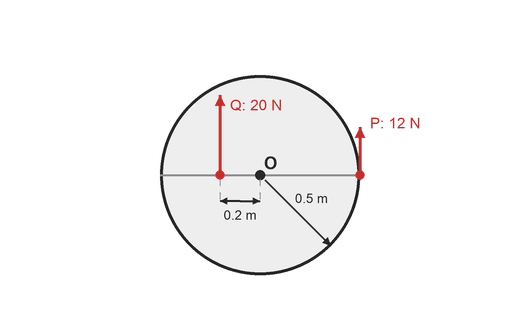
Take an anticlockwise moment as positive and a clockwise moment as negative.
(a) Find the moment of the force of each person about O.
(b) Find the resultant moment. In which direction does the wheel tend to turn ?
(c) Q now pushes at the rim instead, in the same sense as before. What force must Q apply there, so that the resultant moment is zero and the wheel has no tendency to turn ?
- 343 marks
Question 34
Competency: Analysis
A steel cube of side 10 cm is held completely under water in a tank, with its top face horizontal. Because the pressure in a liquid increases with depth, the pressure of the water on its top face is 2000 Pa and on its bottom face, which is 10 cm lower, it is 3000 Pa. (Take the pressures as due to the water only. Hypothetical data.)
(a) Find the area of one face of the cube in m.
(b) Find the thrust of the water on the top face and on the bottom face, and state the direction of each.
(c) Find the resultant thrust of the water on the cube and state its direction. What is this force called ?
- 353 marks
Question 35
Competency: Application
A poultry farmer fills a bottle with water, closes the mouth with his hand, turns the bottle upside down and puts its mouth under the water in a shallow tray, so that the mouth is just below the surface of the water in the tray. The bottle is held in a stand. It stays full of water, although its mouth is open under the water. As the hens drink, the level of water in the tray falls.
(a) Why does the water not run out of the bottle into the tray ?
(b) What happens when the level of water in the tray falls below the mouth of the bottle, and why ?
(c) The farmer makes a tiny hole in the closed end of the bottle, which is now at the top. What happens to the water in the bottle ?
- 363 marks
Question 36
Competency: Analysis
A student presses flat blocks of different base areas on a soft board, each time with the same thrust, and works out the pressure on the board. The graph shows how the pressure depends on the area of the base of the block. (Hypothetical data.)
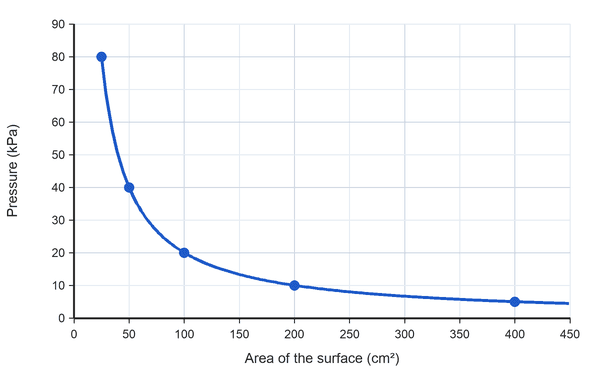
(a) Read the pressure for an area of 200 cm, and the area for which the pressure is 40 kPa.
(b) Using one point of the graph, find the thrust used. Check it with a second point.
(c) What happens to the pressure when the area is doubled ? State the relation between the pressure and the area for a fixed thrust.
- 374 marks
Question 37
Competency: Analysis
Case study: The Meteorological Department sends up a weather balloon from the plains. It carries a small instrument that measures the atmospheric pressure and sends the readings to the ground. The table gives the readings at four heights above sea level. Trekkers use the same idea: a small pressure gauge can tell them roughly how high they are, because the air pressure falls in a known way as they climb. (Approximate values.)
Height above sea level (m) 0 2000 4000 6000 Atmospheric pressure (kPa) 101 80 62 47 (a) What is the atmospheric pressure at a height of 4000 m ? How does it change as the balloon goes higher ?
(b) Find the fall in pressure in each of the three steps of 2000 m. What do you notice ?
(c) At their camp, a group of trekkers finds that the gauge reads 75 kPa. Between which two heights of the table is the camp ? Assuming that the pressure falls evenly within that step, estimate the height of the camp to the nearest 100 m.
- 385 marks
Question 38
Competency: Evaluation
Case study: A village in Maharashtra plans a small dam with a wall 8 m high, built across a stream. The water pressure on the wall grows with the depth, so an engineer works out how thick the wall must be at each depth to be just strong enough. (Hypothetical data. Assume that the thickness needed is proportional to the pressure, and ignore the small width needed at the top.)
Depth below the water surface (m) 2 4 6 8 Pressure of the water (kPa) 20 40 60 80 Thickness needed (m) 1.0 2.0 3.0 4.0 Plan 1 is a wall that is 2.5 m thick from top to bottom. Plan 2 is a wall whose thickness at each depth is the thickness given by the table, so it grows steadily from nothing at the top to 4.0 m at the bottom.
(a) How many times is the pressure at 8 m as great as at 2 m ? How is the thickness needed related to this ?
(b) At which of the depths in the table is plan 1 not strong enough ? Give your working.
(c) The cross-section of each wall is a shape whose area shows how much material is used. Find this area for each plan, and say which plan you would recommend, with reasons.
- 395 marks
Question 39
Competency: Creation
Case study: In a village, the sluice gate of an irrigation canal is opened by turning a spindle with a handle. The gate starts to move only when the moment of force about the spindle is at least 72 N m. The woman who works the gate can push with a force of at most 120 N. The wall of the gate house allows a handle of length at most 1.0 m, measured from the spindle. You are asked to design the handle. The lengths that the workshop has in stock are 0.4 m, 0.5 m, 0.8 m and 1.2 m. (Hypothetical data.)
(a) Find the least length of the handle with which she can open the gate.
(b) Choose a length from the stock, and show that it meets all the conditions.
(c) Describe where on the handle, and in which direction, she should push. What happens to the force needed if she pushes at the middle of the 0.8 m handle ?
- 404 marks
Question 40
Competency: Creation
Case study: In a science class, the teacher shows that a post card stays on the mouth of an upside-down glass full of water when the hand is taken away, as the atmospheric pressure acts from below. Sunita says, "Atmospheric pressure acts only upwards from below, as the air is below the card." Her friend Imran says, "Air presses in all directions." The teacher gives them a glass tumbler, water, a post card and a tray, and asks them to design an experiment to settle the matter.
(a) Write the steps of an experiment, using these things, that tests whether the atmospheric pressure acts sideways as well.
(b) What do you expect to see, and what does it show ?
(c) Why must the glass be filled to the brim, with no air bubble left under the card ?