
Question 493 marksEasy
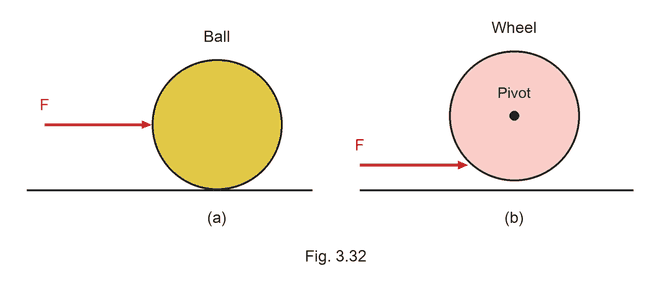
State the effect of force F in each of the following diagrams (a) and (b).
Confirming your payment
Sign up now and get 250 free tokens.
Force and Pressure · Question 49 of 100
State the effect of force F in each of the following diagrams (a) and (b).
Solution:
Concept: A force on a free body moves it along a straight line (linear motion). A force on a body pivoted (fixed) at a point cannot move the body as a whole, but it can turn it about the pivot (turning or rotational motion).
Step 1 — Look at diagram (a).
In diagram (a) the ball is free (not fixed at any point), and the force F acts along a line through its centre.
Step 2 — State the effect in (a).
A force through the centre of a free body moves it along a straight line, so the ball moves forward in the direction of F. The effect is linear (straight-line) motion.
Step 3 — Look at diagram (b).
In diagram (b) the wheel is fixed at a pivot at its centre, and F acts at a point of the rim below the pivot, so its line of action does not pass through the pivot.
Step 4 — State the effect in (b).
The pivot stops the wheel from moving forward, so the force can only turn it: the effect is turning (rotational) motion about the pivot. F pushes the lower part of the wheel to the right, so the top moves to the left and the wheel turns anticlockwise.
Watch out: The wheel in (b) cannot roll forward, because its centre is held by the pivot.
Therefore, in (a) the force produces linear motion of the ball in the direction of F, and in (b) it produces turning (anticlockwise) motion of the wheel about the pivot.