
Opening your dashboard
Class 8 Maths Chapter 21: Circles Solutions
30 textbook questions with step-by-step answers, free to read, for ICSE 2026-27.
Get talked through Ch 21, not just shown the answer
Reading a finished solution is not the same as being able to do it. The AI tutor takes one question at a time and works it with you, in your own words, until you can.
- Ask it out loud, in your own words
- It gives you the next step, not the answer
- Stuck on part (ii)? Start there
30 questions with solutions
1–3 marks · Mixed difficulty
- 11 mark
Question 1
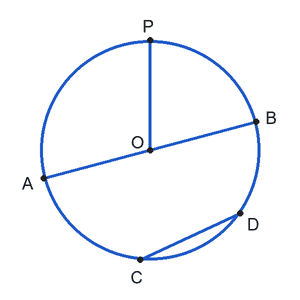
In the given figure, AB is the largest chord of the circle, AB = 18 cm and length of the chord CD is half of length of chord AB, then
 Solve with AI
Answer
(A) OP = 18 cm and CD = 18 cm
(B) OP = 9 cm and CD = 18 cm
(C) OP = 18 cm and CD = 9 cm
- Correct
(D) OP = 9 cm and CD = 9 cm
Answer: (D) OP = 9 cm and CD = 9 cm
Concept: A chord joins two points of a circle. The diameter is the chord through the centre; it is the longest chord of the circle, and diameter = 2 × radius.
Step 1 — Identify AB.
The largest chord of a circle is its diameter, so AB = 18 cm is a diameter and O is its midpoint.
Step 2 — Find OP.
In the figure, P is a point on the circle and O is the centre, so OP is a radius, which is half the diameter.
Step 3 — Find CD.
The chord CD is half as long as the chord AB.
Watch out: OP joins the centre to the circle, so it is a radius (half of AB), not a diameter.
Why the other options are wrong:
- (A): This takes OP equal to the whole diameter and CD equal to AB; both are twice the true values.
- (B): OP = 9 cm is right, but CD is half of AB, which is 9 cm, not 18 cm.
- (C): CD = 9 cm is right, but OP is a radius, which is 9 cm, not the 18 cm diameter.
Therefore, OP = 9 cm and CD = 9 cm, option (D).
- 21 mark
Question 2
The largest chord of a circle is 20 cm, then its radius is :
Solve with AIAnswer
(A) 20 cm
(B) 40 cm
- Correct
(C) 10 cm
(D) none of these
Answer: (C) 10 cm
Concept: A chord joins two points of a circle. The diameter is the chord through the centre; it is the longest chord of the circle, and diameter = 2 × radius.
Step 1 — Identify the largest chord.
The largest chord of a circle is its diameter, so the diameter is 20 cm.
Step 2 — Halve the diameter.
The radius is half of the diameter.
Watch out: The 20 cm chord is the diameter, so it must be halved to get the radius.
Why the other options are wrong:
- (A) 20 cm: 20 cm is the diameter itself, not the radius.
- (B) 40 cm: 40 cm is twice the diameter; it would be the diameter of a circle of radius 20 cm.
- (D) none of these: The radius can be found, and it is 10 cm, which is option (C).
Therefore, the radius is 10 cm, option (C).
- 31 mark
Question 3
The relation between the area enclosed by a major segment of a circle and area enclosed by its semi-circle is :
Solve with AIAnswer
(A) major segment is smaller than the semi-circle.
- Correct
(B) major segment is bigger than the semi-circle.
(C) major segment is equal to the semi-circle
Answer: (B) major segment is bigger than the semi-circle.
Concept: A segment is the region between a chord and an arc. A sector is the region between two radii and an arc. A chord that is not a diameter cuts the circle into a smaller minor segment and a larger major segment.
Step 1 — Compare each part with half the circle.
A semicircle is exactly half of the circle. A chord that is not a diameter does not pass through the centre, so the centre lies in the larger part. That larger part, the major segment, therefore contains a whole semicircle and more.
Step 2 — State the relation.
So the area enclosed by the major segment is bigger than the area enclosed by a semicircle.
Watch out: The major segment is the bigger part; the minor segment is the one smaller than a semicircle.
Why the other options are wrong:
- (A): Smaller than a semicircle describes the minor segment, not the major segment.
- (C) major segment is equal to the semi-circle: The two segments are equal only when the chord is a diameter, and then each part is a semicircle, not a major segment.
Therefore, the major segment is bigger than the semicircle, option (B).
- 41 mark
Question 4
The radius of a circle is 5 cm then the length of its longest chord is :
Solve with AIAnswer
(A) less than 5 cm
(B) equal to 5 cm
- Correct
(C) equal to 10 cm
(D) less than 10 cm
Answer: (C) equal to 10 cm
Concept: A chord joins two points of a circle. The diameter is the chord through the centre; it is the longest chord of the circle, and diameter = 2 × radius.
Step 1 — Identify the longest chord.
The longest chord of a circle is its diameter.
Step 2 — Double the radius.
The diameter is twice the radius.
Watch out: Every chord is at most 10 cm long, and the longest one is exactly 10 cm.
Why the other options are wrong:
- (A) less than 5 cm: Many chords are shorter than 5 cm, but the longest chord is the 10 cm diameter.
- (B) equal to 5 cm: A 5 cm chord exists, but it is not the longest one.
- (D) less than 10 cm: Every chord other than a diameter is less than 10 cm, but the LONGEST chord is equal to 10 cm.
Therefore, the longest chord is equal to 10 cm, option (C).
- 51 mark
Question 5
The diameter of a circle with centre at point O is 30 cm. A point P lies in the same plane as the circle and OP = 20 cm, then point P lies :
Solve with AIAnswer
(A) on the circumference of the circle
(B) inside the circle
- Correct
(C) outside the circle
(D) nothing can be saut
Answer: (C) outside the circle
Concept: Compare the distance of a point from the centre with the radius : the point is inside the circle if , on the circle if , and outside if .
Step 1 — Find the radius.
The radius is half of the 30 cm diameter.
Step 2 — Compare OP with the radius.
The point P is 20 cm from the centre, and 20 cm is more than the radius 15 cm.
So P lies outside the circle.
Watch out: Compare OP with the radius (15 cm), not with the diameter (30 cm).
Why the other options are wrong:
- (A) on the circumference of the circle: P would be on the circumference only if OP were equal to the radius, 15 cm.
- (B) inside the circle: P would be inside only if OP were less than 15 cm; comparing 20 cm with the diameter 30 cm gives this slip.
- (D) nothing can be saut: OP and the radius are both known, so the position of P can be decided.
Therefore, P lies outside the circle, option (C).
- 61 mark
Question 6
The angle between a line AB and the diameter of a circle is 90°; line AB is :
Solve with AIAnswer
(A) a tangent of the circle
(B) not a tangent of the circle
- Correct
(C) nothing can be said
Answer: (C) nothing can be said
Concept: A tangent touches a circle at exactly one point, and the radius drawn to that point of contact is perpendicular to the tangent. So the centre, the point of contact and any point of the tangent form a right-angled triangle, and Pythagoras' theorem applies.
Step 1 — Recall when a line is a tangent.
A line perpendicular to a diameter is a tangent only if it passes through an END of that diameter, because the tangent is perpendicular to the radius at the point of contact.
Step 2 — Use the given information.
The question says only that AB makes 90° with the diameter. It does not say where AB meets the diameter. If it meets it at an end, AB is a tangent; if it meets it at any inner point, AB cuts the circle at two points; if it meets the diameter produced beyond the circle, AB misses the circle. So no single answer follows.
Watch out: Being perpendicular to a diameter is not enough; the line must also pass through an end of it.
Why the other options are wrong:
- (A) a tangent of the circle: AB is a tangent only when it passes through an end of the diameter, and we are not told that.
- (B) not a tangent of the circle: AB IS a tangent when it passes through an end of the diameter, so we cannot say it is not a tangent.
Therefore, nothing can be said, option (C).
- 71 mark
Question 7
A sector of a circle can be equal to its segment :
Solve with AIAnswer
- Correct
(A) Yes
(B) No
(C) none of these two
Answer: (A) Yes
Concept: A segment is the region between a chord and an arc. A sector is the region between two radii and an arc. A chord that is not a diameter cuts the circle into a smaller minor segment and a larger major segment.
Step 1 — Compare the two definitions.
A sector is bounded by two radii and an arc. A segment is bounded by a chord and an arc.
Step 2 — Find a case where they match.
If the angle between the two radii is 180°, the two radii lie along one straight line and together make a diameter. The sector is then a semicircle. The segment cut off by that diameter is the same semicircle. So a sector can be equal to a segment.
Watch out: For any other angle the two regions differ, so the answer rests on the semicircle case.
Note: The printed answer reads "(b) Yes". Yes is option (A) in the order shown here, so (A) is keyed.
Why the other options are wrong:
- (B) No: The semicircle is both a sector (two radii in a straight line) and a segment (cut off by a diameter), so the answer is not No.
- (C) none of these two: One of the two answers, Yes, is correct.
Therefore, a sector can be equal to a segment, option (A).
- 81 mark
Question 8
The given figure shows a circle with centre O. If length of arc AQB is double of arc APB and ∠AOB = 65°; then angle AOC is :
 Solve with AI
Answer
(A) 65°
(B) 2 × 65°
(C) × 65°
- Correct
(D) none of these
Answer: (D) none of these
Concept: Angles on a straight line add up to 180°. An arc subtends at the centre an angle in proportion to its length.
Step 1 — Read the figure.
In the figure, C, O and B lie on one straight line, so CB is a diameter. The angles ∠AOC and ∠AOB are adjacent angles on this straight line.
Step 2 — Use angles on a straight line.
Angles on a straight line add up to 180°.
Here stands for ∠AOC in degrees, so ∠AOC = 115°.
Step 3 — Compare with the options.
115° is not 65°, not 2 × 65° = 130° and not ½ × 65° = 32.5°, so the answer is (D).
Watch out: Read the angle from the figure: CB is a straight line through O, so ∠AOC and ∠AOB together make 180°.
Note: The stem's arc condition cannot hold as printed: arc AQB (through Q and C) is the major arc of 360° − 65° = 295°, which is not double the 65° arc APB. The printed answer, (C) ½ × 65°, fits a different stem, "arc APB is double arc AQC", which would give ∠AOC = 32.5°. The figure as drawn gives 115°, so (D) is keyed.
Why the other options are wrong:
- (A) 65°: 65° is ∠AOB itself, not ∠AOC.
- (B) 2 × 65°: 130° would need ∠AOC = 2∠AOB, but ∠AOC is fixed at 115° by the straight line CB.
- (C) × 65°: 32.5° is an acute angle, but ∠AOC in the figure is the obtuse angle 115°.
Therefore, ∠AOC = 115°, so the answer is none of these, option (D).
- 91 mark
Question 9
Statement 1 : The angle between a radius and a tangent of a circle is 90°.
Statement 2 : At the point of contact, the angle between radius and tangent is equal to one right angle.
Which of the following options is correct?
Solve with AIAnswer
- Correct
(A) Both the statements are true.
(B) Both the statements are false.
(C) Statement 1 is true, and statement 2 is false.
(D) Statement 1 is false, and statement 2 is true.
Answer: (A) Both the statements are true.
Concept: A tangent touches a circle at exactly one point, and the radius drawn to that point of contact is perpendicular to the tangent. So the centre, the point of contact and any point of the tangent form a right-angled triangle, and Pythagoras' theorem applies.
Step 1 — Judge statement 1.
The tangent at a point of a circle is perpendicular to the radius drawn to that point. So the angle between a radius and the tangent (at the radius's end on the circle) is 90°. Statement 1 is true.
Step 2 — Judge statement 2.
One right angle is 90°, and the angle is measured at the point of contact. Statement 2 says the same fact in other words, so it is also true.
Watch out: 90° and one right angle are the same angle.
Why the other options are wrong:
- (B): Both statements state the radius–tangent rule correctly, so neither is false.
- (C): Statement 2 is the same fact as statement 1 (one right angle = 90°), so it is not false.
- (D): Statement 1 is the radius–tangent rule, so it is not false.
Therefore, both the statements are true, option (A).
- 101 mark
Question 10
The following questions are Assertion-Reason based questions. Choose your answer based on the codes given below.
(1) Both A and R are correct, and R is the correct explanation for A.
(2) Both A and R are correct, and R is not the correct explanation for A.
(3) A is true, but R is false.
(4) A is false, but R is true.
Assertion (A) : The radius of a circle is 20 cm, then the length of its largest chord is also 20 cm.
Reason (R) : Longest chord of a circle is equal to its diameter.
Solve with AIAnswer
(A) (1)
(B) (2)
(C) (3)
- Correct
(D) (4)
Answer: (D) (4)
Concept: In an Assertion–Reason item we judge the Assertion (A) on its own, then the Reason (R) on its own, and only when both are true do we ask whether R explains why A is true.
Step 1 — Judge R.
The longest chord of a circle passes through the centre, so it is the diameter. R is true.
Step 2 — Judge A.
The radius is 20 cm, so the largest chord, the diameter, is twice the radius.
A says the largest chord is 20 cm, so A is false.
Step 3 — Choose the code.
A is false and R is true, which is code (4).
Watch out: The largest chord is the diameter, which is twice the radius, not equal to it.
Why the other options are wrong:
- (A): Code (1) needs A to be true, but A is false.
- (B): Code (2) needs A to be true, but A is false.
- (C): Code (3) says A is true and R is false; it is the other way round.
Therefore, A is false and R is true, code (4), option (D).
- 111 mark
Question 11
The following questions are Assertion-Reason based questions. Choose your answer based on the codes given below.
(1) Both A and R are correct, and R is the correct explanation for A.
(2) Both A and R are correct, and R is not the correct explanation for A.
(3) A is true, but R is false.
(4) A is false, but R is true.
Assertion (A) : When the radius of a circle is increased by 3 cm, its diameter will increase by 2 × 3 cm.
Reason (R) : Original radius is cm, original diameter 2r cm.
∴ Increase in length of diameter
Solve with AIAnswer
- Correct
(A) (1)
(B) (2)
(C) (3)
(D) (4)
Answer: (A) (1)
Concept: In an Assertion–Reason item we judge the Assertion (A) on its own, then the Reason (R) on its own, and only when both are true do we ask whether R explains why A is true.
Step 1 — Judge R.
If the radius is cm, the diameter is cm. After the radius grows by 3 cm, the diameter is cm. R writes the increase as the new diameter minus the old one, which is correct. R is true.
Step 2 — Work out the increase.
We simplify R's expression.
So the diameter increases by 6 cm, which is 2 × 3 cm.
Step 3 — Judge A and the link.
A says the diameter increases by 2 × 3 cm, so A is true. The working in R is exactly what shows A, so R explains A: code (1).
Watch out: The diameter is twice the radius, so ANY change in the radius is doubled in the diameter.
Why the other options are wrong:
- (B): Code (2) says R does not explain A, but R's working is the very calculation that gives A.
- (C): Code (3) says R is false, but R's expression for the increase is correct.
- (D): Code (4) says A is false, but the increase really is 2 × 3 = 6 cm.
Therefore, both are true and R explains A, code (1), option (A).
- 121 mark
Question 12
The following questions are Assertion-Reason based questions. Choose your answer based on the codes given below.
(1) Both A and R are correct, and R is the correct explanation for A.
(2) Both A and R are correct, and R is not the correct explanation for A.
(3) A is true, but R is false.
(4) A is false, but R is true.
Assertion (A) : If a circle is of radius 8 cm and the length of its minor arc is also 8 cm, then the length of major arc
Reason (R) : For every circle, some of the length of its major arc and length of its minor arc is equal to circumference of the circle.
Solve with AIAnswer
(A) (1)
(B) (2)
- Correct
(C) (3)
(D) (4)
Answer: (C) (3)
Concept: In an Assertion–Reason item we judge the Assertion (A) on its own, then the Reason (R) on its own, and only when both are true do we ask whether R explains why A is true.
Step 1 — Judge A.
The circumference of a circle of radius 8 cm is cm. A chord splits the circumference into the minor arc and the major arc, so the major arc is the circumference minus the 8 cm minor arc.
So A is true.
Step 2 — Judge R as printed.
R, as printed, says "some of the length of its major arc and length of its minor arc is equal to circumference". Read word for word, "some of" the lengths is not the whole circumference, so R is false as printed. This is the printed key: A true, R false, code (3).
Step 3 — The other reading.
If "some" is a misprint for "sum", R says major arc + minor arc = circumference. That is true for every circle, and it is exactly the fact used to find the major arc in A; R would then explain A, code (1).
Watch out: The two arcs made by a chord always add up to the whole circumference.
Why the other options are wrong:
- (A): Code (1) is right only if "some" is read as "sum"; as printed, R does not state the arc rule, so code (3) is keyed.
- (B): Code (2) needs R to be true; as printed R is false, and with the "sum" reading R does explain A.
- (D): Code (4) says A is false, but the major arc is 16π − 8 = 8(2π − 1) cm, so A is true.
Therefore, A is true and R, as printed, is false, code (3), option (C).
- 131 mark
Question 13
The following questions are Assertion-Reason based questions. Choose your answer based on the codes given below.
(1) Both A and R are correct, and R is the correct explanation for A.
(2) Both A and R are correct, and R is not the correct explanation for A.
(3) A is true, but R is false.
(4) A is false, but R is true.
Assertion (A) : A, B and C are three points on the circumference of a circle such that BC is diameter of the circle. If AC = 4 cm and AB = 3 cm, then diameter BC = 4 cm + 3 cm.
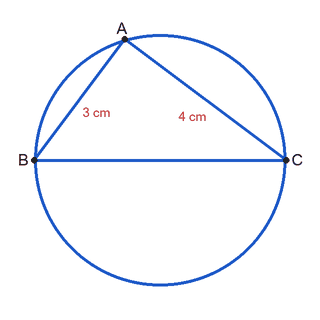
Reason (R) : Angle BAC = angle of semi-circle = 90° and so BC² = AB² + AC².
Solve with AIAnswer
(A) (1)
(B) (2)
(C) (3)
- Correct
(D) (4)
Answer: (D) (4)
Concept: In an Assertion–Reason item we judge the Assertion (A) on its own, then the Reason (R) on its own, and only when both are true do we ask whether R explains why A is true.
Step 1 — Judge R.
BC is a diameter and A is on the circle, so ∠BAC is the angle in a semicircle and equals 90°. In a right-angled triangle the square on the hypotenuse equals the sum of the squares on the other two sides, so BC² = AB² + AC². R is true.
Step 2 — Find BC.
We use R's rule with AB = 3 cm and AC = 4 cm.
Step 3 — Judge A.
A adds the two sides and claims that BC is 7 cm (4 cm + 3 cm). But BC is 5 cm, because the sides of a right-angled triangle combine by Pythagoras' theorem, not by simple addition. So A is false.
Watch out: Use Pythagoras' theorem for the hypotenuse; adding the two sides gives a length that is too big.
Why the other options are wrong:
- (A): Code (1) needs A to be true, but BC is 5 cm, not 7 cm.
- (B): Code (2) needs A to be true, but BC is 5 cm, not 7 cm.
- (C): Code (3) says A is true and R is false; it is the other way round.
Therefore, A is false and R is true, code (4), option (D).
- 143 marks
Question 14
The following figure shows a circle with centre O.
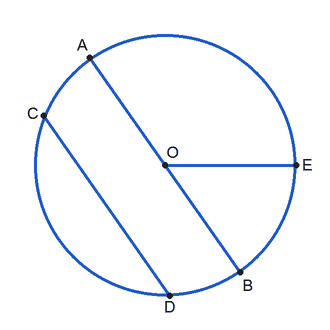
Use the figure to fill the blanks in each of the following :
(i) AB = ..........
(ii) Radius = ..........
(iii) Chords = .......... and ..........
(iv) Diameter = ..........
(v) AB = 2 × ..........
Solve with AIWritten solution
Solution:
Concept: A chord joins two points of a circle. The diameter is the chord through the centre; it is the longest chord of the circle, and diameter = 2 × radius.
Step 1 — Identify the parts in the figure.
AB passes through the centre O, so AB is a diameter. OA, OB and OE join the centre to points of the circle, so each is a radius. CD joins two points of the circle without passing through O, so CD is a chord; a diameter is also a chord.
Step 2 — Fill in the blanks.
Now we use these names.
(i) AB = diameter
(ii) Radius = OA (OB and OE are also radii)
(iii) Chords = AB and CD
(iv) Diameter = AB
(v) AB = 2 × OE (or 2 × OA, or 2 × OB), because a diameter is twice a radius.
Watch out: A diameter is a chord too, so AB is one of the chords.
Therefore, (i) diameter; (ii) OA, OB or OE; (iii) AB and CD; (iv) AB; (v) OE (or OA or OB).
- 153 marks
Question 15
M is a fixed point in a plane and a point P moves in the same plane such that PM = 10 cm. State :
(i) the name of the figure formed
(ii) the length of the radius of the circle
(iii) the length of the diameter of the circle.
Can a chord of length 16 cm be drawn in this circle ? Give reason.
Solve with AIWritten solution
Solution:
Concept: A chord joins two points of a circle. The diameter is the chord through the centre; it is the longest chord of the circle, and diameter = 2 × radius.
Given: PM = 10 cm, M fixed.
Step 1 — Name the figure.
Every position of P is 10 cm from the fixed point M. All points at a fixed distance from a fixed point form a circle, so the figure is a circle with centre M.
Step 2 — Find the radius and diameter.
The fixed distance PM is the radius, and the diameter is twice the radius.
Step 3 — Decide about the 16 cm chord.
The longest chord of this circle is the 20 cm diameter. Chords of every length from 0 up to 20 cm can be drawn, and 16 cm < 20 cm, so a 16 cm chord can be drawn.
Watch out: A chord can be any length up to the diameter, but never longer than it.
Therefore, (i) a circle with centre M; (ii) 10 cm; (iii) 20 cm; yes, a 16 cm chord can be drawn, because it is shorter than the 20 cm diameter.
- 163 marks
Question 16
The radius of a circle is 6 cm. Find its diameter. If O is the centre of the circle; state, giving reasons, the positions of points A, B and C; if:
(i) OA = 4·8 cm
(ii) OB = 7·5 cm
(iii) OC = 6 cm
Solve with AIWritten solution
Solution:
Concept: Compare the distance of a point from the centre with the radius : the point is inside the circle if , on the circle if , and outside if .
Given: Radius = 6 cm.
Step 1 — Find the diameter.
The diameter is twice the radius.
Step 2 — Compare each distance with the radius.
The radius is 6 cm.
So A lies inside the circle.
So B lies outside the circle.
This is equal to the radius, so C lies on the circle (on its circumference).
Watch out: Compare each distance with the radius 6 cm, not with the diameter 12 cm.
Therefore, diameter = 12 cm; (i) A is inside the circle; (ii) B is outside the circle; (iii) C is on the circumference of the circle.
- 173 marks
Question 17
Fill in the blanks :
(i) An arc is the part of the ..........
(ii) Diameter of a circle bisects ..........
(iii) The part of the circumference greater than the semi-circle is called ..........
(iv) Sector of a circle is its region bounded by ..........
(v) The segment of a circle is the region bounded by ..........
(vi) A tangent of a circle meets the circle at ..........
(vii) The number of tangents that can be drawn through a point on its circumference = ..........
(viii) The number of tangents that can be drawn through a point outside the circle is ..........
Solve with AIWritten solution
Solution:
Concept: Use the definitions of the parts of a circle.
Step 1 — Recall the definitions.
Each blank is a definition or a fact about the parts of a circle.
(i) An arc is the part of the circumference of the circle.
(ii) A diameter of a circle bisects the circle (and its circumference) into two equal halves.
(iii) The part of the circumference greater than a semicircle is called the major arc.
(iv) A sector of a circle is the region bounded by two radii and an arc.
(v) A segment of a circle is the region bounded by a chord and an arc.
(vi) A tangent of a circle meets the circle at exactly one point.
(vii) The number of tangents through a point on the circumference is one.
(viii) The number of tangents through a point outside the circle is two.
Step 2 — Reason for (vii) and (viii).
At a point ON the circle the tangent must be perpendicular to the radius there, and only one line through that point is perpendicular to it. From a point OUTSIDE, one tangent touches the circle on each side of the line joining the point to the centre, so there are two.
Watch out: A sector uses two RADII, a segment uses a CHORD; do not mix them up.
Therefore, (i) circumference; (ii) the circle (its circumference); (iii) major arc; (iv) two radii and an arc; (v) a chord and an arc; (vi) one point only; (vii) one; (viii) two.
- 183 marks
Question 18
O is the centre of a circle with diameter 30 cm. P is a point outside the circle and PA is tangent of the circle.

Find :
(i) the length of tangent PA; if OP = 39 cm.
(ii) the distance between O and P, if the length of the tangent PA is 20 cm
Solve with AIWritten solution
Solution:
Concept: A tangent touches a circle at exactly one point, and the radius drawn to that point of contact is perpendicular to the tangent. So the centre, the point of contact and any point of the tangent form a right-angled triangle, and Pythagoras' theorem applies.
Given: Diameter = 30 cm; PA is a tangent at A.
Step 1 — Find the radius.
The radius OA is half of the 30 cm diameter.
Step 2 — Set up the right triangle.
OA ⊥ PA, because the radius meets the tangent at a right angle. So triangle OAP is right-angled at A, with OP as the hypotenuse.
Step 3 — Part (i): find PA.
With OP = 39 cm, we subtract the square of the radius from the square of OP.
Step 4 — Part (ii): find OP.
With PA = 20 cm, we add the squares of the two shorter sides.
Watch out: Use the radius 15 cm, not the diameter 30 cm, in Pythagoras' theorem.
Therefore, (i) PA = 36 cm; (ii) OP = 25 cm.
- 193 marks
Question 19
The following figure shows a circle with centre O and a diameter AB.
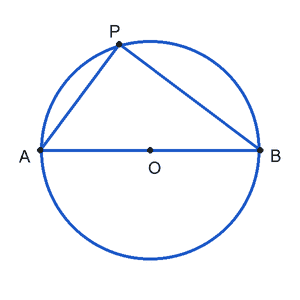
(i) Name the angle APB.
(ii) State the measure of angle APB.
(iii) If AP = 12 cm and OA = 10 cm; find the lengths of AB and BP.
(iv) If 4AP = 3PB = 12 cm; find the radius of the circle.
Solve with AIWritten solution
Solution:
Concept: The angle in a semicircle is a right angle: if AB is a diameter and P is any other point on the circle, then ∠APB = 90°.
Given: AB is a diameter, centre O.
Step 1 — Parts (i) and (ii): name and measure ∠APB.
P is on the circle and AB is a diameter, so ∠APB is the angle in a semicircle, and it measures 90°.
Step 2 — Part (iii): find AB.
AB is a diameter and OA is a radius, so AB is twice OA.
Step 3 — Part (iii): find BP.
Triangle APB is right-angled at P, with hypotenuse AB.
Step 4 — Part (iv): find AP and PB.
The three expressions 4AP, 3PB and 12 cm are equal, so each gives one length.
Here = AP, so AP = 3 cm.
Here = PB, so PB = 4 cm.
Step 5 — Part (iv): find the radius.
Triangle APB is still right-angled at P, so we find the diameter AB and halve it.
Watch out: In (iv), divide 12 by 4 to get AP (do not multiply), and remember that the answer asked for is the radius, half of AB.
Therefore, (i) ∠APB is the angle in a semicircle; (ii) 90°; (iii) AB = 20 cm, BP = 16 cm; (iv) radius = 2.5 cm.
- 203 marks
Question 20
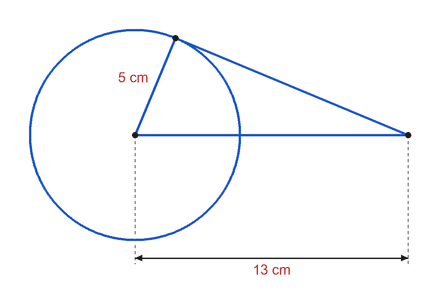
Find the length of the tangent to a circle with radius 5 cm, from a point at a distance of 13 cm from its centre.
 Solve with AI
Written solution
Solution:
Concept: A tangent touches a circle at exactly one point, and the radius drawn to that point of contact is perpendicular to the tangent. So the centre, the point of contact and any point of the tangent form a right-angled triangle, and Pythagoras' theorem applies.
Given: Radius = 5 cm; distance of the point from the centre = 13 cm.
Step 1 — Draw the right triangle.
Let O be the centre, P the outside point and T the point of contact. OT ⊥ PT, so triangle OTP is right-angled at T, with OP = 13 cm as the hypotenuse and OT = 5 cm.
Step 2 — Find the tangent.
We subtract the square of the radius from the square of OP.
Watch out: The 13 cm distance is the hypotenuse, so subtract (do not add) the squares.
Therefore, the length of the tangent is 12 cm.
- 213 marks
Question 21
The following figure shows a circle with diameter AB and centre at point O.
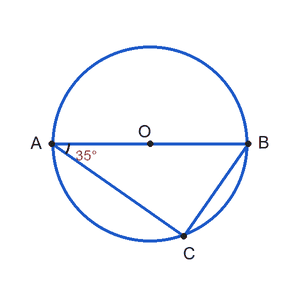
If angle CAB = 35°; find the measure of angle ABC.
Solve with AIWritten solution
Solution:
Concept: The angle in a semicircle is a right angle: if AB is a diameter and P is any other point on the circle, then ∠APB = 90°.
Given: AB is a diameter, ∠CAB = 35°.
Step 1 — Find ∠ACB.
AB is a diameter and C is on the circle, so ∠ACB is the angle in a semicircle: ∠ACB = 90°.
Step 2 — Use the angle sum of triangle ABC.
The three angles of a triangle add up to 180°.
Watch out: The right angle is at C, the point on the circle, not at A or B.
Therefore, ∠ABC = 55°.
- 223 marks
Question 22
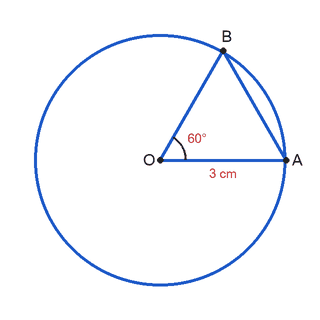
Draw a circle with radius 3 cm and centre at point O. Draw two radii OA and OB of the circle drawn such that ∠AOB = 60°. Join A and B and measure the length of AB.
Solve with AIWritten solution
Solution:
Concept: Radii of the same circle are equal. A triangle with all angles 60° is equilateral.
Step 1 — Construct the figure.
We follow the instructions one at a time.
-
Mark a point O and draw a circle of radius 3 cm with centre O.
-
Draw a radius OA.
-
At O, use a protractor to make ∠AOB = 60°; let the arm meet the circle at B.
-
Join AB.
Step 2 — Predict the length of AB.
OA and OB are both radii of 3 cm, so triangle OAB is isosceles and its base angles are equal.
∠OBA is the same, 60°.
All three angles are 60°, so triangle OAB is equilateral, and AB is as long as OA, which is 3 cm.
Step 3 — Measure.
Measuring AB with a ruler gives 3 cm, as predicted.
Watch out: Draw ∠AOB at the centre O, between the two radii.
Therefore, AB = 3 cm (triangle OAB is equilateral).
-
- 233 marks
Question 23
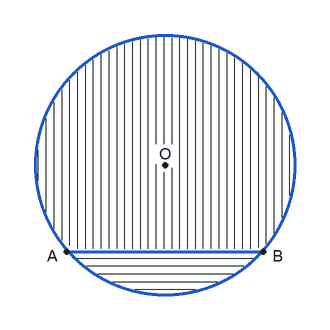
Draw a circle with radius 4 cm. Draw a chord AB of length 6 cm. Shade its minor segment by horizontal lines and major segment by vertical lines.
Solve with AIWritten solution
Solution:
Concept: A segment is the region between a chord and an arc. A sector is the region between two radii and an arc. A chord that is not a diameter cuts the circle into a smaller minor segment and a larger major segment.
Step 1 — Construct the figure.
We draw the circle and the chord.
-
Draw a circle of radius 4 cm with centre O.
-
Mark a point A on the circle. With A as centre and radius 6 cm, draw an arc cutting the circle at B.
-
Join AB; this is the chord of length 6 cm.
Step 2 — Shade the two segments.
The chord is 6 cm long, less than the 8 cm diameter, so it cuts the circle into two unequal parts. The smaller part (between AB and the minor arc) is the minor segment; shade it with horizontal lines. The larger part, which contains the centre O, is the major segment; shade it with vertical lines.
Watch out: The major segment is the part that contains the centre.
Therefore, the minor segment (below AB, away from O) is shaded with horizontal lines and the major segment (containing O) with vertical lines.
-
- 243 marks
Question 24
Draw a circle with centre at point P. Draw its radii PA and PB such that angle APB = 90°. Shade the minor sector of the circle by horizontal lines and its major sector by vertical lines.
Solve with AIWritten solution
Solution:
Concept: A segment is the region between a chord and an arc. A sector is the region between two radii and an arc. A chord that is not a diameter cuts the circle into a smaller minor segment and a larger major segment.
Step 1 — Construct the figure.
We draw the circle and two radii at right angles.
-
Draw a circle with centre P and any convenient radius (say 3 cm).
-
Draw a radius PA.
-
At P, make ∠APB = 90° with a protractor (or set square); let the arm meet the circle at B, and draw PB.

Step 2 — Shade the two sectors.
The two radii divide the circle into two sectors. The minor sector has angle 90° at P; shade it with horizontal lines. The major sector has angle 360° − 90° = 270° at P; shade it with vertical lines.
Watch out: A sector is bounded by two radii, so the shading stops at PA and PB, not at the chord AB.
Therefore, the 90° sector APB is shaded with horizontal lines and the 270° sector with vertical lines.
-
- 253 marks
Question 25
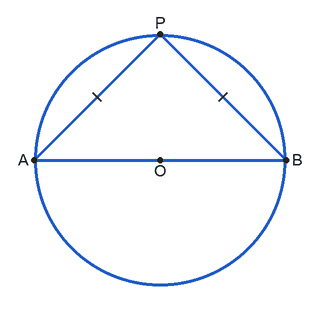
In a circle with centre O and diameter AB; angle APB is the angle of semi-circle. If PA = PB; find the measure of each angle of the triangle APB.
 Solve with AI
Written solution
Solution:
Concept: The angle in a semicircle is a right angle: if AB is a diameter and P is any other point on the circle, then ∠APB = 90°.
Given: AB is a diameter, PA = PB.
Step 1 — Find ∠APB.
AB is a diameter and P is on the circle, so ∠APB is the angle in a semicircle: ∠APB = 90°.
Step 2 — Find the base angles.
PA = PB, so the angles opposite them are equal: ∠PBA = ∠PAB. The three angles add up to 180°.
∠PBA is the same, 45°.
Watch out: The equal angles are the ones OPPOSITE the equal sides, that is at A and B.
Therefore, ∠APB = 90°, ∠PAB = 45° and ∠PBA = 45°.
- 263 marks
Question 26
In the following figure, O is the centre of the circle and AB is a diameter.
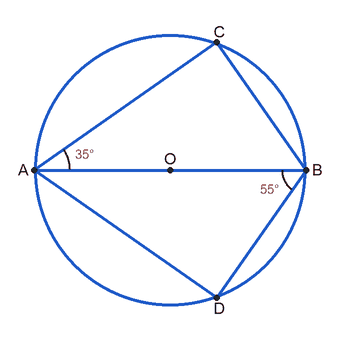
C and D are points on the circumference of the circle such that ∠CAB = 35° and ∠ABD = 55°. Find the measures of angles CAD and CBD.
 Solve with AI
Written solution
Solution:
Concept: The angle in a semicircle is a right angle: if AB is a diameter and P is any other point on the circle, then ∠APB = 90°.
Given: AB is a diameter, ∠CAB = 35°, ∠ABD = 55°.
Step 1 — Use the semicircle angles.
AB is a diameter, and C and D are on the circle, so ∠ACB = 90° and ∠ADB = 90°.
Step 2 — Find ∠BAD in triangle ABD.
The angles of triangle ABD add up to 180°.
Step 3 — Find ∠ABC in triangle ABC.
The angles of triangle ABC add up to 180°.
Step 4 — Add the parts.
∠CAD is made of ∠CAB and ∠BAD, and ∠CBD is made of ∠ABC and ∠ABD.
Watch out: ∠CAD and ∠CBD each have two parts, one on each side of the diameter AB.
Therefore, ∠CAD = 70° and ∠CBD = 110°.
- 273 marks
Question 27
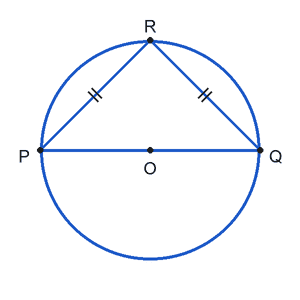
The following figure shows a circle with centre O and diameter PQ. Point R lies on the circumference of the circle such that PR = QR and PR = 4 cm.
Calculate the radius of the given circle and state its value correct to two decimal places.
Solve with AIWritten solution
Solution:
Concept: The angle in a semicircle is a right angle: if AB is a diameter and P is any other point on the circle, then ∠APB = 90°.
Given: PQ is a diameter; PR and QR are each 4 cm.
Step 1 — Find ∠PRQ.
PQ is a diameter and R is on the circle, so ∠PRQ = 90°, and PQ is the hypotenuse of triangle PRQ.
Step 2 — Find PQ.
We use Pythagoras' theorem; each of the shorter sides PR and QR is 4 cm.
Step 3 — Find the radius.
The radius is half of the diameter PQ.
Watch out: PQ is the diameter; halve it to get the radius before rounding.
Therefore, the radius is 2.83 cm (to two decimal places).
- 283 marks
Question 28
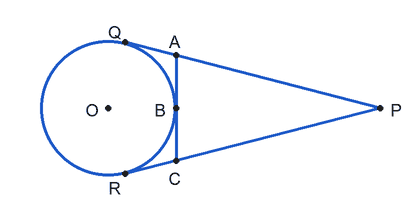
In the following figure, PQ and PR are tangents to a circle with centre O. Line segment AC touches the circle at point B.
(i) State the relation between tangents PQ and PR.
Also, show that :
(ii) PQ = PA + AB
(iii) PR = PC + CB
(iv) PQ + PR = Perimeter of Δ PAC.
Solve with AIWritten solution
Solution:
Concept: The two tangents drawn to a circle from a point outside it are equal in length.
Given: PQ and PR are tangents; AC touches the circle at B.
Step 1 — Part (i).
PQ and PR are the two tangents drawn from the outside point P, so they are equal: PQ = PR.
Step 2 — Part (ii).
From the point A, the two tangents to the circle are AQ and AB, so AQ = AB. Q lies on PA produced, so PQ is made of PA and AQ.
Step 3 — Part (iii).
In the same way, from the point C the tangents CR and CB are equal, so CR = CB.
Step 4 — Part (iv).
We add the results of (ii) and (iii) and group AB and CB, which together make AC (B lies on AC).
PA + PC + AC is the perimeter of triangle PAC.
Watch out: AB and AQ are tangents from the same point A; do not pair AB with PQ, which comes from P.
Therefore, PQ = PR, and the results (ii), (iii) and (iv) are proved: PQ + PR equals the perimeter of Δ PAC.
- 293 marks
Question 29
From an exterior point P, the tangent PA is drawn to a circle with centre O.
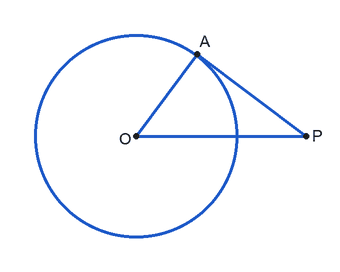
(i) If OP = 20 cm and tangent PA = 16 cm, find the diameter of the circle.
(ii) If diameter of the circle is 20 cm and tangent PA = 24 cm; find the length of OP.
Solve with AIWritten solution
Solution:
Concept: A tangent touches a circle at exactly one point, and the radius drawn to that point of contact is perpendicular to the tangent. So the centre, the point of contact and any point of the tangent form a right-angled triangle, and Pythagoras' theorem applies.
Given: PA is a tangent at A, O is the centre.
Step 1 — Set up the right triangle.
OA ⊥ PA (radius ⊥ tangent), so triangle OAP is right-angled at A, with hypotenuse OP.
Step 2 — Part (i): find the radius.
We subtract the square of PA from the square of OP.
Step 3 — Part (i): double it.
The diameter is twice the radius.
Step 4 — Part (ii): find OP.
Now the radius is half of the 20 cm diameter, OA = 10 cm, and PA = 24 cm.
Watch out: In (i) the answer asked for is the diameter, twice OA; in (ii) halve the diameter before using it.
Therefore, (i) diameter = 24 cm; (ii) OP = 26 cm.
- 303 marks
Question 30
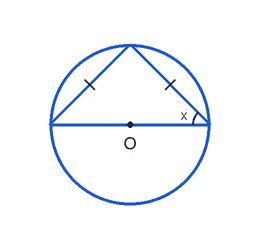
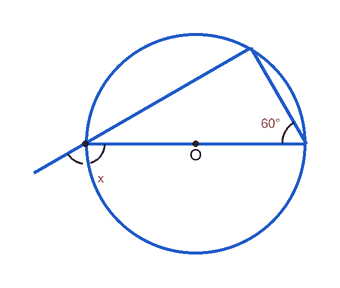
In each figure, given below, O is centre of the circle. Use the given informations to find the value of x :
(i)
(ii)
(iii)
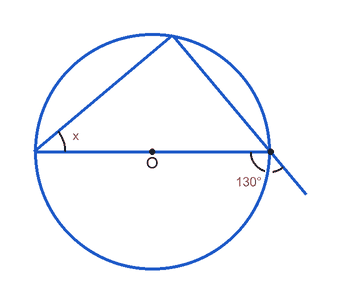
(iv)
(v)
(vi)
 Solve with AI
Written solution
Solution:
Concept: The angle in a semicircle is 90°. A tangent is perpendicular to the radius (diameter) at its point of contact. The perpendicular from the centre to a chord makes a right-angled triangle with a radius. Angles on a straight line add up to 180°, and the angles of a triangle add up to 180°.
Step 1 — Figure (i).
The triangle stands on the diameter, so its top angle is 90° (angle in a semicircle). Its two slanting sides are marked equal, so its two base angles are equal; x is one of them.
Step 2 — Figure (ii).
Call the ends of the diameter A (left) and B (right), and the top point C. ∠ACB = 90° (semicircle) and ∠ABC = 60°, so we first find ∠CAB.
The chord CA is produced beyond A, and x lies on the other side of A, between the produced part and AB. So x and ∠CAB make a straight angle.
Step 3 — Figure (iii).
Again call the ends A (left) and B (right) and the top point C. CB is produced beyond B, and the 130° angle lies between the produced part and BA, so ∠CBA makes a straight angle with it.
∠ACB = 90° (semicircle), so the angle sum of triangle ABC gives x = ∠CAB.
Step 4 — Figure (iv).
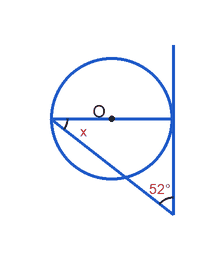
The vertical line touches the circle at the right end B of the diameter AB, so it is perpendicular to AB: ∠ABT = 90°, where T is the point where the slanting line from A meets it. In triangle ABT the angle at T is 52°.
Step 5 — Figure (v).
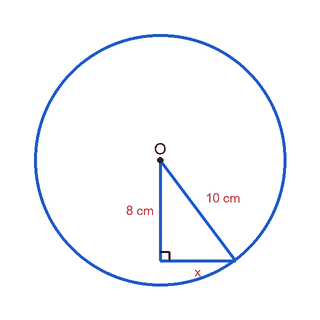
The 8 cm line from the centre is perpendicular to the chord, and the 10 cm line is a radius to the end of the chord. They form a right-angled triangle with the 10 cm radius as hypotenuse and x as one side.
Step 6 — Figure (vi).
The two chords, 10 cm and 24 cm, meet on the semicircle and stand on the diameter, so the angle between them is 90°, and the diameter is the hypotenuse.
x is the distance from an end of the diameter to the centre O, which is the radius.
Watch out: In (ii) and (iii), check whether the marked angle is inside the triangle or on the produced line outside it.
Therefore, (i) x = 45°; (ii) x = 150°; (iii) x = 40°; (iv) x = 38°; (v) x = 6 cm; (vi) x = 13 cm.
What Class 8 Maths Ch 21 covers
The sections of the chapter, in the order the book takes them. Every question above comes from one of these.
- 01Some Important Terms
- 02Interior and Exterior of a Circle
- 03Arcs and Types of Arcs
- 04Sectors
- 05Segments
- 06Central Angle
More ways to study this chapter
The same chapter asked three other ways. Practise it, revise it, and see what the board has set on Ch 21 before.
Class 8 Maths Ch 21 questions students ask
How many questions are there in Class 8 Maths Ch 21?
30 questions. Every one is solved step by step on this page.
Are these Class 8 Maths solutions free?
Yes. Every question and its full working is free to read, with no account needed.
Can I download the Class 8 Maths Ch 21 solutions as a PDF?
There is no PDF to download. Every solution is on this page instead, which means it is searchable, always the current syllabus, and readable on a phone. Use your browser's print option if you want it on paper.